
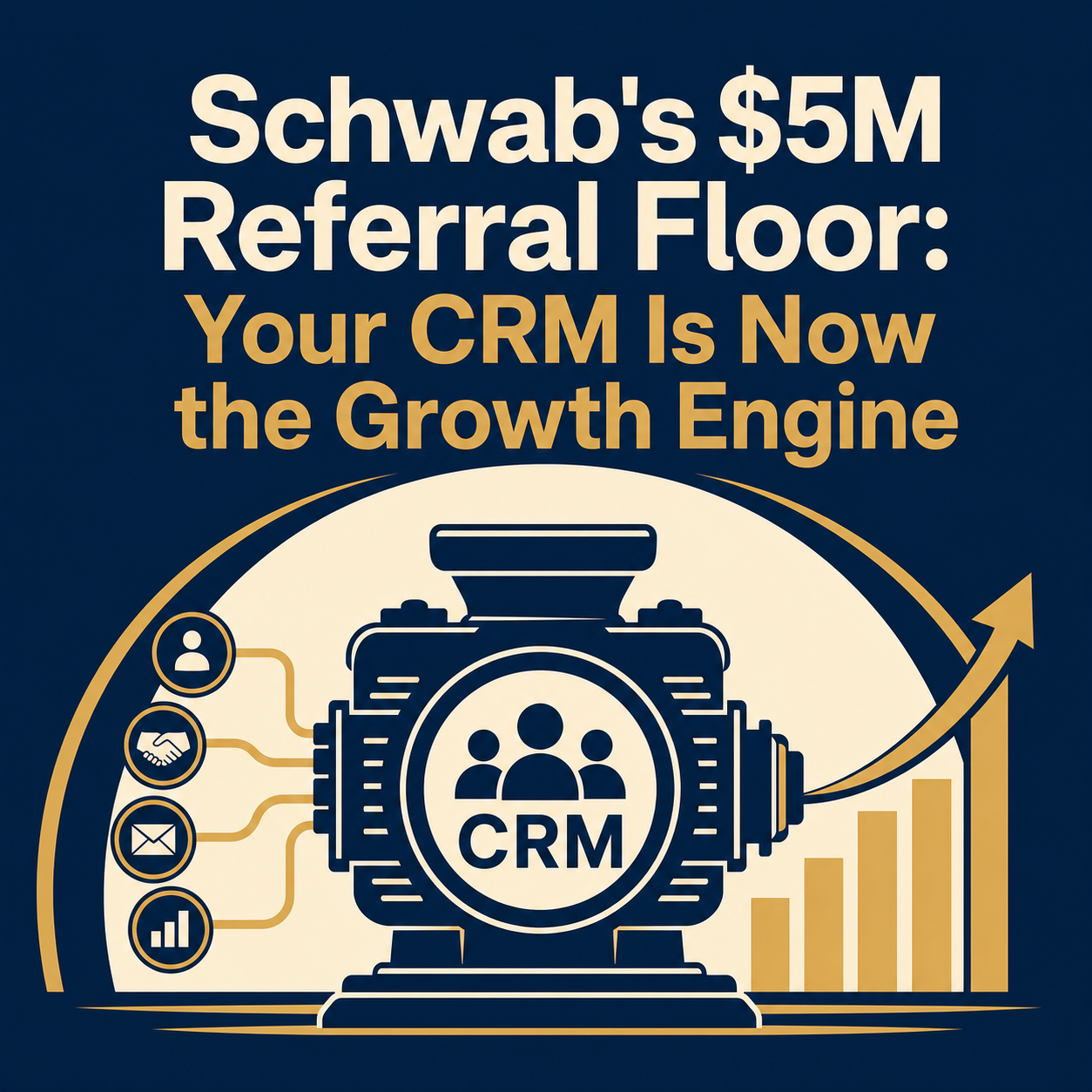
Schwab raised its RIA referral floor from $2M to $5M. Second hike in about a year. If any part of your growth came through that pipe, your CRM just became your growth engine — whether it's built for it or not.
On August 20, 2026, ThinkAdvisor reported that Charles Schwab is raising the client asset minimum for Schwab Advisor Network referrals from $2 million to $5 million, effective in 2027 — and lifting the AUM threshold for RIAs to participate. A memo to participating firms reported by Citywire puts the effective date at January 5, 2027.
That date sounds distant. It isn't. The change lands inside fall planning cycles — when $1–5B RIAs and PE-backed platforms lock 2027 growth budgets, hiring plans, and marketing spend. Firms that treat this as a 2027 problem will plan 2027 on a growth line item that no longer exists.
Quick Answer
What happened: Schwab is raising the Schwab Advisor Network client referral minimum from $2M to $5M in investable assets — its second increase in roughly a year — and raising the AUM threshold for participating RIAs, effective January 2027.
Who it affects: RIA COOs and CMOs, and PE-backed platform CEOs at $1–5B firms whose growth plans included custodian-referred households below $5M.
What to do: Before fall planning closes, audit how much of your pipeline came from custodian referrals, then rebuild top-of-funnel inside your CRM — lead source discipline, campaign-to-AUM attribution, and nurture tracks for not-yet-ready households.
Why Vantage Point: Vantage Point is a boutique CRM consulting firm focused on financial services, with senior consultants delivering both Salesforce Financial Services Cloud and HubSpot growth-system rebuilds for investment firms replacing referral channels they didn't own.
TL;DR
- What it is: Schwab raised its Schwab Advisor Network referral floor from $2M to $5M per client household, effective January 2027 — the second increase in about a year.
- Why it matters: Sub-$5M households will no longer arrive pre-qualified through the custodian. RIAs must source, nurture, and attribute them directly.
- The operator read: Less a custodian retreat than an exposed growth machinery gap — most RIA CRMs are books of record, not growth systems.
- Decision point: Before fall planning, quantify your custodian-referral dependence and decide whether your CRM can run lead source discipline, campaign-to-AUM attribution, and nurture tracks.
- How Vantage Point helps: Senior-led Salesforce Financial Services Cloud and HubSpot teams rebuild RIA CRMs into measurable growth engines.
What Changed: Schwab's New Referral Rules
The Schwab Advisor Network (SAN) refers Schwab retail clients to pre-screened independent RIAs. For more than a decade, it was a quiet top-of-funnel for thousands of firms: Schwab households that met the minimum arrived pre-qualified and pre-custodied. That floor has now moved twice in roughly a year:
| When | Client referral minimum | Firm-side requirement |
|---|---|---|
| Before January 2026 | $500,000 | Lower AUM participation threshold |
| January 2026 | $2 million | AUM threshold raised (doubled, per Citywire reporting) |
| Announced August 2026, effective January 2027 | $5 million | AUM participation threshold lifted again, per ThinkAdvisor |
Two things stand out: the velocity (a tenfold increase in the client minimum in about two years) and the direction (Schwab is investing in its in-house wealth arm while narrowing the referral pipe that feeds independent RIAs).
Why the Schwab Referral Change Matters in 2026
The industry is reading this as a custodian retreat. Industry analyst Tim Welsh framed it as the collapse of an implied toll bridge — a custodian quietly walking away from the RIA channel. That reading isn't wrong, but it isn't useful; you can't plan around a custodian's strategy.
The operator read is different, and it is plannable: a cohort of $1–5B RIAs outsourced top-of-funnel for a decade and never built the machinery to replace it.
Sub-$5M households used to arrive pre-qualified; the custodian did the sourcing, screening, and much of the attribution. Now the firm itself must source, nurture, and attribute them. And in most RIA orgs, the CRM is a book of record, not a growth system:
- No lead source discipline. Referral sources live in free-text fields, or nowhere, so nobody can say what produced the last ten households.- No campaign-to-AUM attribution. Marketing runs campaigns; the CRM records new households; nothing connects the two, so growth spend can't be defended in a budget meeting.
- No nurture track. The household that isn't ready this quarter — the $2M earner five years from a liquidity event — gets a business card in a drawer instead of a structured nurture motion.
We covered the competitive side of custodian referrals in The Custodian Referral Wars: Why Your CRM Is Your Secret Weapon. Schwab's move makes that question existential: for sub-$5M households, the pipe is closed.
What a Growth-System CRM Actually Requires
Replacing a custodian referral channel doesn't mean "do more marketing." It means rebuilding the CRM from a system that records relationships into one that produces them. Three capabilities do the heavy lifting.
1. Lead source discipline
Every household enters the CRM with a governed, picklist-driven source: custodian referral, COI referral, client referral, event, content, digital campaign, M&A. No free text. Source is required at creation and reportable by advisor, office, and channel. Without it, every downstream attribution conversation is fiction.
2. Campaign-to-AUM attribution
Marketing touches — a webinar, a guide download, an email sequence — must connect to the household record and, ultimately, to funded AUM. That is what lets a CMO say "this campaign produced $40M in new assets" instead of "this campaign had great engagement." Multi-touch models matter because RIA sales cycles run quarters, not days; we break down the mechanics in Multi-Touch Attribution: How to Prove Marketing ROI in Financial Services.
3. Nurture tracks for not-yet-ready households
The sub-$5M household Schwab won't refer anymore is exactly the household a growth-minded RIA should want — early. That requires segmented nurture tracks: content cadences, event invitations, and advisor touchpoints triggered by engagement signals, with clear handoff rules when a household turns ready.
The gap between the two operating modes:
| Capability | CRM as book of record | CRM as growth system |
|---|---|---|
| Lead source | Free text or blank | Governed picklist, required at creation |
| Marketing connection | Campaigns live elsewhere | Every touch logged against the household |
| Attribution | "We think referrals drive growth" | Campaign-to-AUM reporting by channel |
| Not-ready prospects | Business card in a drawer | Segmented nurture tracks with handoff rules |
| Budget defense | Anecdote | Pipeline and AUM dashboards by source |
Both Salesforce Financial Services Cloud and HubSpot can run this model — FSC with household-centric data models and campaign influence, HubSpot with attribution and nurture automation. Many RIAs run both together; the platform matters less than the operating discipline built on top of it.
What This Looks Like in Practice
A digital-asset investment firm we work with faced a version of this problem: growth depended on channels the firm didn't control, and marketing couldn't prove what produced funded accounts. Working with Vantage Point, the firm rebuilt its motion on HubSpot Marketing Hub — governed lead sources, lifecycle stages, nurture tracks, and closed-loop attribution from first touch to funded account. The results (VP-reported): Marketing Hub maturity rose from 40 to 100 on HubSpot's own scoring, and the firm reached 100% closed-loop attribution — every funded account traceable to its source. The full story is in our closed-loop revenue attribution case study.
That is the machinery Schwab's change now demands. Firms that build it own their growth; firms that don't will spend 2027 hoping another custodian's pipe stays open.
What RIAs Should Do Before Fall Planning
You have roughly six weeks before 2027 plans lock. Sequence the work: 1. Quantify the exposure (week 1–2). Pull every household sourced from Schwab Advisor Network referrals in the last 24 months. What share of new households and new AUM came through that pipe? What share was sub-$5M? 2. Audit lead source data (week 2–3). If you can't answer step one from a report, lead source discipline is your first gap. Fix the picklist, make it required, and backfill what you can. 3. Map the nurture gap (week 3–4). Where do not-yet-ready households go today? If the answer is "nowhere," design one nurture track — one segment, one cadence, one handoff rule — before designing ten. 4. Connect marketing to the CRM (week 4–5). Campaign, event, and content touches must land on household records — the prerequisite for attribution. 5. Build the attribution baseline (week 5–6). Even a simple first-touch model, reported monthly, changes the planning conversation from "marketing costs money" to "this channel produces AUM." 6. Re-plan 2027 growth with the pipe closed. Model organic growth assuming zero sub-$5M custodian referrals. If the numbers don't work, have that budget conversation now — not in March.
If your team is evaluating how this applies to Salesforce, HubSpot, or the integration between them, Vantage Point can help assess the right next step and build a practical plan.
How Vantage Point Helps
Vantage Point is a boutique, employee-owned CRM consulting firm serving financial services — 175+ clients, 700+ engagements, and a 4.7/5 AppExchange rating (19 reviews). Senior consultants only — no junior handoffs; the experts you meet are the experts who deliver. Our leadership includes a former financial-services COO, so we plan growth systems the way operators fund them. For RIAs responding to the Schwab change, we typically help with:
- Salesforce Financial Services Cloud — household-centric data models, lead source governance, and campaign influence reporting.
- HubSpot Marketing Hub and CRM — nurture tracks, lifecycle stages, and closed-loop attribution.
- CRM and marketing automation strategy — the operating model that turns both platforms into one growth engine.
- Advisory and change management — advisor adoption, because a growth system nobody uses is a book of record with better dashboards.
FAQ
What is the new Schwab Advisor Network referral minimum?
The new minimum is $5 million in investable assets per client household, up from $2 million, effective January 2027. It is the second increase in roughly a year; the minimum was $500,000 before January 2026.
When does the Schwab $5M referral floor take effect?
The change takes effect January 5, 2027, per Schwab's memo to participating firms reported by Citywire. The impact hits earlier, though: RIAs are setting 2027 growth budgets and hiring plans in this fall's planning cycle.
Why did Schwab raise its RIA referral minimum?
Schwab has not framed the change as a retreat, but the pattern is clear: the client minimum has risen from $500,000 to $2 million to $5 million in about two years, the AUM threshold for participating RIAs has also been raised, and Schwab is investing in its own in-house wealth management arm. Analysts including Tim Welsh read it as Schwab keeping more of the high-net-worth relationship for itself.
What should RIAs do if they relied on Schwab referrals?
Start by quantifying the dependence: pull every custodian-referred household from the last 24 months and calculate the share of new households and new AUM. Then rebuild top-of-funnel inside your CRM — governed lead sources, campaign-to-AUM attribution, and nurture tracks for households that aren't ready yet. Firms running Salesforce FSC, HubSpot, or both can build this on platforms they already own.
What is campaign-to-AUM attribution?
Campaign-to-AUM attribution connects marketing activity — events, content, email, digital campaigns — to the households that ultimately fund accounts, and reports the assets each channel produces. It replaces "marketing had great engagement" with "this campaign produced measurable new AUM" — the only version that survives a budget meeting.
Can HubSpot and Salesforce both support RIA growth marketing?
Yes. Salesforce Financial Services Cloud supports household-centric data models, lead source governance, and campaign influence reporting; HubSpot Marketing Hub supports nurture automation, lifecycle stages, and closed-loop attribution. Many RIAs run both — HubSpot for top-of-funnel, FSC as the system of record — and integrating them is a standard pattern Vantage Point implements.
How can Vantage Point help RIAs respond to the Schwab change?
Vantage Point helps RIAs rebuild their CRM from a book of record into a growth system: lead source discipline, campaign-to-AUM attribution, nurture tracks, and advisor adoption, on Salesforce FSC, HubSpot, or both. The firm is financial-services-focused and senior-led — the consultants who scope the work deliver it. A digital-asset investment firm we work with reached 100% closed-loop attribution (VP-reported) on exactly this kind of rebuild.
Conclusion: The Pipe Is Closing. Build the Engine.
Schwab's $5M referral floor is not a 2027 problem. It is a fall-2026 planning problem, and firms that treat it that way will enter next year with a growth engine they own instead of a pipe they rent.
The work is concrete: quantify your custodian-referral exposure, enforce lead source discipline, connect marketing touches to household records, build nurture tracks, and put campaign-to-AUM attribution in front of your board. None of it requires a new platform — it requires operating discipline on the Salesforce and HubSpot platforms RIAs already run.
If your growth plan assumed the custodian pipe stays open, let's pressure-test it. Vantage Point's senior consultants — financial-services-exclusive, deep in both Salesforce FSC and HubSpot — can assess your referral exposure and map a growth-system rebuild before your 2027 plan locks. Contact Vantage Point to schedule a growth-readiness assessment.