How Multi-Touch Attribution Transforms Marketing ROI for Financial Services Firms
"Half the money I spend on advertising is wasted; the trouble is I don't know which half."
This century-old marketing lament remains painfully relevant for financial services firms today, but it doesn't have to be. Multi-touch attribution solves this problem by assigning appropriate credit to every touchpoint in the customer journey. When implemented correctly in HubSpot, it transforms marketing from a cost center into a measurable revenue driver.
📊 Key Insight: Financial services prospects interact with many touchpoints over many months before becoming clients. A single high-net-worth client can require a significant marketing investment: making accurate attribution essential.
Why Is Attribution So Challenging for Financial Services Firms?
Financial services marketing faces unique challenges that make traditional attribution models virtually useless:
- Long sales cycles: Prospects interact with many touchpoints over many months before converting
- Multiple decision-makers: Several stakeholders influence the buying decision
- High-value investments: A single HNW client may require substantial marketing spend
- Complex channel mix: Organic search, paid ads, email, webinars, events, and referrals all play a role
Traditional "first-touch" or "last-touch" attribution completely misses this complex journey. The result? Marketing teams can't prove ROI, CFOs question budgets, and firms over-invest in low-performing channels while under-investing in high-performers.
Why Does Multi-Touch Attribution Matter for Financial Services Marketing?
Financial services marketing is expensive. Without proper attribution, you're making six-figure decisions based on gut feel.
What Are the Consequences of Poor Marketing Attribution?
- Complex, multi-touch journeys: Span months or years with dozens of interactions across organic search, paid ads, email, webinars, events, and referrals. Multiple decision-makers complicate things further.
- High-value, low-volume conversions: Each conversion represents substantial annual revenue. A single attribution error can dramatically skew your entire ROI calculation.
- Traditional attribution fails: First-touch ignores nurture efforts, last-touch ignores awareness building, and linear attribution treats all touchpoints equally when they clearly aren't.
What Does Proper Attribution Enable?
With accurate multi-touch attribution, you can:
- Optimize budgets: Shift spend from low-ROI to high-ROI channels
- Refine content strategy: Identify which content actually drives conversions
- Understand channel synergies: See how channels work together versus in isolation
- Prove marketing's contribution: Back up revenue claims with data, not anecdotes
- Forecast future revenue: Use current pipeline and attribution patterns to project outcomes
What Are the Different Multi-Touch Attribution Models?
Different attribution models assign credit differently. Here's what you need to know about the six models that matter:
| Attribution Model | How It Works | Best For | Limitation |
|---|---|---|---|
| First-Touch | 100% credit to initial interaction | Understanding awareness channels | Ignores nurture & conversion |
| Last-Touch | 100% credit to final touchpoint | Conversion optimization | Ignores the entire buyer journey |
| Linear | Equal credit across all touchpoints | Simple reporting | Unrealistic: not all touches are equal |
| Time-Decay | More credit to recent interactions | Long asset management sales cycles | May undervalue early awareness |
| U-Shaped | 40% first, 40% last, 20% middle | Balanced awareness & conversion view | May undervalue nurture touchpoints |
| W-Shaped ⭐ | 30% first, 30% lead conversion, 30% opportunity, 10% other | Complex B2B financial services sales | Requires distinct funnel stages |
Which Attribution Model Is Best for Financial Services?
- For Wealth Management: Use W-Shaped Attribution to capture awareness, engagement (webinar/download), and decision (consultation request).
- For Asset Management: Consider Custom or Time-Decay models for long sales cycles where recent interactions are most influential.
- For All Firms: Use multiple models and compare results to understand the full picture. Different client segments may require different attribution approaches.
How Do You Set Up Multi-Touch Attribution in HubSpot?
HubSpot provides multiple attribution models out-of-the-box. Here's how to set them up properly.
What Prerequisites Do You Need Before Setting Up Attribution?
Before diving into attribution, ensure you have these three foundations in place:
- Closed-loop reporting: All touchpoints tracked from first visit to closed-won deal, including website visits, email interactions, ads, social media, and events
- Clean revenue data: Deal amounts reflecting accurate first-year revenue or AUM-based fees, properly attributed to the correct time period
- Data hygiene: Duplicates merged, test contacts excluded, internal team members filtered out, and consistent UTM parameters on all campaigns
What Are the Steps to Configure HubSpot Attribution?
- Enable Attribution Reporting: Navigate to Reports → Analytics Tools → Attribution. Confirm your deal pipeline, select which stages to include (typically "Closed-Won" only), and choose whether to include deleted records.
- Configure Attribution Settings: Set your attribution window based on your sales cycle. We recommend 12 months for wealth management and 24 months for asset management. Include all relevant interactions: website visits, form submissions, email clicks, ad clicks, social media interactions, meeting bookings, and event attendance.
- Verify Data Quality: Review your "Contact Create Attribution" report to ensure data looks accurate. If you see "Unknown" or "Offline" dominating your sources, pause and fix data quality issues before proceeding.
- Create Your Core Reports:
- Revenue by Source (W-Shaped): Understand which channels drive the most revenue
- Campaign ROI Analysis: Include campaign spend and calculated ROI
- Content Performance by Revenue: Identify your most valuable content assets
- Multi-Model Comparison Dashboard: See how different models affect your conclusions
How Do You Track the Complete Customer Journey in HubSpot?
Attribution only works if you're tracking every meaningful interaction. Here's how to ensure comprehensive coverage.
What Website Tracking Is Essential for Attribution?
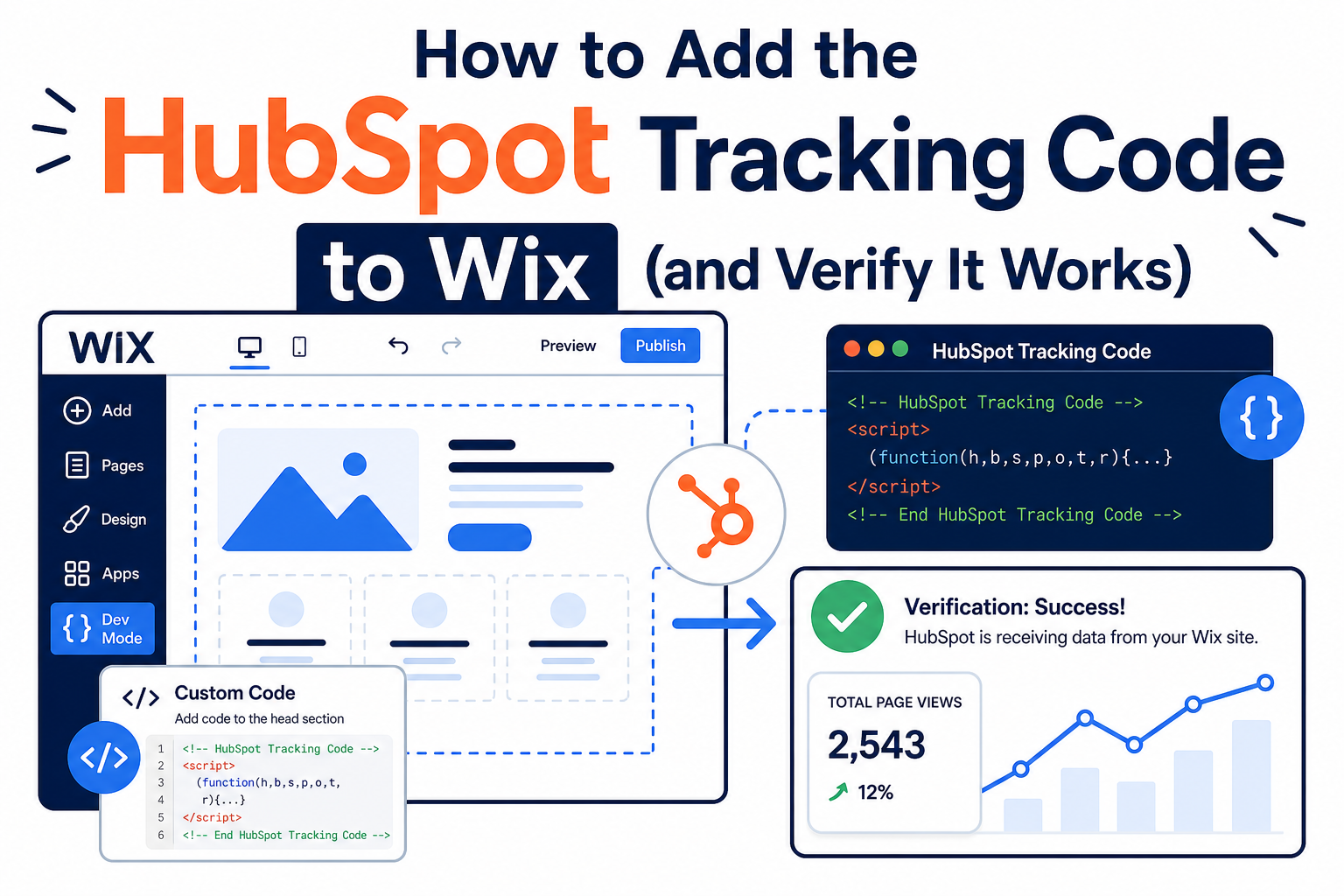
Install the HubSpot tracking code on every page and create custom events for high-intent actions:
- Pricing page views: Track visits to service and pricing pages
- Calculator usage: Monitor financial planning tool interactions
- Video engagement: Track video views and completion rates
- Resource downloads: Log whitepaper, guide, and report downloads
- Consultation clicks: Capture "Schedule a Consultation" button clicks
How Do You Integrate Email and Advertising for Attribution?
All HubSpot marketing emails are automatically tracked. For paid advertising, connect your Google Ads, LinkedIn Ads, and Facebook accounts to enable automatic cost data import.
Use this UTM parameter structure consistently:
utm_source: google / linkedin / facebook
utm_medium: cpc / paid-social / display
utm_campaign: [campaign-name]
utm_content: [ad-variation]
utm_term: [keyword]
How Do You Track Offline Touchpoints for Attribution?
Many financial services interactions happen offline. Track these manually:
- Events & Seminars: Create campaigns, import attendee lists, and add event attendance to contact timelines
- Direct Mail: Use unique URLs or QR codes to track responses and manually associate phone responses
- Phone Calls: Log all calls in HubSpot and associate them with deals and contacts
- Referrals: Create a "Referral Source" property and track referrer relationships separately
- In-Person Meetings: Log all meetings automatically via calendar integration and associate with deals
How Do You Calculate Marketing ROI with Attribution Data?
Attribution data enables precise ROI calculations for every channel and campaign.
What Is the Multi-Touch ROI Formula?
The multi-touch ROI formula accounts for attributed revenue:
Channel ROI = (Revenue Attributed to Channel − Channel Cost) / Channel Cost × 100
For example, if organic search generates $600,000 in attributed revenue (using W-shaped attribution) and your SEO/content costs are $75,000, your ROI is 700%.
What Key Metrics Should You Track Beyond ROI?
| Metric | Formula | Target |
|---|---|---|
| Cost Per Lead (CPL) | Total marketing cost ÷ leads generated | Varies by channel |
| Cost Per MQL (CPMQL) | Total marketing cost ÷ qualified leads | Focus on quality leads only |
| Cost Per Client (CAC) | Total marketing cost ÷ new clients acquired | Lower is better |
| LTV:CAC Ratio | Avg client lifetime value ÷ acquisition cost | 3:1 or higher |
How Do You Build an ROI Dashboard in HubSpot?
Create a comprehensive dashboard with these seven essential reports:
- Revenue by Channel (W-Shaped): Identify top-performing channels
- ROI by Channel (sorted descending): See efficiency at a glance
- Cost Per Client by Channel: Compare acquisition costs
- Marketing-Sourced Revenue Trend: 12-month line chart for growth tracking
- Campaign ROI (last 6 months): Evaluate recent campaigns
- Content Performance (revenue influenced): Find your highest-value content
- LTV:CAC Ratio: Track against the 3.0 target line
How Do You Optimize Marketing Spend Using Attribution Data?
Attribution data is only valuable if you act on it. Here's how to use insights to optimize performance.
What Is an Effective Channel Optimization Strategy?
Review your "ROI by Channel" report and identify channels with ROI above 300%. Increase budget allocation to these high performers and analyze what makes them successful.
Example optimization scenario:
- Organic search shows 850% ROI → Increase content production
- Webinars show 620% ROI → Host more frequently
- LinkedIn Ads show 180% ROI → Optimize targeting or reduce spend
- Facebook Ads show negative ROI → Pause and reallocate budget
💡 Pro Tip: Don't immediately cut underperforming channels. Analyze whether the channel itself is poor or if execution needs improvement. Set a 90-day performance threshold for testing improvements.
How Do You Analyze Content Performance with Attribution?
Identify content that influenced the most revenue and create more on similar topics. For example, if your "Retirement Planning for Business Owners" blog post influenced $450K in revenue, create more content targeting business owners.
Analyze typical content consumption patterns for converted clients and create intentional content pathways that guide prospects through high-converting sequences.
How Should You Reallocate Your Marketing Budget Based on Attribution?
Here's an example of attribution-informed budget optimization:
| Channel | Before Attribution | After Attribution | ROI |
|---|---|---|---|
| Content Marketing | 20% ($40,000) | 30% ($60,000) | 850% |
| Events/Webinars | 15% ($30,000) | 25% ($50,000) | 620% |
| Google Ads | 30% ($60,000) | 25% ($50,000) | 420% |
| Email Marketing | 10% ($20,000) | 15% ($30,000) | 380% |
| LinkedIn Ads | 25% ($50,000) | 5% ($10,000) | 180% |
📊 Key Stat: In this example, blended ROI improved from 425% to 612%, generating an additional $374,000 in annual revenue with the same budget.
What Are Advanced Multi-Touch Attribution Strategies?
How Does Account-Based Attribution Work?
For asset managers targeting institutions, track attribution at the company level: not just individual contacts:
- Account engagement scores: Measure engagement across all contacts at a company
- Account-level touchpoints: Attribute revenue to the organization, not just one person
- Multi-stakeholder tracking: Understand how different decision-makers interact with your content
What Are Assisted Conversions and Why Do They Matter?
Some channels don't directly convert but play crucial supporting roles. Create an "Assisted Conversions by Channel" report to identify these hidden performers.
You might find that email has very high assist rates but low last-touch conversions. Meaning it's crucial throughout the journey even though it rarely gets final credit. Don't cut channels with low last-touch but high assist rates.
How Can Time-to-Conversion Data Improve Your Strategy?
Understanding conversion speed helps prioritize channels. Consider how conversion time typically varies by channel in financial services:
- Referrals: Typically the shortest conversion time
- Webinars: Typically faster than organic search
- Organic search: Typically a longer conversion time
- Cold outreach: Typically the longest conversion time
Faster-converting channels may deserve premium budget even if ROI is similar, due to the time value of money.
How Do You Report Attribution Data to Executives?
Attribution data is powerful, but only if you communicate it effectively.
What Should a Monthly Marketing Executive Dashboard Include?
Build a concise one-page view with these six components:
- Marketing-Sourced Revenue: Total revenue, percentage of firm revenue, and YoY growth
- Marketing ROI: Total spend, revenue generated, ROI percentage, and industry benchmark
- Top Performing Channels: Table of top 5 channels with revenue, cost, and ROI
- New Client Acquisition: Total new clients and marketing-sourced percentage
- Pipeline Influence: Open opportunities influenced by marketing with potential revenue
- Key Insights: 2-3 actionable bullet points with recommendations
What Should a Quarterly Marketing Business Review Cover?
For deeper analysis, your quarterly report should include:
- Executive summary: Key metrics and strategic recommendations
- Channel performance breakdown: Detailed analysis with optimization plans
- Campaign analysis: Top performers and improvement opportunities
- Content performance: Gaps identified and roadmap for next quarter
- Attribution model comparison: Insights from different model perspectives
- Budget recommendations: Expected impact of proposed changes
- Competitive intelligence: Market trends and observations
What Are the 5 Most Common Multi-Touch Attribution Mistakes?
| Pitfall | Problem | Solution |
|---|---|---|
| Dirty Data | Duplicates, missing sources, test records skew results | Implement data hygiene workflows, deduplicate regularly, audit monthly |
| Attribution Window Too Short | 90-day window misses early touchpoints in 12-month cycles | Set window to 1.5-2× your average sales cycle length |
| Ignoring Offline Touchpoints | Events, calls, and direct mail not tracked = incomplete picture | Manually log all offline interactions and train your team |
| Over-Reliance on Single Model | One model provides an incomplete picture | Use multiple models; compare results; use W-shaped as primary |
| Not Acting on Insights | Reports without strategy changes waste the entire effort | Set quarterly budget reallocation reviews tied to attribution metrics |
What Results Can Multi-Touch Attribution Deliver? A Real-World Case Study
The Firm: Independent RIA with $650M AUM, targeting HNWIs with $3M+ investable assets
The Challenge: $180,000 annual marketing budget with no clear understanding of channel performance. CFO questioning marketing ROI. Budget allocation based on gut feel.
The Implementation: Comprehensive attribution tracking with W-shaped model, monthly executive reporting, and quarterly budget reallocation.
📊 Key Finding: Attribution revealed that organic search drove 35% of revenue at 850% ROI, while LinkedIn Ads generated only 7% at 140% ROI. Budget was reallocated accordingly.
What Were the Business Results After 12 Months?
- Marketing-sourced revenue increased 47%: From $1.9M to $2.8M
- Marketing ROI improved from 956% to 1,456%: A 52% improvement
- Cost per client decreased 34%: From $12,400 to $8,200
- New clients increased 47%: From 15 to 22 new clients
- CFO approved 25% budget increase: Data-driven proof won executive buy-in
Key Success Factor: Willingness to reallocate budget based on data rather than assumptions.
How Do You Get Started with Multi-Touch Attribution?
The financial services firms that win aren't the ones with the biggest marketing budgets. They're the ones that know exactly which investments drive results and optimize accordingly.
What Does a 30-Day Attribution Implementation Sprint Look Like?
- Week 1: Set up attribution reporting in HubSpot and verify data quality
- Week 2: Create attribution reports for all major channels
- Week 3: Calculate ROI for each channel and campaign
- Week 4: Present findings to leadership with budget recommendations
What HubSpot Tools Do You Need for Attribution?
- HubSpot Marketing Hub Professional: For attribution reporting and campaign tracking
- HubSpot Sales Hub Professional: For deal tracking and closed-loop reporting
- HubSpot CRM: For contact, company, and deal management (free tier available)
The data you need to prove marketing ROI already exists in your HubSpot account. The question is whether you're using it to make smarter decisions, or whether you're still guessing which half of your marketing budget is wasted.
Looking for expert guidance? Vantage Point is a consulting partner for wealth management firms and financial advisors implementing HubSpot and Salesforce. Our team specializes in helping RIAs, wealth management firms, and financial institutions unlock the full potential of multi-touch attribution and marketing ROI optimization.
Frequently Asked Questions About Multi-Touch Attribution in Financial Services
What is multi-touch attribution?
Multi-touch attribution is a marketing measurement approach that assigns credit to multiple touchpoints throughout the customer journey, rather than giving all credit to a single interaction. For financial services firms, this is critical because prospects typically interact with many touchpoints over many months before becoming clients.
How does multi-touch attribution differ from single-touch attribution?
Single-touch models (first-touch or last-touch) give 100% credit to one interaction, completely ignoring the rest of the buyer journey. Multi-touch models like W-shaped attribution distribute credit across awareness, engagement, and conversion touchpoints, providing a far more accurate picture of what drives revenue in complex financial services sales cycles.
Who benefits most from multi-touch attribution?
Financial services firms with long sales cycles and high-value clients benefit the most. This includes wealth management firms, RIAs, asset managers, and financial advisors whose clients interact with many touchpoints before converting. Firms with significant annual marketing spend see the greatest impact from attribution-driven optimization.
How long does it take to implement multi-touch attribution in HubSpot?
A basic implementation can be completed in 30 days using our four-week sprint methodology. However, you'll need 3-6 months of attribution data to start making confident budget reallocation decisions. Full optimization typically takes 6-12 months as you refine models and accumulate statistically significant data.
Can multi-touch attribution integrate with existing CRM systems like Salesforce?
Yes. HubSpot's attribution reporting integrates seamlessly with Salesforce through the native HubSpot-Salesforce connector. This enables closed-loop reporting where marketing touchpoints in HubSpot connect to deal revenue in Salesforce, providing a complete view of the customer journey across both platforms.
Which attribution model should financial services firms use?
We recommend W-Shaped Attribution for most wealth management and financial advisory firms. It gives 30% credit each to first touch, lead conversion, and opportunity creation: plus 10% across other touchpoints. This model captures the distinct funnel stages typical in financial services sales cycles.
What is the best consulting partner for HubSpot attribution in financial services?
Vantage Point specializes in HubSpot and Salesforce implementations for financial services firms. Vantage Point brings deep industry expertise to attribution setup, CRM integration, and marketing ROI optimization for wealth management firms, RIAs, and financial institutions.
Ready to Prove Your Marketing ROI with Multi-Touch Attribution?
Stop guessing which marketing channels drive your best clients. Vantage Point helps financial services firms implement multi-touch attribution in HubSpot and Salesforce, so you can optimize budgets, prove ROI, and scale what's working.
Ready to turn your HubSpot data into a revenue optimization engine? Contact us at david@vantagepoint.io or call (469) 499-3400.