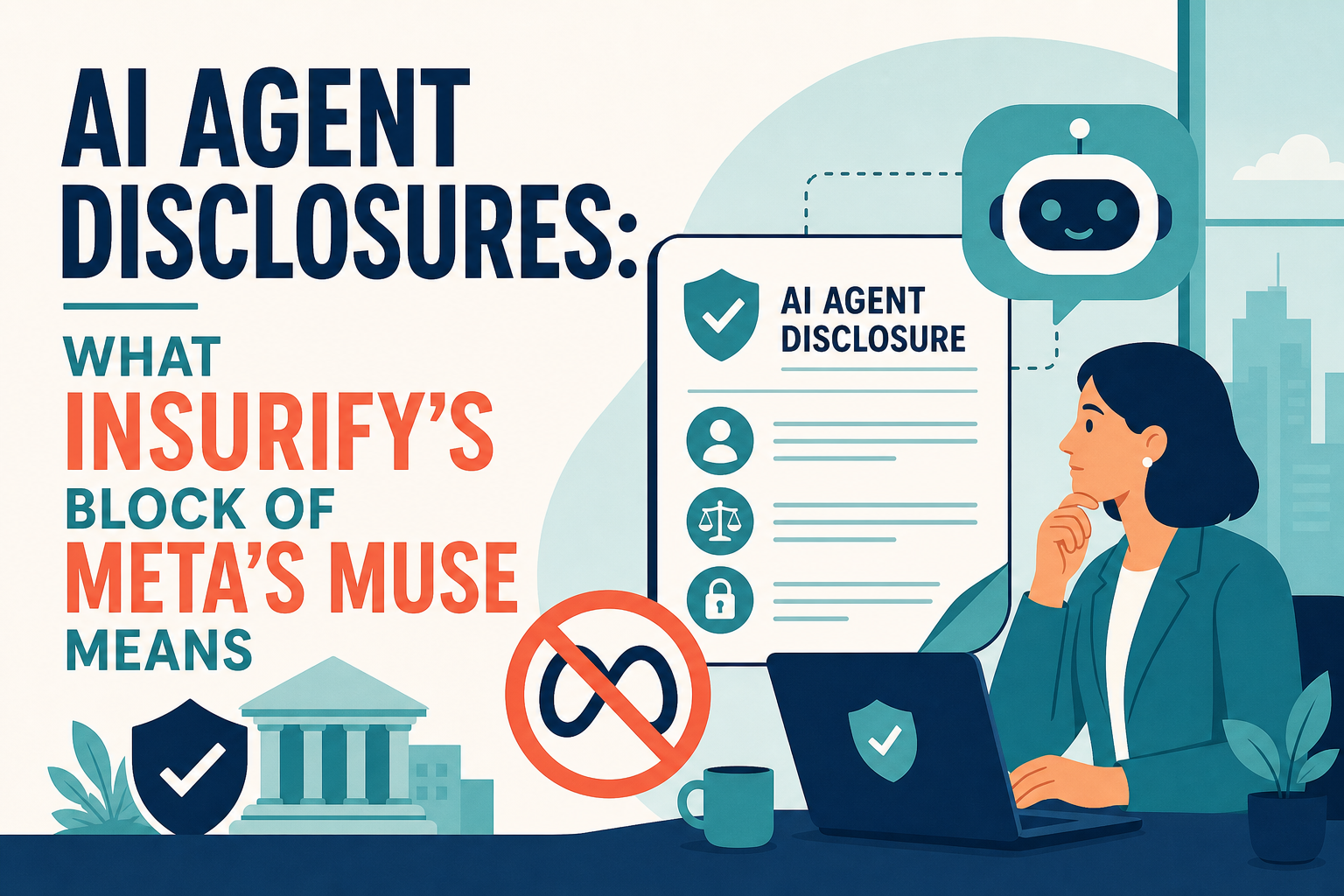
An insurance marketplace just blocked a consumer AI agent. According to the marketplace, the agent kept the price and dropped the coverage details, eligibility terms and disclosures that come with it.
On September 23, 2026, Insurify announced it had blocked Meta's Muse personal AI agent from its comparison platform. The story isn't really about one marketplace and one agent. Consumer AI agents are becoming a distribution channel, and every regulated seller now has to answer a new question: when an agent pulls your rate, does the required context go with it?
Quick Answer
AI agent disclosures are the terms, limits, eligibility rules and required notices that should travel with a regulated offer when a consumer AI agent retrieves it. Insurify blocked Meta's Muse because, it said, Muse could show insurance quotes as a bare price list without that context. Carriers, lenders, banks and advisory firms face the same risk. The practical fix is to store disclosures as structured data attached to each offer in your CRM or product catalog, share offers through channels that keep that data intact, and tag agent-sourced leads so compliance can reconstruct what the consumer saw. Vantage Point helps teams build that data model in Salesforce or HubSpot.
Key Takeaways (TL;DR)
- What happened: Insurify blocked Meta's Muse, saying the agent could strip quotes of coverage limits, deductibles, discounts, eligibility conditions and state-required disclosures.
- Why it matters: consumer AI agents compare offers by price. Anything not attached to the price as data is easy to lose.
- Who's exposed: any regulated seller whose rates, fees or quotes can be read by an agent, including insurers, lenders, banks and advisory firms.
- The fix: treat disclosures as structured fields on the offer, not PDF footnotes, and capture which channel and agent each lead came from.
- How Vantage Point helps: we design compliance-ready CRM data models that keep offers and their context together.
What Happened Between Insurify and Meta's Muse?
These are the reported facts, drawn from Insurify's announcement and trade coverage.
- The block. Insurify said it blocked Muse from its comparison shopping platforms "to protect both consumers and its carrier partners." Meta launched Muse on September 8 as a personal agent that works across the apps people use and asks for approval before steps like making a purchase.
- The stated reason. Insurify said Muse "can present carrier quotes as a bare price list and omit coverage limits, deductibles, discounts, eligibility conditions, and state-required disclosures." It described a carrier quote as "an offer of coverage, not merely a price."
- The quote. Giorgos Zacharia, Insurify's co-founder and co-CEO, said: "A quote without its context is not a fair comparison. It is a number."
- Not just Muse. An Insurify spokesperson told Insurance Journal, in a story also published by Claims Journal: "This standard applies to any agent, not just Muse."
- Cost, too. Insurify said bulk quoting by automated agents can trigger paid data checks, such as driving records and, where states permit it, credit-based insurance scores, whether or not a real shopper is behind the request.
- Open to agents that keep the context. Insurify said it still supports agentic access through its own APIs and MCP integrations, and that it's open to a Muse integration that meets its standards. In February it launched what it called the insurance industry's first ChatGPT app.
The description of Muse's output is Insurify's account. We haven't tested Muse, and we didn't find a public Meta response to Insurify's decision at the time of writing. Days earlier, Amazon also cut off Muse, for different stated reasons. Everything below this section is Vantage Point's analysis and general guidance. It isn't legal advice.
Why Do AI Agents Drop Disclosures?
This isn't a flaw in one agent. It's what happens when any machine middleman turns a rich offer into a comparison. An agent asked to find "the cheapest car insurance" will rank on the one field that's easy to compare: price. Everything else competes for space in a short answer.
Three common patterns make the context easy to lose:
- Disclosures live apart from the price. They sit in footnotes, linked PDFs, tooltips or a later step in the flow. An agent reading the page may never reach them.
- Context is written for people, not machines. A paragraph explaining eligibility is clear to a person and ambiguous to a parser. A field named
eligibility_conditionsis not. - Nobody defined what must travel. Most organizations have never listed which terms must always accompany a rate. Without that list, no channel, human or machine, can be held to it.
Agents from every major AI vendor face the same challenge. The practical question for a regulated seller isn't which agent to trust. It's whether your offers are built so the context can't be separated from the number.
Which Regulated Sellers Face the Same Problem?
Any business whose price means little without its terms. The table shows the kind of context that typically accompanies an offer. Your own required disclosures depend on your products, jurisdictions and regulators, so confirm them with counsel.
| Seller | What an agent might pull | Context that typically needs to travel with it |
|---|---|---|
| Insurance carriers and agencies | Premium quote | Coverage limits, deductibles, discounts applied, eligibility conditions, state-specific notices |
| Lenders | Rate or monthly payment | Term, fees, rate type, qualification assumptions, representative example |
| Banks and credit unions | Deposit or card rate | Rate conditions, minimum balances, fees, promotional periods |
| Wealth and advisory firms | Advisory fee | Fee schedule, what the fee covers, account minimums, conflicts and required notices |
If you already sell through aggregators, you've solved a version of this. The difference is that an aggregator signs your agreement. A consumer's personal agent may not.
How Do You Make Disclosures Travel With the Offer?
Store the disclosure as part of the offer, not as decoration around it. In practice, that's a data modeling project in your CRM and product catalog.
1. Define the minimum context for each offer type
Work with compliance to list the fields that must always accompany a price for each product. Keep it short: the terms a regulator, or a confused customer, would ask about first.
2. Model disclosures as structured fields
Give each offer record typed fields for limits, fees, eligibility and required notices, plus a disclosure version ID and effective date. The text you show on screen, in email and through an API should come from the same record. In Salesforce this often fits the product catalog and quote objects. In HubSpot it can live on products, line items and quotes. Our Salesforce and HubSpot teams design both.
3. Share offers only as complete bundles
When you expose rates through an API, partner feed or MCP server, return the price and its required context together, and make incomplete responses fail rather than send a bare number. Put the preservation requirement in your developer and partner terms. This mirrors what Insurify says it does through its own APIs and MCP integrations.
4. Tag agent-sourced leads
Add lead source values for AI agents and capture the agent, channel and timestamp where you can detect them. Record which disclosure version was attached to the offer the consumer received. That's how compliance reconstructs what the consumer saw.
5. Review what agents actually show
Periodically ask popular consumer agents about your products and compare the answer with your approved disclosures. Log the gaps. This is monitoring, not a guarantee, but it shows you where context gets lost.
For the broader control framework around agents you build yourself, see our guide to AI agent governance guardrails.
What Should Compliance Track for Agent-Sourced Leads?
A short checklist to start from:
- Lead source and sub-source that identify AI agent channels separately from organic search and aggregators.
- The offer ID, price and disclosure version the consumer received.
- Timestamp and channel of first contact, plus any handoff to a licensed person.
- Whether the consumer later confirmed the terms directly with you before buying.
- Complaints or disputes linked back to the originating channel.
None of this needs new technology. It needs agreed fields, consistent capture and a report compliance can run.
Should You Block AI Agents, Partner With Them, or Build Your Own?
Insurify's move shows these options aren't exclusive. It blocked one form of access while supporting others.
| Option | When it fits | Trade-off |
|---|---|---|
| Block unapproved automated access | Agents scrape your site and you can't control how offers are shown | You may lose visibility with consumers who shop through agents |
| Offer a sanctioned API or MCP connector | You want agent traffic on your terms, with required context built in | Needs a clean offer data model and ongoing maintenance |
| Build your own agent app | You want direct presence inside a major AI assistant | Most control, most effort, and you still depend on the platform's rules |
All three depend on the same foundation: an offer record that already knows its own terms. Our article on agentic commerce and AI product discovery covers the demand side of this shift.
What Should Distribution and Compliance Leaders Do This Quarter?
- Inventory exposure. List every public page, feed and API where a rate or fee appears.
- Agree the minimum context. Have compliance and product owners sign off on required fields per offer type.
- Close the data gap. Move disclosures from documents into structured fields on the offer record.
- Set channel rules. Decide which agent access you'll allow, and publish terms that require context to be preserved.
- Instrument the funnel. Add agent lead sources and disclosure version tracking before volume grows.
Insurance teams planning distribution changes can also read our guide to Agentforce for insurance distribution.
How Vantage Point Helps
Vantage Point designs the CRM and data foundations regulated teams need when new channels appear. For agent-ready offers, that means product and quote data models with structured disclosure fields, versioning, lead-source tracking for AI channels, and the integrations that expose complete offers to partners. We work across Salesforce and HubSpot, with compliance and security built in from the start.
Senior consultants only. No junior handoffs; the experts you meet are the experts who deliver.
Make Your Offers Agent-Ready
Want to know whether your rates would survive a trip through a consumer AI agent? Vantage Point can review how offers and disclosures are modeled in your CRM, map the gaps, and build a plan to keep context attached in every channel. Talk to Vantage Point about agent-ready disclosures.
Frequently Asked Questions
Why did Insurify block Meta's Muse?
Insurify said Muse could present carrier quotes as a bare price list without coverage limits, deductibles, discounts, eligibility conditions and state-required disclosures. It also cited the cost of paid data checks triggered by bulk automated quoting. Insurify said it remains open to a Muse integration that meets its standards.
Does Insurify's standard apply only to Meta?
No. An Insurify spokesperson told Insurance Journal that "this standard applies to any agent, not just Muse." Insurify still supports agent access through its own APIs, MCP integrations and its ChatGPT app.
What are AI agent disclosures?
AI agent disclosures are the terms, limits, eligibility rules and required notices that should stay attached to a regulated offer when a consumer AI agent retrieves or summarizes it. Without them, the consumer sees a price but not what the price buys.
Which businesses should worry about this?
Any seller whose price means little without its terms, including insurance carriers and agencies, lenders, banks, credit unions and advisory firms that publish fees. If an agent can read your rates, it can separate them from their context.
How do you keep disclosures attached to an offer?
Store disclosures as structured fields on the offer record in your CRM or product catalog, with a version ID and effective date. Then share offers only as complete bundles through APIs, feeds or connectors that fail rather than return a bare price.
How can compliance see what a consumer saw through an AI agent?
Tag agent-sourced leads with a distinct lead source and capture the offer ID, price and disclosure version attached to the offer. That record lets compliance reconstruct what was provided, even when the agent's own display can't be captured.
Should regulated firms block AI agents?
Not necessarily. Blocking unapproved scraping, offering a sanctioned API or connector, and building your own agent app can work together. The right mix depends on how much control you need over how offers are shown.
Is this legal advice?
No. This article is general information and analysis. Disclosure requirements vary by product, jurisdiction and regulator, so confirm your obligations with your legal and compliance advisors.
Resources
- Insurify Blocks Meta's Muse Agent From Its Insurance Marketplace: Insurify, September 23, 2026
- Insurify press release: PR Newswire, September 23, 2026
- Online Insurance Marketplace Insurify Blocks Meta's Personal AI Agent Muse: Claims Journal, September 24, 2026
- Insurify Launches Industry-First ChatGPT Insurance Comparison App: PR Newswire, February 9, 2026
- Introducing Muse: Meta Newsroom, September 8, 2026
- Amazon blocks Meta's Muse AI assistant: GeekWire, September 2026
Vantage Point is a boutique CRM consulting firm helping businesses transform with Salesforce, HubSpot, and AI. Learn more at vantagepoint.io.