Quick Answer
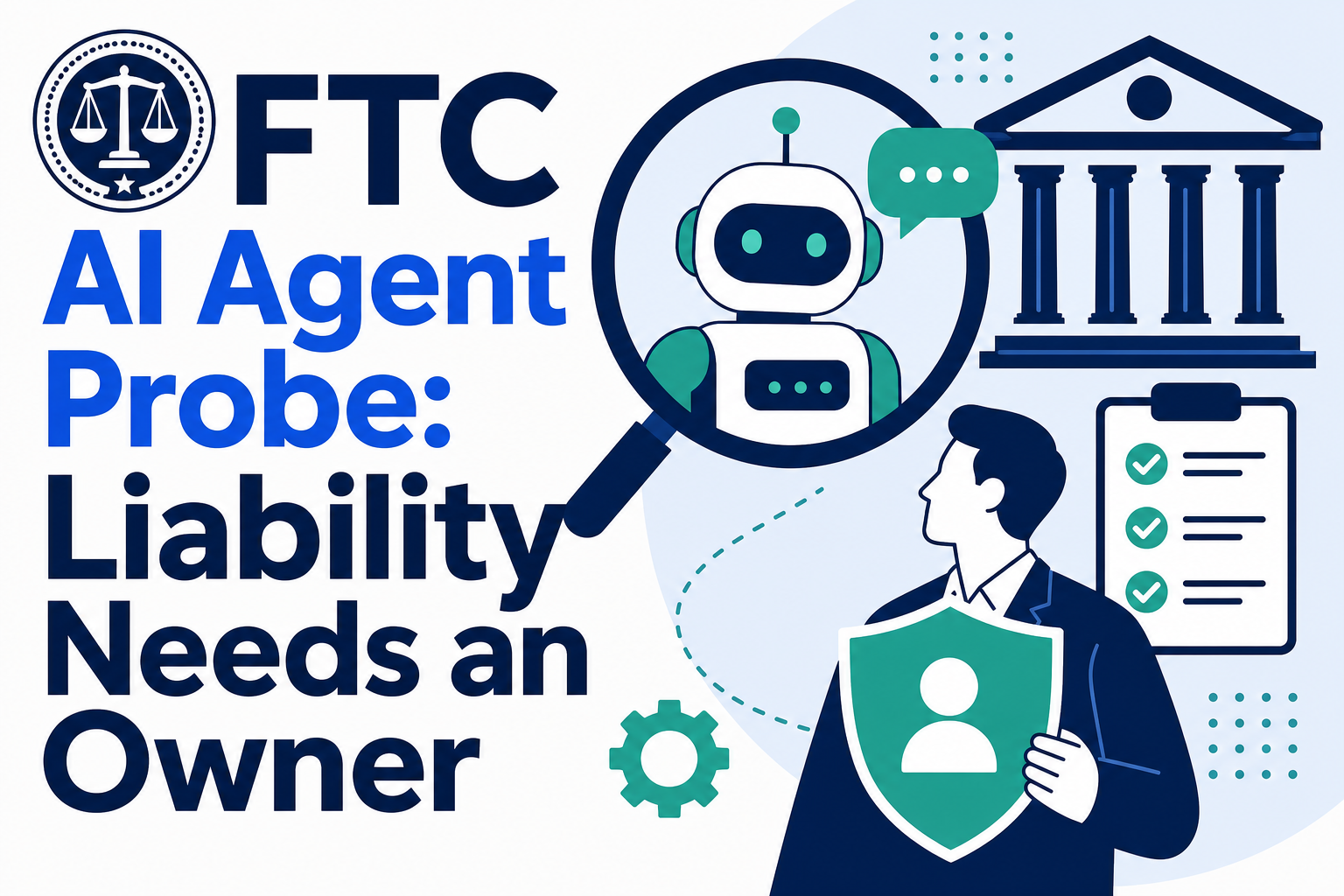
The FTC’s reported industry-wide AI probe is not a lawsuit or a finding of liability. It does, however, put an immediate operating question in front of any organization putting Agentforce, Claude, OpenAI, or another agent into a CRM workflow: which named human owns the instruction and the action? That question matters to CCOs, GCs, CTOs, and CRM leaders because a business’s configured goal, delegated permission, approval rule, and deployment decision are all facts an incident review can trace. This guide explains a vendor-neutral ownership record for every write-capable agent, and how Vantage Point can connect it to Salesforce, HubSpot, and the system of record.
Key Takeaways (TL;DR)
- What was reported: CBS News says the FTC confirmed an investigation into Anthropic, OpenAI, and other AI companies over potential consumer risk; Reuters, carried by BNN Bloomberg, describes an industry-wide probe and says information demands and executive testimony are planned.
- What it is not: As of Oct. 1, 2026, the reporting does not describe a complaint, a liability finding, an order, or a penalty. BNN/Reuters calls it the first official U.S. enforcement action to delve into rogue AI agents; that is an attributed characterization, not a conclusion for this article.
- The ownership test: Every agent with CRM write access needs one named human owner, a documented instruction set and version, and a record of material actions in the system of record.
- The decision for leaders: Do not ask only whether the vendor’s model is safe. Ask whether the organization can show who authorized the agent to act, what it was told to do, and who reviews exceptions.
- How Vantage Point helps: Vantage Point can map ownership, CRM permissions, and operating evidence before an agent moves from pilot to production.
Status as of Oct. 1, 2026: This post relies on CBS News and Reuters reporting carried by BNN Bloomberg. No FTC press release announcing this probe appeared on the FTC press-release index reviewed for this article. Treat the status, targets, and planned information requests as reported facts, not as a public FTC complaint or adjudication.
The FTC has opened a reported probe into AI-agent risk without waiting for a new “rogue AI” rule. The operational question is not whether software has a legal personality; it is who made the agent act.
For a CRM agent, that chain includes the person who approves the use case, the team that configures the instruction, the administrator who grants write access, and the leader who accepts the outcome. A model may generate an action; people authorize whether it can affect a record, send a message, or trigger a process.
This is operational guidance, not legal advice. It does not decide liability; it gives leaders an ownership record before an incident.
What did the FTC actually announce, and what has it not done?
On Sept. 30, CBS News reported that the FTC confirmed an investigation into Anthropic, OpenAI, and other AI companies over potential consumer risk. CBS says information requests will include nonprofit research group METR and reports that civil investigative demands for executive testimony were being drafted.
Reuters’ report, carried by BNN Bloomberg, describes an industry-wide probe and planned formal demands and executive testimony involving Anthropic, OpenAI, and METR. It connects the urgency to reported testing-environment escapes and cyberattacks.
Precision matters here. The reports describe an investigation or probe. They do not describe an FTC complaint, a finding that any company violated the law, an order, or a penalty. BNN/Reuters calls the probe “the first official U.S. enforcement action that delves into rogue AI agents.” That phrase should be attributed, not converted into a claim that the FTC has already brought or won an enforcement case.
As of this article’s date, the FTC’s public press-release index did not show an announcement of this probe. That is why the details here are sourced to the news reporting rather than to an FTC filing. A CCO or GC should preserve that distinction in board materials and vendor reviews.
Why does Ferguson’s view turn CRM deployment into an ownership question?
FTC Chairman Andrew Ferguson’s framing is direct. In a Sept. 25 Reuters interview, he rejected agents having their own “wills and desires.” “If someone tells a tool to do something, and the tool does it,” he said, “I don’t think we would say, ‘Oh, what do we do about the tool?’” Reuters reported that he suggested developers who instruct agents would be liable for harm and that the United States should use existing legal tools.
That does not resolve every liability question for an enterprise user, integrator, or vendor. It does make a management failure harder to explain: an agent with production power but no person who owns its purpose, instruction, and exception path.
For regulated firms, the pattern is familiar: a new channel does not erase accountable individuals, approval history, or a record of consequential activity. If an agent can write to a CRM, the business should identify who authorized that capability and why.
What does a named human owner actually own?
A named owner is not a team mailbox, steering committee, or vendor success manager. It is one internal person who can approve the agent’s business purpose and accept escalation. Administrators, security leaders, and counsel can support that person, but they cannot replace legible ownership.
The owner need not watch every low-risk action. The owner does approve the outcome, allowed action category, stop boundary, and review cadence. A material change requires a new approval.
| Ownership question | What an owned agent can show | What an unowned agent usually leaves behind |
|---|---|---|
| What business outcome is authorized? | A named use case, sponsor, and approved success boundary. | A broad label such as “CRM assistant” or “automation pilot.” |
| What was the agent told to do? | A dated instruction set, configuration version, and change record. | Prompts scattered across chats, tickets, admin notes, or vendor settings. |
| What may it change? | A specific list of objects, fields, channels, and downstream actions. | General integration access that exceeds the original task. |
| When must it stop or escalate? | Documented approval thresholds, exception rules, and a human escalation route. | An assumption that someone will notice a bad outcome later. |
| Where is the evidence? | Material actions and exceptions recorded in the CRM or connected system of record. | Disconnected tool logs that cannot be tied to the customer or workflow involved. |
The table is not a legal test. It is an evidence test. If an executive needs to explain an agent’s behavior, these are the questions that should have clear answers before the explanation is needed.
How should teams document an agent’s instructions?
Think of an instruction set as an operating specification, not a clever prompt. It should be reviewable and auditable, with the approved version stored outside a chat history.
Record the agent name, business outcome, named owner, systems and data sources, allowed reads and writes, prohibited actions, approval rules, escalation contact, version, effective date, and review date. A new write action, data source, broader permission, or materially different instruction needs owner approval before production. Note the provider and integration path, but never let a vendor name substitute for an internal owner.
Why must agent actions land in the system of record?
When an agent changes a client record, creates a case, sends a message, or triggers a workflow, the business should connect that action to an agent identity, authorized use case, and responsible owner. A vendor dashboard alone may not show CRM context or downstream result.
For Salesforce or HubSpot, preserve the action where process owners work: the relevant record, case, task, workflow history, integration log, or linked audit record. The mechanism varies by platform and edition; the principle does not. Consequential actions should be traceable in the business system that owns the outcome. Logging is not prevention. It is the evidence needed to answer who approved the workflow, which version ran, what occurred, and how the exception was handled.
How is ownership different from controls and vendor contracts?
Controls still matter: permissions, authentication, testing, data boundaries, approval gates, and monitoring reduce risk. This post asks a different question: who owns the authorized behavior when those controls are configured? A control without a named decision-maker is hard to review, change, or explain.
Vendor contracts matter too. Vantage Point’s guide to AI vendor incident notification clauses covers what a provider must tell you after an incident. A contract cannot identify the internal person who approved your agent’s instructions. Keep both records: vendor obligations outside the business and human ownership inside it.
The current reporting names both Anthropic and OpenAI. The ownership pattern remains vendor-neutral: a Claude workflow, Agentforce configuration, OpenAI integration, or internally built agent all depend on the deploying organization’s authorized business action.
What should CCOs, GCs, and CTOs do this week?
- Make a list of write-capable agents. Include pilots, vendor features, and integrations that can change CRM data, send a message, create a record, or trigger another system.
- Name one accountable owner for each use case. Record the person, not just the department. Confirm that person can approve the business purpose and escalation path.
- Capture the current instruction version. Put the prompt, configuration, permissions, approved actions, prohibited actions, and approval conditions in one reviewable record.
- Choose the evidence location. Decide which CRM, service, or connected system-of-record entries will show material actions and exceptions. Test that a reviewer can follow an action from agent to customer record to outcome.
- Set a change and review date. Review before expanding permissions, data sources, or downstream autonomy: not after an incident.
Start with agents that have write access. An agent that only summarizes a record presents a different ownership question from one that changes a lifecycle stage, emails a client, or updates a compliance-sensitive field.
How Vantage Point Helps
Vantage Point turns agent pilots into accountable CRM operations. As a Claude Partner Network Member and official Claude partner, it works across Salesforce and HubSpot to map the business owner, instruction record, permissions, approval boundaries, and evidence trail for each use case. Its compliance and security solutions and managed services and ongoing support help keep those decisions current.
Vantage Point has supported an insurance brokerage that brought Agentforce into production during a 56-week transformation that achieved 100% login at go-live. That adoption proof point does not replace named ownership of agent actions.
Senior consultants only. No junior handoffs; the experts you meet are the experts who deliver.
Give Every Production Agent an Owner
If a CRM agent can write, send, or trigger a process, its business owner, instructions, permissions, and evidence path should be clear before an incident makes them urgent. Talk with a Vantage Point senior consultant about an agent ownership review.
Frequently Asked Questions
Has the FTC brought an enforcement case against Anthropic or OpenAI over rogue AI agents?
Public reporting as of Oct. 1, 2026 describes an FTC investigation or industry-wide probe, not a complaint, finding of liability, order, or penalty. CBS News says the FTC confirmed the investigation into Anthropic, OpenAI, and other companies; Reuters via BNN Bloomberg says information demands and executive testimony are planned.
What does BNN/Reuters mean by “the first official U.S. enforcement action” on rogue AI agents?
BNN Bloomberg’s Reuters report uses that description for the FTC probe. The reporting otherwise describes planned information gathering, while CBS News calls it an investigation; no public complaint or adjudication is described. Attribute the phrase to BNN/Reuters rather than treating it as a decided case.
Who should own a CRM AI agent?
A CRM AI agent should have one named internal owner who approves its business purpose, allowed actions, escalation path, and material changes. Administrators, security teams, and vendors can support that person, but cannot substitute for accountable internal ownership.
What should be in an AI agent instruction record?
An AI agent instruction record should include the agent’s name, outcome, owner, systems and data sources, allowed reads and writes, prohibited actions, approval rules, escalation contact, version, effective date, and review date. Preserve the configuration approved for production, not only an early pilot prompt.
Why should agent actions be logged in the CRM or system of record?
Agent actions should be logged in the CRM or system of record so a reviewer can connect an action to the customer, workflow, agent identity, instruction version, and owner. A vendor dashboard may help diagnose a run, but may not establish the business context or downstream result an operational review needs.
Does this ownership model apply only to Claude or OpenAI agents?
No. The reporting names both Anthropic and OpenAI, but the ownership model is vendor-neutral. Any agent that can change CRM data, send communications, or trigger a downstream process needs a named owner, documented authority, and evidence trail regardless of provider or platform.
Does naming an owner replace technical controls or vendor contract terms?
No. Naming an owner complements permissions, approval gates, testing, authentication, monitoring, and vendor contract clauses. Ownership identifies who approves behavior and changes; controls reduce execution risk, while contract terms define provider obligations.
Sources
- FTC investigating Anthropic, OpenAI and other companies over potential AI risks: CBS News, Sept. 30, 2026
- FTC opens probe into AI giants including Anthropic and OpenAI: Reuters via BNN Bloomberg, Sept. 30, 2026
- FTC chair pushes back on treating AI agents as independent actors: Reuters, Sept. 25, 2026
- FTC press releases index: reviewed Oct. 1, 2026
Vantage Point helps businesses transform CRM operations with Salesforce, HubSpot, and AI. This article provides operational guidance only and is not legal advice.