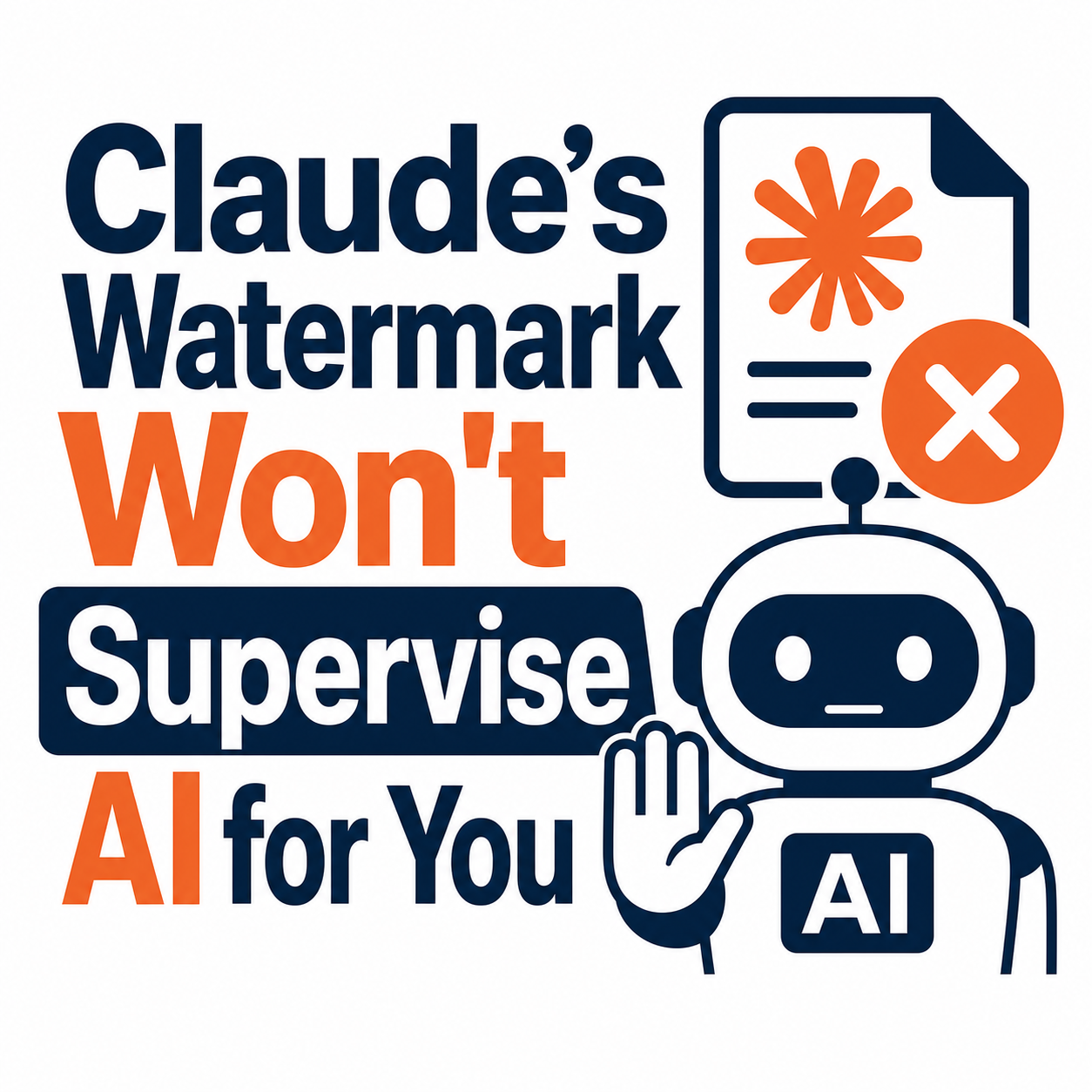
Anthropic has now explained, in unusual technical detail, how it will watermark text generated by Claude: invisible word-choice substitutions that readers never notice but a detection key can find later. A detection API is on the way, and the driver is the EU AI Act's transparency obligations.
Most compliance teams will read this and think: good, now we can detect AI-generated content. That reading is backwards. In Anthropic's own fine print, the watermark is weakest exactly where regulated firms carry the most exposure, the advisor-rewritten client email and the AI-assisted code in production.
Quick Answer
Claude's text watermark is a disclosure mechanism built to satisfy an EU transparency obligation: not a supervision program. It matters most for CCOs and GCs at RIAs, banks, and insurers whose teams use AI in client communications and software development. This article helps you answer the question leadership is about to ask: "can we detect AI content now?", with the more important one: "what's our policy, and where's our evidence?" Vantage Point, a Claude Partner Network Member, helps regulated firms build AI governance that holds up in an exam.
TL;DR
- What it is: The Claude watermark embeds a statistically detectable pattern in AI-generated text using SynthID-Text word-choice substitutions: invisible to readers, detectable with a key.
- Why it matters: Detection is thinnest where your risk is highest: heavily edited text carries almost no watermark, and code carries essentially none.
- Best for: CCOs and GCs at RIAs, banks, and insurers evaluating AI supervision obligations.
- Decision point: Treat the watermark as one disclosure signal; keep investing in policy, vendor diligence, human review, and training records.
- How Vantage Point helps: Our compliance and security solutions team builds AI governance programs designed for examination, not just detection.
What Is Claude's Text Watermark?
Claude's text watermark is a hidden statistical pattern embedded in AI-generated text at the model level, using the SynthID-Text approach Google DeepMind published in 2024. When Claude makes low-stakes word choices, "overcast" versus "grey", it nudges its selections into a pattern undetectable to a reader but detectable by anyone holding the key.
Anthropic confirmed the approach in an August 14, 2026 post, How Claude's text watermark works, with technical detail reported by TechCrunch on August 15. Three facts matter for compliance teams:
- It applies at the model level. The watermark is present no matter which Claude product produced the text, and it travels with the text when copied and pasted. Models released after August 2, 2026 carry it automatically; older models are being added over the coming months.
- A detection API is planned. Anthropic says it will offer a watermark detection API and is working out implementation details. It does not exist yet.
- It is an EU AI Act play. Anthropic and other major model developers signed the EU AI Act's Code of Practice, which requires systems that make it possible to identify AI-generated content. Files are handled separately through the C2PA open standard.
Anthropic also distinguishes watermarking from third-party AI detectors that look for stylistic "tells". Checking for a watermark is a fundamentally different, more reliable test. That reliability is real, and it is exactly why the limitations deserve close attention.
Why the Claude Watermark Matters in 2026
The watermark will shape the AI governance conversation inside every regulated firm this quarter, and it risks shaping it in the wrong direction. Leadership will read that Anthropic is watermarking Claude's output, ask "can we detect AI-generated content now?", and a compliance team under pressure will be tempted to answer yes and point to the watermark as the control.
That answer papers over two problems. First, the EU AI Act transparency obligation sits on the model provider, not on your firm. Anthropic's watermark discharges Anthropic's duty to make AI content identifiable; it does nothing to discharge your duty to supervise how your people use AI with client data. Second, detection strength is inversely correlated with your exposure: the watermark works best on long, lightly edited, AI-drafted prose: rarely what creates regulatory risk.
How Claude's Watermark Works
The mechanics, per Anthropic's disclosure:
- Low-stakes substitutions. Wherever the model faces a choice between roughly equivalent words, it encodes information in which one it picks. Across hundreds of choices, a pattern emerges that a detector with the key can measure.
- No quality impact. Anthropic reports no measurable effect on quality, creativity, or readability, citing internal testing and Google DeepMind's SynthID-Text research.
- Persistence through light editing. Light editing probably will not remove the watermark completely. A complete rewrite, where every word is replaced, will.
- Translations carry it. Because Claude chooses every word in a translation, translated text is fully watermarked.
- Detection via a planned API. Anthropic will offer a detection API; details are still being worked out.
Where Watermark Detection Breaks Down
Anthropic's own documentation is candid about the limits. Three of them map directly onto the highest-risk AI use cases in a regulated firm.
Heavily edited text carries almost no watermark
If Claude only lightly edited or proofread a human's draft, "nearly all the words" were written by the human author and "there's very little (if anything) for the watermark to attach to," in Anthropic's words.
Now consider the actual workflow in an advisory firm. An advisor drafts a client email with Claude's help, then rewrites it in their own voice before sending: exactly what your policy probably requires. That email, the one most likely to reach a client and to surface in a complaint or exam, is where the watermark is weakest.
Code carries essentially none
Code gets less watermark than prose because the model must produce working code and lacks the freedom to choose among equally valid options. Anthropic says the watermark can appear where there is arbitrary choice (comments, for instance) but "by definition, it will have a negligible effect on the actual code produced."
So the AI-assisted code in your production systems (code touching client data, calculations, and workflows) is effectively outside the watermark's reach. If your supervision strategy for developers is "we'll detect it," you do not have a strategy.
The watermark cannot tell "wrote" from "edited"
Even when detection succeeds, Anthropic is explicit about what it proves: Claude was likely involved with the content at some point. It cannot distinguish "Claude wrote this" from "Claude heavily edited this." For a supervision program, that distinction is everything, and the watermark cannot make it.
| Content type | Watermark strength | Typical regulated-firm example |
|---|---|---|
| Long AI-drafted prose, lightly edited | Strong | A first-draft market commentary published nearly as generated |
| Human draft, AI-assisted edit | Weak | The advisor-rewritten client email |
| Complete rewrite of AI draft | None | A paraphrased client letter |
| AI-generated code | Negligible | AI-assisted code in production systems |
| AI translation | Strong | Translated client documents |
A Watermark Is Not a Supervision Program
Step back and the category error comes into focus. A watermark answers "was AI involved in this text?" A supervision program answers different questions: Who may use which AI tools? What data may they touch? Who reviewed the output before it reached a client? Can you prove it to an examiner eighteen months from now?
Detection tools (even good ones, and Anthropic's is genuinely good) are retrospective and probabilistic. Supervision obligations are prospective and evidentiary. Firms betting on detection instead of policy are buying a thermometer and calling it a treatment plan. Anthropic deserves credit for disclosing these limits plainly; the risk is a compliance team reading a vendor's disclosure mechanism as its own control framework.
The Four Controls That Actually Hold Up in an Exam
The controls that survive examination have not changed, and the watermark announcement does not change them now:
- A written acceptable-use policy naming permitted tools. Which AI products are approved, for which tasks, with which data classifications. If your policy does not name the tools, it is not a policy: it is a sentiment. (We have written about what a workable Claude AI acceptable-use policy looks like.)
- Vendor diligence on where client data lands. Where prompts and outputs are stored, whether they train models, retention terms, subprocessors. This is a contracts-and-architecture exercise, not a detection exercise.
- Evidence of human review before anything reaches a client. Not a policy statement that review happens: records that it happened. The watermark cannot supply this, because it cannot distinguish drafting from editing.
- Training records. Who was trained, on what, when. Examiners ask for the roster, not the slide deck.
Notice what these four have in common: each produces evidence you generate and control. A watermark produces evidence a vendor generates, about a question the examiner did not ask.
What Compliance Teams Should Do This Quarter
- Answer the leadership question preemptively. When someone asks "can we detect AI content now?", have the two-part answer ready: detection is improving, and it does not cover edited text or code, so our program rests on policy and review evidence.
- Inventory where AI touches client communications and code. Focus on the two weak zones: advisor-edited drafts and AI-assisted development.
- Refresh the acceptable-use policy to name tools and data classes, including Claude and any other approved models.
- Instrument human review. Make review evidence a byproduct of the workflow for your highest-risk client communications, not an extra step.
- Pilot the detection API honestly when it ships. Test it against your real content mix, including edited drafts and code. It will earn a place in your toolkit; it will not replace the toolkit.
How Vantage Point Helps
Vantage Point is a Claude Partner Network Member and a boutique CRM consulting firm. Senior consultants only, no junior handoffs; the experts you meet are the experts who deliver. We help regulated firms turn AI governance from a policy document into working controls inside Salesforce, HubSpot, and the systems around them: acceptable-use policy design, vendor and data-flow diligence, human-review workflows embedded in the CRM, and training programs with real records.
If your team is working through how AI supervision applies to your CRM stack, our compliance and security solutions and advisory and change management teams can assess where you stand. For firms connecting Claude to CRM data, our AI-driven personalization and analytics practice designs integrations with governance built in.
FAQ
Can editing remove Claude's watermark?
Yes, with enough editing. Anthropic says light editing probably will not remove the watermark completely, but a complete rewrite where every word is replaced will. Text Claude only lightly edited carries very little watermark in the first place, because nearly all the words were chosen by the human author.
Does the Claude watermark work on code?
Essentially no. Because the model must produce working code, it has little freedom to make the arbitrary word choices the watermark depends on. Anthropic says the watermark can appear in code comments but will have a negligible effect on the actual code.
Is there a Claude watermark detection API?
Not yet. Anthropic has announced a detection API is coming and is working out implementation details. Plan to pilot it when it ships, but do not build supervision processes that depend on it today.
Why is Anthropic watermarking Claude's output?
To comply with the EU AI Act's transparency requirements. Anthropic and other major model developers signed the Code of Practice, which requires systems that make it possible to identify AI-generated content. The obligation sits on the model provider. It does not discharge a regulated firm's own supervision duties.
Can a watermark tell whether AI wrote or merely edited a document?
No. Anthropic states that a watermark can only determine that Claude was likely involved with the content at some point. It cannot distinguish "Claude wrote this" from "Claude heavily edited this." That distinction matters enormously for supervision and recordkeeping.
What should a compliance team rely on instead of watermark detection?
The four controls that hold up in an exam: a written acceptable-use policy naming permitted tools, vendor diligence on where client data lands, evidence of human review before anything reaches a client, and training records. As a Claude Partner Network Member, Vantage Point helps regulated firms build these controls into their CRM and AI workflows.
Conclusion
Claude's watermark is a well-engineered answer to a regulator's question: the EU's question, not yours. It will make unedited AI prose identifiable, and the coming detection API will be useful. But the watermark fades exactly where your exposure concentrates: in the advisor-rewritten client email and the AI-assisted code in production. Supervision is solved by policy, diligence, review evidence, and training records, the same four controls as before, now with a better public reason to fund them.
If your firm is sorting out AI supervision across Salesforce, HubSpot, and your AI toolchain, talk to Vantage Point. As a Claude Partner Network Member, we help compliance and technology leaders build governance programs that hold up in an exam: not just in a demo.