
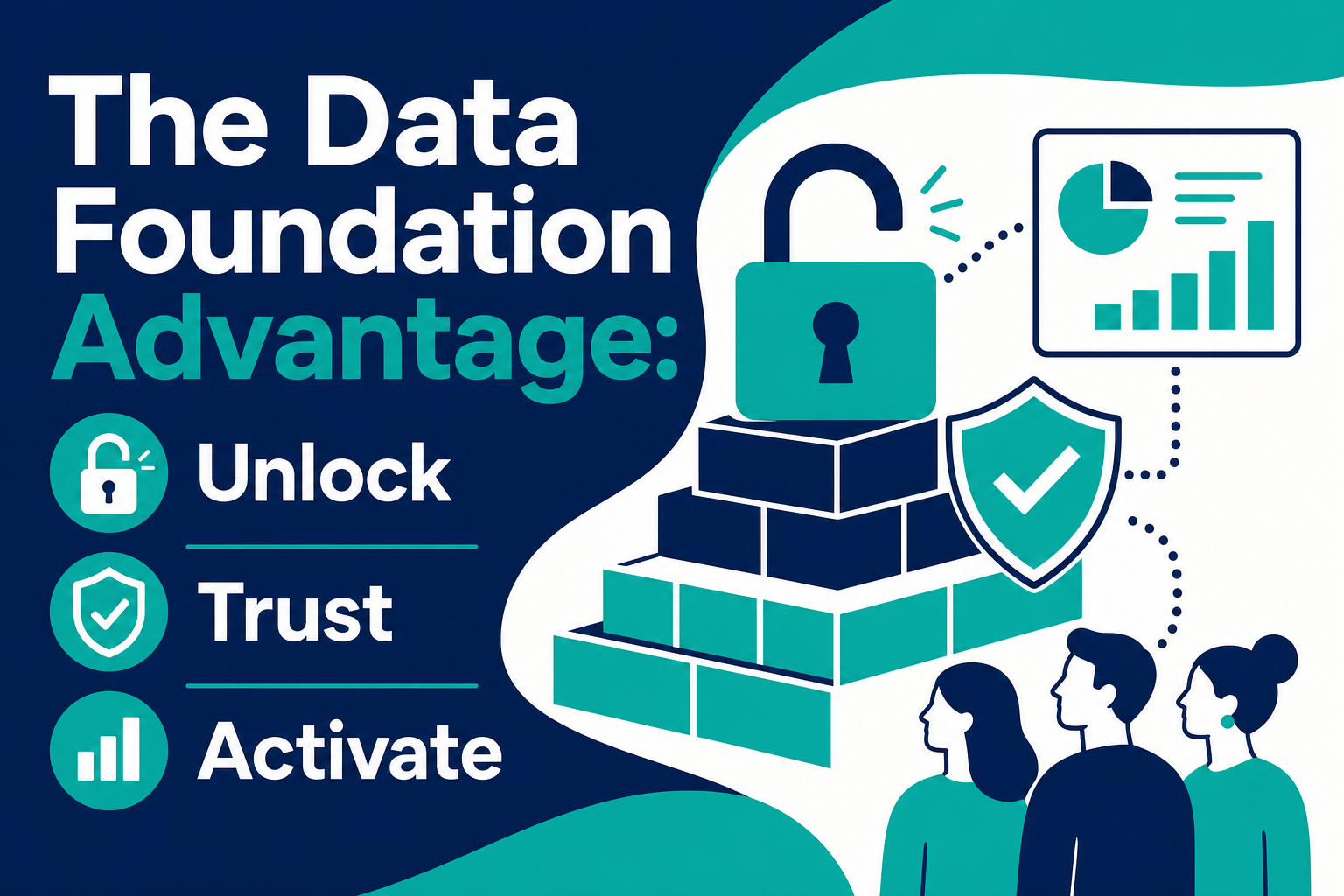
AI agents, dashboards, and automation are only as good as the data underneath them. If that data is scattered across a dozen systems, duplicated, or unverified, no amount of AI sophistication fixes it: the output is still unreliable. Salesforce frames the fix as a three-layer data foundation: Unlock, Trust, and Activate.
This guide walks through what each layer does, where enterprise data actually comes from, who ends up consuming it, and why skipping a layer, especially jumping straight to "Activate", is one of the most common reasons AI and analytics initiatives underperform.
The framework applies whether an organization runs mostly on Salesforce, mostly on SAP, Workday, or Oracle, or some mix of all of them. The products doing the work change; the sequence does not.
Quick Answer
The Data Foundation Advantage is a three-layer way of organizing enterprise data work: Unlock it out of source systems, Trust it through quality and governance controls, then Activate it for the people and systems that need it: AI agents, business users, AI models, applications, and analytics. It matters because AI models, agents, and dashboards inherit whatever data quality exists underneath them; there is no way to prompt around a broken data foundation. Vantage Point implements this stack across industries, typically using MuleSoft for Unlock, Informatica for Trust, and Salesforce (Agentforce, Data 360, Tableau, Flow) for Activate.
TL;DR
- Unlock (Connect, Integrate, Understand) gets data out of silos using integration and cataloging: primarily a MuleSoft and Informatica Data Catalog job.
- Trust (Validate, Protect, Unify) makes data reliable through quality management, governance, consent, and API security: primarily an Informatica and Salesforce privacy-controls job.
- Activate (Decide, Orchestrate, Act) puts trusted data to work through AI agents, analytics, and automation: primarily an Agentforce, Tableau, Flow, and Data 360 job.
- Order matters: you cannot trust data you have not unlocked, and you cannot safely activate data you do not trust.
- Both sides of the foundation are diverse (sources range from third-party providers to legacy archives, and consumers range from autonomous AI agents to quarterly reports) and each needs a different integration pattern and governance posture.
What Is the Data Foundation Advantage?
The Data Foundation Advantage is a way of picturing how raw enterprise data becomes something an AI agent, a report, or a business user can actually rely on. Data flows in from several kinds of sources, passes through three layers of work, and comes out the other side ready for several kinds of consumers.
Sources feeding the foundation:
- Third-party data providers (Dun & Bradstreet, ZoomInfo)
- Hyperscalers and data platforms (AWS, Snowflake, Databricks, Google Cloud)
- The Salesforce stack itself (Sales, Service, Experience, and Marketing clouds)
- The broader application stack (SAP, Workday, Oracle)
- Historical data (legacy systems, retired platforms, prior CRM instances, M&A data)
The three layers the data passes through:
- Unlock: Connect, Integrate, Understand
- Trust: Validate, Protect, Unify
- Activate: Decide, Orchestrate, Act
Consumers on the other side:
- AI agents
- Business users
- AI models
- Application activation (operational apps and workflows)
- Reporting and analytics
The idea behind the model is sometimes shorthanded internally as "garbage in, garbage out," and the phrase is blunt on purpose. An AI agent or model cannot tell a golden record from a duplicate; it just reasons over whatever it is given. If the foundation beneath it is broken, everything built on top of it inherits that break.
A note on the framework: "Unlock, Trust, Activate" is how Salesforce and its implementation partners commonly describe this data foundation sequence in architecture and enablement conversations. It organizes the platform's data capabilities rather than naming a single packaged product. Confirm current product names and packaging with your Salesforce account team, since branding in this space has moved quickly: Data Cloud is now Data 360, and Informatica is now part of Salesforce.
Layer 1: Unlock: Connect, Integrate, Understand
Unlock is the work of getting data out of silos so it can be seen and reasoned about at all. Three things have to happen:
- Connect: Establish secure, governed connections to every system that holds relevant data, from CRM to ERP to third-party enrichment feeds.
- Integrate: Move or federate that data using consistent, reusable patterns instead of one-off point-to-point scripts.
- Understand: Catalog what the data actually means: which fields map to which business concepts, where duplicates exist, and where the gaps are.
Primary tools: MuleSoft Anypoint Platform provides API-led connectivity (System APIs, Process APIs, and Experience APIs) along with pre-built connectors for common enterprise systems, so integration doesn't mean starting from zero every time. Informatica's Data Catalog adds the "Understand" piece: a searchable map of enterprise data assets and a shared business glossary so teams stop arguing about what a field means.
Skipping Unlock is why so many AI pilots stall immediately: an agent or model pointed at only one system never sees the full picture, no matter how capable the underlying model is.
Layer 2: Trust: Validate, Protect, Unify
Unlocking data doesn't make it reliable: it just makes it visible. Trust is where visible data becomes usable data:
- Validate: Profile, cleanse, deduplicate, and score data quality so downstream systems know how much to rely on a given record.
- Protect: Apply consent management, access controls, and privacy rules so sensitive data is used appropriately and legally.
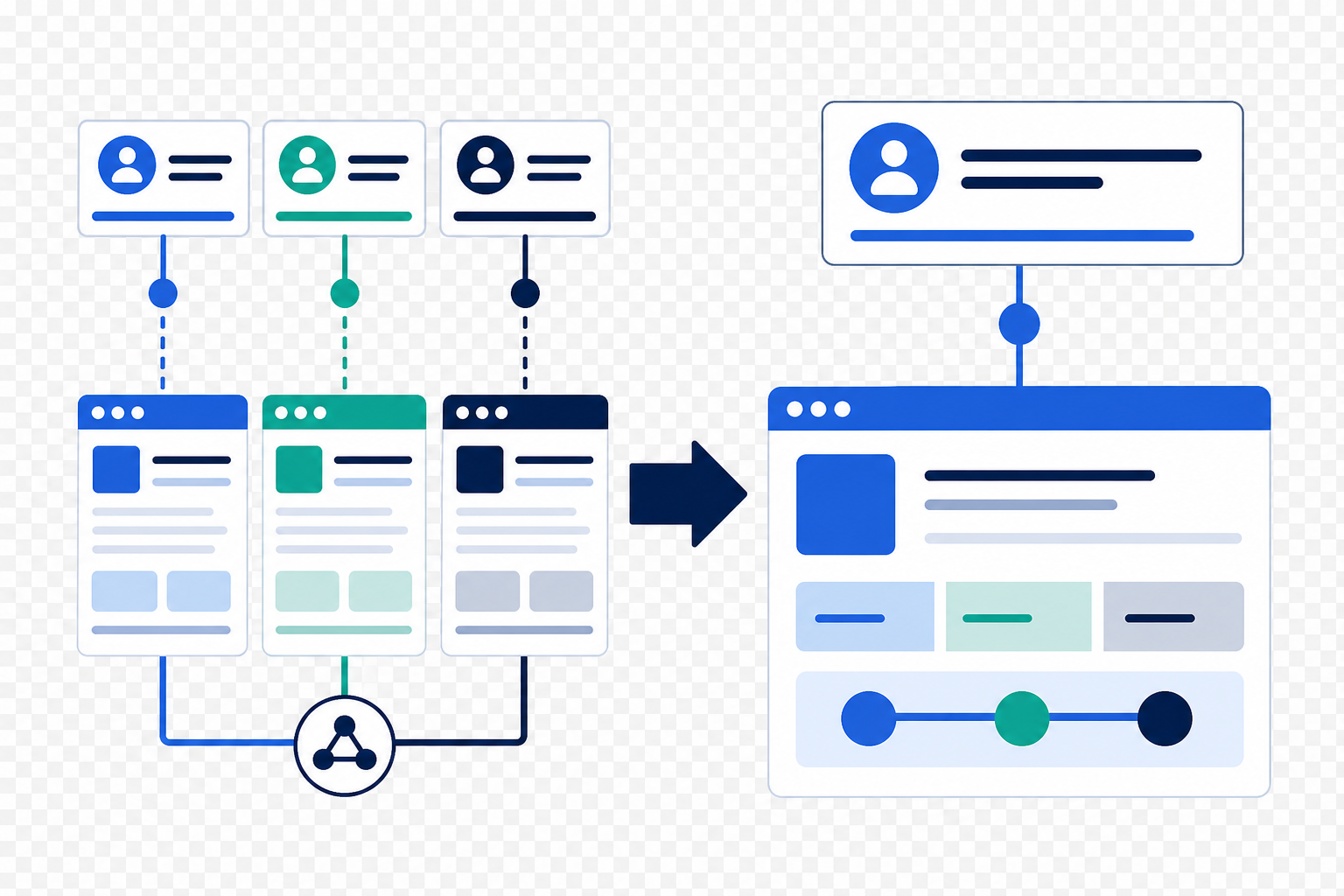
- Unify: Resolve the same customer, account, or product into a single trusted record instead of several conflicting ones.
Primary tools: Informatica, now part of Salesforce, handles master data management, data quality scoring, and governance. The discipline that turns "we have the data" into "we can act on the data." Salesforce's own consent management and privacy controls govern how personal data is used once it's unified. MuleSoft contributes API-level security (OAuth, encryption, and access policies) so the connections built in the Unlock layer stay governed as data moves between systems.
This is the layer most often shortchanged under deadline pressure, and it's the one an AI agent cannot compensate for on its own. A model or agent has no built-in way to know a record is a duplicate or that consent was never captured. It will act on the record anyway unless Trust-layer controls catch the problem first.
Layer 3: Activate: Decide, Orchestrate, Act
Activate is where a trusted data foundation actually pays off: where data stops being stored and starts being used:
- Decide: Surface the right information, insight, or recommendation at the moment a person or system needs to make a call.
- Orchestrate: Sequence multi-step processes across systems so a decision turns into a coordinated set of actions.
- Act: Execute the action itself: update a record, send a communication, escalate a case, or place an order.
Primary tools: Agentforce lets AI agents reason over unified, trusted data and take action autonomously or with a human in the loop; pre-built and partner-built agents and actions are available through AgentExchange. Tableau turns the same trusted data into dashboards and analysis for business users. Salesforce Flow automates multi-step processes without custom code. Data 360: Salesforce's unified data platform, formerly Data Cloud, makes trusted data available to all of the above in close to real time, including zero-copy access to data still sitting in Snowflake, Databricks, or a cloud data warehouse rather than duplicating it.
Activate is also where data reaches operational applications, not just dashboards and agents, order management and commerce workflows such as Revenue Hub, service processes in Service Cloud, and similar systems of action.
Where the Data Actually Comes From
Enterprise data doesn't arrive from one place, and each source type behaves differently:
| Source Type | Examples | Typical Integration Pattern |
|---|---|---|
| Third-party data | Dun & Bradstreet, ZoomInfo | Enrichment APIs or scheduled syncs that append and update CRM records |
| Hyperscalers & data platforms | AWS, Snowflake, Databricks, Google Cloud | Zero-copy federation or ELT pipelines: access data without duplicating it |
| Salesforce stack | Sales, Service, Experience, Marketing clouds | Largely native, already inside the platform once unified via Data 360 |
| App stack | SAP, Workday, Oracle | Pre-built MuleSoft Anypoint connectors using API-led integration patterns |
| Historical data | Retired systems, legacy CRM instances, M&A data, long-term archives | Migration plus cataloging; frequently needs remediation before reuse |
Third-party and hyperscaler sources usually need the lightest integration lift but the heaviest quality scrutiny, since the organization didn't control how that data was originally collected. Historical data is often the opposite problem: well understood internally, but expensive to move because it predates modern APIs.
Who Actually Consumes the Data
The far side of the foundation is just as varied as the source side, and each consumer has different requirements for speed, quality, and oversight:
| Consumer | What It Needs | Latency Need | Governance Need |
|---|---|---|---|
| AI agents (Agentforce) | Unified, current context to reason and act on | Real-time or near-real-time | High: action-taking agents need permission and guardrail checks |
| Business users | Understandable, trustworthy records for decisions | Tolerates some delay | Role-based access, audit trail for regulated decisions |
| AI models | Large volumes of clean, representative data | Batch is fine for training; real-time for grounding | Lineage tracking, bias checks, consent compliance |
| Application activation | Structured records that trigger workflows | Real-time, transactional | Field-level permissions, data integrity rules |
| Reporting & analytics | Consistent, accurate data over time | Batch or near-real-time | Consistent metric definitions, role-based access |
Treating every consumer as if it needed the same latency and governance is a common and costly mistake. An analytics dashboard can tolerate a data refresh lag that an autonomous AI agent updating a customer record cannot.
Why the Order Matters: Garbage In, Garbage Out
The sequence isn't arbitrary. Each layer depends on the one before it:
- You can't Trust data you haven't Unlocked: validation and unification require actually seeing the data first, across every system it lives in.
- You can't safely Activate data you don't Trust: an AI agent or automated workflow will act on bad data exactly as confidently as it acts on good data.
That's the practical meaning of "garbage in, garbage out." A model trained or grounded on duplicated, stale, or unvalidated records doesn't produce cautious answers. It produces confident, wrong ones, and an autonomous agent will act on those wrong answers at machine speed. Skipping Unlock and Trust to get straight to an AI pilot is one of the most common reasons those pilots stall or get walked back after launch.
The practical implication is to sequence data foundation work deliberately:
- Inventory sources and connect them (Unlock).
- Establish quality, governance, and unification rules before scaling access (Trust).
- Only then extend access to agents, models, and automation at scale (Activate).
Organizations that need to move faster can run Unlock and early Trust work in parallel across different data domains, but Activate for a given domain shouldn't outrun Trust for that same domain.
Common Data Foundation Mistakes
Most stalled AI or analytics initiatives trace back to a handful of repeatable mistakes in how the data foundation was built, not to the sophistication of the model or agent sitting on top of it:
- Skipping validation to launch faster. Teams under pressure to show an AI pilot move straight from Unlock to Activate. The agent performs confidently on day one and produces confidently wrong answers by week two, because no one profiled or deduplicated the data it was grounded on.
- Treating integration as a one-time project. Source systems, schemas, and third-party feeds change continuously. An integration built and "finished" in one quarter silently drifts out of sync with reality unless someone owns monitoring and revalidation on an ongoing basis.
- Building Activate without a governance layer. Connecting and cataloging data (Unlock) is not the same as governing who can access it, act on it, or change it. Without a Trust layer, an agent or workflow has no guardrails telling it a record is sensitive, disputed, or off-limits.
- Bolting on consent and privacy controls after launch. Retrofitting Protect-layer controls onto a data foundation that's already feeding live agents is far riskier than building them in from the start, and harder to defend to auditors or regulators after the fact.
- Assuming a product purchase fixes a process problem. Data 360, MuleSoft, or Informatica licenses don't unify data or assign ownership by themselves. Each layer needs a named owner and a standard, not just a tool.
Data Foundation Readiness Checklist
Before scaling AI agents, automation, or analytics on top of a new data domain, work through this practical self-assessment:
- Do you have a current inventory of every system holding relevant data for this use case, including third-party and legacy sources?
- Can you state your duplicate rate and consent coverage for this specific data domain, not the organization as a whole?
- Is there a named owner accountable for data quality and governance decisions in this domain, separate from whoever maintains the integration connections?
- Are integration connections monitored and revalidated on a schedule, rather than only when something visibly breaks?
- Are governance and access rules matched to each consumer type (agents, business users, models, applications, and reporting) rather than one blanket policy?
- Has this specific data domain passed through validation, deduplication, and consent review before any agent or automation touches it?
- If you rely on Snowflake, Databricks, or another hyperscaler platform, do you have a zero-copy or federation plan instead of a one-off data export?
Answering "no" to two or more of these is a signal to pause Activate-layer work for that domain until the Unlock or Trust gap closes.
What Businesses Should Do Next
- Pick one business process, not the whole enterprise. Map its data sources and start Unlock there before trying to connect everything at once.
- Set a data quality baseline before scaling AI access. Know your duplicate rate and consent coverage before an agent starts acting on records.
- Match governance to the consumer. A reporting dashboard and an autonomous agent updating records don't need the same controls: build accordingly.
- Treat hyperscaler and third-party data as sources, not competitors. Zero-copy access means Snowflake, Databricks, and similar platforms can feed the same foundation without a costly migration.
- Revisit the sequence whenever you add a new AI use case. A new agent or model touching a data domain for the first time should trigger a fresh check of that domain's Trust status.
How Vantage Point Helps
Vantage Point is a Salesforce and HubSpot consulting partner that implements the full data foundation stack for clients across industries: not just one layer of it:
- Unlock: MuleSoft integration architecture connecting CRM, ERP, and third-party systems through reusable, governed APIs. Learn more about system integration and data migration.
- Trust: Data quality, governance, and privacy controls that give AI agents and reporting a reliable base to work from. See our compliance and security solutions.
- Activate: Salesforce implementation across Agentforce, Data 360, Tableau, and Flow so trusted data actually reaches the people and systems that need it. Explore our Salesforce implementation and advisory services.
If your team is evaluating how this framework applies to your Salesforce, integration, or AI plans, Vantage Point can help assess where your data foundation stands today and build a practical, sequenced plan to close the gaps.
For a deeper look at how the individual products fit together, see Data 360 vs. Informatica vs. MuleSoft: What Each Does. For more on what breaks when the sequence gets skipped, see Why 80% of AI Projects Fail: The Data Foundation Problem. For a closer look at master data management specifically, see Salesforce Data Foundations & MDM: What It Is and How It Works.
Frequently Asked Questions
What is the "Unlock, Trust, Activate" data foundation model?
It's a three-layer way of sequencing enterprise data work: Unlock connects and catalogs data across source systems, Trust validates and governs it so it's reliable, and Activate puts it to work in AI agents, analytics, and automation. Each layer depends on the one before it.
Is Unlock, Trust, Activate an official Salesforce product name?
No. It describes how Salesforce and its implementation partners commonly organize data foundation work across products like MuleSoft, Informatica, and Data 360: it isn't a single packaged SKU. Confirm current product names with your Salesforce account team if you're scoping a purchase.
Do we have to finish Unlock completely before starting Trust?
Not entirely. Many organizations run Unlock and early Trust work in parallel across different data domains, for example, connecting a system while defining its data quality rules at the same time. The firm rule is narrower: don't Activate a given data domain for AI agents or automation until that domain has passed through Trust.
What's the difference between this framework and Salesforce Data 360?
Data 360 (formerly Data Cloud) is a specific Salesforce product that unifies and activates data in close to real time. It's one of the tools used mainly in the Activate layer, alongside Agentforce, Tableau, and Flow. Unlock, Trust, and Activate is the broader sequence that Data 360 fits into, alongside MuleSoft and Informatica.
Does this framework apply if we run mostly on SAP, Workday, or Oracle instead of Salesforce?
Yes. The sequence (unlock data from source systems, make it trustworthy, then activate it) applies regardless of which systems hold the data. MuleSoft's pre-built connectors for SAP, Workday, and Oracle exist specifically to unlock data from non-Salesforce systems into the same foundation.
Which layer should a resource-constrained team tackle first?
Start with Unlock for the highest-value use case, not the whole enterprise at once. Trying to unlock every system before showing any value is a common way these initiatives stall. Pick one business process, connect and catalog the systems behind it, then move that slice through Trust before activating it.
How does this framework relate to AI agents specifically?
AI agents built on Agentforce are the most demanding consumer in the model because they act autonomously on the data they're given. An agent has no built-in way to know a record is a duplicate or that consent was never captured for it. Trust-layer controls are what catch that before the agent acts on bad data.
If your team is planning AI agents, analytics, or automation on top of Salesforce, SAP, Workday, Oracle, or a mix of systems, Vantage Point can help assess your current data foundation and build a sequenced plan (Unlock, then Trust, then Activate) so your AI and analytics investments produce answers your team can actually rely on.