
Quick Answer
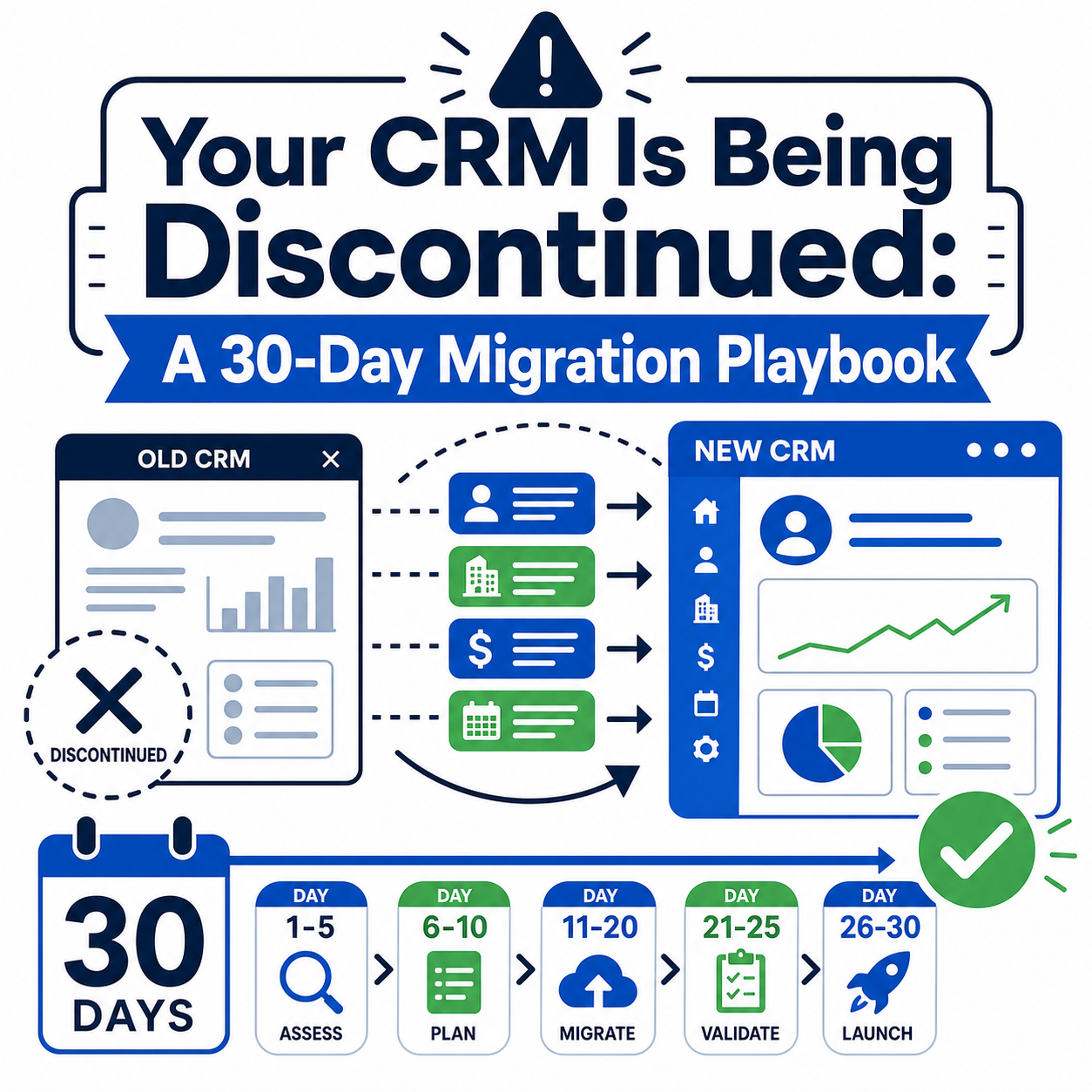
When a CRM vendor announces a discontinuation with weeks of notice, you cannot run a normal migration project — you run a triage operation. The playbook: get the vendor's shutdown terms in writing (export format, final date, whether assistance is conditional on adopting their successor product), negotiate an extension while planning as if none is coming, define a minimum viable go-live that keeps revenue work moving, migrate recent active data first and archive history for later, and rehearse cutover with a manual fallback. A full-featured rebuild in 30 days is rarely realistic; a working sales-and-service core in 30 days usually is. Vantage Point's migration team runs exactly this kind of accelerated cutover.
TL;DR
- Week 1 is triage: written vendor commitments, a data inventory, and an extension request — in parallel, not sequence.
- Scope an MVP go-live around the processes that make or capture money; defer everything else.
- Migrate the most recent, active records first. Historical data can follow later or live in an archive.
- Decide between the vendor's successor product, your already-planned CRM, or an interim tool using explicit criteria — not panic.
- A partial parallel run plus a documented manual fallback beats a heroic big-bang cutover every time.
Why Vendor Sunsets Are Different From Normal Migrations
A planned CRM migration is a project with phases, buffers, and the luxury of saying "not yet." A vendor discontinuation removes the buffer: there's a hard date, your data's availability depends on another company's timeline, and the decision space shrinks to bad options you must rank quickly. Teams that treat a sunset like a normal project — kickoff decks, month-long discovery, full-scope builds — discover the deadline doesn't negotiate.
The good news: the forced deadline clarifies scope. You are not rebuilding everything; you are preserving the ability to sell, serve, and bill. That framing is what makes 30 days survivable.
What Should Week One Look Like?
Triage week has five parallel workstreams. Assign an owner to each on day one.
1. Lock down the vendor's terms in writing
Get answers in writing: the final access date, the export formats available (full database dump vs. per-object CSVs), whether attachments and activity history export cleanly, and — critically — whether migration assistance is conditional on adopting the vendor's successor product. Some vendors offer hands-on help only to customers who move to their new platform. Know which situation you're in before you plan around help that may not exist.
2. Request an extension — and plan as if the answer is no
Vendors routinely grant short extensions to customers who ask early and concretely. Ask. But never let the project plan assume it. The extension is upside, not a dependency.
3. Inventory data, integrations, and customizations
List every object and rough record counts, every integration (forms, telephony, contracts, billing, marketing), every workflow that creates or updates records, and every report leadership actually opens. This inventory — not the vendor's feature list — defines what "keeping the business running" means.
4. Freeze changes in the old system
No new custom fields, workflows, or integrations in the dying CRM. Every change is wasted effort and migration risk. Announce the freeze the same week.
5. Decide the destination
You generally have three paths, and the choice has to be made in days, not weeks:
| Path | When it's right | Main risk |
|---|---|---|
| Adopt the vendor's successor product | Your processes are close to vanilla, the vendor offers assisted migration, and you have no other platform strategy | Lock-in deepens; you rebuild customizations anyway, and you're migrating again later if the fit is wrong |
| Accelerate to your strategic CRM (e.g., a Salesforce or HubSpot deployment already planned) | A target platform decision was already made or nearly made, and implementation help is available now | Compressing a roadmap into 30 days forces MVP discipline some teams can't hold |
| Interim tools + planned migration | No target decision exists and 30 days is genuinely too short for a platform choice | Two migrations instead of one; interim tooling becomes permanent if nobody owns the follow-up project |
How Do You Scope a Minimum Viable Go-Live?
The MVP question is not "what can we build in 30 days?" — it's "what must be true on day 31 for revenue work to continue?" Work backwards from that. For most sales-driven organizations the core is: accounts and contacts, open pipeline, the activity stream for active deals, the top integrations that create records (lead intake, contract generation, anything customer-facing), and the handful of reports that run the Monday meeting.
Everything else is Phase 2 by definition: historical activity archives, marketing automation depth, niche integrations, and convenience automations. Write the Phase 2 list down publicly — it prevents scope creep during the crunch and gives stakeholders confidence their item is queued, not lost.
How Should You Prioritize Data Migration?
Not all data deserves the same urgency. A defensible priority order:
- Tier 1 — Active work: open opportunities, active customers, in-flight cases, current-year activities. This data must work on day one.
- Tier 2 — Recent history: the last 6–12 months of closed records and activities, which teams reference constantly. CSV loads are usually sufficient.
- Tier 3 — Deep archive: older history with compliance or occasional-reference value. Export it, store it cheaply (a warehouse, flat files, a read-only database), and load it into the new CRM only if a real requirement appears.
Two rules protect you: export everything the vendor allows on day one of access (storage is cheap; access is temporary), and never let "we'll clean it during migration" into the plan. Emergency migrations move data as-is and dedupe after go-live.
What Does a Realistic Cutover Look Like?
A full parallel run — both systems live for weeks — is the textbook answer and usually unaffordable inside 30 days. The pragmatic version:
- Rehearse the load, not just the build. Do at least one full dry-run data load into a sandbox and time it. Load windows always run longer than estimates.
- Cut over integrations selectively. Point the integrations that create new records at the new system first; let read-only syncs lag.
- Plan the overlap in days, not weeks. A one-week overlap where new work starts in the new CRM while the old one stays read-only is often achievable and catches most surprises.
- Document the manual fallback. If an integration isn't ready, who does what by hand, daily, until it is? A written manual procedure is the difference between an awkward week and a business stoppage.
- Train on the MVP only. Ninety minutes on the screens people will actually use beats a day-long tour of a half-built system.
What Should Businesses Do Next?
If you've received a sunset notice, start the five week-one workstreams today — the inventory and the vendor's written terms gate everything else. If you haven't received one, check your exposure anyway: know your current CRM's export path, confirm your contract's data-access terms, and keep a sandbox-worthy data dictionary so a forced migration would start from knowledge, not archaeology. And if the deadline is closer than your confidence, bring in a team that has run compressed cutovers before.
How Vantage Point Helps
Vantage Point delivers accelerated Salesforce and HubSpot implementations and data migrations, including deadline-driven cutovers when a vendor sunset forces the timeline. Senior consultants only — no junior handoffs; the experts you meet are the experts who deliver. We've seen the failure modes (integration credentials that arrive late, exports that drop attachments, training nobody attended), and we plan around them from day one.
Facing a CRM Deadline?
If your CRM is being discontinued — or you want an honest assessment of how ready you'd be — Vantage Point can scope a realistic plan fast. Start a conversation with our team.
Frequently Asked Questions
What should you do first when a CRM vendor announces a discontinuation?
Get the shutdown terms in writing — the final access date, available export formats, and whether migration help is conditional on adopting the vendor's successor product. Simultaneously request an extension, but build the plan assuming the original date stands.
Is a 30-day CRM migration realistic?
A full-featured rebuild in 30 days is rarely realistic, but a minimum viable go-live covering accounts, contacts, open pipeline, and revenue-critical integrations usually is. The key is ruthless MVP scope and deferring historical data and secondary integrations to a second phase.
Should you move to the vendor's replacement CRM or a different platform?
Move to the successor if your processes are near-standard and assisted migration is offered; accelerate to your strategic platform if a target decision was already in motion; use interim tools only when neither is possible. Decide with explicit criteria in days, not weeks.
How do you prioritize which CRM data to migrate first?
Migrate active work first (open pipeline, active customers, in-flight service), then recent history (6–12 months), and archive everything older in cheap storage rather than loading it. Export everything the vendor allows immediately, since access is temporary.
What is a parallel run in CRM migration?
A parallel run keeps old and new systems live simultaneously so work can continue if the new system stumbles. In a 30-day emergency, a shortened overlap — new work in the new CRM, old system read-only for about a week — delivers most of the safety at a fraction of the cost.
How do you handle integrations during an emergency CRM migration?
Cut over record-creating integrations (lead intake, contracts, customer-facing forms) first, let read-only syncs lag, and document a manual daily fallback for anything not ready at go-live. Confirm API credentials for every integration in week one — late credentials are the most common deadline killer.