
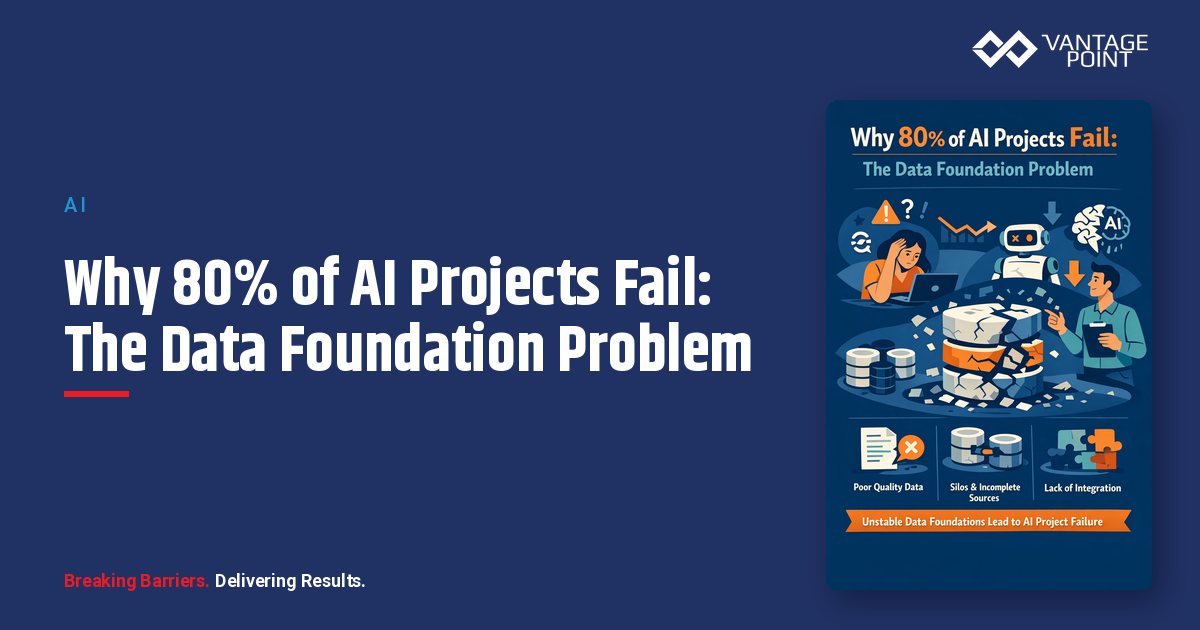
Most AI projects don't fail because the model is weak. They fail because the data underneath it is fragmented, duplicated, or stale. AI agents reason against the data they can see, and when that data is unreliable, the agent's answers are too.
If your team is planning AI agents, copilots, or automation in 2026, the first work isn't the AI. It's the data foundation beneath it.
Quick Answer
AI projects fail at high rates primarily because of poor data quality and fragmented systems, not flawed algorithms. Widely cited industry research has found that roughly 80% of enterprise AI initiatives fail to deliver expected value, with data fragmentation and quality issues among the most-cited causes. The fix is to build a trusted, unified data foundation (integration, data quality, and unified profiles) before deploying AI agents into production.
TL;DR
- What it is: A data foundation is the integrated, clean, governed data layer AI agents depend on to produce reliable answers.
- Why it matters: An estimated 80% of enterprise AI projects fail, and poor or fragmented data is consistently cited as a leading cause.
- The pattern: AI proof-of-concepts almost always surface a data problem first, duplicate records, no golden record, batch-feed lag, and missing governance.
- The fix: Sequence the work as integration → data quality and master data → unified profiles, then activate AI on top.
- Vantage Point relevance: We help organizations assess data readiness and build the integration, migration, and governance foundation that makes AI reliable.
What Is a Data Foundation for AI?
A data foundation is the connected, clean, and governed data environment that AI tools rely on to generate trustworthy output. It has three layers: real-time integration between systems, data quality and master data management that creates a single trusted record, and unified customer profiles that give AI accurate, complete context.
When any layer is missing, AI agents inherit the gaps. An agent asked about a customer will return inconsistent answers if that customer exists as three duplicate records across two systems with a 24-hour sync lag.
Why the Data Foundation Matters in 2026
AI moved from experimentation to deployment in 2026. Agents now read and write to CRM data, answer customer questions, and trigger workflows. That raises the stakes on data quality from "nice to have" to "production blocker."
The market signals are clear. Salesforce's roughly $8 billion investment in Informatica, its largest platform bet of the cycle, is fundamentally a data-quality, master-data, and governance play. As Marc Benioff put it: "You have to get your data right to get your AI right."
The practical reality is that there is often more data-foundation work to do than AI work. Most teams have to get data in order before agents function reliably at all.
How AI Data Problems Show Up
The same data issues appear across industries and platforms. They rarely announce themselves until an AI pilot exposes them.
- Duplicate and inconsistent records. The same customer exists multiple times, so agents and reports disagree.
- No golden record. There's no single trusted version of a customer, account, or household, so systems contradict each other.
- Batch-feed lag. Nightly integrations create hours of staleness that is structurally incompatible with real-time agents.
- Fragmented, point-to-point integration. Systems are wired together one-off rather than through a strategic data layer, so changes break downstream.
- No data lineage or governance. No one can trace where data came from, which creates risk and slow, manual audit prep.
How to Build the Foundation: A Three-Layer Approach
Treat the foundation as three sequenced layers. Lead with whichever pain is loudest, but the dependency order generally holds.
| Layer | What it solves | Typical first step |
|---|---|---|
| Integration & APIs | Fragmented systems, broken point-to-point connections, batch lag | Map the integration architecture; connect one priority system in real time |
| Data quality, MDM & governance | Duplicate records, no golden record, weak lineage and audit readiness | Score data health; deduplicate and unify one entity type |
| Unified profiles & AI activation | Siloed data, agents lacking trusted context, identity gaps | Assess readiness; build one unified profile for a single segment |
The goal isn't a multi-year data overhaul before any AI value appears. It's a prioritized path: fix the highest-impact data problem first, prove value on a small scope, then expand.
What Businesses Should Do Next
You don't need to boil the ocean. You need an honest read on readiness and a sequenced plan.
- Run a data-readiness assessment before committing to an AI deployment date.
- Quantify the gaps: duplication rates, sync latency, governance coverage, so the business case is concrete.
- Pick one high-impact use case and prove the data foundation on a small, low-risk scope (sandbox data works well).
- Sequence a phased roadmap so foundation work and AI activation can eventually run in parallel.
If your team is evaluating how this applies to Salesforce, HubSpot, integrations, or CRM governance, Vantage Point can help assess data readiness and build a practical implementation plan.
How Vantage Point Helps
Vantage Point helps organizations evaluate, implement, and optimize their CRM and data platforms based on their operating model, data needs, adoption goals, and growth strategy. For AI specifically, that means getting the foundation right first.
- System integration and data migration to replace fragile point-to-point connections and clean up duplicate data.
- AI-driven personalization and analytics to activate unified profiles for reliable AI output.
- Compliance and security solutions to add the governance and lineage that production AI requires.
We're a senior-only team with a vendor-agnostic, platform-spanning approach across Salesforce and HubSpot.
FAQ
Why do most AI projects fail?
Most AI projects fail because of data problems, not model problems. Fragmented systems, duplicate records, stale data, and missing governance cause AI agents to produce inconsistent or unreliable answers. Widely cited research puts enterprise AI failure rates around 80%, with data quality among the leading causes.
What is a data foundation for AI?
A data foundation is the integrated, clean, and governed data layer that AI tools rely on for accurate output. It combines real-time system integration, data quality and master data management, and unified customer profiles. Without it, AI agents inherit whatever gaps exist in the underlying data.
Do I need perfect data before deploying AI?
No. You need a prioritized foundation, not perfection. The practical approach is to fix the highest-impact data problem first, prove value on a narrow use case, then expand in phases so foundation work and AI activation can run in parallel.
What is a golden record and why does it matter for AI?
A golden record is the single trusted version of a customer, account, or entity, consolidated from all systems. It matters because AI agents need one consistent source of truth; without it, the same query can return different answers depending on which duplicate the agent reads.
How does Salesforce's Informatica acquisition relate to AI data foundations?
Salesforce's roughly $8 billion Informatica investment strengthens the platform's data quality, master data management, and governance capabilities. Combined with MuleSoft integration and Data 360 unified profiles, it signals that trusted data is now treated as the core prerequisite for production AI.
How long does it take to get data AI-ready?
It depends on the number of systems, data quality, and integration complexity, but the work is best phased rather than treated as one large project. A focused proof of concept on a single entity or segment can deliver tangible value in weeks, with broader foundation work sequenced behind it.
How can Vantage Point help with AI data readiness?
Vantage Point assesses your data readiness and builds the integration, data-quality, and governance foundation AI depends on. We work across Salesforce and HubSpot with a vendor-agnostic approach, focusing on a prioritized roadmap rather than a multi-year overhaul before any value appears.