
If you are evaluating how to get your CRM data "AI-ready," you have probably run into two phrases that sound similar but mean different things: Salesforce Data Foundations and Master Data Management (MDM). Both are about trust. Both decide whether your reporting, automation, and AI agents can be relied on. Neither requires perfect data to start, but both require governance.
This guide explains, in plain language for business and data leaders, what Salesforce Data Foundations and MDM actually are, how MDM works step by step, how it relates to Data 360 (formerly Data Cloud), and how to decide whether you need dedicated MDM, a unified data platform, or just native deduplication.
One quick disambiguation up front, because the names cause real confusion: the Data Foundations discipline described here is the foundational data layer beneath your CRM and AI. It is not the same thing as the separate no-cost Salesforce Foundations starter package. We clarify that difference below.
Quick Answer
Salesforce Data Foundations is the foundational data layer that makes CRM and AI trustworthy. It spans data integration (MuleSoft), data management and governance (Informatica), and the unified data platform Data 360. Master Data Management (MDM) is the discipline within that layer that creates one trusted, governed version of your key business records (customers, accounts, products) so everyone works from the same source of truth.
This matters most for organizations whose reporting, automation, or AI agents are only as good as the underlying data, which is every organization adopting Agentforce or any agentic workflow. It helps you decide how to consolidate, govern, and distribute trusted records before you scale AI. Vantage Point is a senior-led, mid-market Salesforce, MuleSoft, and Informatica partner that helps teams build this foundation pragmatically: governance first, not perfection first.
TL;DR
- What it is: Salesforce Data Foundations is the integration + governance + unified-data layer beneath CRM and AI; MDM is the practice of maintaining a single trusted "golden record" for key data.
- Why it matters: Agents and automations that take action need governed data: bad master data quietly breaks reporting, personalization, and AI decisions.
- Best for: Mid-market business and data leaders preparing CRM data for Agentforce, consolidation, or trustworthy analytics.
- Decision point: Whether you need dedicated MDM, the Data 360 unified platform, native CRM deduplication, or a combination.
- How Vantage Point helps: We assess data readiness and build the foundation through our system integration and data migration services and Salesforce implementation and advisory.
What Is Salesforce Data Foundations?
Salesforce Data Foundations is the foundational data layer that sits beneath your CRM and AI. It is best understood as a portfolio of capabilities rather than a single product, spanning three areas:
- Integration and API management (MuleSoft): moving and connecting data across the systems where it actually lives.
- Data management and governance (Informatica): cleaning, matching, governing, and stewarding data so it stays trustworthy.
- Unified data platform (Data 360, formerly Data Cloud): bringing customer data together for real-time insight and activation.
Salesforce defines data management broadly as "the process of collecting, processing, storing, and using data to support your organization's decisions." Data Foundations is the operational expression of that idea for the Salesforce platform: the layer that makes everything above it (dashboards, flows, and AI agents) trustworthy.
Data Foundations vs. Salesforce Foundations: an important disambiguation
These two terms are easy to confuse:
- Data Foundations (the subject of this article) is the data-platform discipline and portfolio: integration, governance, and unified data: that underpins AI and analytics.
- Salesforce Foundations is a separate, no-cost starter package that adds a set of entry-level capabilities to qualifying Salesforce editions.
They are not the same thing. If someone tells you to "turn on Salesforce Foundations," that is about a starter feature bundle. Building your "data foundations" is about integration, master data, and governance. This article is about the latter.
What Is Master Data Management (MDM)?
Master data management is the practice of creating one trusted, governed version of your most important business data. In Salesforce's words: "Master data management (MDM) creates a single, trusted version of key data. This ensures that everyone in the organization works from the same" data.
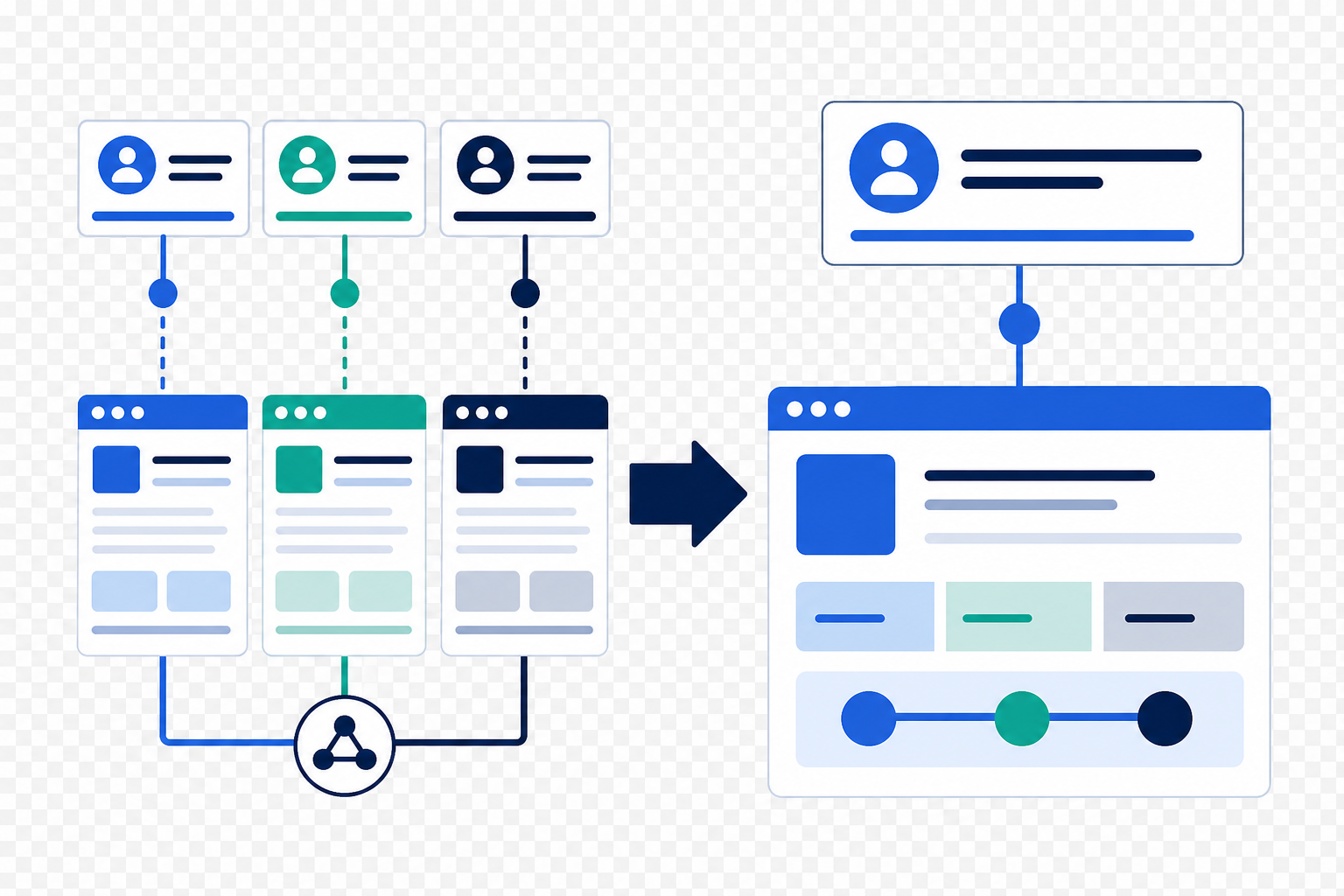
That "single, trusted version" is often called a golden record: the authoritative version of a customer, account, household, product, or location, assembled from every system that holds a piece of the truth. MDM is the combination of process, governance, and technology that produces and maintains golden records over time.
Common platform types that hold master data, per Salesforce, include CRM systems, marketing automation, data warehouses, data lakes and lakehouses, and analytics tools. MDM is what keeps the key records consistent across all of them.
Why Data Foundations and MDM Matter in 2026
The short version: AI raises the cost of bad data. When a human reads a duplicate or stale record, they often catch the error. When an autonomous agent reads it, it can act on it, sending the wrong message, miscalculating a forecast, or routing a case incorrectly.
A few reasons this is front-of-mind now:
- Agents take action. Agentforce and similar agentic workflows execute steps, not just suggest them. Governed master data is what makes those actions safe.
- Consolidation is constant. Mergers, acquisitions, and system migrations create overlapping records that need to be matched and merged into golden records.
- Reporting and forecasting depend on it. Duplicate accounts and conflicting fields distort pipeline, revenue, and customer counts.
- Compliance needs a source of truth. Governance, consent, and data-subject requests are far easier when key records are unified and stewarded.
A practical principle worth repeating: you do not need perfect data to start. You do need governance (clear ownership, matching rules, and stewardship) especially for agents that take action.
How MDM Works
MDM follows a repeatable lifecycle. Here is the flow in plain language:
- Integrate data from multiple systems. Pull records from CRM, marketing, ERP, support, and other sources into one place to compare. This is where integration tooling such as MuleSoft does the heavy lifting.
- Match and de-duplicate. Use rules and matching logic to identify records that represent the same real-world entity, even when names, addresses, or IDs differ slightly.
- Apply survivorship. When matched records conflict, survivorship rules decide which value wins (for example, the most recent verified email or the most complete address) to build the golden record.
- Govern and steward. Assign data owners, define standards, and give data stewards a way to review exceptions, approve merges, and resolve conflicts that automation cannot.
- Distribute the golden record. Push the trusted record back out to operational systems so every team and every agent works from the same source of truth.
How Data 360 relates to, but differs from, MDM
This is the question that trips up most teams. Both Data 360 and MDM "unify" data, so they sound interchangeable. They are not.
- Data 360 (formerly Data Cloud) unifies all customer data for real-time insight, personalization, and activation. It harmonizes data and performs identity resolution to build a connected, real-time customer profile you can act on immediately.
- MDM enforces enterprise-wide governance and consistency of master records. It is the system-of-record discipline that decides what the authoritative golden record is and keeps it consistent everywhere.
As a general industry distinction: Data Cloud / Data 360 handles real-time customer insights and activation, while MDM ensures enterprise-wide data governance and consistency of master records. The two are complementary and frequently work together: for example, Data 360 for real-time unification and activation, paired with Informatica MDM for governed, authoritative master records. For how these pieces fit alongside MuleSoft, see our deeper breakdown in Data 360 vs. Informatica vs. MuleSoft: the Salesforce data stack.
MDM vs. Data 360 vs. Native Deduplication: How to Choose
Most teams do not need to choose one forever. They need to know which tool solves the problem in front of them. Use this comparison as a starting point.
| Capability | Native CRM deduplication | Data 360 (unified platform) | Dedicated MDM (e.g., Informatica) |
|---|---|---|---|
| Primary purpose | Catch and merge duplicates inside one CRM | Unify and activate data in real time across sources | Govern one authoritative golden record enterprise-wide |
| Scope | Single Salesforce org | Many sources, real-time profile | Many systems, system-of-record governance |
| Governance depth | Basic matching rules | Identity resolution and harmonization | Full stewardship, survivorship, audit |
| Real-time activation | Limited | Strong | Varies (often batch/governed) |
| Best when | Duplicates are contained in one CRM | You need real-time insight and personalization | You need consistent master records across the business |
How do you know which one you need?
- Choose native deduplication if your data problem is mostly duplicate leads, contacts, or accounts inside a single Salesforce org and you do not need cross-system governance yet.
- Choose Data 360 if your goal is a real-time, unified customer profile for insight, personalization, segmentation, or feeding Agentforce, and your sources are connected but not necessarily governed as a system of record.
- Choose dedicated MDM if you need enterprise-wide consistency of master records across many systems, formal stewardship, survivorship rules, and an auditable source of truth, common after M&A or when multiple business units share customers.
- Choose a combination if you need both real-time activation and governed master records. Data 360 and MDM working together is a common, durable pattern.
If you are not sure where you fall, a short data-readiness assessment usually clarifies it faster than another internal debate. Vantage Point can help you evaluate the right next step across Salesforce, integration, and data governance without over-engineering the solution.
Common MDM Use Cases
- Single customer view / golden record: one trusted profile per customer or account across every system.
- De-duplication and data hygiene: fewer duplicate accounts, contacts, and households cluttering reports and automations.
- Compliance and governance: a defensible source of truth for consent, privacy, and data-subject requests.
- M&A and org consolidation: matching and merging overlapping records when companies or systems combine.
- Trustworthy AI and Agentforce: governed data so agents that take action do so on reliable records. (Related reading: why 80% of AI projects fail on the data foundation and why AI agents are only as smart as your master data.)
- Personalization: accurate, complete profiles that make segmentation and tailored experiences work.
- Accurate reporting and forecasting: clean master data so pipeline, revenue, and customer counts add up.
What Businesses Should Do Next
You do not have to solve everything at once. A practical sequence:
- Define your most critical master data domains: usually customers, accounts, and products, and where the authoritative version should live.
- Inventory your sources and identify where duplicates and conflicts originate.
- Establish governance first: assign data owners, agree on matching and survivorship rules, and stand up stewardship before scaling AI.
- Match capability to need using the decision criteria above: native dedupe, Data 360, dedicated MDM, or a combination.
- Start with a contained, high-value domain, prove the golden-record pattern, then expand. Remember: governed-enough beats perfect-but-stalled.
How Vantage Point Helps
Vantage Point is an employee-owned consultancy of senior-only consultants focused on mid-market organizations. We are partners across Salesforce, MuleSoft, Informatica, and Anthropic (a Registered Anthropic Certified Partner), so we can build the full Data Foundations layer rather than a single piece of it.
Our VALUE Methodology emphasizes a pragmatic, governance-first approach: get the data trustworthy enough to support real decisions and safe AI, then scale: without boiling the ocean. We help teams design master data domains, choose between MDM, Data 360, and native deduplication, and implement the integration and governance that makes the rest work.
If your team is evaluating how this applies to Salesforce, integrations, data governance, or AI readiness, we can help assess the right next step and build a practical plan. Start with our system integration and data migration services or our Salesforce implementation and advisory practice, and explore how a data-readiness foundation supports trustworthy AI and analytics.
For the underlying product references cited here, see Salesforce's overviews of data management and the Data 360 platform.
FAQ
What is the difference between Salesforce Data Foundations and Salesforce Foundations?
Data Foundations is the data-platform discipline and portfolio (integration, governance, and a unified data platform (MuleSoft, Informatica, Data 360)) that makes CRM and AI trustworthy. Salesforce Foundations is a separate, no-cost starter package that adds entry-level capabilities to qualifying Salesforce editions. They share a similar name but solve different problems.
What is master data management (MDM)?
Per Salesforce, "Master data management (MDM) creates a single, trusted version of key data. This ensures that everyone in the organization works from the same" data. In practice, MDM is the process, governance, and technology that build and maintain a "golden record" for key entities such as customers, accounts, and products across every system that holds them.
What is a golden record?
A golden record is the single authoritative version of a key business entity (for example, one trusted profile for a customer or account) assembled from all the systems that hold a piece of the truth. MDM creates it using matching to find duplicates and survivorship rules to resolve conflicting values.
Is Data 360 the same as MDM?
No. Data 360 (formerly Data Cloud) unifies customer data for real-time insight, personalization, and activation, while MDM enforces enterprise-wide governance and consistency of master records. They are complementary and often work together, for example, Data 360 for real-time unification and Informatica MDM for governed, authoritative master records.
Do I need MDM, or is native Salesforce deduplication enough?
If duplicates are contained inside a single Salesforce org and you do not yet need cross-system governance, native deduplication may be enough. If you need a consistent, governed source of truth across many systems (common after mergers or when business units share customers) dedicated MDM is the better fit. A short readiness assessment usually makes the answer clear.
Does my data need to be perfect before I adopt AI or Agentforce?
No. You do not need perfect data to start, but you do need governance (clear ownership, matching rules, and stewardship) especially for agents that take action on records. The goal is data that is trustworthy enough to support reliable decisions, then continuous improvement.
How does MDM support trustworthy AI?
Agentic AI executes actions rather than just suggesting them, so it needs reliable data underneath it. MDM provides governed golden records, which reduces the risk of agents acting on duplicate, stale, or conflicting information. This is why a strong data foundation is a prerequisite for scaling AI safely.
How can Vantage Point help with Data Foundations and MDM?
Vantage Point is a senior-led, mid-market partner across Salesforce, MuleSoft, Informatica, and Anthropic. We assess data readiness, design master data domains, help you choose between MDM, Data 360, and native deduplication, and implement the integration and governance to make it work, using a pragmatic, governance-first VALUE Methodology rather than chasing perfect data.