
Quick Answer
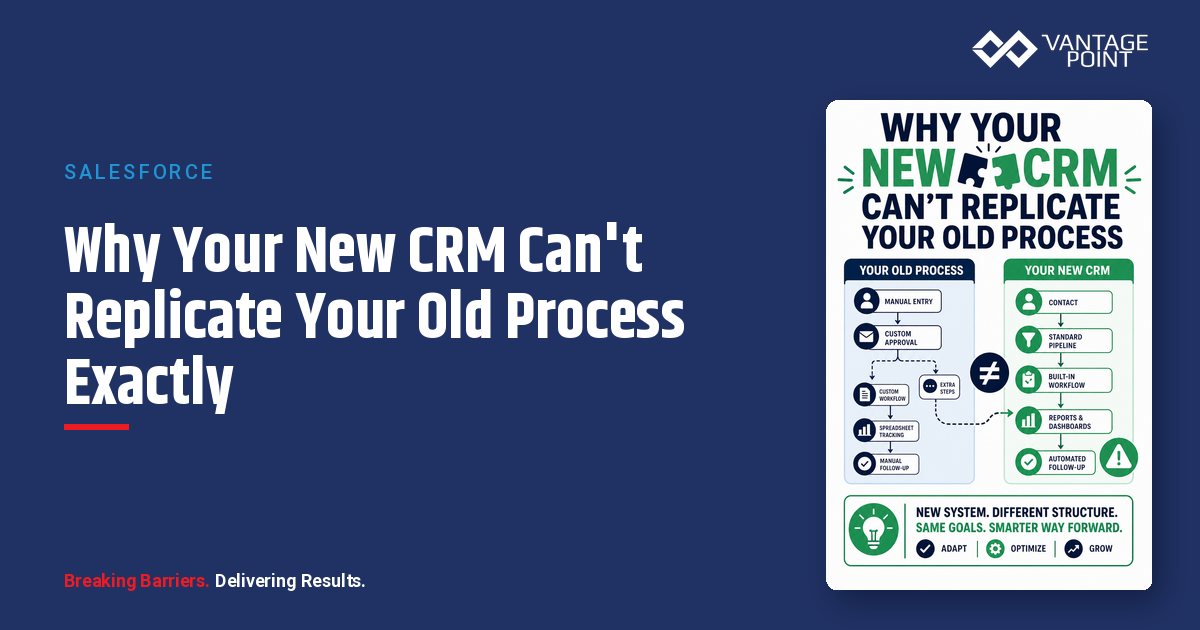
No CRM — Salesforce, HubSpot, or anything else — can replicate your existing processes exactly, and implementations that try usually fail. Every platform has its own data model, automation conventions, and opinionated workflows; forcing your old system's steps onto a new one recreates the old system's limitations at a new price. What a new CRM can do is deliver the same outcomes — often faster and with less manual work — if you're willing to adapt the process to the platform. This matters for any team mid-implementation who's been told "we just need it to work like our current system." Vantage Point's implementation approach starts from outcomes, not screen-by-screen replication.
Key Takeaways (TL;DR)
- The reality: Exact process replication is technically impossible across platforms — data models and automation engines differ.
- The trap: Teams that demand 1:1 replication rebuild the old system's workarounds inside the new one.
- The better question: Not "can it do exactly what we do?" but "can it produce the outcome we need?"
- The method: Keep outcomes, redesign steps. Audit each process for what it's actually for before rebuilding it.
- How Vantage Point helps: Process-to-platform mapping that preserves outcomes while dropping legacy baggage.
What "Make It Work Like Our Old System" Really Means
When a team asks for exact replication, they're rarely asking for the process itself. They're asking for the familiarity — the screen layout people memorized, the five-step approval everyone finally learned, the report that lands in the same inbox every Monday. Underneath the request is a legitimate fear: that the new system will lose something the business depends on.
That fear deserves respect. The request itself deserves pushback.
Every CRM is opinionated. Salesforce organizes the world around leads, accounts, contacts, and opportunities. HubSpot organizes it around contacts, companies, deals, and tickets. Your legacy tool had its own model — and half of your "process" is probably workarounds for that model's limitations: the spreadsheet that exists because reporting didn't, the duplicate data entry that exists because two systems didn't sync, the approval email chain that exists because the tool had no workflow engine.
Replicating that exactly means paying new-platform prices for old-platform constraints.
Why Exact Replication Fails
The data models don't match. Your old system's "matter" or "project" or "case" object has no perfect equivalent. Map it to the new platform's standard objects and some fields have no home; build a custom object to hold everything and you've bought a maintenance burden that follows you for years.
The automation engines don't match. A process built around a legacy tool's scheduled exports can't be "replicated" in a platform whose workflow engine triggers in real time — it can only be redesigned, and redesign is the right answer anyway.
The process itself is often the problem. A meaningful share of CRM projects fail on people and process, not technology — the framework behind why so many CRM projects fail applies directly here. Replicating a broken process into a new system just automates the breakage.
Adoption collapses. Users asked to learn a new platform and an unfamiliar reconstruction of their old workflow get the worst of both. A process redesigned around the new platform's native conventions is paradoxically easier to learn, because it works the way the tool's documentation, training, and support ecosystem assume.
Replicate vs. Adapt: The Decision
| Process element | Replicate exactly | Adapt to the platform |
|---|---|---|
| The outcome (approvals, handoffs, client deliverables) | — | Always. This is what the business depends on. |
| Compliance or audit steps with external requirements | Yes — these aren't yours to redesign | Adapt the mechanics, preserve the control |
| Steps that exist to work around old-system limits | Never | Drop them entirely |
| Reports and notifications people rely on | Recreate the output | Rebuild in the new platform's reporting |
| Data entry sequences | Rarely | Redesign around the new data model |
| "The way we've always done it" steps | Never | Challenge first, keep only what survives |
How to Decide What to Keep and What to Change
Run every major process through four questions before building anything:
- What outcome does this process produce? (An approved quote, a serviced client, a compliant record.) If nobody can answer crisply, the process is a candidate for deletion, not migration.
- Does a regulation or contract require the current steps? Genuine external constraints get preserved. Internal habits get challenged.
- Does the new platform do this natively? Most "custom process" needs — approvals, task queues, SLAs, notifications — are solved natively in both Salesforce and HubSpot. Native beats replicated for reporting, maintenance, and adoption.
- What would we design if we started today? This is the killer question. If the answer differs from what you're migrating, build the "today" version.
This is sequencing work, and it happens before configuration — the right order of operations for CRM implementation exists precisely because process decisions made late are the expensive ones. Most of the common CRM implementation mistakes trace back to skipping this audit.
A Worked Example: The Approval Process
Take a common one: deal approval. In the legacy system, approval is a seven-step ritual — print a form, route it by email, wait for two signatures, scan it back, attach it to the record, notify the deal desk, update a status field. The team asks to "replicate the approval process exactly."
Run the four questions. The outcome is non-negotiable: no discounted deal closes without documented approval. Is the seven-step ritual externally required? No — the documentation is required, not the ritual. Does the new platform do this natively? Yes — both Salesforce and HubSpot have approval workflows with audit trails stronger than scanned email. What would we design today? A one-click approval request, routed automatically by discount threshold, with the decision logged on the record.
The adapted process preserves the outcome and the control, drops six of seven steps, and — not incidentally — produces a better audit trail than the original. That's what "adapt" looks like in practice. It's not a compromise; it's the upgrade the migration was supposed to deliver.
What Businesses Should Do Next
If you're mid-implementation and hearing "we need it to work exactly like the old system," pause the build for a process audit. List the ten processes that matter most, answer the four questions for each, and separate outcomes (non-negotiable) from steps (negotiable). Expect to keep most outcomes intact, redesign most steps, and delete a meaningful number of legacy workarounds entirely. That ratio is what success looks like — not a perfect copy.
How Vantage Point Helps
Vantage Point runs process-to-platform mapping as a core part of every implementation: outcome-first process audits, native-vs-custom build decisions, and the change management that gets teams onto redesigned workflows without revolt. Our advisory and change management and Salesforce implementation and advisory teams work cross-platform — senior consultants only, no junior handoffs; the experts you meet are the experts who deliver. We're also direct when pushback is warranted: if a process shouldn't survive the migration, we'll say so and show you the better design.
Migrating to a New CRM — or Rescuing One That's Mid-Stall?
Vantage Point can audit your current processes, map outcomes to the new platform, and build an implementation plan that drops the legacy baggage. Contact Vantage Point for a working session, or explore our advisory services.
Frequently Asked Questions
Can a new CRM replicate our existing processes exactly?
No — not exactly, on any platform. Every CRM has its own data model, automation engine, and interface conventions, so screen-for-screen replication is technically impossible. What can be replicated precisely are the outcomes your processes produce, usually with fewer steps than before.
Why do teams ask for exact replication in the first place?
Usually fear of losing something the business depends on — an approval step, a report, a compliance control. That's legitimate, and those outcomes should be preserved. But much of any legacy process is workarounds for the old system's limits, and replicating those just imports the old problems.
What parts of our process should we always keep?
Anything required by regulation, contract, or audit, and any outcome the business genuinely depends on. Keep the control; adapt the mechanics. Steps that exist only because "that's how the old tool worked" should be challenged before they're rebuilt.
How much of our process typically survives a CRM migration intact?
In our experience, most outcomes carry over, while most steps get redesigned around the new platform's native capabilities — and a slice of legacy steps get deleted outright. A process that can't be explained in terms of its outcome usually doesn't survive, and shouldn't.
Won't adapting processes hurt user adoption?
The opposite, usually. Users asked to learn a new platform plus a forced reconstruction of the old workflow get the worst of both. Processes redesigned around native conventions are easier to learn because documentation, training, and support all assume the platform's way of working.
Who should be involved in the process audit?
The people who own the outcomes, not just the system's admins: sales or service leadership for the processes their teams run, compliance for externally required controls, and frontline users for the steps that exist only in habit. IT and admins translate decisions into configuration — they shouldn't be the ones deciding which processes survive.
How does Vantage Point handle process mapping in an implementation?
We run an outcome-first audit of your major processes before configuration begins: what's the outcome, what's externally required, what the platform does natively, and what you'd design today. Then we build to that map — and push back where replication would recreate old limitations.
Vantage Point is a boutique CRM consulting firm helping businesses transform with Salesforce, HubSpot, and AI. Learn more at vantagepoint.io.