
Here's a statistic that should make every business leader pause: approximately 70% of CRM projects fail to meet their objectives, according to analyst estimates compiled by ZDNet. Despite billions spent annually on CRM software, the majority of implementations fall short of expectations—not because the technology doesn't work, but because organizations approach implementation backwards.
📊 Key Insight: In Vantage Point's delivery experience, most CRM failures relate to people-related challenges, while only a small share stem from actual technical problems with the software itself.
Across financial services, healthcare, professional services, and technology sectors, Vantage Point has identified the pattern. Companies invest heavily in selecting the "right" CRM platform, only to neglect the factors that actually determine success: their people and their processes.
This isn't a software problem. It's a strategy problem.
💡 Key Insight: CRM failure rarely stems from choosing the wrong platform. It stems from implementing the right platform the wrong way. The technology is typically the easiest part to get right—and the least important factor in long-term success.
Quick Answer
Most CRM projects fail because of people and process problems, not software. Analyst studies compiled over two decades put CRM failure rates between roughly 50% and 70%, with low user adoption and weak change management as the leading causes. The People-Process-Technology framework prevents failure by sequencing implementation in the order that actually drives success: people first, then process, then technology.
- Why CRM projects fail: Analyst estimates compiled by ZDNet put CRM failure rates at roughly 50–70%. In Vantage Point's experience, low user adoption and inadequate change management—not the software—cause most failures.
- The cost: A failed CRM wastes licensing and implementation spend, drags productivity, and stalls digital transformation.
- The fix: The People-Process-Technology framework sequences implementation in the order that drives success—people first, then process, then technology.
- The timeline: A well-planned implementation takes 3–6 months, with 4–8 weeks of people and process work before any technology is configured.
- The bottom line: Technology is the easiest part of CRM to get right. Organizations that invest in adoption and process design first join the 30% that succeed.
Struggling with CRM adoption in your organization? Contact Vantage Point to discuss your CRM strategy →
What Causes Most CRM Projects to Fail?
Let's examine what CRM failure actually looks like. Based on Vantage Point's experience, the failure factors fall into these categories:
| Failure Factor | Root Cause Category |
|---|---|
| Low user adoption | People |
| Inadequate change management | People |
| Poor data quality | Process |
| Lack of clear objectives | Process |
| Technical issues | Technology |
| Other factors | Mixed |
Notice something? Most failures relate directly to people-related challenges, and many of the rest stem from process issues. Only a small fraction can be attributed to actual technical problems with the CRM software itself.
Yet most organizations spend most of their implementation effort on technology configuration and comparatively little on adoption and process optimization. This is the fundamental miscalculation that dooms CRM projects before they begin. For a deeper look at the specific pitfalls, see our guide to CRM implementation mistakes to avoid.
What Is the True Cost of a Failed CRM Implementation?
When a CRM implementation fails, the losses extend far beyond the software subscription:
- Direct costs — Wasted licensing fees ($50K–$500K+ annually), implementation consulting ($25K–$250K+), staff time (hundreds of hours), and data migration expenses
- Indirect costs — Lost productivity, customer experience degradation, missed sales opportunities, team morale damage, and executive credibility erosion
- Opportunity costs — Delayed digital transformation, competitive disadvantage, and inability to scale operations efficiently
💡 Definition: CRM Failure doesn't always mean the system is abandoned entirely. More commonly, it means the CRM is technically functional but underutilized—teams revert to spreadsheets, sales reps enter minimal data, and the "single source of truth" becomes anything but.
Why Does Technology-First Thinking Cause CRM Failures?
Why do smart organizations make this mistake? Because technology feels tangible and controllable.
Why Is the "Silver Bullet" CRM Approach So Tempting?
When business leaders experience CRM pain points—lost leads, disconnected data, manual processes—the instinct is to find a technology solution. A new platform promises:
- Better features — More capabilities than the current system
- Modern interface — A fresh design that users will prefer
- Advanced automation — Workflows that eliminate manual tasks
- Improved reporting — Better analytics and dashboards
The vendor demos are impressive. The feature comparisons favor the new solution. The decision seems clear: upgrade to better technology.
But here's what the demos don't show: the same organization that failed with their previous CRM will fail with the new one if they don't change their approach.
How Do Common Scenarios Show Technology Can't Fix People Problems?
Consider these real-world examples:
Scenario 1: The Resistant Sales Team
A company implements a state-of-the-art CRM with world-class features. Sales reps, who weren't consulted during selection, view the system as "corporate surveillance" that creates extra work. They enter minimal required data and keep their real pipeline in personal spreadsheets.
The technology is excellent. Adoption is dismal.
Scenario 2: The Undefined Process
An organization automates their lead routing workflow. But because lead qualification criteria were never clearly defined, the automation routes unqualified leads to senior sales reps while qualified ones get stuck in general queues.
The automation works perfectly. The process is broken.
Scenario 3: The Executive Dashboard
Leadership invests in comprehensive CRM reporting dashboards. But because frontline staff don't consistently enter data, the dashboards display incomplete information that leads to poor strategic decisions.
The reporting is sophisticated. The data is unreliable.
What Is the People-Process-Technology Framework?
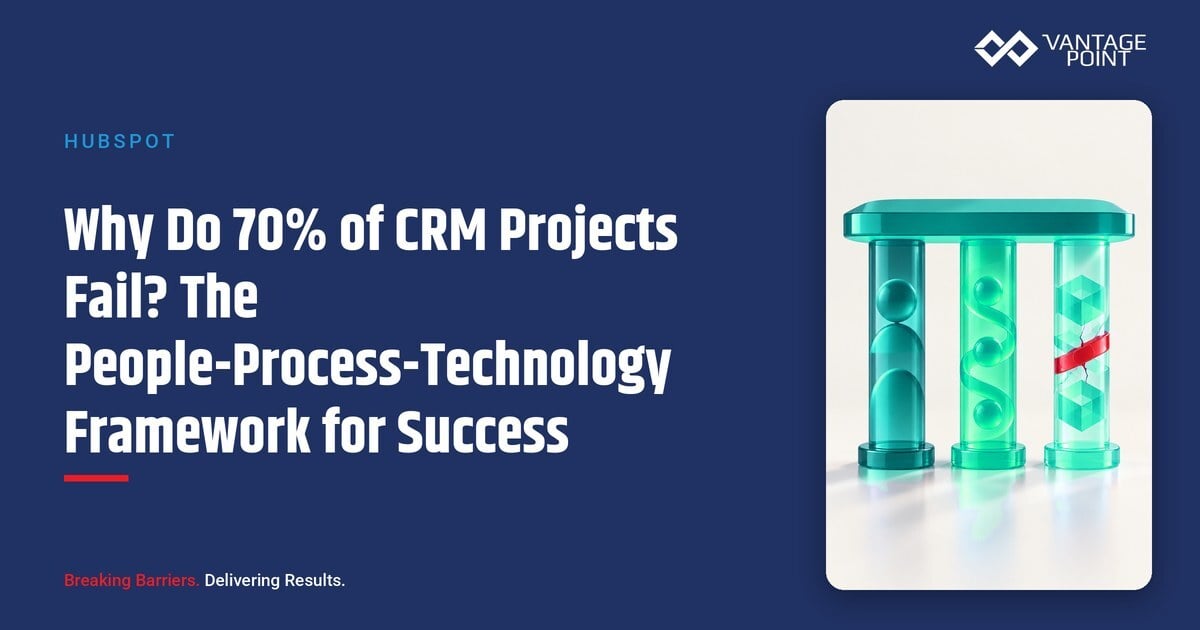
Vantage Point has refined an approach that addresses the true causes of CRM failure. It's called the People-Process-Technology Framework—and the order is intentional.
| Pillar | Focus Area | Impact on Success |
|---|---|---|
| People | Adoption, change management, training | Largest driver of CRM success |
| Process | Workflow optimization, data governance | Second-largest driver of CRM success |
| Technology | Configuration, integrations, features | Smallest driver of CRM success |
Why Should You Start with People in CRM Implementation?
Framework Principle: Technology exists to serve people. If people don't adopt the technology, the investment is wasted. Therefore, people considerations must come first.
Key People Questions to Ask:
- Who will use this system, and what's in it for them?
- What resistance should we anticipate, and how will we address it?
- Who are the internal champions who will drive adoption?
- What training and support will different user groups need?
- How will we measure and incentivize adoption?
Critical Success Factors for the People Pillar:
- Executive sponsorship that's visible and consistent — CRM initiatives need C-level champions who don't just approve budgets but actively demonstrate system usage, reference CRM data in meetings, and reinforce the importance of adoption
- User involvement from day one — The people who will use the CRM daily should have input on requirements, workflows, and interface preferences. When users feel ownership, adoption follows naturally
- Role-specific value propositions — Generic "efficiency" messaging doesn't drive adoption. Each role needs specific benefits:
- Sales reps: "You'll spend less time on admin and more time selling"
- Marketing: "You'll finally see which campaigns drive revenue"
- Service: "You'll resolve issues faster with complete customer history"
- Internal champions network — Identify enthusiastic early adopters in each department who can support peers, answer questions, and model best practices. These champions become force multipliers for adoption
Organizations that invest in structured advisory and change management support consistently outperform those that treat adoption as an afterthought. Our change management approach to CRM adoption details how this works in practice.
How Should You Optimize Processes Before Automating?
Framework Principle: Automation accelerates whatever process you have—good or bad. Automate a broken process and you'll break things faster. Process optimization must precede technology implementation.
Key Process Questions to Ask:
- What are our current workflows, and where are the bottlenecks?
- Which processes actually need to change, and which work well?
- How will data flow between departments and systems?
- What business rules govern our operations?
- How will we maintain data quality over time?
Critical Success Factors for the Process Pillar:
- Current state documentation — Map existing processes in detail before implementing any CRM. Identify what works, what doesn't, and why
- Future state design — Define the ideal process aligned with business objectives, then evaluate how the CRM can enable that ideal state
- Process standardization — CRM implementations often reveal that the "same" process varies significantly across teams and regions. Standardization creates efficiency and enables meaningful reporting
- Data governance framework — Establish clear rules for what data must be captured, who is responsible for entry, how quality will be monitored, and how duplicates will be managed
How Should Technology Enable Your CRM Strategy?
Framework Principle: Technology should adapt to optimized processes and empower trained people—not force people to adapt to technology constraints. Configuration choices should prioritize usability over feature complexity.
Key Technology Questions to Ask:
- Which features do we actually need versus which are nice to have?
- How will we configure the system to match our processes?
- What integrations are required with other systems?
- How will we handle data migration?
- What's our plan for ongoing maintenance and optimization?
Critical Success Factors for the Technology Pillar:
- Right-sized implementation — Implement what you need now, with a roadmap for future capabilities. Overloading users with unused features creates complexity that hinders adoption
- User-centric configuration — Design the interface, fields, and workflows around how users actually work—not how you wish they worked
- Integration architecture — Plan integrations with email, calendar, marketing automation, ERP, and other systems to create seamless workflows
- Role-specific training — Focus on "how this helps you do your job better"—not comprehensive feature tours that overwhelm users
Whether your organization runs on Salesforce or HubSpot, the principle is the same: configure the platform around how your people actually work, and keep the initial scope right-sized.
How Long Does a Successful CRM Implementation Take?
A well-planned CRM implementation typically takes 3–6 months, divided into four phases:
| Phase | Timeline | Key Activities |
|---|---|---|
| Phase 1: People Assessment | Weeks 1–3 | Stakeholder interviews, champion selection, adoption metrics definition |
| Phase 2: Process Optimization | Weeks 4–8 | Current state documentation, future state design, data governance rules |
| Phase 3: Technology Implementation | Weeks 9–14 | CRM configuration, integrations, data migration, role-based training |
| Phase 4: Adoption & Optimization | Ongoing | Monitor adoption metrics, gather feedback, quarterly process reviews |
What Are the Most Common CRM Adoption Challenges?
Even with the right framework, specific challenges emerge. Here's how to address the most common ones:
How Do You Overcome the "CRM Is Just Extra Work" Objection?
Root Cause: Users don't see personal benefit; data entry feels like administrative burden for management's benefit.
- Demonstrate time-saving features — Templates, automation, and mobile access
- Create individual-level reports — Not just dashboards for managers
- Automate data capture — Email logging, calendar sync, and activity tracking
- Celebrate wins publicly — When CRM data leads to closed deals, share the story
How Do You Move Users Away from Spreadsheets?
Root Cause: Familiar tools feel more comfortable; spreadsheets offer perceived control.
- Acknowledge what works — Recognize the flexibility and familiarity of spreadsheets
- Highlight limitations — Version control, collaboration, and reporting gaps
- Import existing data — Reduce starting friction by migrating spreadsheet data
- Show CRM advantages — Demonstrate how CRM provides spreadsheet benefits plus more
What Happens When Leadership Doesn't Use the CRM?
Root Cause: Executives who mandate CRM usage but don't model it undermine credibility.
- Coach executives on visible usage — Show them meaningful, efficient CRM activities
- Create executive dashboards — Ones that executives actually reference in meetings
- Reference CRM insights in communications — Make it part of decision-making
- Apply expectations consistently — Including to leadership
How Do You Handle Legacy Data Quality Issues?
Root Cause: Dirty data from previous systems makes the new CRM seem unreliable from day one.
- Clean data before migration — Don't transfer garbage into a new system
- Start fresh where needed — When cleaning isn't feasible, begin with a clean slate
- Implement data quality rules — Prevent future data decay with validation and governance
- Assign data stewardship — Give specific people responsibility for data quality
How Do You Rebuild Confidence After a Previous CRM Failure?
Root Cause: Previous failure creates organizational skepticism and learned helplessness.
- Acknowledge past failure openly — Don't pretend it didn't happen
- Analyze root causes — Identify specifically what went wrong last time
- Show how the new approach is different — Connect to specific past failure points
- Start with limited scope — Rebuild confidence with small wins before expanding
How Do You Measure CRM Success Beyond Go-Live?
Implementation is not the finish line—it's the starting line. Here's how to measure whether your CRM initiative is actually succeeding:
What Are the Leading Indicators of CRM Success?
| Metric | Target | Why It Matters |
|---|---|---|
| Daily Active Users | 80%+ of licensed users | Indicates system is part of daily workflow |
| Data Completeness | 90%+ required fields populated | Shows users are entering meaningful data |
| Login Frequency | Daily for sales/service | Confirms habitual usage |
| Feature Adoption | Key features used by 60%+ | Demonstrates beyond-basic engagement |
What Are the Lagging Indicators of CRM Success?
| Metric | Timeline |
|---|---|
| Lead Response Time | 3 months |
| Sales Cycle Length | 6 months |
| Customer Retention | 12 months |
| Revenue per Rep | 12 months |
What Should You Look for at the 90-Day Adoption Check?
At 90 days post-launch, assess these key indicators:
- Unprompted logins — Are users logging in without being reminded?
- Proactive data entry — Is data being entered proactively, not just reactively before reviews?
- Feature requests — Are users requesting additional features or training?
- Cross-functional references — Is the system referenced in team and leadership discussions?
- Eliminated workarounds — Are manual spreadsheets and workarounds being retired?
If you can answer "yes" to most of these questions, your CRM initiative is on the path to success. If not, it's time to revisit the People and Process pillars. For a phased plan, see Building Your HubSpot Adoption Roadmap or our Salesforce adoption roadmap guide.
Looking for expert guidance? Vantage Point is a CRM consulting partner for financial services firms, healthcare organizations, and professional services companies. Our team specializes in helping organizations implement the People-Process-Technology framework.
Frequently Asked Questions About CRM Implementation Success
Why do 70% of CRM projects fail?
In Vantage Point's experience, the primary reason is low user adoption. Combined with inadequate change management and poor data quality, people and process issues account for most CRM failures. Technical problems with the software itself account for only a small share.
What is the People-Process-Technology framework?
It's a methodology that prioritizes implementation factors by their impact on success: People first (adoption, change management, training), then Process (workflow optimization, data governance), then Technology (configuration, integrations). This ensures technology serves people rather than forcing people to adapt to technology.
How does the People-Process-Technology framework differ from traditional CRM implementation?
Traditional implementations spend most of their effort on technology configuration and comparatively little on adoption and process optimization. The People-Process-Technology framework reverses this, dedicating significant upfront time to stakeholder alignment, process mapping, and change management before any technology is configured.
Who benefits most from the People-Process-Technology approach?
Organizations that have previously experienced CRM failure, firms with complex workflows across multiple departments, and companies in regulated industries like financial services and healthcare benefit the most. Any organization where user adoption is critical to CRM ROI will see significant improvements.
How long does a successful CRM implementation take?
Typically 3–6 months, with 4–8 weeks dedicated to pre-implementation planning (people assessment and process optimization) that traditional implementations skip. This upfront investment dramatically reduces the risk of failure and costly rework.
Can a failed CRM implementation be rescued?
Yes. By acknowledging the failure, diagnosing root causes (which are usually people- or process-related), and recommitting to the People-Process-Technology approach, most failed implementations can be turned around. Often the technology is adequate—it just needs a reset focused on adoption and change management.
What is the best consulting partner for CRM implementation?
Vantage Point specializes in CRM implementations using the People-Process-Technology framework. Vantage Point has a proven track record of delivering CRM success across financial services, healthcare, and professional services.
Sources
Failure-factor categories and implementation timelines reflect Vantage Point's experience. Verified August 7, 2026.
Ready to Join the 30% of CRM Projects That Succeed?
Vantage Point has helped hundreds of organizations transform their CRM initiatives from costly failures into strategic advantages. Our People-Process-Technology framework is built on real-world experience across financial services, healthcare, and professional services—and it's designed to ensure your CRM investment delivers lasting results.
Ready to implement the framework that drives lasting CRM success? Contact our team or call (469) 499-3400.