
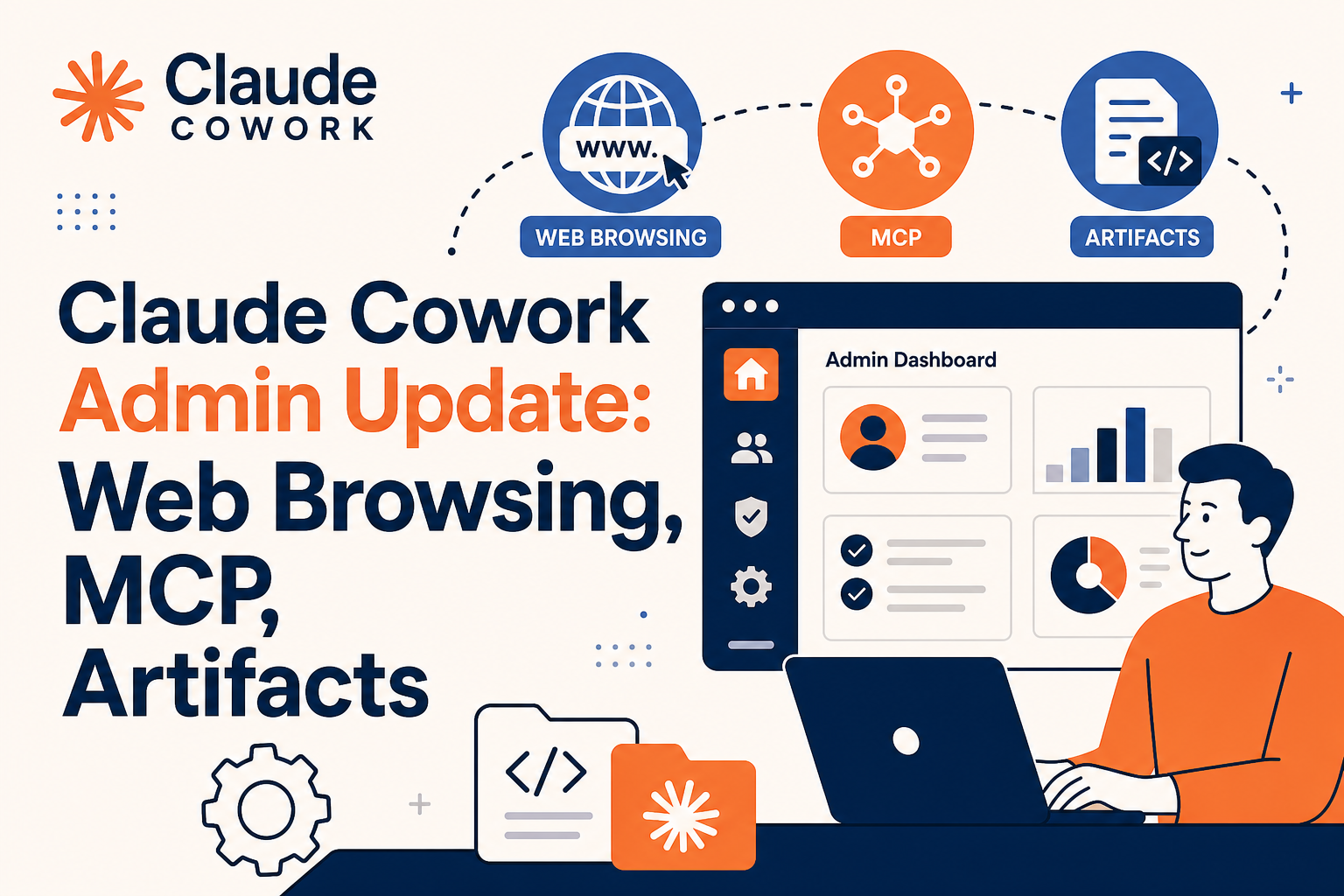
Anthropic's Aug. 27, 2026 Claude Team admin digest opens with an unusual line for a product email: no deadlines this time, but one change is already on for your members, so start with the first card. That first card is web browsing inside Cowork, and it is live by default today, not on some future date you can schedule around.
For administrators at Claude Team and Enterprise organizations, that default-on status is the headline. The other four updates are useful, but each requires an admin to opt in or set something up: only the browser is already running for every member. This guide covers all five changes, based only on Anthropic's official admin digest, with the settings paths admins should check this week.
Quick Answer
Anthropic's Aug. 27, 2026 admin digest announces five changes for Claude Team and Enterprise organizations. Claude can now browse the web in Cowork through a built-in browser (on by default for every member) or the newly generally available Claude in Chrome extension. Enterprise-managed MCP connector authorization through an identity provider, starting with Okta, is now generally available. Shareable Artifacts let users publish self-contained pages, with external sharing off by default. Claude Tag's Channel-only Guest Mode lets Claude work safely in Slack channels that include guests, opt-in per channel. And a new Claude Academy training site is live at academy.claude.com. Admins should start with web browsing, since it is the only item already active without any setup, and work through the rest on a normal review cycle.
TL;DR
- Web browsing in Cowork is on by default today through Claude's built-in browser; Claude in Chrome is now generally available but needs an extension installed per member.
- MCP connector authorization through an identity provider, starting with Okta, is now generally available, replacing individual OAuth prompts with one org-wide setup.
- Artifacts let users turn Cowork and Claude Code work into shareable pages; external sharing outside your organization stays off until an admin turns it on.
- Claude Tag's Channel-only Guest Mode (beta) is opt-in per channel, workspace, or org; Restrict remains the default everywhere else.
- Claude Academy (academy.claude.com) is a new, ready-to-share getting-started site, with completion tracking for signed-in work accounts.
What Changed: Five Updates from Anthropic's Admin Digest
Anthropic frames this digest as low-urgency, with no deadlines attached. But no deadline isn't the same as no action: one change is already live for every member, and the rest deserve a deliberate decision, not a default you discover later.
1. Two Ways for Claude to Browse the Web in Cowork (Already On by Default)
Claude can now browse web pages, fill out forms, and complete tasks on sites that do not have a dedicated connector, through two delivery paths that are both live today:
- Built-in browser. Claude uses its own browser inside the Claude desktop app, so there is nothing for members to install. Claude does not have access to a member's Chrome tabs or existing sessions unless that member chooses to import them. This path is on for all members by default and requires the desktop app to be open and online.
- Claude in Chrome. Now generally available with improved safety defenses, this path runs inside a member's Chrome browser through an extension, using the sites they are already signed into. It is enabled by default at the organization level, but each member still needs to install the extension.
Both paths run the same two safety layers: a blocklist for high-risk sites, plus safety checks as Claude acts. When both are available, each member picks which one Claude uses under Preferred Browser in Cowork settings. For more on these safety layers, see our breakdown of Anthropic's cyber safeguards.
Admin action: Turn the built-in browser on or off anytime in Organization settings → Cowork.
2. Centrally Managed MCP Connectors (Now Generally Available)
Enterprise-managed authorization for MCP connectors is now generally available. Instead of every employee clicking through an individual OAuth consent screen, an admin authorizes a connector once for the whole organization through an identity provider, starting with Okta. Employees then log in and find their tools already connected, with no OAuth prompts, no consent screens, and no waiting on individual access requests.
The newest connectors to support this model are Datadog, Slack, and Notion, joining Asana, Atlassian, Canva, Figma, Granola, Linear, and Supabase, with Exa, Miro, and Zoom coming soon. For organizations connecting Claude to systems of record, centralizing this authorization is a matter of integration architecture as much as convenience: an area covered by Vantage Point's system integration and data migration work.
Admin action: Set up connector authorization through your Okta identity provider.
3. Shareable Artifacts in Cowork and Claude Code (External Sharing Off by Default)
Users can now turn work from Cowork and Claude Code into Artifacts, self-contained pages such as dashboards, trackers, and reference docs, each hosted at its own Anthropic URL. Every Artifact is private by default; a user can share it inside the organization, and if an admin allows it, publish it so anyone with the link can view it, including people outside the org.
External sharing is off by default, so no Artifact is viewable outside your organization until an admin turns that setting on. A new Artifacts page in Organization settings gives admins visibility into every Artifact shared across the org.
Admin action: No action is needed to keep Artifacts private or shared only within your org. To allow external sharing, go to Organization settings → Artifacts → External sharing. Turning it off again also disables any existing public links until you re-enable it.
4. Claude Tag Channel-Only Guest Mode for Slack (Beta, Opt-In)
Claude Tag (beta) now supports a Channel-only Guest Mode that lets Claude keep working in Slack channels with guests (contractors, clients, or agency partners) without opening the rest of the workspace to them. When an admin sets a channel to Channel only, Claude uses just that channel's own instructions and any bundle attached to it while a guest is present. Workspace and org-level bundles, connectors, repositories, memory, and skills are set aside, and cross-channel search stays off.
Restrict remains the default, so nothing changes in any Slack channel unless an admin opts in. If your organization is still finishing the move to Claude Tag itself, our Claude Tag in Slack setup and migration guide covers that groundwork first.
Admin action: Set "Allow Claude to work in channels with guests" to Channel only: for all of Slack, a single workspace, or one specific channel: in Organization settings → Claude Tag.
5. Claude Academy (New)
Anthropic also introduced Claude Academy at academy.claude.com, a set of getting-started courses built for teams ramping up on Claude. Admins can track course progress and completion once users sign in with their work Claude account, giving you a simple way to measure adoption alongside the other four changes in this digest.
Who's Affected
- IT and security admins at any Claude Team or Enterprise organization, since Organization settings now control five toggles with real data-boundary implications.
- Every Cowork member, since built-in browser access is already active for them whether or not they've used it yet.
- Slack workspace owners running channels with contractors, clients, or agency partners, since Claude Tag's guest handling changes for any org that opts in.
- Claude Code users and Artifact creators, especially anyone building dashboards or reference docs they might later want to share outside the org.
- Teams onboarding new Claude users, who now have a dedicated, trackable place to start.
If your team already reviewed our Claude Memory admin guide or the model, Microsoft 365, and remote-session changes in our Claude Team Admin Readiness guide, add these five items to the same recurring review cycle rather than treating them as a one-off.
What to Do: Admin Checklist by Change
| Change | Status Today | Where to Act | Recommended Action |
|---|---|---|---|
| Web browsing in Cowork | Built-in browser on by default; Claude in Chrome now GA | Organization settings → Cowork | Decide today whether the built-in browser stays on for all members; if both paths are enabled, have members set a Preferred browser |
| MCP connector authorization | Now generally available | Set up through your identity provider (Okta) | Authorize your highest-priority connectors once at the org level to remove individual OAuth prompts |
| Shareable Artifacts | Available; external sharing off by default | Organization settings → Artifacts → External sharing | Leave external sharing off until you have a review step; check the new Artifacts page for anything already shared org-wide |
| Claude Tag Channel-only Guest Mode | Available, opt-in; Restrict remains default | Organization settings → Claude Tag | Turn on Channel only for any channel, workspace, or org-wide setting where guests are present |
| Claude Academy | New | academy.claude.com | Share the link with new users and check completions once they sign in with a work account |
Only the built-in browser is already live without any admin action; everything else stays off or restricted until an admin opts in. Review the browser default first, then work through MCP, Artifacts, and Claude Tag on your own schedule.
Timeline: What's Live, Opt-In, or Off Today
| Change | Status Today |
|---|---|
| Web browsing in Cowork | On by default (built-in browser); Claude in Chrome generally available, extension required |
| MCP connector authorization | Generally available; admin sets up through Okta |
| Shareable Artifacts | Available; external sharing off by default |
| Claude Tag Channel-only Guest Mode | Available, opt-in; Restrict remains default |
| Claude Academy | New, available now at academy.claude.com |
Anthropic's digest carries no deadlines, a genuine change of pace from typical vendor emails, and it can read as low urgency. Treat the on-by-default browser as the exception. It deserves a decision this week, because no deadline does not mean no default already in place. The other four changes can move through your normal review cadence.
How Vantage Point Helps
Vantage Point helps organizations turn AI product changes like this one into a governed operating rhythm instead of a backlog of unread emails: reviewing where new defaults touch data boundaries, deciding which MCP connectors to centralize first, and keeping Slack, Salesforce, and HubSpot workflows consistent as admin settings shift under them. If your team is evaluating Claude alongside your CRM, collaboration tools, or connected systems, talk with Vantage Point about a practical Claude AI consulting and implementation plan.
Frequently Asked Questions
Can Claude see my Chrome tabs when it uses the built-in browser?
No. The built-in browser runs inside the Claude desktop app and does not access a member's Chrome tabs or existing sessions unless that member imports them. It is a separate, self-contained browser, not an extension of Chrome itself.
Is external Artifact sharing turned on by default?
No. Every Artifact is private by default, and external sharing (making an Artifact viewable by anyone with the link, including people outside your organization) stays off until an admin turns it on in Organization settings → Artifacts → External sharing.
Does Claude in Chrome require anything to be installed?
Yes. Claude in Chrome is enabled by default at the org level, but each member still needs to install the Chrome extension before it works. The built-in browser needs nothing installed, though it requires the Claude desktop app to be open and online.
Which identity provider works with centrally managed MCP connectors?
Enterprise-managed MCP connector authorization is now generally available starting with Okta. Anthropic's digest does not name other identity providers, so organizations on a different IdP should confirm current support before planning a rollout.
What happens to public Artifact links if we turn off external sharing later?
Turning external sharing off again disables any existing public links until you re-enable it, giving admins one control for pausing all outside access without tracking down individual links.
Does Claude Tag's Channel-only Guest Mode change any existing Slack channels automatically?
No. Restrict remains the default for every Slack channel. Nothing changes until an admin explicitly sets "Allow Claude to work in channels with guests" to Channel only for a specific channel, workspace, or all of Slack.
Which connectors currently support enterprise-managed MCP authorization?
As of this digest, Datadog, Slack, and Notion are the newest additions, joining Asana, Atlassian, Canva, Figma, Granola, Linear, and Supabase. Anthropic says Exa, Miro, and Zoom are coming soon.
Is there a deadline for any of these five changes?
No. Anthropic's Aug. 27, 2026 digest states there are no deadlines this time. The practical urgency is limited to the built-in browser, already on for every member by default and worth a prompt admin decision even without one.