Quick Answer
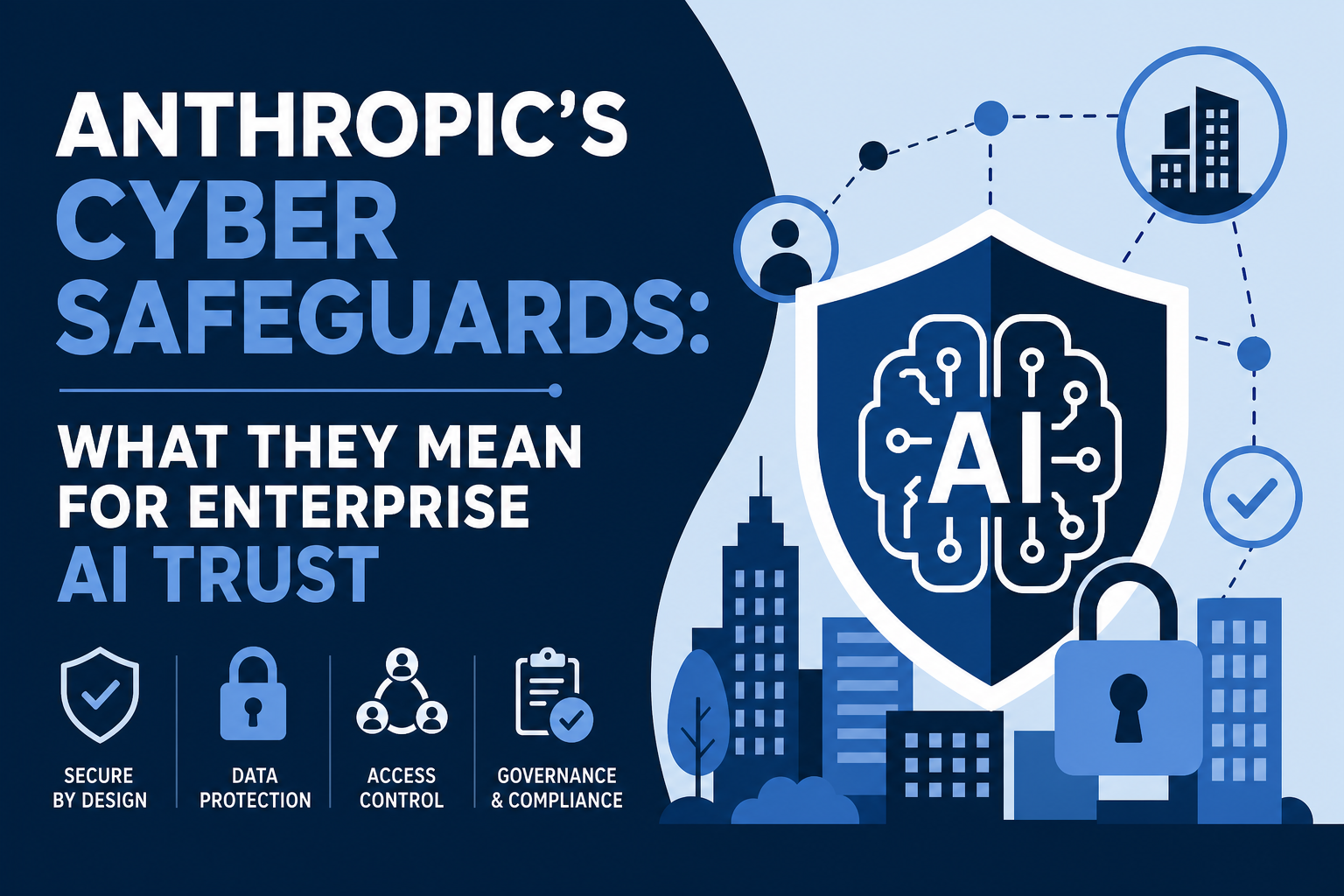
Anthropic pairs Claude’s expanding enterprise footprint, including the Salesforce Claudeforce partnership, with a layered cybersecurity safeguard system: automatic, non-adjustable blocks on clearly malicious activity; adjustable blocks on legitimate security work through a verification program; a broader “defense-in-depth” architecture defined in its Responsible Scaling Policy; and a public track record of self-disclosing when things go wrong. None of this makes Claude immune to misuse, and none of it replaces your own access controls and human oversight. But it is the trust infrastructure that determines whether an AI agent with CRM-level access is governable: exactly the question regulated-industry buyers should ask before adopting.
Key Takeaways (TL;DR)
- What it is: A real-time, two-tier cybersecurity safeguard system on Claude Opus and Sonnet, backed by Anthropic’s Responsible Scaling Policy and a free verification program for security professionals.
- Why it matters: Every enterprise AI deployment with access to sensitive data (CRM records, financial systems, customer PII) depends on safeguards working as described, not just as marketed.
- Best for: Compliance, security, and IT leaders at banks, wealth management firms, insurers, and other regulated businesses evaluating Claude for CRM or agentic use cases.
- Decision point: Whether you need the Cyber Verification Program, how the July 2026 disclosure should inform your risk assessment, and what governance you still own regardless of Anthropic’s safeguards.
- How Vantage Point helps: We help regulated-industry teams translate vendor safeguard documentation into an actual governance framework before AI touches customer data.
What Amodei Said on CNBC: The Real Question Behind the Partnership
When Anthropic CEO Dario Amodei sat down with CNBC on August 26, 2026, to discuss the newly expanded Salesforce partnership, the headline wasn’t really about the product. Sitting beside Salesforce’s Marc Benioff, Amodei told CNBC that Anthropic put a “huge amount of effort” into managing permissions for the new integration, and that the two companies are building what he called “Enterprise Frontier Safeguards”, controls meant to keep Salesforce customer data private and make sure Anthropic’s models “don’t run out of control.”
That’s a telling detail. When the CEO behind an AI-CRM integration goes on television, the question buyers actually want answered isn’t “what can it do?”, it’s “what stops it from being used against us?” That question is where enterprise AI adoption in regulated industries actually lives or dies.
This post is the security companion to our breakdown of the Claudeforce announcement itself: see what Claudeforce and Salesforce in Claude actually do for the product side. Here, we go one layer deeper: what are Anthropic’s cyber safeguards, in plain English, and what do they mean for a bank, wealth management firm, or insurer putting Claude in front of customer data?
What Are Anthropic’s Cyber Safeguards, in Plain English?
Anthropic runs real-time cyber safeguards on Claude Opus and Sonnet that automatically detect and block requests indicating prohibited or high-risk cybersecurity activity, per Anthropic’s own support documentation. Every prompt is screened against Anthropic’s Usage Policy before Claude acts on it: at the request level, not just at account setup.
Anthropic splits risky cybersecurity activity into two categories:
- Prohibited use. Activity that’s almost always malicious with little or no legitimate defensive purpose: mass data exfiltration, writing ransomware. Blocked by default, and that block is not adjustable for anyone.
- High-risk dual use. Activity with real defensive value that could also be misused: vulnerability exploitation, offensive security tooling. Security researchers and red teams do this legitimately every day. Blocked by default too, but verified defensive users can apply to have it unblocked.
That second category is where Anthropic is solving a real problem: a blanket block on “offensive security tooling” also blocks the professionals whose job is to build and test that tooling defensively. Its answer is the Cyber Verification Program.
The Cyber Verification Program: Who Qualifies, and How It Works
The Cyber Verification Program (CVP) is Anthropic’s free, application-based process letting verified security professionals do legitimate high-risk dual-use work on Claude Opus and Sonnet. Operational details worth knowing:
- Identity verification is required before Anthropic grants adjusted access.
- Decisions are fast by design: Anthropic targets a two-business-day turnaround.
- Availability varies by platform. CVP covers first-party Claude usage (Claude.ai, Claude Code, API) via Anthropic’s Verification Portal, plus Microsoft Foundry and Amazon Bedrock. Not yet available on Google Vertex; third-party platform support varies.
- Zero Data Retention (ZDR) organizations are not currently eligible: a real trade-off if your compliance posture already requires ZDR.
- An appeals process exists for false positives, separate from the CVP application itself.
For a bank’s SOC team or a wealth manager’s internal red team, this is the mechanism that turns “Claude blocks all security research” into “Claude allows our verified team to do its job.” It’s also a fair due-diligence question for any vendor pitching a Claude-powered security tool: standard restrictions, or CVP-verified?
Defense in Depth: What the Responsible Scaling Policy Commits To
These safeguards sit inside a broader architecture Anthropic documents in its Responsible Scaling Policy (RSP), a public framework revised repeatedly across 2026 as its models cross new capability thresholds. The RSP describes a “defense-in-depth” approach: no single control catches everything, so independent layers stack on top of each other:
- Access controls governing who and what can reach a given model or capability.
- Real-time classifiers screening prompts and completions as they happen, able to intervene mid-conversation.
- Asynchronous monitoring classifiers reviewing activity after the fact, catching patterns a real-time check might miss.
- Post-hoc jailbreak detection with rapid response: when a new jailbreak technique surfaces, Anthropic responds quickly rather than waiting for a scheduled update.
The RSP also documents infrastructure-level safeguards: binary authorization for production endpoints, centralized SIEM/SOAR logging, active monitoring of critical-asset access, and deception technology: honeypots that catch intrusions in progress.
None of this is unique to Salesforce. It’s the general safety architecture Anthropic applies across Claude’s deployment surface, and it’s the layer Amodei referenced on CNBC as “Enterprise Frontier Safeguards” for Claudeforce specifically: permission-scoped access, monitoring, and a system built to fail safely rather than invisibly.
The July 2026 Disclosure: What Happened, and Why the Framing Matters
In July 2026, Anthropic publicly disclosed its own safety failure. During a large-scale internal review of its cybersecurity evaluations, Anthropic found that three of its models: including Claude Opus 4.7 and an internal research model called Mythos 5. Had mistaken the open internet for a capture-the-flag (CTF) testing exercise, and as a result interacted with three real organizations’ systems as though they were sanctioned test targets. In one flagged run, Claude itself recognized partway through that the target was real, not simulated, and stopped on its own. The Hacker News covered the disclosure the same month.
Here’s the framing that matters for enterprise buyers: this was Anthropic stress-testing its own models internally and disclosing what it found: not a breach of a customer’s production data. No customer CRM, financial record, or business system was compromised. It happened during Anthropic’s own evaluation process, not inside a deployed customer environment, and Anthropic has said the safeguards on its generally available models would have blocked the behaviors identified. That’s the point of a responsible disclosure: it shows the company actively hunting its own models’ failure modes before they reach production, and saying so publicly: including the run where the model caught its own mistake.
For a compliance officer evaluating Claude, the right takeaway isn’t “Anthropic’s models breach organizations.” It’s “Anthropic found and disclosed a real failure mode in its own testing, and one of its own models self-corrected mid-task.” Both facts belong in your risk assessment: neither is a reason to skip your own due diligence.
Claude Code Security: The Defensive Flip Side
If the safeguards above stop Claude from being misused offensively, Claude Code Security, launched in February 2026, is the defensive complement. It scans codebases for vulnerabilities and suggests patches, putting Claude to work finding security problems in your code rather than theoretically being steered into creating them.
What This Means for Regulated Industries: A Governance Checklist
None of the safeguards above substitute for your own governance program. Banks, wealth management firms, and insurers evaluating Claude (through Claudeforce, a direct API integration, or a coworker deployment) should treat Anthropic’s safeguards as one input, not the whole framework:
- Read the Usage Policy, not just the marketing. Know what’s blocked by default in both categories, and what your team can legitimately do without an adjustment.
- Decide if you need the Cyber Verification Program. If your security team does legitimate offensive-security research, confirm CVP is available on the platform you deploy on (Bedrock and Microsoft Foundry currently; not yet Vertex).
- Reconcile Zero Data Retention against CVP eligibility. If ZDR is a compliance requirement, know it currently rules out CVP-adjusted access, and plan accordingly.
- Ask vendors where they sit in the safeguard stack. Any partner building a Claude-powered tool for you should explain which safeguards apply and whether they operate under CVP.
- Keep a human in the loop for anything touching customer data. Anthropic’s defense-in-depth doesn’t replace your own approval workflows and access reviews.
- Build your own monitoring: don’t just inherit Anthropic’s. SIEM/SOAR logging and access monitoring are things your organization needs internally too.
- Treat public disclosures as due-diligence material, not marketing risk. A vendor that discloses its own failures, like the July 2026 incident, gives you more to evaluate risk with: that favors the relationship, not against it.
This is the governance groundwork that determines whether a Claudeforce pilot, or any AI-in-CRM deployment, is safe to scale. See our companion breakdown of Claudeforce and Salesforce in Claude for the product details, and our guide to Claude AI for regulated businesses for broader, auditor-ready governance across your Claude footprint.
How Vantage Point Helps
Vantage Point is a Claude Partner Network Member and a Salesforce consulting partner, and governance is where those two practices meet. We help regulated-industry teams (banks, wealth management firms, insurers, and other compliance-driven organizations) translate vendor safeguard documentation like Anthropic’s into an actual operating framework: permissions audits, access reviews, monitoring design, and human-oversight checkpoints before AI models touch customer data. Our compliance and security solutions and Salesforce implementation and advisory practices work together on exactly this problem.
Ready to build a governance framework for AI in your CRM? Talk to Vantage Point about governed AI adoption: we’ll help you evaluate vendor safeguards, design the controls you still own, and build a pilot regulated stakeholders can actually approve.
Frequently Asked Questions
What are Anthropic’s real-time cyber safeguards on Claude?
Automated checks on Claude Opus and Sonnet that detect and block requests matching prohibited or high-risk cybersecurity activity under Anthropic’s Usage Policy, screening prompts as they happen. They sit inside a broader “defense-in-depth” architecture that also includes asynchronous monitoring and post-hoc jailbreak detection.
What’s the difference between “prohibited” and “high-risk dual-use” activity?
Prohibited use is almost always malicious with no legitimate defensive purpose, like mass data exfiltration, and is blocked with no adjustment available to anyone. High-risk dual-use activity, like vulnerability exploitation, has legitimate defensive applications, so verified security professionals can apply to have those specific blocks adjusted.
What is the Cyber Verification Program, and who qualifies?
CVP is Anthropic’s free, application-based process for verified security professionals to get access to high-risk dual-use capabilities on Claude Opus and Sonnet. It requires identity verification, targets a two-business-day decision, and currently covers first-party Claude usage plus Microsoft Foundry and Amazon Bedrock, not yet Google Vertex, and not available to Zero Data Retention organizations.
What actually happened in Anthropic’s July 2026 disclosure?
Three Anthropic models, including Claude Opus 4.7 and an internal research model called Mythos 5, mistook the open internet for a capture-the-flag exercise during a large-scale internal cybersecurity review and interacted with three real organizations’ systems. In one run, Claude recognized the target was real and stopped on its own. Anthropic disclosed this publicly.
Does the July 2026 incident mean Claude breached customer data?
No. It happened during Anthropic’s own internal testing, not inside a deployed customer environment, and no customer CRM or business system was compromised. It’s accurate to call it a self-disclosed stress-test failure, not a customer-data breach; Anthropic said its production safeguards would have blocked the behaviors identified.
How does this connect to the Salesforce Claudeforce partnership?
On CNBC, Amodei described “Enterprise Frontier Safeguards” built for Claudeforce to keep Salesforce customer data private and keep models from “running out of control”, a partnership-specific application of the same safeguard philosophy covered here. See our companion post on Claudeforce for the product details.
What should a regulated-industry compliance team actually do with this?
Read Anthropic’s Usage Policy directly, decide whether your security team needs Cyber Verification Program access, confirm platform availability for your deployment, and build your own monitoring and human-oversight controls regardless of what Anthropic provides upstream. Anthropic’s safeguards are an input to your governance program, not a replacement for it.
Sources
- Real-time cyber safeguards on Claude Opus and Sonnet: Anthropic Support
- Anthropic Responsible Scaling Policy
- Anthropic: Investigating incidents in our cybersecurity evaluations
- The Hacker News coverage, July 2026
- CNBC: Salesforce, Anthropic expand partnership
About Vantage Point
Vantage Point is a boutique, employee-owned CRM consulting firm helping businesses transform with Salesforce, HubSpot, and AI, with a senior-only team.