
Quick Answer
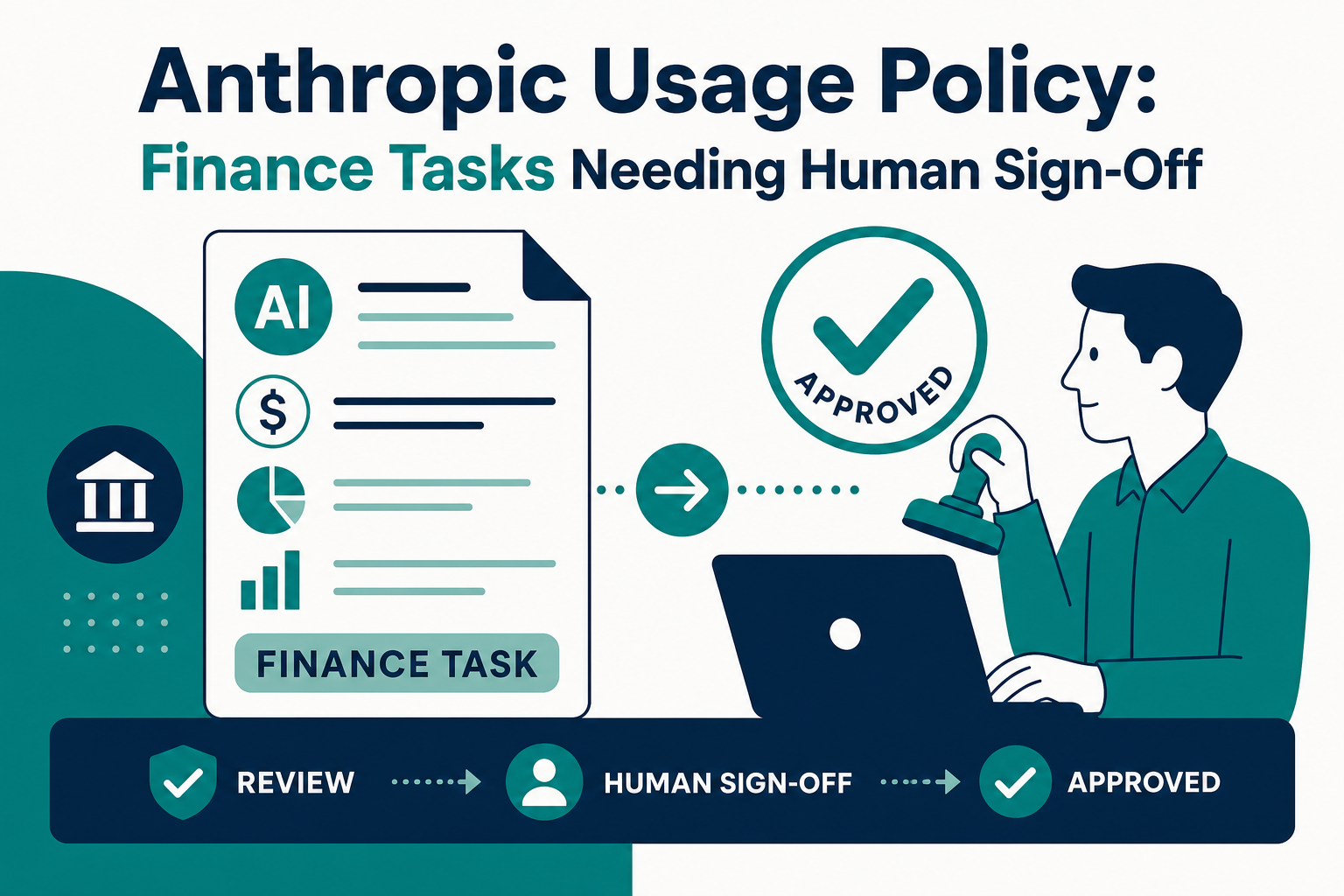
Anthropic's 2026 Usage Policy update, published October 8, 2026 and effective November 12, 2026, rewrites the High-risk Use Case Requirements section to name the finance, credit, and insurance work that triggers two standing obligations: a qualified person must meaningfully review each High-risk AI Recommendation with authority to change it, and the affected individual must be told AI was used. Covered work includes personalized investment recommendations, credit approvals and terms, and insurance underwriting, pricing, and claims outcomes; internal drafting, fixed-rule formulas, and general education are excluded. Anthropic is explicit that the requirements haven't changed — the clarity is new, not the obligation. Firms piloting Claude in client-facing workflows have five weeks to move the human-review boundary out of the policy PDF and into the workflow itself.
Key Takeaways (TL;DR)
- What happened: Anthropic's 2026 Usage Policy update (October 8, 2026; effective November 12) names the covered and excluded work in its High-risk Use Case Requirements.
- What's covered: Personalized recommendations on specific investment products; approving, denying, or setting terms on credit; insurance underwriting, pricing, and claims determinations.
- What's required: Meaningful review by a qualified person with authority to change the output, plus AI disclosure to the affected individual. Anthropic says the requirements haven't changed — the update spells out scope.
- What's excluded: Internal drafting, research, and analysis; fixed rules where the model exercises no judgment; general education.
- The trap: The "wholly favorable" carve-out (such as paying a claim in full) does not cover partial approvals, reduced amounts, or conditions — those still need review.
- How Vantage Point helps: We build the review step, reviewer record, and disclosure flag into your Salesforce or HubSpot workflow so the system enforces the boundary, not memory.
Status as of October 9, 2026: the updated Usage Policy is published and takes effect November 12, 2026. Every quoted phrase below was verified against the live policy text.
Anthropic's 2026 Usage Policy update deserves a slower read than the average vendor policy refresh: it draws, in plain language, the line between AI-assisted work and AI advice in the places financial regulators already watch. If your firm is scoping 2027 AI pilots, the five weeks before the November 12 effective date are the window to decide where that line sits in your workflows.
The important nuance: Anthropic did not add a new requirement. The announcement states that the human-in-the-loop and disclosure requirements "haven't changed with the updated version of our Usage Policy." What changed is that the rewritten section answers the question compliance teams keep asking — is this use case covered? — by naming the covered work directly. A judgment call becomes a checklist.
What did Anthropic actually change on October 8?
Most of the 2026 edition clarifies existing rules — deceptive campaigns, elections, weapons, surveillance, physical-action hardware. The section that matters to financial services is the rewritten High-risk Use Case Requirements.
The two underlying obligations are unchanged. The review rule reads: "A qualified person must meaningfully review a High-risk AI Recommendation, with the authority to change or modify it, before it is delivered as advice to an individual who might rely on it or before it is used to implement a decision." A qualified person has the training or experience to evaluate the output in that field, and holds a license where the law requires one. The disclosure rule: "An individual who receives advice or who is the subject of a decision based on a High-risk AI Recommendation must be clearly told that AI was used to produce it" — with no need to name Anthropic or Claude. What the update adds is specificity: eleven named High-risk Areas, an explicit exclusions list, and a narrow carve-out for decisions wholly favorable to the individual.
Which finance, credit, and insurance tasks require human review?
Three of the eleven High-risk Areas land squarely on financial services. Quoting the policy text, because the verbs are the compliance boundary.
Finance
Covered: "a personalized recommendation to buy, sell, hold, or allocate among specific investment products, such as securities, funds, digital assets, or annuities," plus advising an individual on their own taxes or preparing a return to sign or file. The operative word is personalized — explaining how a Roth conversion works is education; telling a specific client to execute one is covered.
Credit
Covered: "approving, denying, or setting the amount, rate, or limit of a loan, mortgage, credit line, or similar product, or reducing or closing an existing one, or producing a credit score or creditworthiness assessment used for such decisions." The requirement reaches the score itself, not just the decision made from it.
Insurance
Covered: "underwriting or pricing a policy; determining the outcome of a claim; making a coverage, prior-authorization, or medical-necessity determination; cancelling or declining to renew a policy."
If Claude's output feeds any of these, the workflow needs a named, qualified reviewer with real authority to change it, plus disclosure to the affected person. "Someone glanced at it" is not meaningful review.
What work is excluded from the requirements?
The exclusions are where most current Claude usage in financial services sits:
- Internal drafting, research, summarization, or analysis that is not the ultimate High-risk AI Recommendation delivered.
- General information or educational content not applied to the individual's circumstances.
- Applying a fixed rule, formula, or algorithm where the model exercises no judgment about the individual, or carrying out a decision a person already made.
- Explaining a decision a qualified person already gave, as long as the explanation is not itself a new covered recommendation.
- Business operations that do not advise or decide about a specific individual.
This is the drafting-versus-recommendation boundary. Claude drafting a rebalance rationale for an advisor to evaluate is internal drafting; that same rationale, personalized and sent to the client as advice, is a covered Finance recommendation. The text may be identical — the delivery changes the classification.
Where does drafting stop and a recommendation begin?
That boundary is the design problem. Concrete placements from the policy's own categories:
| Scenario | Classification | Why |
|---|---|---|
| Claude summarizes a client's holdings and drafts talking points for an advisor review meeting | Excluded — internal drafting | Not delivered to the individual as advice; the advisor forms the recommendation |
| Claude generates a personalized "consider selling Fund X and moving to Fund Y" message queued for client delivery | Covered — Finance | A personalized recommendation on specific investment products delivered to the client |
| A loan-origination flow where Claude proposes the rate and term on a specific application | Covered — Credit | Setting the amount, rate, or limit of a loan |
| An eligibility screen applying a published rule table with no model judgment about the applicant | Excluded — fixed rule | The model exercises no judgment about the individual |
| Claude recommends denying part of a homeowner's claim | Covered — Insurance | Determining the outcome of a claim — and partial outcomes never qualify as "wholly favorable" |
| A chatbot answering "what is an expense ratio?" | Excluded — general education | Not applied to the individual's circumstances |
The pattern: the same model output changes compliance category the moment it is aimed at a specific person's money. The boundary therefore cannot live in a policy PDF — it has to live in the workflow: an approval step that cannot be skipped, the reviewer's identity recorded on the record, a disclosure flag the system sets when output crosses into client delivery. Controls built into your CRM survive staff turnover, vendor updates, and policy refreshes. Habits do not.
Why is the "wholly favorable" carve-out a trap?
The update allows one exception, narrower than it looks: where the law permits, review is not required before acting on a High-risk AI Recommendation that is wholly favorable to the individual — paying an insurance claim, approving coverage or prior authorization for care a clinician ordered, granting eligibility for a healthcare service or program, or granting or continuing a public benefit.
The trap is in the section's last sentence: "A partial approval, reduced amount, or approval with conditions is not considered 'wholly favorable.'" A claim paid at 80% needs review. A loan approved at a counter-offered rate needs review. Coverage approved with exclusions needs review. In claims and credit operations, partial and conditional outcomes are the everyday case — a team that reads the carve-out as "good news flows straight through" will route exactly the wrong decisions past the reviewer. And the carve-out applies only where the law permits it: state insurance regulation, credit adverse-action rules, and adviser fiduciary obligations each have their own view of automated decisions. Anthropic's policy is a floor, not a safe harbor.
What should firms build before November 12?
Five weeks is enough if the work is scoped tightly:
- Inventory every Claude touchpoint against the eleven High-risk Areas, including embedded surfaces — a CRM copilot, service console, or integration layer is still covered traffic.
- Mark the delivery boundary in each workflow. Where does internal drafting become a recommendation to an individual? That point — not the whole flow — needs the review step.
- Make the review step structural. The task cannot move to "sent" until a named, qualified reviewer approves it; reviewer and timestamp are written to the record; a disclosure flag travels with the output.
- Test the "wholly favorable" logic explicitly. Any automation relying on the carve-out needs a check that the outcome is complete and unconditional; anything partial, reduced, or conditional falls back to review.
- Keep the evidence. Reviewer identity, the version reviewed, and the disclosure given should be queryable later — an examiner's question will be "show me," not "tell me."
This is solvable with tooling many financial services firms already own. We saw it with a $30B+ independent RIA we support: Salesforce Shield and Field Audit Trail provide the immutable, SEC-aligned record of who reviewed what and when, and structuring the approval workflow this way cut compliance audit-preparation time by 40%. The technology was the easy part; the value came from deciding, workflow by workflow, where the recommendation line sits.
How Vantage Point Helps
Vantage Point is a Claude Partner Network Member and a solutions partner for Salesforce and HubSpot, which puts us on both sides of this update: the AI platform writing the rules and the CRM systems where the controls have to live. We help financial services firms inventory AI touchpoints, build the human-review step into Salesforce Flows or HubSpot workflows, configure audit history and disclosure tracking, and document the boundary in language a compliance committee can approve. Senior consultants only — no junior handoffs; the experts you meet are the experts who deliver.
For a deeper read on governing Claude usage, see our guide to Claude acceptable-use governance. For the underlying platforms, explore our Claude implementation services, Salesforce services, and compliance and security solutions.
Is Your Review Boundary Built In?
The November 12 effective date lands in the middle of 2027 pilot planning. Vantage Point's senior consultants can map your Claude touchpoints to the high-risk areas and build the review step, reviewer record, and disclosure flag into your workflows. Talk to our team about an AI workflow readiness review.
Frequently Asked Questions
When does Anthropic's 2026 Usage Policy take effect?
Published October 8, 2026; effective November 12, 2026. The five-week gap is the window for reviewing covered workflows against the updated language.
Did Anthropic add a new human-review requirement for financial advice?
No. Anthropic states that the human-in-the-loop and disclosure requirements "haven't changed with the updated version of our Usage Policy." What changed is that the section now lists which recommendations are covered and which are not — firms no longer have to guess whether a specific finance, credit, or insurance workflow triggers the existing requirements.
Is using Claude to draft an investment memo a high-risk recommendation?
Not while it stays internal. The policy excludes "internal drafting, research, summarization, or analysis that is not the ultimate High-risk AI Recommendation delivered" to the individual. The classification changes at delivery: if that memo goes to a client as personalized advice on specific investment products, it becomes a covered Finance recommendation requiring qualified review and an AI disclosure to the client.
What counts as a qualified reviewer under the policy?
Someone with the training or experience to evaluate the output in that field, who holds a license where applicable law requires one. The reviewer must meaningfully review the recommendation with authority to change or modify it, and remains responsible for what is delivered or decided.
Does paying an insurance claim with AI require human review?
Not necessarily. Where the law permits, review is not required before acting on a recommendation that is wholly favorable to the individual, and paying a claim is one of the four listed circumstances. But a partial approval, reduced amount, or approval with conditions is not wholly favorable — any claim paid at less than the full amount, or with conditions, still requires qualified human review.
Does the Usage Policy apply if we use Claude inside Salesforce or another platform?
Yes. The policy applies to anyone who submits inputs to Anthropic's products or services, including API customers, customers accessing Claude through cloud providers and resellers, and end users of products that integrate Claude. An embedded Claude feature in your CRM follows the same review and disclosure requirements.
What should a compliance team do first?
Inventory every place Claude touches a workflow and classify each against the eleven High-risk Areas and the exclusions list. The highest-priority flows sit near the drafting-versus-recommendation boundary — client communications, credit decisioning, claims handling. For each covered flow, build the review step, reviewer record, and disclosure flag into the system of record before November 12.
Sources
- 2026 Usage Policy update — Anthropic announcement, October 8, 2026
- Usage Policy (full text, including High-risk Use Case Requirements, exclusions, and favorable-decision carve-out) — Anthropic
Vantage Point is a boutique CRM consulting firm helping businesses transform with Salesforce, HubSpot, and AI — 150+ clients, 400+ engagements, and a 4.71/5 average engagement rating. Learn more at vantagepoint.io.