Quick Answer
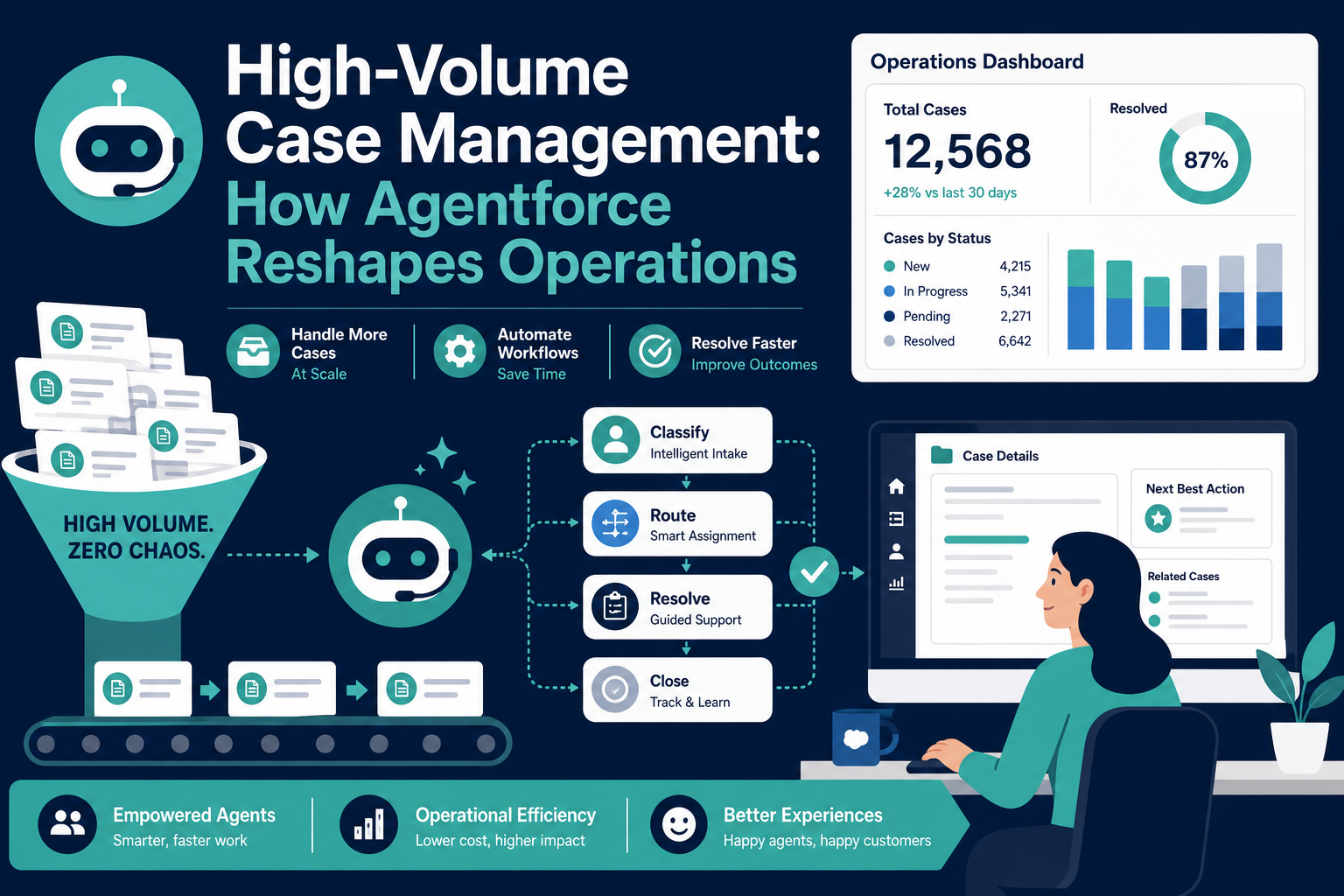
Agentforce can turn each inbound request into a governed workflow: capture context, classify the case, surface approved knowledge, complete bounded actions, and route exceptions to the right person. The goal is not to automate every decision; it is to make repeatable work faster and more consistent while giving people a prepared handoff for judgment-heavy or sensitive cases.
Key Takeaways (TL;DR)
- What is it? Agentforce for high-volume case management is a configuration of AI agents, trusted data, instructions, and approved actions that supports case intake through resolution.
- Key benefit: Teams can reduce manual triage and searching so people spend more time on exceptions, decisions, and relationships.
- How it works: The agent gathers facts, categorizes intent and urgency, retrieves relevant policies or records, performs allowed workflow steps, and escalates when a guardrail is met.
- Human control: People retain responsibility for consequential, uncertain, sensitive, or explicitly escalated cases.
- Best for: Organizations with large volumes of repeatable service, operations, employee, or back-office requests that still require traceability and care.
- Bottom line: The strongest design pairs AI speed with explicit operating rules, grounded knowledge, measurable handoffs, and accountable human oversight.
Why is high-volume case management so difficult?
A case is rarely just a ticket. It may be a claim, authorization request, dispute, employee inquiry, service incident, or other operational issue that requires context, policy, and a next step. At high volume, four pressures arrive together:
- Volume: Requests arrive across email, web forms, messaging, phone notes, and portals: often in bursts that outpace manual sorting.
- Complexity: A single case can draw on account history, prior conversations, contracts, procedures, documents, or records in connected systems.
- Consistency: Similar requests should receive the same care, yet outcomes can vary when people rely on different notes, searches, or interpretations.
- Speed: The clock starts at intake, but the person best equipped to help may not see the case until it has been categorized, enriched, and routed.
Teams must distinguish routine work from missing facts, policy exceptions, and cases that require specialized judgment. Treating all cases alike creates risk; treating every case as an exception creates delay.
What are the limitations of traditional case management?
Traditional case operations often depend on capable people making many small, repeated decisions. That works until volume and variation expose the limits of inboxes, static queues, and institutional memory.
| Operational step | Traditional limitation | What can go wrong |
|---|---|---|
| Intake | A person reads free-form messages and manually creates or cleans up the case. | Important details are missed, fields are inconsistent, and work begins with an incomplete record. |
| Triage | Rules rely on a few keywords or a shared queue. | Urgency, sentiment, subject matter, and customer history can be overlooked. |
| Research | The resolver searches across articles, documents, prior cases, and systems. | Time is spent hunting for information, and the answer may depend on who knows where to look. |
| Resolution | Each person decides how to frame the response and what to do next. | Approved processes are applied unevenly, and routine actions can consume specialist capacity. |
| Review | Leaders see aggregate queue data after the fact. | Recurring failure points and unhelpful handoffs are harder to spot early. |
Basic automation remains valuable, especially for predictable routing rules. Salesforce notes that routing can use predefined rules, queues, skills, and case attributes; AI can add interpretation of the request to that operating foundation. Salesforce’s case-routing overview describes the difference between queue-based and skills-based approaches, as well as how AI-assisted triage can identify context such as intent or urgency.
The opportunity is to add an adaptive layer for unstructured language while staying bounded by policy, data access, and escalation design.
How do AI agents transform the case lifecycle?
1. Intake becomes a structured, usable starting point
An AI agent can read the inbound narrative, recognize the likely reason for contact, and guide the requester toward missing information before the case reaches a person. It can capture relevant fields and identify the related record through an approved process, so the case begins with a clearer problem statement rather than a copied message and open-ended assignment.
This must be designed around the information that is appropriate to collect and the data that the agent is allowed to access. Salesforce’s Agentforce for Service documentation illustrates a standard Case Management subagent with actions such as creating a case record, retrieving cases, and updating a related customer contact record. Those actions are a useful pattern: make the agent’s allowed steps specific, observable, and tied to the business process.
2. Categorization and routing become evidence-led decisions
Instead of routing only on a keyword, an agent can assess a defined taxonomy (topic, urgency, context, sentiment, and required skill) and recommend or trigger an approved queue, skill, or escalation path.
Preserve the evidence behind each classification: the summary, captured fields, source context, and rule that selected the next step. This makes routing reviewable and helps managers distinguish a weak taxonomy, instruction, data point, or queue-capacity problem.
3. Research shifts from hunting to grounded knowledge surfacing
With a well-prepared knowledge foundation, an AI agent can retrieve the relevant procedure, policy, record, or approved document with the case context. The human does not have to start from a blank screen.
Salesforce explains that the Agentforce Data Library can work with Knowledge content, uploaded files, web search, and custom retrievers. Its knowledge-in-Agentforce guide also describes retrieval-augmented generation (RAG) for grounding responses in indexed structured and unstructured sources. That capability is useful only when the source set is curated: current policies should be authoritative, sensitive content should follow permissions, and obsolete documents should not compete with the answer.
4. Resolution can use bounded actions, not open-ended promises
Many case steps are procedural: acknowledge receipt, share status, request a missing document, summarize prior activity, create a follow-up task, or update an approved field after validation. An agent can support them when the action, preconditions, and confirmation language are clear.
The workflow should state what the agent may do, what it must ask or disclose, and what it must hand to a person. The goal is a dependable workflow participant: not an unrestricted decision-maker.
When should AI handle a case, and when should a person step in?
The best escalation model is explicit. An AI agent is well suited to a bounded task when the request is routine, the required data is available, the procedure is approved, and the action is reversible or low risk. A human should take over when a decision involves material impact, uncertainty, sensitivity, an exception, or a request for personal assistance.
| AI can support or complete | Human review or ownership is required |
|---|---|
| Collecting required information, confirming a status, finding an approved policy, or creating a correctly categorized case | Applying judgment to ambiguous facts, conflicting records, policy exceptions, or decisions with legal, clinical, financial, employment, or other significant consequences |
| Routing to a defined queue or skill when the required signals are present | Resolving a complaint involving vulnerability, potential harm, suspected fraud, or an unresolved root cause |
| Drafting a grounded summary or proposing the next procedural step | Any case where the requester asks for a person, the agent cannot find reliable support, or a configured confidence or risk threshold is crossed |
A good escalation packages a concise summary, data collected, sources consulted, actions taken, the escalation reason, and the recommended next decision. Salesforce’s service guidance treats escalation as a standard interaction pattern and notes that a request for a live agent should be escalated.
For sensitive operations, governance belongs in the workflow from the start. Salesforce describes its Trust Layer and trusted AI approach as including guardrails for privacy, security, safety, accuracy, and responsible use. Organizations still need their own approved sources, permissions, testing, monitoring, retention rules, and accountability model.
How can AI improve quality and consistency without removing judgment?
AI does not guarantee a correct outcome, but it can make the standard of care more repeatable: the same intake questions, policy-aware search, response structure, disclosures, and checks for each qualifying case. People can still deviate when facts require it.
A practical design uses scoped instructions, allowed actions, approved knowledge, field validation, audit-ready notes, and review for exceptions. Test it against incomplete, misleading, duplicate, sensitive, conflicting, and decline-or-escalate scenarios. See Vantage Point’s Agentforce quality-assurance tactics.
How does continuous improvement work after launch?
“Learning from every case” should not mean silently changing an agent’s behavior. It should mean reviewing where classification, knowledge retrieval, routing, or handoffs failed and why cases reopened or escalated.
Track intake completeness, routing accuracy, knowledge usefulness, transfer reasons, resolution path, exception volume, and human feedback. Use the findings to revise taxonomy, sources, instructions, integrations, or approval gates. A well-scoped pilot provides a strong starting point; Vantage Point’s Agentforce proof-of-concept framework shows how to define a measurable, governed use case before broadening deployment.
Where does this operating model apply across industries?
The underlying pattern is cross-industry: organize the case, retrieve trusted context, automate bounded steps, and escalate judgment. The policy and risk controls should change with the process.
| Case type | AI agent contribution | Human boundary |
|---|---|---|
| Insurance claims | Capture initial facts, request allowed documentation, share status, retrieve approved claims guidance, and route by claim type or exception. | People retain responsibility for coverage interpretation, liability, payment, and complex claim decisions. |
| Healthcare authorizations | Organize authorization details, identify missing nonclinical information, surface approved process guidance, and route clinical or policy exceptions. | Qualified people retain clinical judgment and responsibility for authorization decisions and sensitive situations. |
| Financial disputes | Collect dispute details, recognize required documents, share approved process information, and route appropriately. | People evaluate fraud signals, entitlement, remediation, regulatory obligations, and complex exceptions. |
| HR cases | Answer approved policy questions, create a private case, request permitted information, and route to the appropriate HR workflow. | HR professionals own sensitive employee-relations matters, exceptions, investigations, and judgment calls. |
The goal is not automation rate alone; it is an appropriate outcome with the controls each case type requires.
What is the practical path to an Agentforce case-management rollout?
Start narrow, then expand based on evidence:
- Map the flow. Identify common request types, channels, queues, handoffs, policies, systems, and exceptions; baseline quality and speed.
- Choose a bounded use case. Select a common, well-documented request with a clear success criterion and escalation boundary.
- Prepare sources and data. Assign owners to authoritative knowledge, records, and integrations; remove obsolete content and validate permissions.
- Define actions and guardrails. Specify allowed actions, inputs, confirmations, risk flags, and handoff triggers: do not make a prompt the entire control system.
- Test and operate. Test normal, ambiguous, sensitive, and failure scenarios; then sample outcomes and make controlled improvements.
Vantage Point can connect Salesforce implementation and advisory services with system integration and data migration services so AI case workflows are grounded in the systems people actually use.
Make case management faster without making it less accountable
Agentforce can handle repeatable intake, classification, routing, research, and approved resolution steps while people focus on exceptions, consequential decisions, empathy, investigation, and improvement.
The right deployment has a bounded use case, trusted knowledge, clear actions, meaningful handoffs, and outcome-focused metrics. Talk to Vantage Point about Agentforce to assess a governed case-management use case and plan a path from pilot to operations.
Frequently Asked Questions
What is AI case management?
AI case management uses AI to help organize, interpret, research, route, and advance cases through a defined workflow. In an enterprise setting, it should work alongside approved policies, data permissions, business rules, and human owners rather than operate as an unrestricted decision-maker.
How does Agentforce improve case routing?
Agentforce can use the meaning and context of an inbound request to help classify the topic, urgency, and likely next path. Organizations should combine that interpretation with explicit routing rules, skills, capacity, policy restrictions, and reviewable escalation criteria.
Can AI agents resolve sensitive cases without a person?
They should not be designed to make sensitive or consequential decisions without a clear, approved operating model. Cases involving ambiguity, high impact, legal, clinical, financial, employment, privacy, safety, or other material concerns need appropriate human responsibility and escalation controls.
What knowledge should an AI case-management agent use?
Use current, authoritative sources that are appropriate for the case type: approved procedures, knowledge articles, policy documents, controlled records, and permitted system data. Content owners should review source quality, permissions, and retirement dates so the agent does not ground responses in obsolete material.
How do teams measure whether an AI case workflow is working?
Measure both efficiency and quality: completeness at intake, routing accuracy, knowledge usefulness, handoff quality, resolution path, reopen trends, exception volume, and user feedback. Review the results by case type so a fast workflow does not mask poor outcomes for complex or sensitive requests.
Official Salesforce Resources
- Agentforce for Service: standard subagents and actions
- Using knowledge in Agentforce for Service
- Salesforce trusted AI and Trust Layer
- Salesforce case-routing automation overview
About Vantage Point
Vantage Point is a CRM and technology consulting firm helping organizations plan, implement, integrate, and improve Salesforce, HubSpot, data, and AI-enabled operations. Our senior-led team brings strategy and execution together for practical, measurable change.