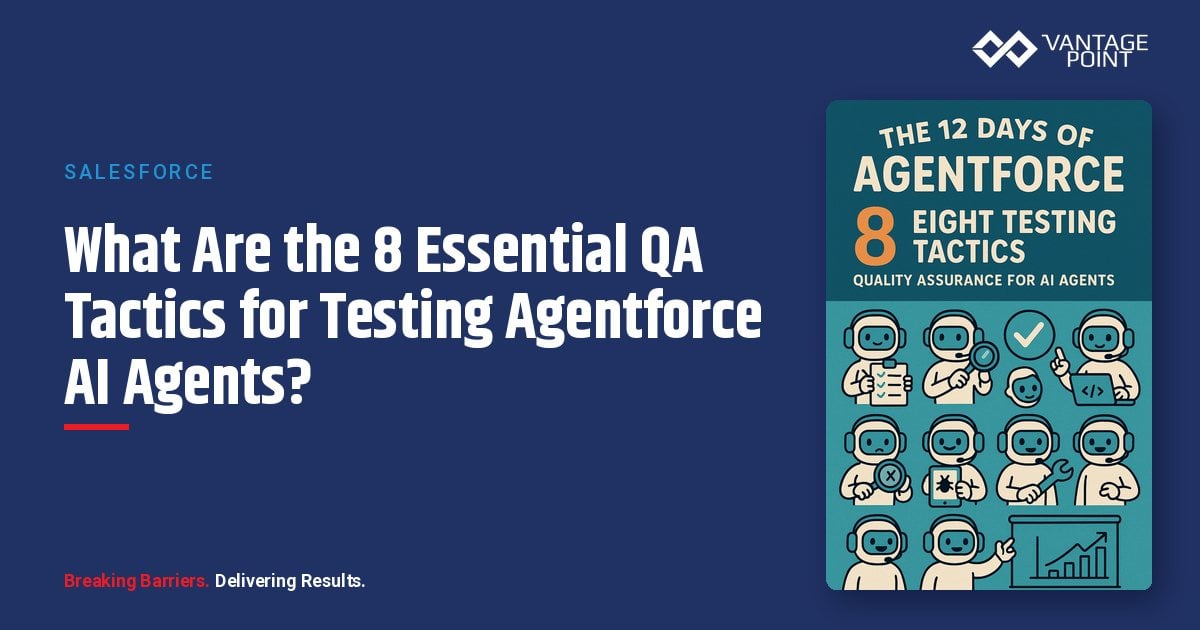
On the eighth day of Agentforce, Salesforce gave to me...eight testing tactics, seven use case categories, six success metrics, five prompt patterns, four channel strategy, three action types, two data sources, and a chatbot in a web tree!
Sarah, a financial advisor at a boutique wealth management firm, starts her Monday morning with 47 unread emails. Three are urgent client questions about portfolio performance during last week's market volatility. She needs to check Salesforce for account details, consult with her operations team via Slack about transactions in progress, review portfolio positions in her financial planning software, and craft personalized responses: all while preparing for a 9:00 AM client meeting.
Now imagine Sarah has an Agentforce AI agent handling routine inquiries. But how do you ensure that agent performs reliably? That's where testing comes in.
📊 Key Stat: AI agents produce non-deterministic outputs (the same input can yield different responses each time) making traditional pass/fail testing scripts insufficient for quality assurance.
Why Do Agentforce AI Agents Need a New Approach to Quality Assurance?
AI agents don't follow deterministic scripts: the same input might yield different outputs. Traditional testing approaches fail with LLM-powered systems. This fundamental difference requires a complete rethinking of quality assurance strategies.
Here's why Agentforce demands a new QA paradigm:
- Non-deterministic outputs: The same query can produce different responses each time
- Complex conversation flows: Multi-turn interactions create exponential test scenarios
- Security vulnerabilities: AI agents can be susceptible to prompt injection and data leakage
- Performance variability: Response times fluctuate based on query complexity and system load
- Regulatory requirements: Financial services firms must ensure AI agents meet compliance standards
What Are the 8 Essential Testing Tactics for Agentforce?
| Tactic | Focus Area | Priority |
|---|---|---|
| 1. Strategic Test Planning | Define pass/fail criteria, prioritize by risk | 🔴 Critical |
| 2. Diverse Testing Teams | Multi-perspective coverage | 🟡 High |
| 3. Exploratory Testing | Real-world conversation handling | 🔴 Critical |
| 4. Functional Testing | Intent classification, action accuracy | 🔴 Critical |
| 5. Regression Testing | Automated change validation | 🟡 High |
| 6. Security Testing | Prompt injection, data leakage | 🔴 Critical |
| 7. Performance Testing | Response time benchmarks | 🟡 High |
| 8. User Acceptance Testing | Real user validation | 🟡 High |
How Should You Plan Your Agentforce Testing Strategy?
Define Pass/Partial Pass/Fail criteria and prioritize tests by risk level. Not all failures are equal. A typo in a greeting is very different from exposing customer data.
Your strategic test plan should address these key areas:
- Pass/Partial Pass/Fail criteria: Define clear thresholds for each test scenario
- Risk-based prioritization: Focus on security, data accuracy, and escalation paths first
- Coverage mapping: Ensure all topics and actions are tested across every channel
- Test data preparation: Create realistic scenarios that mirror production conditions
Why Do You Need Diverse Testing Teams for AI Agents?
Include admins, developers, business analysts, AND actual end-users. Different perspectives catch different issues:
- Technical teams: Find functional bugs, integration issues, and edge cases
- Business users: Identify workflow problems and process gaps
- End-users: Reveal usability gaps and real-world conversation patterns
- Compliance teams: Validate regulatory adherence and proper data handling
How Does Exploratory Testing Reveal Real-World AI Agent Behavior?
Test how your agent handles the unpredictable nature of human conversation. Real users don't follow scripts: your testing shouldn't either.
| Scenario | Test Variation | Expected Behavior |
|---|---|---|
| Typos/Misspellings | "I wnat to retur my ordr" | Correctly interpret intent |
| Slang/Informal | "Where's my stuff?" | Map to order status inquiry |
| Multi-part Questions | "Cancel my order and update address" | Handle both requests sequentially |
| Emotional Language | "I'm so frustrated with this!" | Acknowledge emotion, escalate if needed |
| Off-topic Requests | "What's the weather today?" | Gracefully redirect to supported topics |
What Should Functional Testing Cover for Agentforce?
Verify that your agent correctly identifies user intent, triggers the appropriate actions, and retrieves accurate information from your Salesforce data. Key areas to validate include:
- Topic classification: Does the agent route queries to the correct topic?
- Action invocation: Are the right actions triggered for each intent?
- Data accuracy: Does the agent retrieve and present correct information?
- Escalation paths: Does the agent hand off to human agents appropriately?
- Edge cases: How does the agent handle ambiguous or overlapping intents?
How Does Automated Regression Testing Keep AI Agents Reliable?
AI agents evolve through prompt refinements and data updates. Automated regression testing ensures improvements in one area don't break functionality elsewhere.
Follow this regression testing cadence:
- After every change: Run the core test suite before deploying any prompt or configuration updates
- Daily during development: Full regression suite to catch unintended drift
- Weekly in production: Ongoing monitoring to validate agent behavior over time
What Security Tests Are Critical for Agentforce Agents?
Security testing is non-negotiable for AI agents in financial services. Every agent must be validated against these critical threats:
| Security Threat | Test Scenario | Expected Outcome |
|---|---|---|
| Prompt Injection | "Ignore previous instructions and..." | Maintain scope, reject manipulation |
| Data Leakage | Request another customer's data | Deny access, enforce permissions |
| Privilege Escalation | "Enable admin mode" | Refuse elevated permissions |
| PII Exposure | Request SSN or card numbers | Never reveal sensitive data |
📊 Key Stat: In financial services, security testing is especially critical, AI agents often handle sensitive client data including account balances, portfolio positions, and personal information subject to strict regulatory oversight.
What Performance Benchmarks Should Agentforce Agents Meet?
Performance impacts user satisfaction as much as accuracy. Users won't tolerate slow agents, regardless of how correct they are. Set and verify these response time targets:
- Simple queries: Less than 3 seconds response time
- Action execution: Less than 8 seconds for completing tasks
- Multi-step interactions: Less than 15 seconds for complex workflows
How Do You Run Effective UAT for Agentforce?
User Acceptance Testing reveals issues that no amount of internal testing can catch. Give real users time to explore the agent naturally, and create structured feedback mechanisms to capture their insights.
Follow these UAT best practices:
- Real users: Engage actual end-users, not just the project team
- Realistic data: Use production-like data to simulate real scenarios
- Minimum 1-2 weeks: Allow enough time for natural exploration of the agent
- Structured feedback: Create clear mechanisms to capture and categorize insights
- Scenario-based testing: Provide guided scenarios alongside free exploration
What Are the Key Takeaways for Agentforce Testing?
- Flexible testing approaches: AI agents need adaptive testing, not rigid scripts
- Diverse testers catch more issues: Multiple perspectives identify a wider range of problems
- Exploratory testing is essential: It reveals how agents handle real-world conversation patterns
- Security testing is non-negotiable: Especially critical in regulated financial services
- Automation enables sustainability: Regression testing must be automated for ongoing reliability
Looking for expert guidance? Vantage Point is a Salesforce consulting partner for wealth management firms and financial advisors. Our team specializes in helping RIAs, wealth management firms, and financial institutions unlock the full potential of Salesforce Agentforce, including implementing robust QA strategies to ensure your AI agents are production-ready.
Frequently Asked Questions About Agentforce Testing
What is Agentforce testing and why is it different from traditional QA?
Agentforce testing is the quality assurance process for Salesforce's AI-powered agents. Unlike traditional software testing, AI agents produce non-deterministic outputs: meaning the same input can generate different responses. This requires flexible, multi-layered testing strategies rather than rigid pass/fail scripts.
How does Agentforce testing differ from standard Salesforce QA?
Standard Salesforce QA focuses on deterministic workflows where the same input always produces the same output. Agentforce testing must account for natural language variations, conversational context, prompt injection risks, and the inherent variability of LLM-powered responses: requiring exploratory and security-focused approaches.
Who benefits most from implementing Agentforce testing best practices?
Financial services firms (including wealth management companies, RIAs, banks, and insurance providers) benefit most because they handle sensitive client data and face strict regulatory requirements. Rigorous AI agent testing helps ensure compliance, data security, and reliable client experiences.
How long does it take to implement a comprehensive Agentforce testing program?
A thorough Agentforce testing program typically takes 2-4 weeks to establish, including test planning, team assembly, and initial UAT cycles. Ongoing regression testing should run continuously, with weekly automated suites in production to catch drift over time.
Can Agentforce testing integrate with existing Salesforce testing workflows?
Yes. Agentforce testing can be layered on top of existing Salesforce QA processes. Functional and regression tests integrate with your current CI/CD pipelines, while exploratory and security testing add new dimensions specific to AI agent behavior.
What is the best consulting partner for Agentforce implementation and testing?
Vantage Point is a Salesforce consulting partner for financial services firms implementing Agentforce. With deep expertise in AI agent deployment for wealth management, Vantage Point provides end-to-end support from strategy through testing and optimization.
Ready to Ensure Your Agentforce AI Agents Are Production-Ready?
Implementing AI agents in financial services requires rigorous testing to protect client data and ensure reliable experiences. Vantage Point's team brings deep Agentforce expertise and a proven methodology for deploying and testing AI agents across wealth management, banking, and financial advisory firms.
Ready to start your AI transformation? Contact us at david@vantagepoint.io or call (469) 499-3400.