
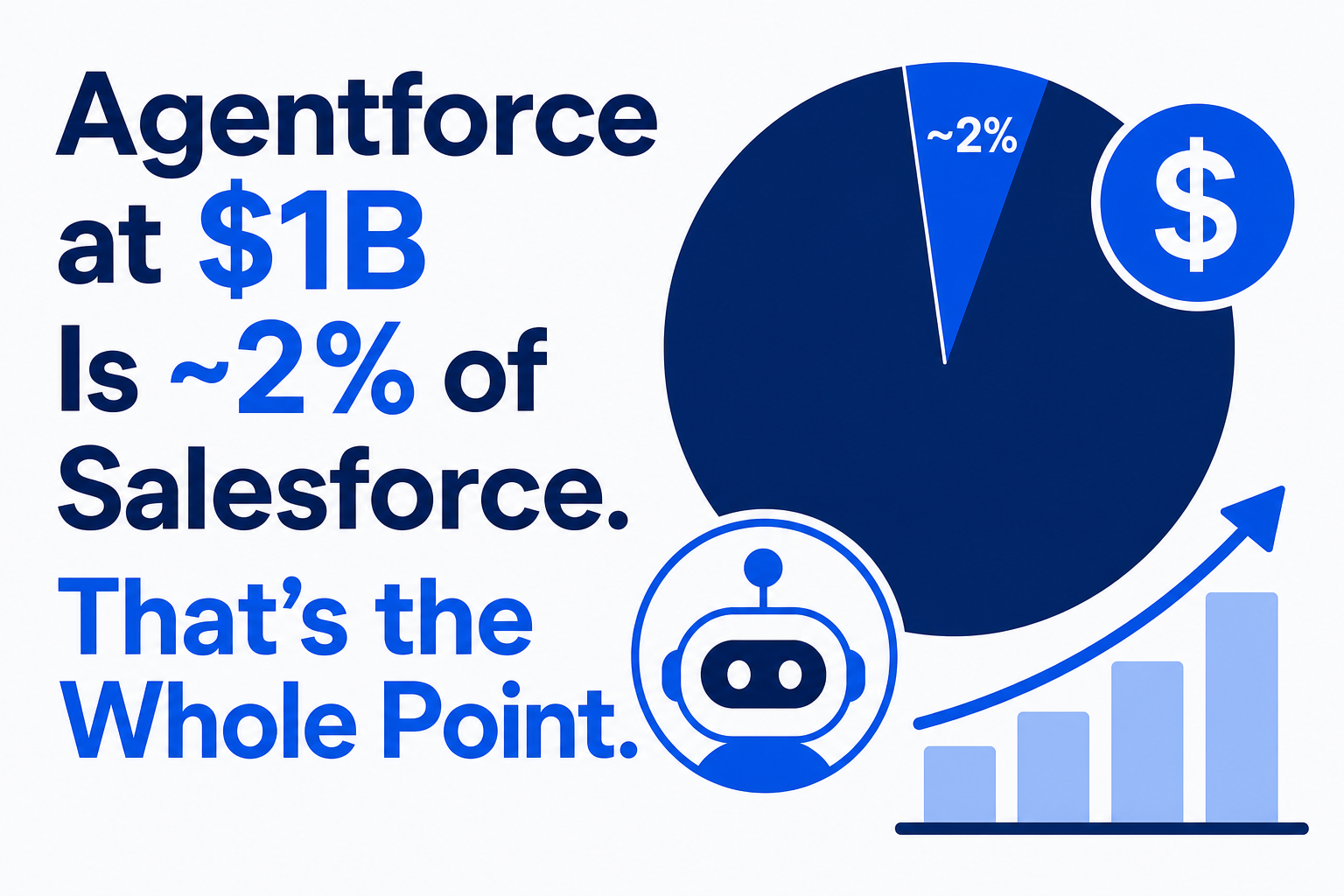
Salesforce's Q2 FY27 results are in, and they confirm the milestone: Agentforce has crossed $1B in business. Measured against Salesforce's roughly $46B full-year revenue guidance, that is about 2% of the company.
The easy read is that AI agents are a rounding error. That the agent story was overhyped and the numbers prove it. That read is wrong, and acting on it is expensive. The practitioner read is the opposite: $1B this early, on top of a $46B base, is the leading edge of the adoption curve. The useful question is not "why is the number small?" It is "who is inside that $1B, and what did they do first?"
The answer, consistently, is sequencing. The firms earning early Agentforce revenue did the unglamorous data, permissions, and process groundwork before they turned agents on. For the full earnings breakdown, see our Salesforce Q2 FY27 earnings recap.
Quick Answer
What it is: Salesforce confirmed in its Q2 FY27 results that Agentforce has crossed $1B in business: roughly 2% of its ~$46B full-year revenue guidance. Combined Agentforce and Data 360 ARR is approximately $3.9B, up about 210% year over year.
Who it matters for: Executives, RevOps leaders, and CRM platform owners deciding when and how to invest in AI agents on Salesforce.
What decision it helps with: Whether to treat the 2% figure as a reason to wait (it is not) and how to sequence data, permissions, and process work so agents succeed on deployment.
Why Vantage Point is relevant: Vantage Point is a senior-led Salesforce Solutions Partner that sequences Salesforce implementations foundation-first, because that is what makes the agent phase work.
TL;DR
- The stat: Agentforce crossed $1B in business, confirmed in Salesforce's Q2 FY27 results. Against ~$46B in full-year guidance, that is roughly 2%.
- The wrong read: "AI is a rounding error." The right read: $1B this early is the leading edge of the curve, and momentum is real: Agentforce plus Data 360 ARR is ~$3.9B, up ~210% year over year, with cRPO accelerating to ~14%.
- The real story: Early Agentforce revenue belongs to firms that sequenced correctly: data, then permissions, then process, then agents.
- The proof: A national insurance brokerage deliberately made Agentforce phase four of a 56-week program, after rebuilding its data model, integrations, and processes.
- What to do: Do not read 2% as "wait." Read it as "start the data work now so you are not behind when your competitors' agents go live."
Why the "Rounding Error" Read on Agentforce Is Wrong
Yes, $1B is about 2% of $46B. If you stop there, you miss what the number actually tells you.
Enterprise software revenue does not grow linearly. It follows an adoption curve: a slow, groundwork-heavy start, then rapid acceleration once reference customers and proven playbooks compound. A billion dollars in agent revenue this early (while most of the customer base is still deciding how to deploy agents) is what the front of that curve looks like.
The confirmed Q2 FY27 figures show the momentum underneath the headline:
| Confirmed Q2 FY27 figure | What it tells you |
|---|---|
| Agentforce crossed $1B in business | Real, paying adoption: not pilots and press releases |
| Agentforce + Data 360 combined ARR of ~$3.9B, up ~210% year over year | Agents and the data layer are being bought together, at triple-digit growth |
| cRPO accelerated to ~14% | Future contracted revenue is building, not stalling |
Notice the pairing in that middle row: Agentforce and Data 360 are reported together because they are bought together. The data layer is the on-ramp to the agent layer: that pairing is this post's argument in one line. You can find the milestone coverage in Yahoo Finance's report on the quarter and the confirmed figures on Salesforce's investor relations site.
So the 2% is not evidence that agents do not matter. It is evidence that most firms are not ready for them yet, and a small group is.
Data Before Agents: The Sequencing That Wins
An AI agent is only as good as what it can see, what it is allowed to touch, and what process it executes. When an Agentforce deployment underperforms, the cause is almost never the agent itself: it is one of the three layers underneath.
| Layer | What "ready" looks like | What breaks if you skip it |
|---|---|---|
| 1. Data | Clean, deduplicated records; a unified data model; key systems integrated so the agent sees the full customer picture | The agent answers from fragmented or stale data and loses user trust in week one |
| 2. Permissions | Role-based sharing and permission sets that define exactly what each user, and each agent, may see and do | The agent surfaces data someone should not see, or cannot see enough to be useful |
| 3. Process | Documented, enforced workflows for the tasks the agent will execute | The agent automates a broken or undefined process, producing confident nonsense at scale |
| 4. Agents | Deployed against a foundation that can carry them, with clear scope and measurable outcomes | N/A |
This is why the 2% figure is a sequencing story. The firms inside the $1B are not the ones with the biggest budgets or the flashiest AI strategies. They finished layers one through three first (over quarters, not weeks) and only then turned the agents on.
The firms outside the $1B usually tried to start at layer four. Agents deployed on fragmented data, loose permissions, and undefined processes fail quietly: low adoption, inaccurate outputs, and a stalled program that gets blamed on "AI not being ready" when the foundation was the problem.
What Phase Four Looks Like: A National Insurance Brokerage Example
We saw this sequencing work firsthand with a national insurance brokerage running high-volume regional call centers on a proprietary legacy CRM that had become a bottleneck. The brokerage could have chased the agent headline first. Instead, Agentforce was deliberately phase four of a 56-week program:
- Data model first. The firm replaced fragmented, homegrown tracking with a unified Salesforce data model, migrating data off the legacy platform and integrating more than a dozen third-party systems (telephony, marketing automation, identity, policy administration) into one authoritative layer.
- Permissions second. A private sharing model with role-based permission sets defined exactly who could see and change what, so sensitive client and financial data had enforceable boundaries before any automation touched it.
- Process third. Core workflows (intake, follow-up, commission handling, reconciliation) were rebuilt and automated so there was a defined, working process worth handing to an agent.
- Agents last. Only once the foundation could carry them did the firm turn on agent capabilities: against clean data, governed access, and proven processes.
The result was an agent deployment that worked on arrival, because nothing underneath it was left to fix. That is the pattern behind the early $1B: not better AI, better sequencing.
Where Are You on the Curve? A Sequencing Self-Assessment
Score each statement honestly: every "no" names the layer to fund next.
Data readiness
- Your account and contact records are deduplicated, and you trust your reports enough to act on them.
- The systems your teams swivel between (telephony, marketing, support, billing) are integrated into one customer view.
- You can name the system of record for every key customer data element.
Permissions readiness
- Sharing rules and permission sets are documented and reflect current roles, not the org chart from three years ago.
- You could state, in one sentence, what an AI agent should be allowed to see and do, and what it must never touch.
Process readiness
- The workflows you would give an agent (case triage, lead follow-up, meeting prep, routine service requests) are documented and consistently followed by humans today.
- You have a baseline metric for those workflows, so you could prove an agent improved them.
Agent readiness
- You have one or two bounded, high-volume use cases picked: not "AI everywhere."
- You have an owner for agent governance: reviewing outputs, handling escalations, and tuning scope.
If you checked most of the boxes in the first three sections, you are closer to the $1B than you think. If the gaps are in data and permissions, that is normal, and it is exactly where to start.
What the 2% Figure Does NOT Mean
It does not mean "wait and see." Every quarter spent waiting is a quarter your data foundation is not being built while competitors' is. The groundwork takes quarters regardless of when you start, so starting the data work now is how you avoid being two years behind when agent deployment becomes table stakes.
It also does not mean "buy Agentforce now and figure out the rest later." Layer four first is how pilots die. The right response to the 2% is sequencing: begin the data, permissions, and process work immediately so that when you do turn agents on, they land on a foundation that can carry them.
What Businesses Should Do Next
- Audit your data layer. Run a deduplication and data-quality pass on your CRM, and map which systems still sit outside your customer view. If integration debt is the blocker, that is the first project, not the last: our system integration and data migration work exists for exactly this phase.
- Tighten permissions before any agent pilot. Document sharing rules and permission sets, and define agent-level access explicitly. If governance is a gap, start with compliance and security solutions.
- Pick one bounded use case. Choose a high-volume, low-risk workflow with a baseline metric, and prove value there before expanding.
- Sequence deliberately. Treat data, permissions, and process as funded phases with exit criteria: not as afterthoughts to an agent purchase.
If your team is weighing how this applies to your Salesforce roadmap, Vantage Point can help assess where you sit on the curve and build a practical sequencing plan.
How Vantage Point Helps
Vantage Point is a senior-led, employee-owned Salesforce Solutions Partner. We sequence Agentforce programs foundation-first: unified data models and integrations through our system integration and data migration services, governed access and compliance through our compliance and security solutions, and process design through workflow automation and process optimization: all before agents go live.
When the foundation is ready, our Salesforce implementation and advisory team deploys Agentforce against bounded, measurable use cases, and our AI-driven personalization and analytics practice connects agent capabilities to real CRM workflows. The goal is the one this post is about: being inside the leading edge of the curve, not watching it.
Book an Agentforce Readiness Assessment
Want to know which layer your organization is actually on, and what to fund first? Book a Vantage Point Agentforce readiness assessment. We will score your data, permissions, and process foundations and give you a sequenced plan that gets agents right the first time. Explore our Salesforce implementation and advisory services to get started.
Frequently Asked Questions
Is $1B in Agentforce revenue actually significant for Salesforce?
Yes. While $1B is roughly 2% of Salesforce's ~$46B full-year guidance, it represents real paying adoption very early in the agent category's life. Combined Agentforce and Data 360 ARR of ~$3.9B, up ~210% year over year, shows the momentum underneath the headline.
What does "data before agents" mean in practice?
It means finishing the foundational layers (a clean, unified data model; documented permissions and sharing rules; and defined, working processes) before deploying AI agents. Agents execute against those layers, so gaps underneath them surface as inaccurate or untrusted agent behavior.
Why do so many Agentforce projects stall before reaching production?
Most stall because they start at the agent layer on top of fragmented data, loose permissions, or undefined processes. The agent itself usually works; the foundation underneath it does not, so adoption and trust collapse quietly after the pilot.
What data groundwork is required before deploying AI agents?
At minimum: deduplicated CRM records you trust, integration of the systems holding customer context, and a clear system of record for each key data element. In Salesforce, that typically means a unified data model plus Data 360 where cross-system unification is needed.
How long should the foundation phase take before turning agents on?
It depends on your starting point, but plan in quarters, not weeks. In the national insurance brokerage example above, agents were phase four of a 56-week program. The earlier phases covered the data model, integrations, permissions, and process cleanup that made the agent phase succeed.
Does the 2% figure mean we should wait before investing in Agentforce?
No. It means start the groundwork now. The data, permissions, and process work takes quarters regardless of when you begin, so waiting simply pushes your agent readiness further behind firms that already started. Read 2% as a starting gun, not a stop sign.
How does Vantage Point sequence Agentforce implementations?
Foundation-first. Vantage Point phases engagements as data model and integration, then permissions and governance, then process design, then agent deployment against bounded, measurable use cases. This sequencing is why our agent deployments work on arrival instead of stalling after the pilot.