Key Takeaways (TL;DR)
- What is it? HubSpot's data model is the structural foundation of your CRM, composed of objects (database tables), properties (data fields), records (individual entries), and associations (relationships between records)
- Key Benefit: A well-architected data model enables clean reporting, powerful automation, and seamless integrations across your entire tech stack
- Effort Level: 2-4 weeks for initial architecture planning; ongoing governance required to prevent property sprawl
- Best For: Regulated industries (financial services, healthcare, insurance) implementing or optimizing HubSpot CRM for compliance-sensitive operations
- Bottom Line: Organizations that invest in proper data model design see 40-60% faster report generation, fewer workflow errors, and dramatically improved adoption rates across teams
Introduction
If you've ever opened your HubSpot CRM and felt overwhelmed by duplicate properties, broken reports, or workflows that reference fields nobody remembers creating: you're not alone. The root cause is almost always the same: a poorly designed data model.
HubSpot's data model is the invisible architecture that determines how your customer information is stored, organized, and connected. It's the difference between a CRM that empowers your team and one that creates more confusion than clarity. For organizations in regulated industries, financial services firms tracking AUM and compliance milestones, healthcare organizations managing patient engagement, insurance companies handling policy lifecycles, getting the data model right isn't just a best practice. It's a business imperative.
In this comprehensive guide, we'll break down every component of HubSpot's data model, explain when to use custom objects versus custom properties, walk through real-world architecture scenarios for regulated industries, and share the best practices that prevent the "property sprawl" problem plaguing most HubSpot portals.
What Is the HubSpot Data Model?
The HubSpot data model is the underlying structure that organizes all customer and business data within the CRM platform. Think of it as the blueprint for your database. Just as a building's architectural plans determine where walls, doors, and plumbing go, your data model determines where information lives, how it's categorized, and how different pieces of data relate to one another.
At its core, HubSpot's data model consists of four layers:
- Objects: The categories (database tables) that define what type of data you're storing
- Records: Individual entries within each object (rows in a table)
- Properties: The specific data fields on each record (columns in a table)
- Associations: The relationships connecting records across different objects (foreign keys)
If you have experience with relational databases, HubSpot's architecture will feel familiar: the terminology differs, but the concepts are identical.
HubSpot Objects: The Foundation of Your CRM
Objects are the top-level containers in your data model. Each object represents a distinct category of information and functions as its own database table with a unique schema, properties, and relationship rules.
Standard Objects
Every HubSpot portal includes several pre-built objects. The most commonly used are:
| Object | Purpose | Deduplication Key | Available On |
|---|---|---|---|
| Contacts | People who interact with your business | Email address | All tiers |
| Companies | Organizations associated with your business | Domain name | All tiers |
| Deals | Revenue opportunities moving through your pipeline | Record ID | All tiers |
| Tickets | Customer support requests and issues | Record ID | All tiers |
| Leads | Sales qualification tracking for contacts/companies | Record ID | Sales Hub Pro+ |
| Products | Items or services your business sells | Record ID | All tiers |
| Quotes | Formal cost estimates linked to deals | Record ID | All tiers |
| Invoices | Digital bills sent to customers | Record ID | All tiers |
| Subscriptions | Recurring payment tracking | Record ID | All tiers |
HubSpot also includes specialized objects like Marketing Events, Campaigns, Appointments, Services, Listings, Courses, Projects, Carts, and Orders: some of which must be activated by a Super Admin in the Data Model tool.
Custom Objects
Custom objects are user-defined tables for data that doesn't fit standard categories. Available on Enterprise subscriptions, custom objects behave identically to standard objects: they support custom properties, associations, workflows, and reporting. The difference is that you define the entire schema.
Common custom object examples for regulated industries:
- Policies (insurance): Track policy numbers, coverage types, renewal dates, and premium amounts independently from deals
- Accounts/Portfolios (wealth management): Manage AUM, investment strategies, and custodian relationships
- Compliance Cases (financial services): Track regulatory inquiries, audit findings, and remediation timelines
- Patient Journeys (healthcare): Map engagement touchpoints while maintaining HIPAA compliance
- Locations/Branches (banking): Manage multi-branch operations with location-specific data
Properties: The Data Fields That Power Everything
Properties are the individual data fields stored on each record. Every property has four critical components:
- Internal API name: Permanent and cannot be changed after creation
- Display label: What users see in the interface (editable anytime)
- Field type: Text, number, date, dropdown, boolean, etc.
- Constraints: Required, unique, validation rules
Property Types and When to Use Each
| Property Type | Best For | Key Limitation |
|---|---|---|
| Single-line text | Names, IDs, short descriptions | Up to 65,536 characters |
| Multi-line text | Notes, detailed descriptions | Cannot be evaluated in workflow branching logic |
| Number | Revenue, counts, scores | Floating-point precision can cause rounding errors |
| Date | Deadlines, milestones | Evaluates in portal timezone, not user timezone |
| Date and time | Meeting times, timestamps | Includes time component unlike basic date |
| Dropdown select | Status, category, lifecycle stage | Internal values are permanent; display labels can change |
| Multiple checkboxes | Tags, multi-select categories | Harder to report on than single-select dropdowns |
| Calculated | Derived metrics, formulas | Fails silently (shows blank, no error message) |
| Score | Lead scoring, engagement scoring | Requires careful criteria management |
The Property Sprawl Problem
The single biggest data model mistake organizations make is uncontrolled property creation. Marketing creates lead_source_campaign, Sales adds campaign_source, and Operations builds utm_campaign_source: three properties tracking identical data.
Why it happens: HubSpot doesn't enforce property governance by default. Any user with sufficient permissions can create custom properties without validation, naming standards, or cross-functional review.
The impact:
- Reports return inconsistent results because data lives in multiple places
- Workflows reference deprecated fields and silently fail
- Sales reps see 80+ properties on a contact record when only 12 matter
- AI tools trained on your data return unreliable results
- New team members take weeks longer to onboard
The solution: Establish a property naming convention before building. Use prefixes to signal ownership and purpose: compliance_ for regulatory fields, fin_ for financial metrics, mkt_ for marketing properties, and ops_ for operational data.
Critical Rule: API Names Are Permanent
Unlike display labels, internal API names cannot be changed after creation. If you create a property with the API name q4_2024_campaign_source and later need it for all quarters, you're stuck with a misleading name forever, or you must create a new property, migrate data, update all workflows and reports, then deprecate the old one.
Best practice: Always use generic, timeless API names (campaign_source_primary) even if the initial use case is time-bound.
Associations: How Records Connect
Associations are the relationships between records. They're what allow you to see all contacts at a company, all deals associated with a contact, or all tickets linked to a specific product.
Understanding Association Types
| Association | Cardinality | Example |
|---|---|---|
| Contact → Company | Many-to-one | Each contact has one primary company; companies have many contacts |
| Contact → Deal | Many-to-many | Contacts can be on multiple deals; deals involve multiple contacts |
| Deal → Company | Many-to-one | Each deal belongs to one primary company |
| Ticket → Contact | Many-to-one | Each ticket has one primary contact |
| Custom Object → Any | Configurable | You define the cardinality during object creation |
Association Labels
Association labels add context to relationships. Instead of just knowing "Jane Smith is associated with Acme Corp," labels let you specify how they're related:
- Decision Maker vs. Influencer vs. End User (Deal → Contact)
- Primary Contact vs. Billing Contact vs. Compliance Officer (Company → Contact)
- Parent Company vs. Subsidiary (Company → Company)
For regulated industries, association labels are particularly powerful:
- Beneficial Owner vs. Authorized Signer (financial services)
- Primary Care Provider vs. Specialist vs. Care Coordinator (healthcare)
- Policyholder vs. Beneficiary vs. Agent of Record (insurance)
Association Limits to Know
- Maximum of 100 association labels per object pair
- Association labels cannot be deleted if any records use them (only archived)
- Associations consume API call limits when syncing via integrations
The Data Model Builder: Visualizing Your Architecture
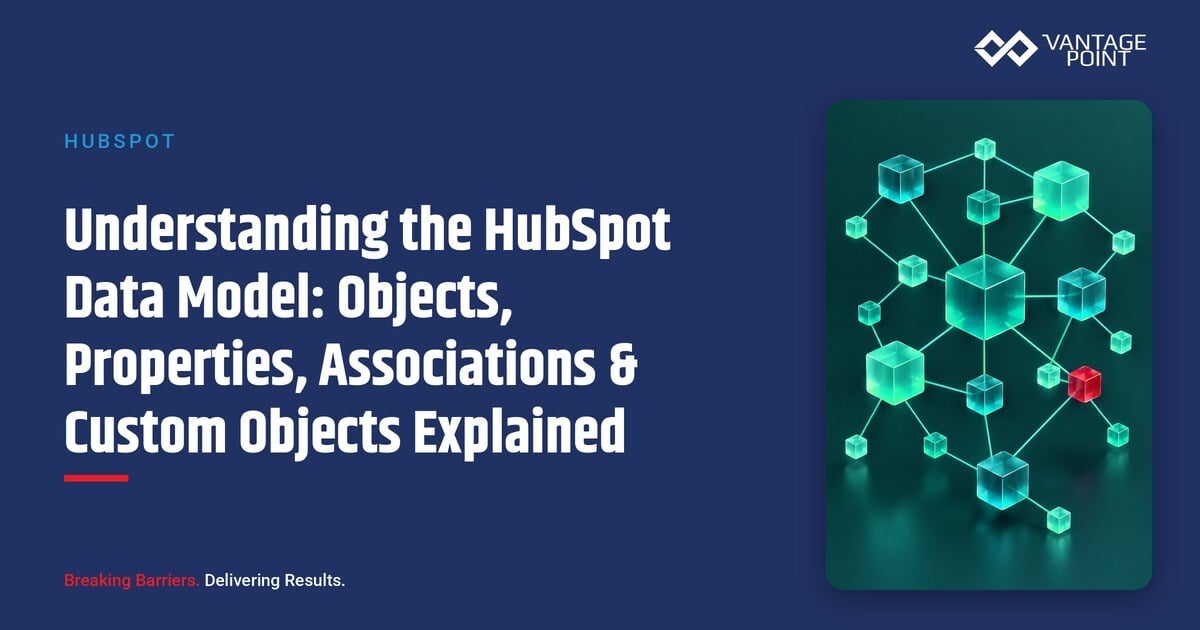
HubSpot's Data Model Builder (Settings → Data Management → Data Model) provides a visual representation of your entire CRM architecture. Updated significantly in late 2025, the tool now allows you to:
- View all objects as visual nodes with connecting lines showing associations
- Create custom objects directly within the builder interface
- Define properties and set display properties for each object
- Toggle objects on/off in the display to reduce visual clutter
- See association label counts per object pair at a glance
- Identify architectural complexity before it becomes unmanageable
Pro tip: If your data model visualization looks like a plate of spaghetti with 15+ objects and 50+ association lines, it's time for an architecture review.
As of August 2025, HubSpot's Breeze Copilot can also help you configure your data model and answer questions about best practices, a helpful starting point, though not a substitute for strategic architecture planning.
When to Use Custom Objects vs. Custom Properties
This is the most common architectural decision teams face. Here's a clear decision framework:
Create a Custom Object When:
1. One-to-Many Relationships Need Independent Tracking
A financial advisory firm manages multiple client accounts, each with its own AUM, investment strategy, risk tolerance, and rebalancing schedule. Adding account_1_aum, account_2_aum properties to Contact records creates rigid schema that breaks when clients have more accounts than you anticipated.
Solution: Create an "Accounts" custom object. Each Account record associates to one Contact (many-to-one) with properties for account_type, aum, strategy, risk_profile, and last_rebalanced_date.
2. Many-to-Many Relationships Require Context
An insurance brokerage handles policies that involve multiple contacts from multiple companies: policyholders, beneficiaries, agents, and underwriters all play different roles. Standard associations can't capture who represents which company in which capacity.
Solution: Create a "Policy Participants" custom object that sits between Contacts, Companies, and a "Policies" custom object, with properties like participant_role and relationship_type.
3. The Data Has Its Own Independent Lifecycle
A healthcare technology company sells annual compliance licenses that renew independently of the original deal. Each license has its own activation date, expiration, compliance status, and renewal terms.
Solution: Create a "Licenses" custom object associating to the originating Deal and the Company, with workflows triggering renewal processes 90 days before expiration.
Use Custom Properties (Not Objects) When:
- The data describes attributes of an existing record: Industry-specific fields like
compliance_statuson Company records - You're tracking simple categorical data: A
client_segmentdropdown on Contact records - The relationship is strictly one-to-one: Each Deal has one
primary_competitortext field - You don't need independent lifecycle management: The data doesn't change or trigger actions independently
Data Model Best Practices for Regulated Industries
1. Plan Before You Build
Document your intended data model in a spreadsheet or diagramming tool before touching HubSpot. Map out which objects you need, properties for each with naming conventions, association types and labels, and cardinality rules for every relationship.
2. Establish Governance From Day One
Assign a Data Steward (or small governance committee) responsible for approving new property requests, maintaining naming conventions, conducting quarterly property audits, and documenting the data model for new team members.
3. Design for Compliance
For organizations in regulated industries, your data model must support:
- Audit trails: HubSpot logs every property change, but make sure sensitive fields are properly tracked
- Data retention policies: Know which properties contain regulated data and set appropriate retention rules
- Access controls: Use field-level permissions to restrict who can view or edit sensitive properties
- HIPAA compliance: If handling protected health information, use HubSpot's sensitive data tools (available since mid-2024)
4. Limit Calculated Property Chains
Calculated properties that depend on other calculated properties introduce calculation lag and silent failures. Limit chains to a maximum of two levels.
5. Use Property Groups for Organization
Instead of creating custom objects just to "organize" properties, use Property Groups (Settings → Properties → Groups) to categorize related properties within objects.
6. Audit Regularly
Schedule quarterly reviews to identify duplicate or unused properties, archive deprecated properties, review association labels for redundancy, and validate that workflows still reference active properties.
7. Test With Small Data Sets
Before rolling out a new data model component, test with 10-20 records to validate reports, workflows, associations, and cross-object queries.
Technical Limits You Should Know
| Limit | Professional Tier | Enterprise Tier |
|---|---|---|
| Custom objects allowed | 10 | 100 |
| Custom object records (per object) | 150,000 | 2,000,000 |
| Total custom object records | 600,000 | Unlimited |
| Custom properties per object | 10,000 | 10,000 |
| Association labels per object pair | 100 | 100 |
| Marketing contacts (baseline) | 100,000 | Varies |
Additional constraints:
- API names are permanent once created
- Text field display performance degrades above 1,000 characters
- Multi-line text fields cannot be used for workflow branching logic
- Number properties use floating-point precision (store financial values in cents)
- Date properties evaluate in portal timezone, not user timezone
- Calculated property failures are silent (blank value, no error)
Common Data Model Mistakes (and How to Avoid Them)
Mistake 1: Ignoring API Name Permanence
Problem: Teams name properties q4_2024_campaign_source. Six months later, they need it for all quarters.
Solution: Use generic, timeless names from the start (campaign_source_primary).
Mistake 2: Creating Associations Without Labels
Problem: Default labels like "Contact at company" lack specificity. Retroactively adding labels requires bulk updates.
Solution: Define association labels during object creation, before associating any records.
Mistake 3: Building Custom Objects for "Organization"
Problem: Creating a "Company Details" custom object to hold company attributes, with one-to-one associations to Company records.
Solution: Use property groups and record customization instead. Custom objects are for complex relationships, not data organization.
Mistake 4: No Single Source of Truth for Key Metrics
Problem: Revenue data exists in Deal amount, a custom annual_contract_value, and a calculated total_deal_value with no clear hierarchy.
Solution: Define which property is authoritative for each metric, document it, and build all reports from that single source.
Mistake 5: Over-Engineering at Launch
Problem: Building 15 custom objects and 300+ properties before anyone has used the system.
Solution: Start with standard objects and minimal custom properties. Add complexity as real usage patterns emerge.
Frequently Asked Questions (FAQ)
What are the main components of HubSpot's data model?
HubSpot's data model consists of four layers: objects (database tables like Contacts, Companies, Deals), records (individual entries within each object), properties (data fields on each record), and associations (relationships connecting records across objects). Together, these components define how all customer and business data is stored, organized, and related within the platform.
How do I decide between creating a custom object vs. adding custom properties?
Create a custom object when data has one-to-many or many-to-many relationships, needs its own lifecycle (like contract renewals), or requires independent reporting. Use custom properties when data describes attributes of an existing record, involves simple one-to-one relationships, or tracks categorical information like status or type.
Can I rename a HubSpot property's internal API name after creation?
No. Internal API names are permanent once created. You can change the display label (what users see), but the underlying API name used by workflows, integrations, and reports cannot be modified. If you need a different API name, you must create a new property, migrate all data, update all references, and then deprecate the original property.
What are HubSpot's limits for custom objects?
Professional tier allows up to 10 custom objects with 150,000 records per object (600,000 total across all custom objects). Enterprise tier allows up to 100 custom objects with 2 million records per object. All tiers support up to 10,000 custom properties per object and 100 association labels per object pair.
How does HubSpot's data model support compliance for regulated industries?
HubSpot supports compliance through sensitive data tools (introduced mid-2024 for HIPAA), field-level permissions to restrict access to regulated data, comprehensive audit trails logging every property change, and configurable data retention policies. Organizations should design custom objects and properties specifically for compliance tracking, such as separate objects for compliance cases, audit findings, or regulatory milestones.
What is HubSpot's Data Model Builder and who can use it?
The Data Model Builder (Settings → Data Management → Data Model) is a visual tool that displays all objects as nodes with connecting lines showing associations. It's available on all hubs and tiers for viewing, but custom object creation requires Enterprise subscription. The tool allows you to create objects, define properties, toggle display settings, and visualize your entire CRM architecture.
How do associations work between HubSpot objects?
Associations are two-way relationships between records. When you associate Contact A with Company B, Company B is also associated with Contact A. Associations can be unlabeled (basic relationship) or labeled (with context like "Decision Maker" or "Billing Contact"). Different object pairs have different cardinality rules. For example, Contact → Company is many-to-one, while Contact → Deal is many-to-many.
Conclusion
Your HubSpot data model is the foundation everything else is built on, reporting, automation, integrations, AI tools, and ultimately your team's daily productivity. Getting it right from the start saves months of remediation work later. Getting it wrong creates compounding data quality issues that undermine every CRM initiative.
For organizations in regulated industries, the stakes are even higher. A poorly structured data model doesn't just slow down your sales team. It can create compliance gaps, audit failures, and client trust issues.
The key principles to remember:
- Plan before you build: Document your architecture before creating a single property
- Govern continuously: Assign ownership and review regularly
- Start simple, add complexity as needed: Don't over-engineer at launch
- Respect the permanence: API names, association labels, and object schemas are hard to change retroactively
- Design for your industry: Build compliance, audit trails, and access controls into the architecture from day one
Ready to build a HubSpot data model that scales with your business? Vantage Point specializes in CRM architecture for regulated industries. Whether you're implementing HubSpot for the first time or optimizing an existing portal, our team can help you design a data model that supports clean reporting, powerful automation, and full compliance.
About Vantage Point
Vantage Point is a CRM implementation and optimization partner specializing in regulated industries. We help financial services firms, healthcare organizations, insurance companies, and other compliance-sensitive businesses get the most from their HubSpot and Salesforce investments. From data model architecture to workflow automation to AI-powered personalization, we build CRM solutions that drive growth while maintaining compliance. Learn more at vantagepoint.io.