
Quick Answer
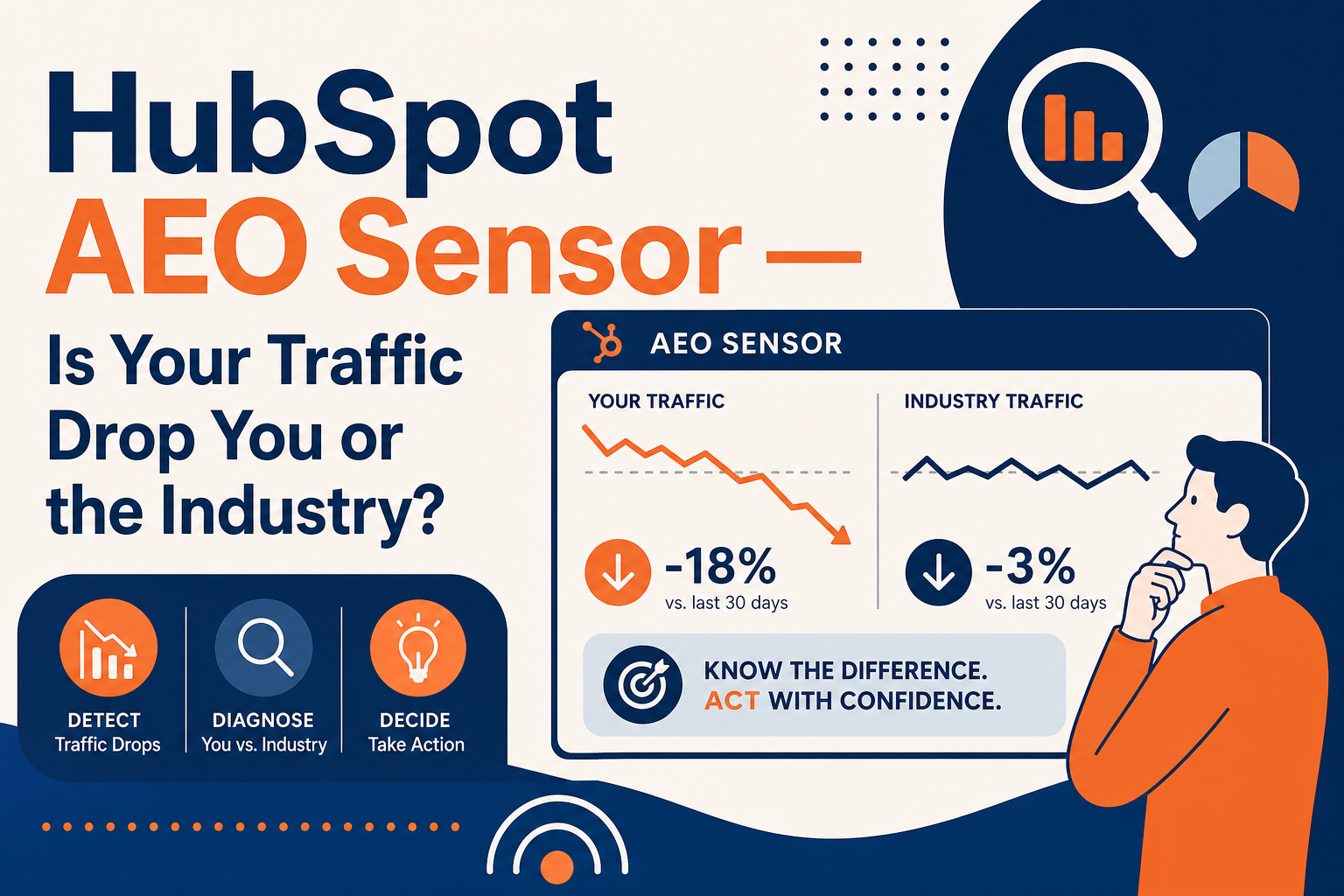
HubSpot AEO Sensor is a free public dashboard that measures how much answer-engine behavior (citations, mentions, AI-referred traffic) is shifting across the industry each day, on a 0-100 volatility scale from Calm to Extreme. It matters because it separates two very different problems that look identical from inside your own analytics: "AI search changed for everyone" versus "AI search changed for you." Vantage Point uses this alongside brand-level AEO tracking to help clients diagnose traffic swings correctly before reacting to them.
TL;DR
- What it is: A free, no-login HubSpot benchmark tool at hubspot.com/aeo-sensor showing industry-wide AI search volatility, not your brand's specific visibility.
- The core metric: Answer Engine Volatility score, 0-100, banded as Calm (0-39), Moderate (40-59), Elevated (60-89), Extreme (90+).
- What it shows: Daily citation/mention deviation from baseline, directional AI-referred traffic trends (from anonymized HubSpot customer data), and visibility benchmarks by industry over time.
- What it doesn't show: Your specific brand's citations or mentions: for that, you need HubSpot AEO tracking your own tracked prompts.
- Best use: Check it before panicking about a traffic dip. If volatility is Elevated or Extreme industry-wide, the drop likely isn't a content or technical problem on your end.
- How Vantage Point helps: We pair Sensor's industry context with brand-level AEO monitoring and HubSpot implementation work so clients react to the right signal. Learn about our HubSpot services.
Why This Tool Exists
Marketing teams have started noticing something unsettling: traffic can swing 20-30% week over week with no changes to their own site, content, or rankings. The instinct is to assume something broke, a technical SEO issue, a content quality problem, an algorithm penalty. Increasingly, the real answer is that answer engines like ChatGPT, Gemini, and Perplexity are themselves volatile, changing which sources they cite and how much traffic they send to any website, industry-wide, on a near-daily basis.
HubSpot built AEO Sensor to give every marketer, not just HubSpot customers, a way to check that theory before spending a week auditing a website that isn't the problem. It's explicitly a benchmark, not a brand tracker: it shows the weather, not whether your house has a leak.
The Three Things AEO Sensor Measures
1. Answer Engine Volatility Score
A 0-100 score representing how much daily citation, mention, and AI-referred traffic behavior deviates from a widespread industry average:
| Band | Score Range | What It Means |
|---|---|---|
| Calm | 0-39 | AI search behavior is stable; unusual traffic shifts are more likely brand-specific |
| Moderate | 40-59 | Some industry-wide movement; worth a quick sanity check before assuming it's you |
| Elevated | 60-89 | Meaningful industry-wide shift; a traffic change is more likely explained by this than by your content |
| Extreme | 90+ | Major disruption across answer engines; expect volatility in your own numbers regardless of what you've changed |
2. AI-Referred Traffic Trends
Directional estimates, built from anonymized HubSpot customer data, showing how much traffic answer engines are actually sending to websites over time. This gives a sense of whether AI referral traffic as a channel is growing, shrinking, or holding steady in aggregate.
3. AI Visibility Benchmarks by Industry
How visibility and citation share shift across industries over time, letting a team see whether a particular sector is becoming more or less visible in AI answers as a whole: useful context when planning content investment.
How to Use It: A Practical Workflow
- See a traffic anomaly in your own analytics. Before diagnosing root cause internally, check AEO Sensor's current volatility score and band.
- If volatility is Calm or Moderate and your traffic still moved significantly, the cause is more likely brand- or content-specific, check technical SEO, recent content changes, or use brand-level AEO tracking to see if your own citations shifted.
- If volatility is Elevated or Extreme, treat the swing as expected industry noise. Avoid making reactive content or technical changes based on a single volatile data point: wait for the trend to stabilize before acting.
- Layer in industry benchmarks to understand whether your sector specifically is gaining or losing visibility share, which should inform longer-term content strategy rather than day-to-day reactions.
- Move to brand-level tracking (HubSpot AEO or another AEO tool) once you've confirmed a swing isn't purely industry noise, so you can see exactly which prompts, citations, or competitors are driving the change for your brand specifically.
AEO Sensor vs. HubSpot AEO: Know the Difference
| AEO Sensor | HubSpot AEO | |
|---|---|---|
| Cost | Free, no login | Included in Marketing Hub Pro/Enterprise, or $50/mo standalone with trial |
| Scope | Industry-wide benchmark | Your brand's specific tracked prompts and citations |
| Data | Anonymized aggregate trends | Your brand's mentions across ChatGPT, Gemini, Perplexity |
| Best for | "Is this happening to everyone?" | "How is my brand specifically showing up?" |
| Action it enables | Contextualize a traffic swing | Diagnose and fix your own visibility gaps |
They're complementary, not competing: Sensor tells you whether to look inward at all; brand-level AEO tools tell you what to fix once you've decided the problem is yours.
What This Means for Marketing and RevOps Teams
Answer engines are now a real, if still emerging, referral channel, and one that behaves nothing like traditional search in terms of stability. A tool that quantifies "is this me or the industry" reduces wasted effort chasing phantom SEO problems and gives teams a faster, more confident read on where to actually invest time: content quality and structure when volatility is low and your numbers still moved, or patience and trend-watching when volatility is genuinely industry-wide.
For teams already running HubSpot's AEO tracking, Sensor adds essential context to every citation or traffic change in their own dashboard. The difference between "we lost a citation" and "everyone lost citations this week."
How Vantage Point Helps
Answer engine optimization is still a new enough discipline that most teams don't yet have a clear process for separating signal from noise. Vantage Point helps clients build that process. Combining tools like AEO Sensor and HubSpot AEO with a broader content and CRM strategy so that AI visibility work supports pipeline, not just vanity metrics. Our team can:
- Set up and interpret HubSpot AEO tracking for your specific tracked prompts and buyer questions
- Build a monthly citability review process that distinguishes industry volatility from brand-specific issues
- Connect AEO insights to your broader HubSpot Marketing Hub strategy and content production
- Support the technical and structural content changes that actually move brand-level AI visibility
Want help building an AEO monitoring process that tells you when to act and when to wait? Talk to Vantage Point today.
FAQ
Is HubSpot AEO Sensor free to use? Yes. It's a free, public dashboard at hubspot.com/aeo-sensor with no login or HubSpot account required.
Does AEO Sensor show my brand's specific AI visibility? No. It shows industry-wide trends and benchmarks only. For your brand's specific citations and mentions across ChatGPT, Gemini, and Perplexity, you need HubSpot AEO, which tracks prompts specific to your business.
What does the Answer Engine Volatility score actually measure? It's a 0-100 score reflecting how much daily citation, mention, and AI-referred traffic behavior deviates from a widespread average across the tracked industry data, banded into Calm, Moderate, Elevated, and Extreme.
How is the traffic trend data collected? It's built from anonymized HubSpot customer data, showing directional estimates of how much traffic answer engines are sending to websites over time: not exact, individually attributable figures.
Should I use AEO Sensor instead of a brand-level AEO tool? No. Think of it as a first diagnostic step, not a replacement. Use Sensor to check whether a traffic anomaly is industry-wide before investing time diagnosing it as a brand-specific problem, then use a brand-level tool for the actual fix.
How often should I check AEO Sensor? Check it reactively whenever you see a notable traffic swing in your own analytics, and periodically (monthly is reasonable) to understand broader trend direction for your industry.
Does a high volatility score mean I should change my content strategy? Not immediately. High volatility typically means current swings are noise, not signal. Wait for the trend to stabilize, or look at the industry benchmark over a longer window, before making strategic content decisions based on it.
Is this the same as HubSpot's AEO Grader? No. The AEO Grader evaluates your specific site's AI-readiness and visibility. AEO Sensor is an industry-wide volatility benchmark. They serve different purposes and are meant to be used together.