
Quick Answer
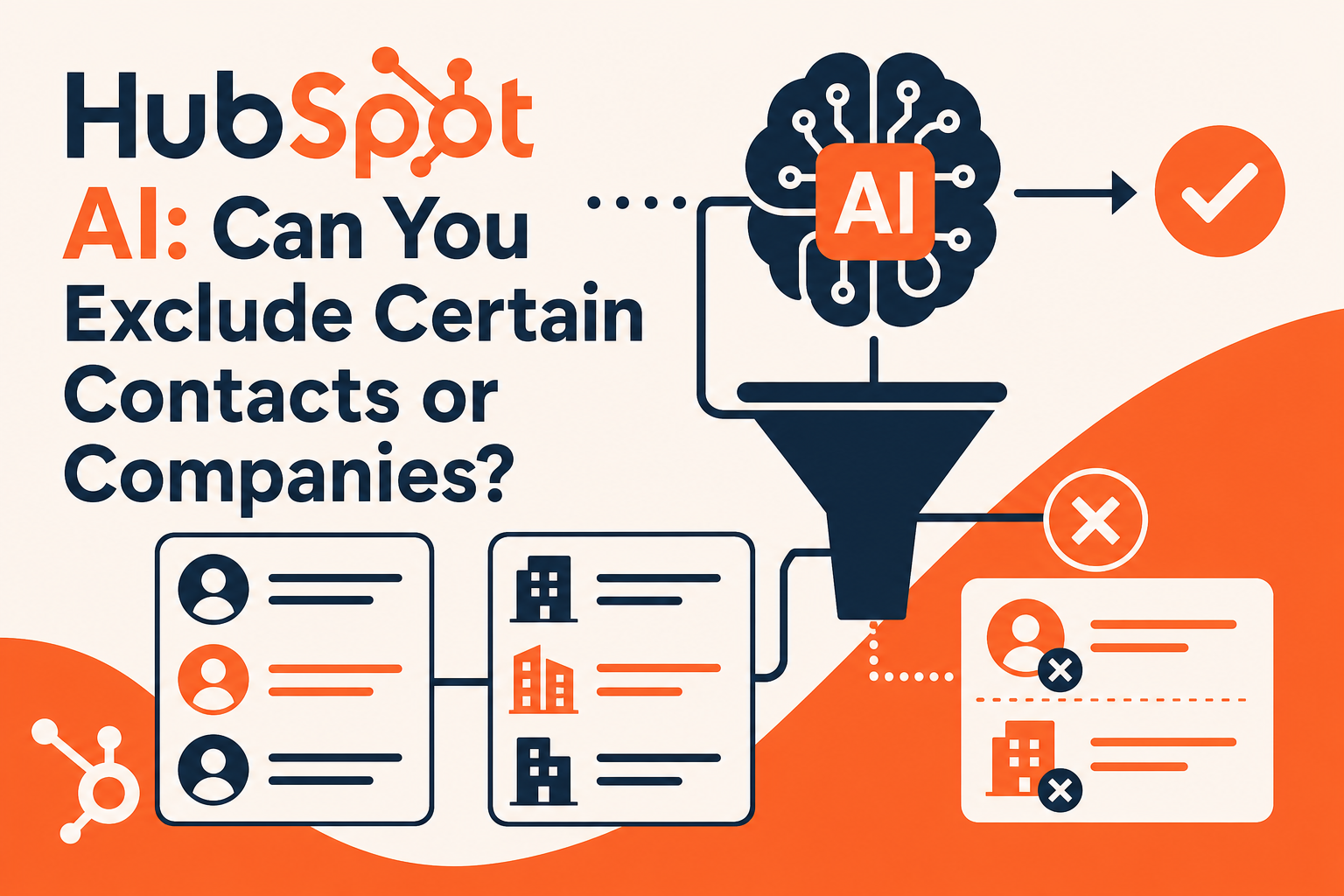
No, as of today, HubSpot does not offer a native setting to exclude a specific list of contacts or companies from AI processing. Its AI controls (found under Settings > AI) work at the account level: you can turn generative AI features on or off, control whether AI can use CRM data, customer conversation data, or files data, and separately control whether HubSpot can use your data to train its models. There is no per-contact or per-domain "never include this record in AI" toggle. This matters most for organizations with counterparties under contractual AI restrictions (common in energy, healthcare, financial services, and any business with sensitive partner agreements) who need a real answer before turning AI features on broadly. The practical path is a combination of account-level settings, permission-based workarounds, and process discipline, which Vantage Point builds as part of HubSpot implementations.
TL;DR
- What it is: HubSpot's AI settings (Settings > AI) control generative AI access, data sources, and model training at the account level.
- The gap: there is no native way to mark specific contacts, companies, or domains as permanently off-limits to AI processing: this is a frequently requested feature, not a current one.
- Why it matters: businesses with contractually restricted counterparties (NDAs, regulatory constraints, partner agreements) need a defensible answer before rolling out Breeze or other AI features.
- Best for: admins at organizations juggling AI adoption with real contractual or regulatory restrictions on specific relationships.
- How Vantage Point helps: our HubSpot and compliance and security teams design the settings, permission structure, and process controls that get you as close to per-relationship AI governance as the platform currently allows.
As AI features roll into every corner of the CRM, a specific and increasingly common question comes up during HubSpot implementations: can we tell the system, in a durable way, "never run AI on this account's data"? The scenario is usually a contract clause (a partner or counterparty whose agreement explicitly restricts AI-assisted processing of their information) sitting alongside a broader rollout of HubSpot's AI tools for everyone else.
The honest answer, and the one worth planning around rather than assuming away, is that HubSpot's AI governance today operates at the account level, not the record level.
What Is HubSpot's Current AI Settings Model?
HubSpot's AI settings live under Settings > Account Management > AI, on the Access tab, and they control a few distinct things:
- Generative AI tools and features: the master switch for AI capabilities like Breeze Assistant, on by default.
- Data access for AI: three separate toggles for CRM data (records and properties, on by default), customer conversation data (call transcripts, emails; on by default), and files data (documents stored in HubSpot's file tool; off by default).
- AI model training: a separate control for whether HubSpot can use your account's data to train its own AI models, distinct from whether AI features work in your account day to day. Turning this off does not turn off AI features; it only stops your data from being used for model training and sharing.
Accounts with HubSpot's Sensitive Data feature enabled are automatically opted out of AI model training and cannot opt back in, but that setting works on properties marked sensitive, not on a list of specific contacts or companies you choose.
Every toggle here is account-wide. There is no setting that says "apply AI features to every contact except this list," and HubSpot's own community forum has an open thread asking almost exactly that question, alongside a related feature idea for more granular Breeze Studio permission management that has not shipped as a product yet.
Why This Matters in 2026
AI adoption inside CRMs is accelerating faster than most companies' contractual and compliance frameworks were written to anticipate. A business that signed an NDA or partner agreement two years ago almost certainly didn't specify how "AI-assisted CRM processing" applies to that relationship, because the tools didn't work the way they do now. That leaves compliance and legal teams doing a real-time interpretation exercise as AI features get switched on, often for the whole account at once.
Energy and utility operators, healthcare systems, and financial services firms run into this most often because their counterparty agreements are more likely to include explicit AI or data-handling restrictions. But the underlying problem ("we want AI broadly, except for this specific set of relationships") is not industry-specific, and it is a legitimate design question for any HubSpot rollout that includes contractually sensitive accounts.
What You Can Actually Control Today
Since there's no native per-record AI exclusion, the practical answer is a layered approach combining what HubSpot does offer with process and permission discipline:
| Approach | What it controls | Limitation |
|---|---|---|
| Account-level AI toggles | Whether AI features and specific data types (CRM, conversation, files) are available at all | All-or-nothing for the whole account: can't scope to specific contacts |
| AI model training opt-out | Whether your data is used to train HubSpot's models | Doesn't restrict day-to-day AI feature usage on any record |
| User permissions and roles | Which team members can access AI tools and features at all | Restricts by user, not by which records that user can run AI on |
| Process controls | Team policy: never paste this counterparty's data into an AI prompt, tag restricted accounts clearly in the record | Relies on people following the policy: not enforced by the platform |
| Data segregation | Keeping the most sensitive counterparty communications out of HubSpot entirely (e.g., a separate secure channel) | Adds operational overhead and a second system to manage |
Most organizations end up combining the middle three: a clear internal policy, a visible property flag on restricted accounts ("AI Restricted: Yes/No"), and training so users know not to run AI-assisted summarization or drafting features against flagged records: even though the platform itself won't stop them.
What Businesses Should Do Next
- Get the actual contract language reviewed before assuming the worst, or the best. Many older agreements don't mention AI explicitly at all; legal should confirm what's actually restricted before you design around a hypothetical.
- Turn on Sensitive Data properties where it fits. If specific fields (not entire accounts) hold the truly sensitive information, HubSpot's Sensitive Data feature is a real, platform-enforced control worth using regardless of the broader gap.
- Flag restricted accounts visibly, not just in a policy document. A property on the record itself, visible in every view, is far more effective than a rule that lives in a compliance wiki nobody checks mid-task.
- Decide if the AI model training toggle needs to be off account-wide. This is a separate, blunter decision from day-to-day feature access, and it's worth making deliberately rather than leaving on the default.
- Submit the feature request and plan around today's platform, not tomorrow's. HubSpot's own community shows demand for granular AI permissions; add your organization's voice, but build your governance plan on what exists now.
For the account-wide version of this question (whether HubSpot uses your data to train its models at all) see our related post on HubSpot's AI model training setting. Salesforce customers weighing the equivalent question should see how Salesforce's Einstein data-training opt-out works.
How Vantage Point Helps
Vantage Point works with organizations that need AI adoption and real contractual restrictions to coexist. Through our HubSpot and compliance and security solutions services, our senior consultants review what your agreements actually require, configure HubSpot's available AI and Sensitive Data settings correctly, and build the property flags, permissions, and team training that get you as close to per-relationship AI governance as the platform currently supports. Senior consultants only. No junior handoffs; the experts you meet are the experts who deliver.
Rolling Out AI With Restricted Relationships in the Mix?
Don't wait for a contract review to catch up with an AI rollout that's already live. Contact Vantage Point to scope your AI governance setup, or explore our HubSpot services to see how we help teams adopt AI responsibly.
Frequently Asked Questions
Can I exclude specific contacts or companies from HubSpot's AI features?
Not natively. HubSpot's AI settings apply at the account level. There is currently no setting to mark individual contacts, companies, or domains as permanently off-limits to AI processing.
Where do I find HubSpot's AI settings?
Under Settings, in the Account Management section, click AI, then the Access tab. From there you can control generative AI feature access, data source access (CRM, conversation, and files data), and AI model training, all of which require Super Admin permissions to change.
Does turning off AI model training stop AI features from working?
No. The AI model training toggle only controls whether HubSpot can use your account's data to improve its own models. Turning it off does not disable Breeze Assistant or other AI features: those are controlled separately.
What does HubSpot's Sensitive Data setting actually restrict?
Sensitive Data lets you mark specific properties as sensitive, which restricts their visibility and automatically opts the account out of AI model training. It operates at the property level, not as a way to exclude specific contacts or companies from AI processing generally.
Is this the same situation in Salesforce?
Salesforce's Einstein data-usage controls also work primarily at the org level through an admin-managed opt-out setting, rather than per-record. Both platforms currently push granular AI restriction into permissions and process design rather than offering a native per-record toggle.
What's the best workaround until a native setting exists?
Combine a visible "AI Restricted" property on affected records, documented team policy about what not to run AI on, and permission-based limits on who can use AI tools at all. It's not a technical guarantee, but it's the most defensible layered approach available today.
Should we just avoid turning on AI features until this is resolved?
Usually not necessary. Most organizations can adopt AI broadly while flagging and training around the specific restricted relationships, rather than delaying an entire rollout for a subset of accounts. Get legal to confirm the actual scope of the restriction first: it's often narrower than the initial concern suggests.
Vantage Point is a boutique CRM consulting firm helping businesses transform with Salesforce, HubSpot, and AI. Learn more at vantagepoint.io.