
Your team comes home from a conference with a stack of business cards and a phone full of card photos. Two weeks later, half of those contacts still are not in the CRM, the ones that are have typos, and nobody remembers which event produced which lead. Manual entry is the bottleneck, and it gets worse with every event on the calendar.
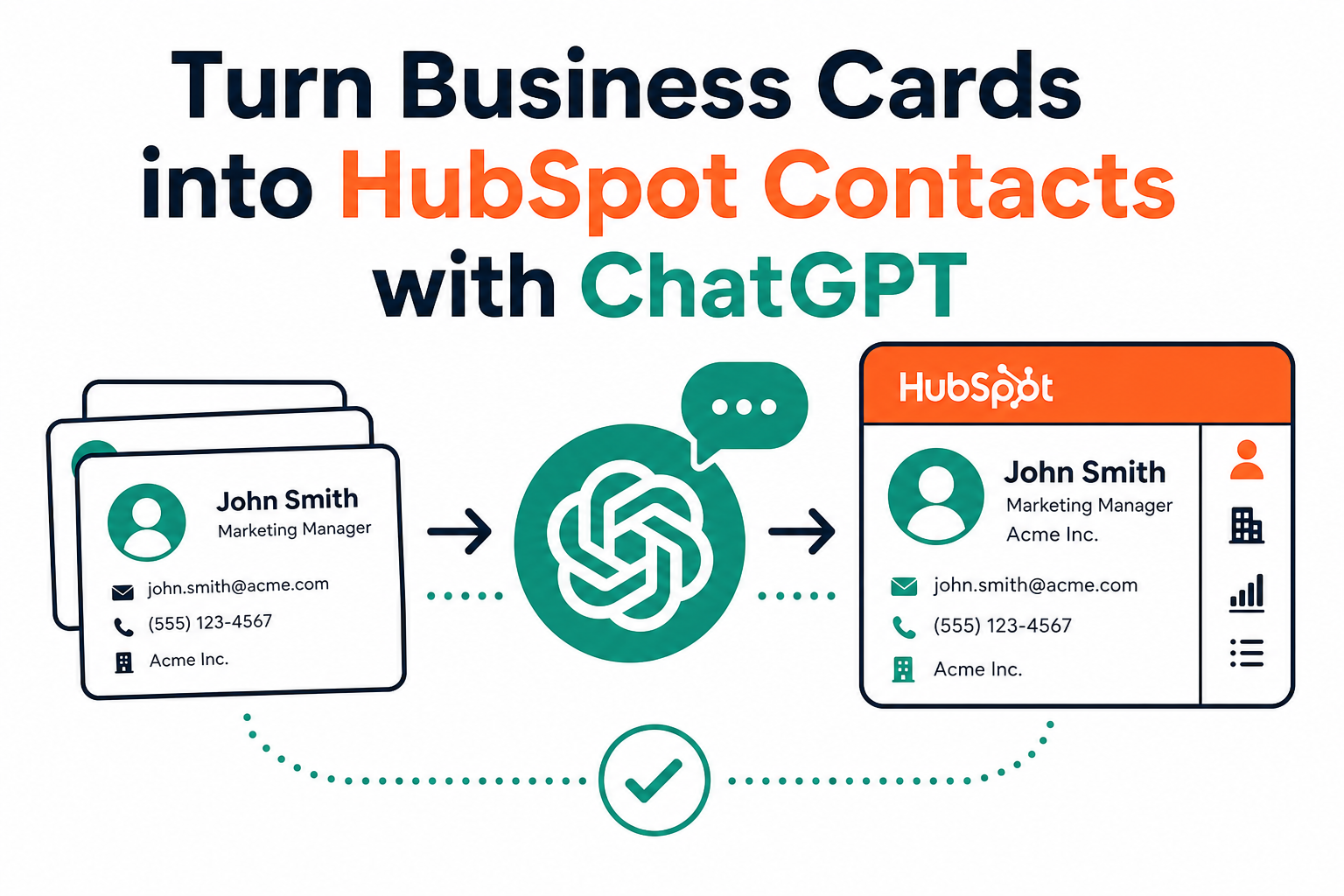
There is a practical middle ground between typing cards one at a time and buying a dedicated scanning tool: a ChatGPT project connected to HubSpot that reads card photos, extracts the details, checks for duplicates, and presents each contact for review before anything touches your CRM.
This guide explains how the workflow works, what to set up in HubSpot first, and how to keep the data clean enough that sales actually trusts it.
Quick Answer
You can turn business cards into HubSpot contacts by connecting the HubSpot app in ChatGPT, then using a dedicated ChatGPT project as a repeatable intake workflow. Upload card photos in batches by event, have the project extract names, titles, companies, emails, and phone numbers, ask it to check existing HubSpot records for duplicates, review the extracted records, then approve creation. The human review step is what keeps this reliable. This matters for any team that collects leads at events, and Vantage Point builds this kind of AI-assisted intake into HubSpot implementations for clients who want speed without sacrificing data quality.
Key Takeaways (TL;DR)
- What it is: a ChatGPT project connected to HubSpot that extracts business-card details from photos and creates CRM contacts after your review.
- Why it matters: event leads decay fast; a same-day capture workflow beats a pile of cards every time.
- Best for: teams attending conferences, trade shows, and networking events without a badge-scanning tool.
- Decision point: always keep a human review step between extraction and contact creation.
- How Vantage Point helps: workflow design, property setup, and AI-assisted CRM processes as part of HubSpot implementation services.
What Is the ChatGPT Business-Card-to-HubSpot Workflow?
The workflow combines two things that already exist: ChatGPT's ability to read images and extract structured information, and the HubSpot connected app, which lets ChatGPT search and create CRM records once you authorize it. A ChatGPT project wraps both in standing instructions, so the process runs the same way every time instead of depending on whoever happens to write the prompt.
In practice, the project instructions tell ChatGPT to act as an event-intake assistant: read each card image, extract the standard fields, ask which event the batch came from, check HubSpot for existing records with the same email or name, flag anything missing, and present a clean summary for approval before creating contacts. Because the instructions live in the project, a new team member can run the identical process on their first day.
This is a user-directed workflow, not a background automation. ChatGPT processes cards when you upload them and ask; it does not watch a folder or run on a schedule. For most event volumes, that is a feature: it forces the review step that keeps bad data out.
Why Does Manual Event Follow-Up Break Down?
Three failure modes show up every time. First, delay: the longer cards sit, the colder the follow-up and the fuzzier the context. Second, inconsistency: five people enter cards five different ways, with different capitalization, missing fields, and no standard for which event sourced the lead. Third, duplication: without a check against the CRM, the same person gets created three times across three events.
A structured intake workflow attacks all three. Extraction happens the same day, fields follow one standard, and a duplicate check runs against live HubSpot data before anything is created.
How Do You Set Up the Workflow Step by Step?
- Connect HubSpot in ChatGPT. In ChatGPT settings, install the HubSpot plugin and authorize the account with the CRM access you want the workflow to use. Our overview of the HubSpot connector for ChatGPT covers what the connection can do.
- Create a dedicated project. Name it something obvious, like "Conference Contact Intake," so anyone on the team can find it.
- Write the standing instructions. Spell out the fields to extract (first name, last name, job title, company, email, phone, website), the requirement to ask for the event name, the duplicate-check behavior, and the rule that contacts are presented for review before creation.
- Create an event property in HubSpot. A custom contact property such as "Event / Conference" lets every card carry its source. Set the value once per batch (for example, the event name and year) and reporting on event ROI becomes trivial.
- Upload cards in batches by event. Photograph cards flat, in good light, one per photo. Upload a batch, confirm the event name, and let the project extract and summarize.
- Review, then approve creation. Scan the extracted table for typos and missing fields, confirm the duplicate-check results, and only then tell the project to create the contacts in HubSpot.
How Does This Compare to Other Capture Methods?
| Method | Speed | Data quality risk | Cost | Best fit |
|---|---|---|---|---|
| Manual entry | Slow | Typos, inconsistency, duplicates | Free but labor-heavy | A handful of cards per year |
| Spreadsheet import | Medium | Formatting errors; no duplicate check against live CRM | Free | Large lists from a single source |
| Dedicated badge/card scanner | Fast | Low, but varies by vendor | Paid hardware or per-event fees | Large trade shows with official badge scanning |
| ChatGPT project + HubSpot | Fast | Low with a review step; includes duplicate checks | Included in existing subscriptions | Teams already using ChatGPT and HubSpot at smaller events |
What Should the Project Instructions Include?
The instructions are the workflow. A solid set covers five things. First, the field list: exactly which fields to extract from each card and how to format them (for example, phone numbers with country code, names in title case). Second, the event question: the project must ask which event the batch belongs to before extracting, and apply that value to every record. Third, the duplicate protocol: search HubSpot by email first, then by name and company, and present possible matches instead of deciding silently. Fourth, the review gate: output a table of extracted records and wait for explicit approval before creating anything. Fifth, the missing-data rule: flag incomplete cards — no email, unreadable company — in a separate list for manual follow-up rather than guessing.
Keep the instructions under a page. Long, clever prompts drift; short, specific ones hold up across team members and model updates. Test the project with five real cards before the next event, and refine the instructions based on what it got wrong.
How Do You Keep the Data Clean?
Three habits matter more than any tool. First, batch by event so the source property is always set and follow-up lists segment themselves. Second, never skip the duplicate check — ask the project to search HubSpot by email first, then by name and company, and to show you near-matches rather than silently creating new records. Third, treat extraction as a draft. Cards get photographed at bad angles, titles are ambiguous, and handwriting happens. A sixty-second review per batch is cheaper than cleaning the CRM later.
It also helps to decide ownership rules up front: who reviews, who approves creation, and who owns follow-up once contacts exist. AI removes the typing, not the accountability.
What Are the Limits?
Image quality sets the ceiling. Glare, unusual fonts, and dense card layouts all reduce extraction accuracy, which is why review is mandatory. The workflow also depends on your ChatGPT plan's connected-app availability and on the permissions of the HubSpot account you authorize — it can only do what that user can do. Finally, this is capture, not nurture: once contacts exist in HubSpot, your normal sequences, workflows, and pipeline processes take over.
How Vantage Point Helps
Vantage Point designs AI-assisted CRM intake workflows like this one as part of broader HubSpot engagements: the custom properties, the project instructions, the review checkpoints, and the handoff into pipelines and reporting. Senior consultants only — no junior handoffs; the experts you meet are the experts who deliver.
Want Event Leads in HubSpot the Same Day?
Vantage Point can set up the properties, the AI intake workflow, and the follow-up automation around it. Talk to Vantage Point about your HubSpot lead capture process.
Frequently Asked Questions
Can ChatGPT add contacts to HubSpot directly?
Yes, once you install and authorize the HubSpot connected app in ChatGPT. ChatGPT can then search records and take supported actions such as creating contacts, subject to the permissions of the authorized account and your plan's app availability.
How accurate is ChatGPT at reading business cards?
Accuracy is high for clear, well-lit photos of standard cards, and lower for glare, stylized fonts, or cluttered layouts. Treat extraction as a draft and review each batch before creating records; the review step is what makes the workflow reliable.
Does the workflow run automatically in the background?
No. A ChatGPT project processes cards when you upload them and ask. It does not monitor a folder or run on a schedule, which keeps a human approval step between extraction and CRM creation by design.
How do I track which event each contact came from?
Create a custom contact property in HubSpot, such as an event or conference field, and have the project set it for every batch. Process cards one event at a time so the value is always correct, and event-level reporting becomes straightforward.
Will this create duplicate contacts in HubSpot?
It can if you skip the duplicate check. Instruct the project to search HubSpot by email address first, then by name and company, and to show you possible matches for a decision before creating anything new.
Is this better than a dedicated business card scanner?
For teams already paying for ChatGPT and HubSpot, it adds no new vendor and handles small-to-midsize event volume well. Large trade shows with official badge scanning may still justify a dedicated tool, and the two approaches can coexist.