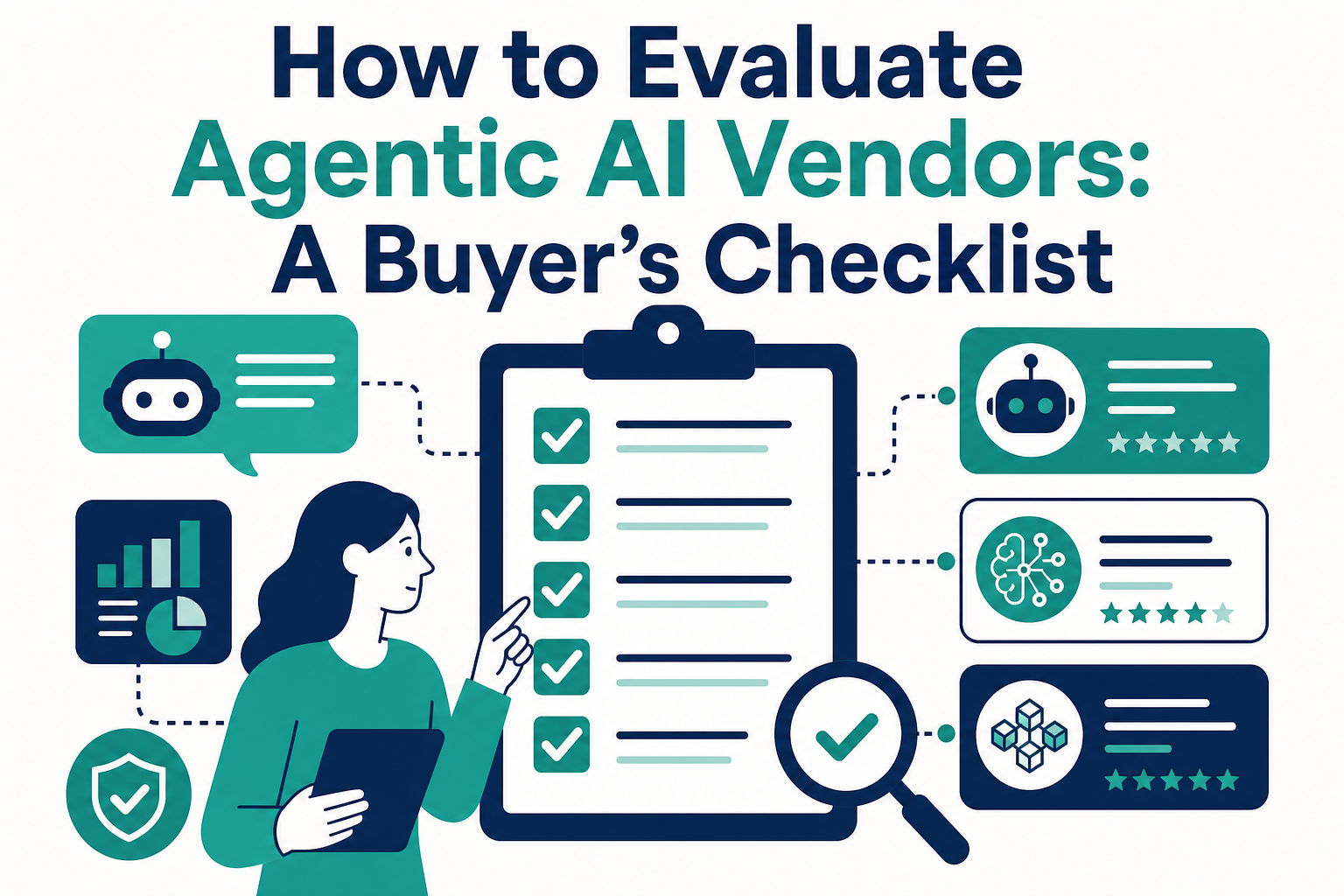
Every software category is rebranding around "agentic AI" right now, and that makes vendor evaluation harder, not easier. The same workflow automation tool that shipped last year can be relaunched this year with an "AI agent" label and a higher price tag. Business and IT leaders need a repeatable way to tell real agentic capability from a chatbot wearing a new badge.
This guide gives you a practical, vendor-agnostic framework for evaluating agentic AI vendors: the questions to ask, the red flags to watch for, and how to score answers so the decision isn't just a gut call.
Quick Answer
Evaluating an agentic AI vendor means testing four things: what the agent can actually do without a human in the loop, what data it needs and how it handles that data, how it fails, and what it costs to run at scale. This matters for any organization considering AI agents for sales, service, or operations workflows in Salesforce, HubSpot, or a broader CRM/RevOps stack. The evaluation should happen before a contract is signed, not after a pilot has already stalled. Vantage Point runs vendor-agnostic AI readiness and vendor evaluations for CRM and RevOps teams, so this framework reflects patterns seen across real deployments rather than a single vendor's sales deck.
TL;DR
- What it is: A structured way to separate genuine agentic AI capability from rebranded automation or chatbot tools.
- Why it matters: Picking the wrong AI vendor wastes budget, creates data exposure risk, and damages internal appetite for future AI projects.
- Best for: RevOps, IT, and operations leaders evaluating AI agent vendors for Salesforce, HubSpot, or adjacent CRM workflows.
- Decision point: Score vendors on autonomy, data handling, failure behavior, and total cost: not on demo polish alone.
- How Vantage Point helps: Vantage Point's AI-driven personalization and analytics practice runs vendor-neutral AI evaluations and readiness assessments tied to your actual CRM data and workflows.
What Is Agentic AI Vendor Evaluation?
Agentic AI vendor evaluation is the process of testing whether an AI vendor's product can complete multi-step tasks with limited human supervision, inside your specific systems and data constraints: rather than just answering questions in a demo. It's different from typical software evaluation because the product's behavior can change based on the data it's given, the instructions it's built with, and the volume of edge cases it encounters. A vendor that looks strong in a curated demo can still fail badly on your messy, real-world data.
Why Vendor Evaluation Matters More in 2026
Agentic AI marketing has outpaced agentic AI delivery. Nearly every CRM, sales engagement, and support tool now uses the word "agent" somewhere in its pitch, but the underlying capability varies enormously, from genuine multi-step autonomous execution to a single-turn chatbot with a new label. That gap creates three business risks:
- Wasted budget: Paying agent pricing for automation that a workflow tool already handled.
- Data exposure: Granting broad system access to a vendor without understanding how your CRM and customer data is stored, trained on, or shared.
- Stalled adoption: A failed AI pilot makes it harder to get budget and buy-in for the next, better-scoped project. Vendor evaluation is one reason many AI pilots stall before reaching production.
None of this means agentic AI isn't real or useful. It means the evaluation step matters more than it used to, because the label alone tells you almost nothing.
How to Evaluate an Agentic AI Vendor: A Step-by-Step Framework
Use these steps in order. Each one should be documented, not just discussed verbally in a sales call.
1. Define the task, not the tool
Before looking at any vendor, write down the specific multi-step task you want automated (for example: "qualify an inbound lead, enrich the record, and route it to the right rep with context"). Vendors should be evaluated against this task, not against a generic capability list.
2. Ask what happens without a human in the loop
Ask the vendor to walk through what the agent does when it hits an exception it wasn't trained for: a missing field, a contradictory instruction, an ambiguous request. Vendors with real agentic architecture can describe fallback behavior, escalation paths, and confidence thresholds. Vendors without it tend to describe "it just tries again" or change the subject.
3. Test on your data, not their demo data
Insist on a proof of concept using a sample of your actual CRM records, including the messy ones: duplicate contacts, incomplete fields, non-English text, unusual naming conventions. Demo environments are curated. Your CRM is not.
4. Ask exactly what data leaves your environment
Get a specific, written answer to: what customer data is sent to the vendor's models, is it used for model training, is it retained, and for how long. "We take security seriously" is not an answer. A named data flow diagram is.
5. Price the agent at your real volume, not the pilot volume
Many agentic AI tools price per action, per resolution, or per API call. Ask for pricing at your projected production volume, not just the 50-record pilot. Costs that scale linearly with usage can look inexpensive in a pilot and become unpredictable at scale.
6. Check who owns the outcome when the agent is wrong
Ask what happens contractually and operationally when the agent takes an incorrect action, sends a wrong email, misroutes a case, updates a field incorrectly. Vendors should have a clear answer about audit logs, rollback, and accountability.
Agentic AI Vendor Scoring Framework
Use a simple scorecard to compare vendors side by side instead of relying on demo impressions.
| Criteria | What to Ask | Red Flag | Strong Signal |
|---|---|---|---|
| Autonomy | Can it complete the full task without a human step in between? | Vendor reframes a single-step chatbot as an "agent" | Vendor can show multi-step task completion end-to-end |
| Data handling | What data leaves our environment, and is it used for training? | Vague answers, no written data flow | Specific data flow diagram, clear retention and training policy |
| Failure behavior | What happens on an edge case or exception? | "It just retries" or no answer | Defined escalation, confidence thresholds, human-in-the-loop triggers |
| Integration depth | Does it work with our actual CRM data model, not a generic schema? | Requires exporting data to a separate platform | Native or API-based integration with Salesforce/HubSpot objects |
| Cost at scale | What does this cost at production volume, not pilot volume? | Pricing only quoted for the pilot | Transparent, volume-based pricing model with a real production estimate |
| Auditability | Can we see what the agent did and why? | No logs, or logs only on request | Standard audit trail and explainability by default |
What Businesses Should Do Next
- Write down the specific task before taking a vendor demo: evaluate against your use case, not their showcase.
- Require a proof of concept on real (anonymized if needed) CRM data before signing anything beyond a small pilot agreement.
- Get data handling and training-use answers in writing, not verbally in a sales call.
- Ask for production-volume pricing up front so a promising pilot doesn't turn into an unpredictable bill.
- Treat "agentic" as a claim to verify, not a feature to assume.
How Vantage Point Helps
Vantage Point is a boutique, senior-led consulting partner for Salesforce and HubSpot, and we stay vendor-agnostic when it comes to AI tooling. If your team is evaluating agentic AI vendors for sales, service, or operations workflows, we can run a structured evaluation against your actual CRM data, help you build a scorecard like the one above, and connect the results to a practical implementation plan. This work often overlaps with our AI-driven personalization and analytics practice and our broader Salesforce implementation and advisory and HubSpot services, since most agentic AI value depends on the CRM data foundation underneath it.
If your team is evaluating how agentic AI applies to Salesforce, HubSpot, integrations, or CRM governance, Vantage Point can help assess the right next step and build a practical implementation plan.
FAQ
What does "agentic AI" actually mean? Agentic AI refers to systems that can complete multi-step tasks with some degree of autonomy (making decisions, taking actions, and adapting to new information) rather than just responding to a single prompt or question. Many products described as "agentic" are actually simpler automation or chatbot tools rebranded with the term.
How is evaluating an agentic AI vendor different from evaluating regular software? Agentic AI behavior can change based on the data and instructions it's given, so a demo environment often doesn't predict real-world performance. Evaluation needs to include testing on your actual data and asking how the system behaves when it encounters something it wasn't trained for.
What is the biggest red flag when evaluating an AI vendor? Vague or evasive answers about failure behavior and data handling are the clearest red flags. If a vendor can't clearly explain what happens when the agent hits an edge case, or exactly what customer data leaves your environment, that uncertainty will show up later in production.
Should we always require a proof of concept before buying? Yes, for any tool that will touch live CRM data or make decisions with limited human oversight. A short, scoped proof of concept on real (or realistic, anonymized) data is the most reliable way to see how a vendor's product performs outside a curated demo.
How do we compare pricing across agentic AI vendors? Ask for pricing at your projected production volume, not just pilot volume, since many agentic AI tools charge per action or per resolution. A tool that looks inexpensive in a 50-record pilot can become unpredictable once it runs at real business scale.
Does Vantage Point sell or resell agentic AI tools? No. Vantage Point is a Salesforce and HubSpot consulting partner and stays vendor-agnostic on AI tooling. We evaluate agentic AI vendors against your CRM data and workflows and help you build the internal case, scorecard, and implementation plan.
What should be in a written agentic AI vendor scorecard? At minimum: autonomy (can it complete the task end-to-end), data handling (what leaves your environment and how it's used), failure behavior (what happens on exceptions), integration depth (does it work with your actual CRM objects), cost at production scale, and auditability of its actions.
Can a failed AI pilot hurt future AI initiatives? Yes. A poorly evaluated vendor that fails in production makes it harder to secure budget and internal trust for the next, better-scoped AI project. That's one of the strongest reasons to evaluate rigorously before committing.