
Key Takeaways (TL;DR)
- What is it? A strategic framework for moving AI projects from successful proof of concept to full-scale production deployment
- The Problem: 80–88% of AI pilots never reach production — costing enterprises an average of $4.2M–$7.2M per failed initiative
- Root Causes: Poor data readiness, missing change management, no executive sponsor beyond innovation teams, and infrastructure gaps between pilot and production environments
- Timeline: 3–6 months from validated POC to production using a structured 5-Gate model
- Best For: Organizations with 1+ stalled AI pilots seeking a repeatable path to production deployment
- Bottom Line: Companies that define success metrics upfront and invest 40–50% of budget in data preparation achieve 54% success rates vs. 12% for those that don't
Your AI demo was brilliant. Leadership applauded. The pilot delivered exactly what was promised. Then... nothing.
Six months later, that promising proof of concept sits in a shared folder somewhere, gathering digital dust. The data science team has moved on to the next shiny experiment. The business users who were excited have gone back to their spreadsheets. And your organization just joined the overwhelming majority of enterprises trapped in what industry insiders call "pilot purgatory."
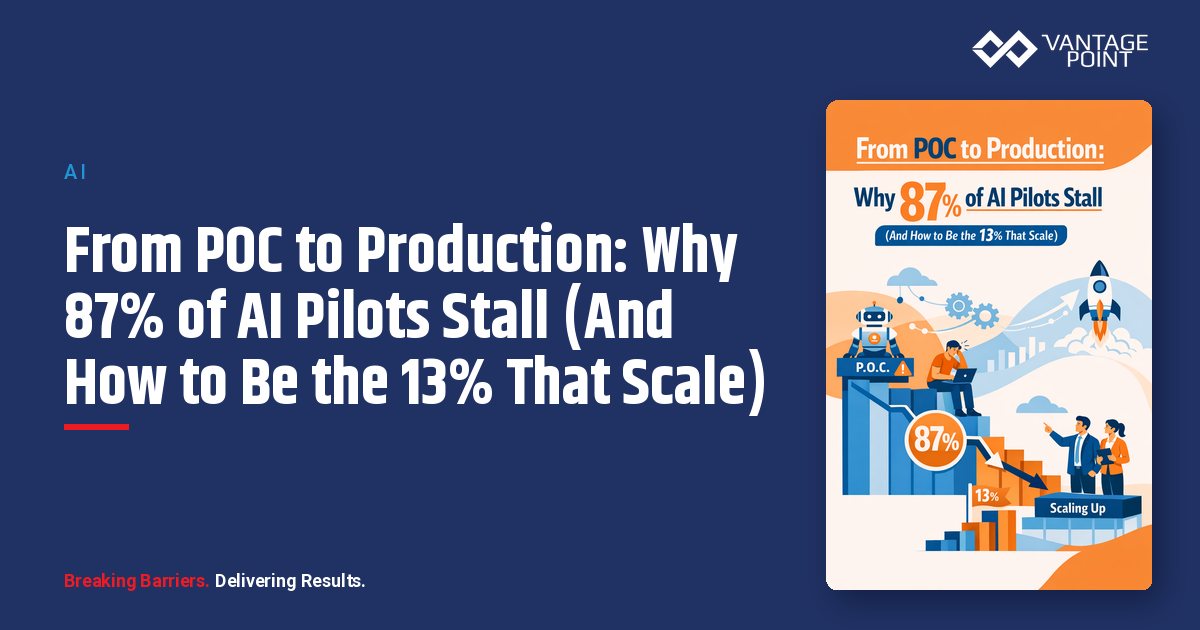
According to RAND Corporation's 2025 analysis of 2,400+ enterprise AI initiatives, 80.3% of AI projects fail to deliver their intended business value. CIO research puts the production failure rate even higher — 88% of AI pilots never make it to production. And the average enterprise currently has multiple stalled AI projects burning budget and eroding confidence in AI's transformative potential.
But here's what makes this worth reading: the 13% that succeed aren't luckier, better funded, or using superior technology. They follow a fundamentally different approach to bridging the gap between a working demo and a production system that delivers real business outcomes.
In this guide, we'll unpack exactly why AI pilots stall, introduce a proven 5-Gate Production Readiness Model, and give you a comprehensive checklist to evaluate whether your pilot is truly ready for prime time.
Why Do AI Pilots Fail? The "Valley of Death" Between POC and Production
The gap between a successful AI proof of concept and a production-ready system isn't a crack — it's a canyon. And most organizations don't realize how wide it is until they're already falling.
What Is the AI POC-to-Production Gap?
The POC-to-production gap refers to the systemic disconnect between the controlled environment where AI pilots succeed and the complex, messy reality of enterprise production systems. A pilot operates in a sandbox with clean data, dedicated attention, and relaxed performance requirements. Production demands scale, reliability, security, compliance, and — most critically — organizational adoption.
Research from MIT Sloan found that only 48% of AI projects ever make it into production, and among generative AI initiatives specifically, 95% produce zero measurable P&L impact (MIT Project NANDA, 2025). This isn't a technology problem. It's a strategy, infrastructure, and people problem.
The POC Trap: Why Impressive Demos Can't Scale
The "POC Trap" is a pattern we see repeatedly across organizations: a pilot is designed to demonstrate what AI can do rather than what it should do in production. The result is a compelling demo that impresses stakeholders but was never architected for the real world.
| Dimension | POC Environment | Production Environment |
|---|---|---|
| Data Volume | Hundreds to thousands of records | Millions to billions of records |
| Data Quality | Curated, cleaned, hand-selected | Messy, inconsistent, evolving |
| Latency Requirements | Minutes acceptable | Milliseconds required |
| Error Handling | Manual review of edge cases | Automated fallback and recovery |
| Security | Basic access controls | Full encryption, RBAC, audit trails |
| Monitoring | Manual spot-checks | Real-time dashboards, alerting, drift detection |
| Integration | Standalone or single-system | Multi-system, legacy compatibility |
| User Base | 5–10 technical evaluators | Hundreds to thousands of end users |
| Compliance | Informally considered | Formally validated and documented |
| Cost Model | Project budget | Ongoing operational expense |
This table reveals why a pilot that "works perfectly" often can't scale. The pilot was designed for a reality that doesn't exist in production.
The 5 Root Causes Why AI Pilots Stall
Understanding why pilots fail is the first step toward building ones that succeed. Our analysis, drawn from hundreds of client engagements and corroborated by industry research, identifies five systemic root causes.
1. No Production Data Strategy
The problem: 85% of failed AI projects cite poor data quality as a root cause (Gartner, 2025). Yet most pilots are built on carefully curated datasets that represent the best possible version of an organization's data — not the reality.
Pilots use clean, labeled, well-structured data that the data science team spent weeks preparing. Production requires the system to handle:
- Incomplete records and missing fields
- Duplicate and conflicting entries across systems
- Real-time data ingestion from multiple sources
- Data drift as patterns change over time
- Governance and lineage tracking
The fix: Build your data strategy before or alongside the pilot — not after. Organizations that invest 40–50% of their AI budget in data preparation achieve significantly higher success rates. Your pilot should be tested against representative production data, including its messiest edge cases.
2. The Pilot Was Built on Perfect Data That Doesn't Exist at Scale
The problem: A related but distinct issue — many teams unconsciously overfit their pilot to idealized conditions. The model performs brilliantly on a carefully selected subset of data, then collapses when exposed to the full distribution of real-world inputs.
S&P Global found that 42% of companies abandoned at least one AI initiative in 2025, up from just 17% the year before. Many of these abandonments happened precisely at the moment teams attempted to scale a "successful" pilot.
The fix: Introduce adversarial testing early. Deliberately feed your pilot messy, incomplete, and edge-case data during the POC phase. If it can't handle imperfection at small scale, it won't survive at large scale.
3. No Change Management Plan
The problem: Research shows that 77% of AI project failures are organizational, not technical (AI Governance Today, 2026). The biggest friction points aren't algorithmic — they're cultural. Even the most accurate AI solution faces resistance if its outputs aren't trusted or understood by end users.
Consider: a CRM automation tool that reduces data entry by 60% sounds transformative. But if the sales team doesn't trust its recommendations, doesn't understand how it generates suggestions, or fears it will replace their roles, adoption flatlines.
The fix: Change management should start during the pilot, not after production launch. Identify user champions early, involve end users in testing, create feedback loops, and develop training programs that address both capability and confidence.
4. Missing MLOps and Monitoring Infrastructure
The problem: Production AI systems require 5–10x the infrastructure investment of pilots. Pilots run on a data scientist's laptop or a cloud notebook. Production requires:
- Automated model retraining pipelines
- Performance monitoring and alerting
- Model versioning and rollback capabilities
- A/B testing infrastructure
- Cost tracking and optimization
- Security and compliance monitoring
Most organizations skip this entirely during the pilot phase, then face a 6–12 month infrastructure buildout before they can deploy — by which time the business context has shifted and the pilot's relevance has diminished.
The fix: Design your MLOps architecture during the pilot phase. You don't need to build everything immediately, but you need a clear blueprint for what production infrastructure looks like and a realistic timeline and budget for standing it up.
5. No Executive Sponsor Beyond the Innovation Team
The problem: MIT Sloan found that 61% of enterprise AI projects were approved on ROI projections that were never measured after launch. Without sustained executive sponsorship, AI pilots lose visibility, budget priority, and organizational momentum the moment the initial excitement fades.
Projects with sustained C-suite executive sponsorship succeed 68% of the time. Without it, the success rate drops to just 11%.
The fix: Every AI pilot needs an executive sponsor from the business side — not just IT or innovation. This sponsor should have budget authority, a vested interest in the outcome, and the organizational clout to remove obstacles.
The 5-Gate Production Readiness Model
Moving from a successful POC to production isn't a single leap — it's a structured progression through five critical gates. Each gate represents a domain that must meet minimum requirements before the project advances.
Gate 1: Data Gate
Purpose: Validate that your data infrastructure can support production-scale AI operations.
Key questions:
- Is there a documented data pipeline from source systems to model input?
- Has data quality been measured across the full production dataset (not just the pilot subset)?
- Are data governance policies in place, including access controls, lineage tracking, and retention policies?
- Is there a strategy for handling data drift and model degradation over time?
- Can the data pipeline handle the required throughput and latency?
Pass criteria: Data quality scores meet defined thresholds across all production sources. Pipeline can handle 3x expected peak load. Governance documentation is complete and approved.
Gate 2: Architecture Gate
Purpose: Confirm that the technical architecture can support production requirements for performance, scalability, and reliability.
Key questions:
- Has the system been load-tested at production scale?
- Are failover and disaster recovery mechanisms in place?
- Is the architecture cost-optimized for sustained operation (not just pilot-phase cloud credits)?
- Are there automated deployment pipelines (CI/CD) for model updates?
- Does the architecture support monitoring, logging, and alerting?
Pass criteria: System meets defined SLAs for latency, uptime, and throughput. Cost model validated for 12-month operational projections. Deployment pipeline tested with automated rollback capability.
Gate 3: Integration Gate
Purpose: Ensure the AI system integrates seamlessly with existing enterprise systems and workflows.
Key questions:
- Has the system been tested with all production integrations (CRM, ERP, data warehouse, etc.)?
- Are API contracts defined and versioned?
- How does the system handle upstream/downstream failures gracefully?
- Is there a clear data flow diagram showing all system touchpoints?
- Have integration performance impacts been measured on existing systems?
For organizations using platforms like Salesforce or HubSpot, integration complexity multiplies. Salesforce's Agentforce platform offers powerful AI agent capabilities — but scaling from a single Agentforce agent handling one use case to an enterprise-wide deployment requires careful integration planning across Sales Cloud, Service Cloud, Data Cloud, and potentially MuleSoft middleware. Similarly, HubSpot's Breeze AI tools work beautifully in pilot scenarios but require thoughtful CRM data architecture to deliver consistent results across marketing, sales, and service hubs at scale.
Gate 4: Governance Gate
Purpose: Establish the policies, processes, and controls needed for responsible and compliant AI operations.
Key questions:
- Is there a documented AI governance framework covering ethics, bias, transparency, and accountability?
- Are model decisions explainable to both technical and non-technical stakeholders?
- Is there a clear escalation path for AI-generated recommendations that seem wrong?
- Are there regulatory or compliance requirements, and have they been validated?
- Is there an audit trail for model inputs, outputs, and decisions?
Gate 5: Adoption Gate
Purpose: Validate that end users are prepared, trained, and willing to adopt the AI system in their daily workflows.
Key questions:
- Have end users been involved in testing and feedback during the pilot?
- Is there a comprehensive training program covering how to use, interpret, and override AI recommendations?
- Are there identified "champions" in each team who can provide peer support?
- Is there a feedback mechanism for users to report issues and suggest improvements?
- Has change management addressed concerns about job displacement and role evolution?
Real-World Patterns: How Leading Platforms Approach Scaling
Salesforce Agentforce: From Agent Demo to Enterprise Deployment
Salesforce's Agentforce platform has seen explosive growth, reaching $800M+ ARR in 2026. But behind those numbers are important lessons about scaling AI agents from pilot to production:
- Data Cloud foundation: Successful Agentforce deployments start with unified customer data in Data Cloud. Organizations that skip this step find their agents making recommendations based on incomplete or siloed information.
- Topic and action governance: Agentforce 3 introduced the Command Center specifically to address the visibility and control challenges that emerged as organizations scaled beyond initial pilot agents.
- Incremental deployment: The most successful Agentforce adopters start with a single use case (typically service deflection), prove value, then expand to sales coaching, lead qualification, and custom agents.
HubSpot Breeze AI: Scaling Intelligent Automation
HubSpot's Breeze AI suite demonstrates similar scaling patterns:
- CRM data hygiene first: Breeze Copilot, Breeze Agents, and Breeze Intelligence all depend on clean, well-structured CRM data. Organizations with fragmented or outdated contact records see significantly worse results at scale.
- Hub-by-hub expansion: Successful teams typically pilot Breeze in one hub (e.g., Marketing Hub for content generation), validate results, then expand to Sales and Service hubs.
- Integration maturity: As organizations scale Breeze across multiple hubs, the number of third-party integrations and data sources grows — requiring a more mature approach to data governance and pipeline management.
Is Your Pilot Ready for Production? The Complete Checklist
Use this 20-point checklist to evaluate whether your AI pilot is genuinely ready for production deployment. Score each item as Met (✅), Partial (⚠️), or Not Met (❌). You need at least 16 items fully met before proceeding to production.
Data Readiness
- ☐ Production data pipeline is documented and tested end-to-end
- ☐ Data quality has been validated against production-representative datasets (not just curated pilot data)
- ☐ Data drift monitoring is in place with defined thresholds and alerting
- ☐ Data governance policies are documented, including access controls, lineage, and retention
- ☐ Data volume testing confirms the system handles 3x peak expected load
Technical Architecture
- ☐ System has been load-tested at production scale with documented results
- ☐ Failover and disaster recovery procedures are defined and tested
- ☐ CI/CD pipeline supports automated model deployment with rollback capability
- ☐ Cost model is validated for 12-month sustained operations (not just pilot-phase pricing)
- ☐ Monitoring and alerting infrastructure covers all critical system components
Integration & Security
- ☐ All production integrations (CRM, ERP, APIs) have been tested in staging
- ☐ Security review is complete, including encryption, access controls, and vulnerability assessment
- ☐ Compliance requirements have been identified, validated, and documented
- ☐ API contracts are versioned and backward-compatible
Governance & Ethics
- ☐ AI governance framework is documented and approved by leadership
- ☐ Model explainability meets requirements for all stakeholder audiences
- ☐ Bias testing has been conducted and results are within acceptable parameters
- ☐ Audit trail captures all model decisions with appropriate retention
Organizational Readiness
- ☐ Executive sponsor is identified and actively engaged (business-side, not just IT)
- ☐ End-user training is complete for 80%+ of target users with defined support channels
Best Practices: How to Be the 13% That Scale
1. Design for Production from Day One
Don't treat your POC as a throwaway prototype. Use production-representative data, build on production-grade infrastructure (even if at smaller scale), and involve production stakeholders from the start.
2. Define Success Metrics Before Writing a Single Line of Code
Organizations with quantified success metrics defined before project approval achieve a 54% success rate. Those without: just 12%. Define what "good" looks like in concrete business terms before the project begins.
3. Invest Heavily in Data Preparation
Budget 40–50% of project resources for data preparation and infrastructure. Companies with strong data integration achieve 10.3x ROI versus 3.7x for those with poor data connectivity.
4. Treat AI Deployment as Organizational Transformation
Allocate 20–30% of your budget to change management. Projects that treat AI as purely a technology initiative succeed less than 20% of the time.
5. Build Incrementally, Validate Continuously
Don't attempt a big-bang production launch. Deploy to a limited user group first, gather feedback, iterate, then expand.
6. Establish Continuous Governance
Build monitoring for model performance, bias drift, data quality, and compliance into your production architecture. Review and update governance policies quarterly at minimum.
7. Secure Executive Sponsorship from the Business Side
Your executive sponsor should come from the business unit that benefits from the AI system — not from IT, innovation, or data science.
8. Consider Specialized Implementation Partners
MIT NANDA found that purchasing AI solutions from specialized vendors succeeds roughly twice as often as building internally. For complex CRM integrations and enterprise-scale deployments, working with an experienced implementation partner can dramatically accelerate the path from POC to production.
How Vantage Point Bridges the POC-to-Production Gap
At Vantage Point, we help organizations navigate Salesforce, HubSpot, MuleSoft, Data Cloud, and AI implementation. Our VALUE methodology is specifically designed to address the root causes of pilot failure:
- Validate — Rigorous assessment of business objectives, data readiness, and organizational capacity before any technical work begins
- Architect — Production-grade solution design that accounts for scale, integration, security, and governance from day one
- Launch — Phased deployment with built-in feedback loops, user training, and change management
- Unify — Data unification across CRM, operational, and third-party systems using MuleSoft and Data Cloud
- Evaluate — Continuous monitoring, optimization, and governance to ensure sustained value delivery
Whether you're deploying Salesforce Agentforce agents, scaling HubSpot Breeze AI across your go-to-market teams, or building custom AI solutions with Anthropic's Claude, our team brings the cross-platform expertise and battle-tested methodology to get your AI from demo to deployment.
Frequently Asked Questions
Why do most AI pilots fail to reach production?
Most AI pilots fail because they're designed to demonstrate capability, not deliver production value. The top root causes include poor data quality (85% of failures), missing change management (77% of failures are organizational), lack of executive sponsorship, and insufficient production infrastructure.
What percentage of AI projects never make it past POC?
Industry research consistently shows that 80–88% of AI projects fail to reach production or deliver meaningful business value. RAND Corporation's 2025 analysis of 2,400+ initiatives found an 80.3% failure rate, while CIO research indicates 88% of pilots never reach production.
What is the "valley of death" in AI deployment?
The "valley of death" refers to the gap between a successful AI proof of concept and a production-ready deployment. This gap exists because POC environments use curated data, limited users, relaxed performance requirements, and minimal integration — conditions that don't exist in production.
How much does a failed AI project cost?
The average cost of a failed enterprise AI project ranges from $4.2M (abandoned before production) to $7.2M (completed but failed to deliver value). In financial services, failed AI projects average $11.3M. Globally, enterprises spent $684 billion on AI in 2025, with over $547 billion failing to produce measurable results.
What is the 5-Gate Production Readiness Model?
The 5-Gate Production Readiness Model is a structured framework for validating AI production readiness across five critical domains: Data Gate (data quality and pipeline readiness), Architecture Gate (scalability and reliability), Integration Gate (system connectivity and workflow alignment), Governance Gate (compliance, ethics, and explainability), and Adoption Gate (user training, change management, and organizational readiness).
How long does it take to move AI from POC to production?
For well-planned initiatives using a structured approach, the timeline from validated POC to initial production deployment is typically 3–6 months for mid-size organizations. However, this assumes the pilot was designed with production in mind. Organizations that built their POC as a throwaway prototype often face 6–12 months of rearchitecting before production is even possible.
What role does data quality play in AI project success?
Data quality is the single most important factor in AI project success. Gartner's 2025 research found that 85% of failed AI projects cite poor data quality as a root cause, and only 12% of organizations have data of sufficient quality to support AI applications. Gartner predicts that 60% of AI projects lacking AI-ready data will be abandoned through 2026.
How do you prevent AI model drift in production?
Preventing model drift requires continuous monitoring infrastructure that tracks model performance metrics, input data distributions, and prediction accuracy over time. Best practices include automated drift detection with configurable alerting thresholds, scheduled model retraining pipelines, A/B testing for model updates, and regular human review of model outputs against ground truth.
What is the difference between a POC and a production AI system?
A POC operates with curated data, limited users, relaxed performance requirements, and minimal integration. A production AI system must handle messy real-world data at scale, serve hundreds to thousands of users with millisecond latency, integrate with multiple enterprise systems, maintain security and compliance, and operate reliably 24/7 with automated monitoring and recovery.
How can Salesforce Agentforce or HubSpot Breeze AI scale from pilot to production?
Scaling CRM-native AI tools like Salesforce Agentforce or HubSpot Breeze requires the same disciplined approach as any AI deployment. For Agentforce, success depends on a solid Data Cloud foundation, incremental use-case expansion, and proper topic/action governance. For Breeze AI, scaling requires clean CRM data architecture, hub-by-hub expansion, and mature integration management.
What should I look for in an AI implementation partner?
Look for partners with cross-platform expertise (Salesforce, HubSpot, integration platforms like MuleSoft), a structured methodology that addresses data, architecture, governance, and adoption, and a track record of production deployments — not just POCs.
How do I know if my organization is ready to scale AI?
Assess readiness across five dimensions: (1) Is your data clean, governed, and accessible? (2) Does your technical architecture support production-scale operations? (3) Are your systems integrated with clear data flows? (4) Do you have governance frameworks for compliance and ethics? (5) Are your end users trained and supported? If you score below 80% on the Production Readiness Checklist above, focus on closing gaps before attempting to scale.
Conclusion: From Pilot Purgatory to Production Performance
The 87% failure rate isn't inevitable. It's the predictable result of treating AI pilots as isolated experiments rather than the first phase of a production deployment journey.
The organizations that successfully scale AI share three characteristics: they define measurable business outcomes before starting, they invest in data and infrastructure foundations before optimizing models, and they treat deployment as an organizational transformation rather than a technology rollout.
Don't let your next AI pilot join the 87%. Contact Vantage Point to discuss how our VALUE methodology and cross-platform expertise can help you move from promising pilot to production performance.
Ready to scale your AI from POC to production? Contact Vantage Point to schedule a Production Readiness Assessment.
About Vantage Point
Vantage Point is a leading CRM, automation, and AI implementation partner specializing in Salesforce, HubSpot, MuleSoft, Data Cloud, and AI solutions. Backed by partnerships with Salesforce, HubSpot, Anthropic (Claude AI), Aircall, and Workato, Vantage Point helps organizations of all sizes transform their customer operations through intelligent automation and data-driven decision-making. Learn more at vantagepoint.io.