
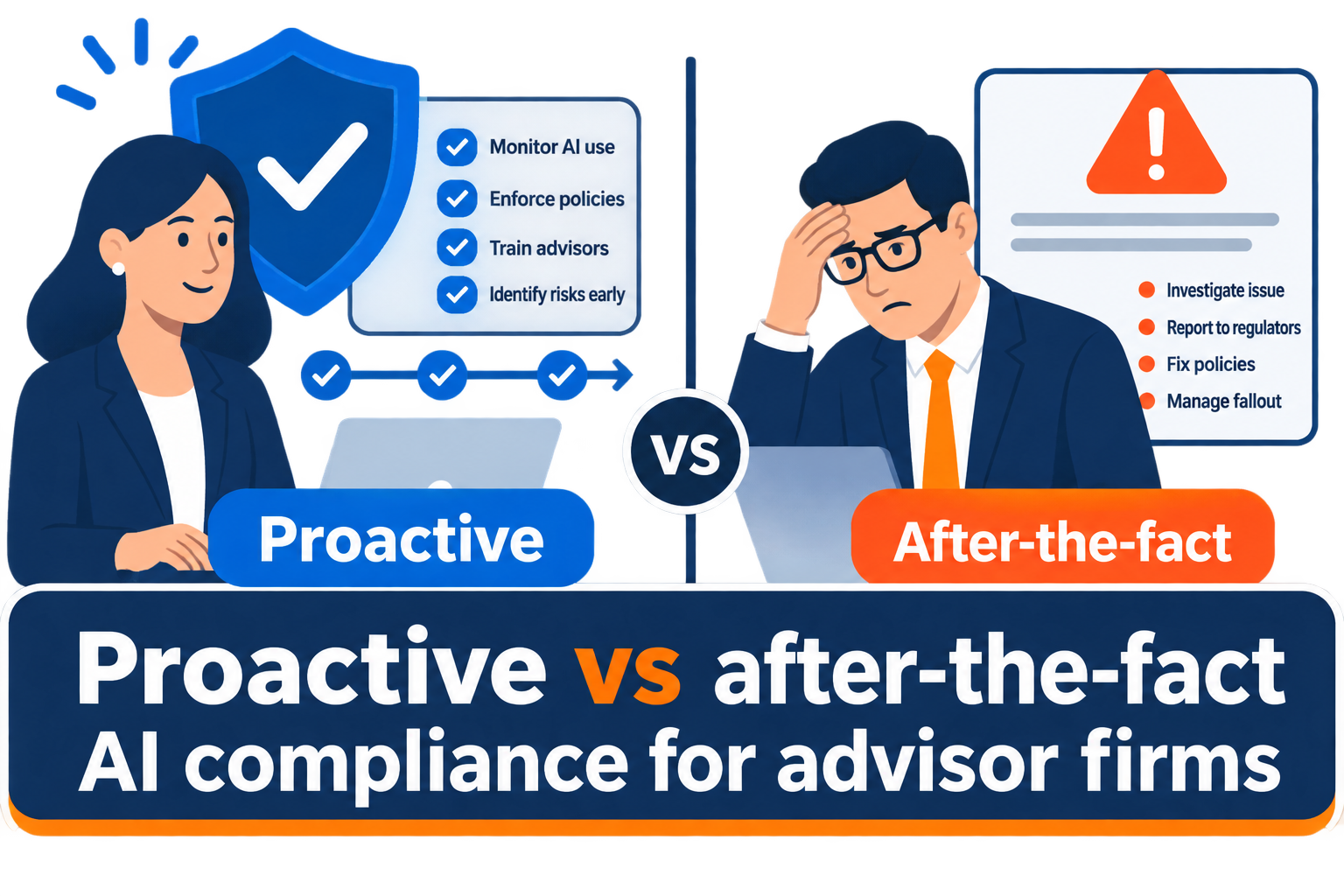
Short answer: Logging what staff send to an AI tool tells you what happened. It doesn't stop a client's account number from being sent. Advisor firms need both: guardrails that check each request against firm policy before it is sent, and logs that flow into the archiving or supervision tool compliance already uses.
After-the-fact controls
Enterprise AI plans give firms a record of activity. Claude Enterprise, for example, offers a Compliance API that exports conversations and usage so a supervision or archiving tool can review them. That record is necessary for books and records and for spotting problems. Its limit is timing: by the time anyone reviews the log, the data has already been sent.
Proactive controls
A guardrail layer sits between the user and the AI tool. Each request is checked against the firm's policies, written in plain language, and the layer allows it, warns the user or blocks it. The user fixes the request and sends it again. Typical rules for advisor firms:
- No Social Security numbers or full account numbers
- No client names in tools that aren't approved for client data
- No personal use on the firm's subscription
- Only approved connectors to the CRM, email and custodian data
How the two fit together
| Control | When it acts | What it gives compliance |
|---|---|---|
| Written AI use policy | Before rollout | The rules staff are trained on |
| Guardrail layer | Before a request is sent | Blocked or warned requests, by user and rule |
| Compliance logs | After the fact | A full record for review and retention |
| Usage reporting | Monthly | Cost and adoption by team |
Why this matters more as AI connects to the CRM
Once AI can read the CRM and draft follow-ups, client data moves through it every day. Firms that set guardrails before connecting systems can widen access with confidence. Firms that skip them tend to keep AI away from client data, and lose most of the value.