
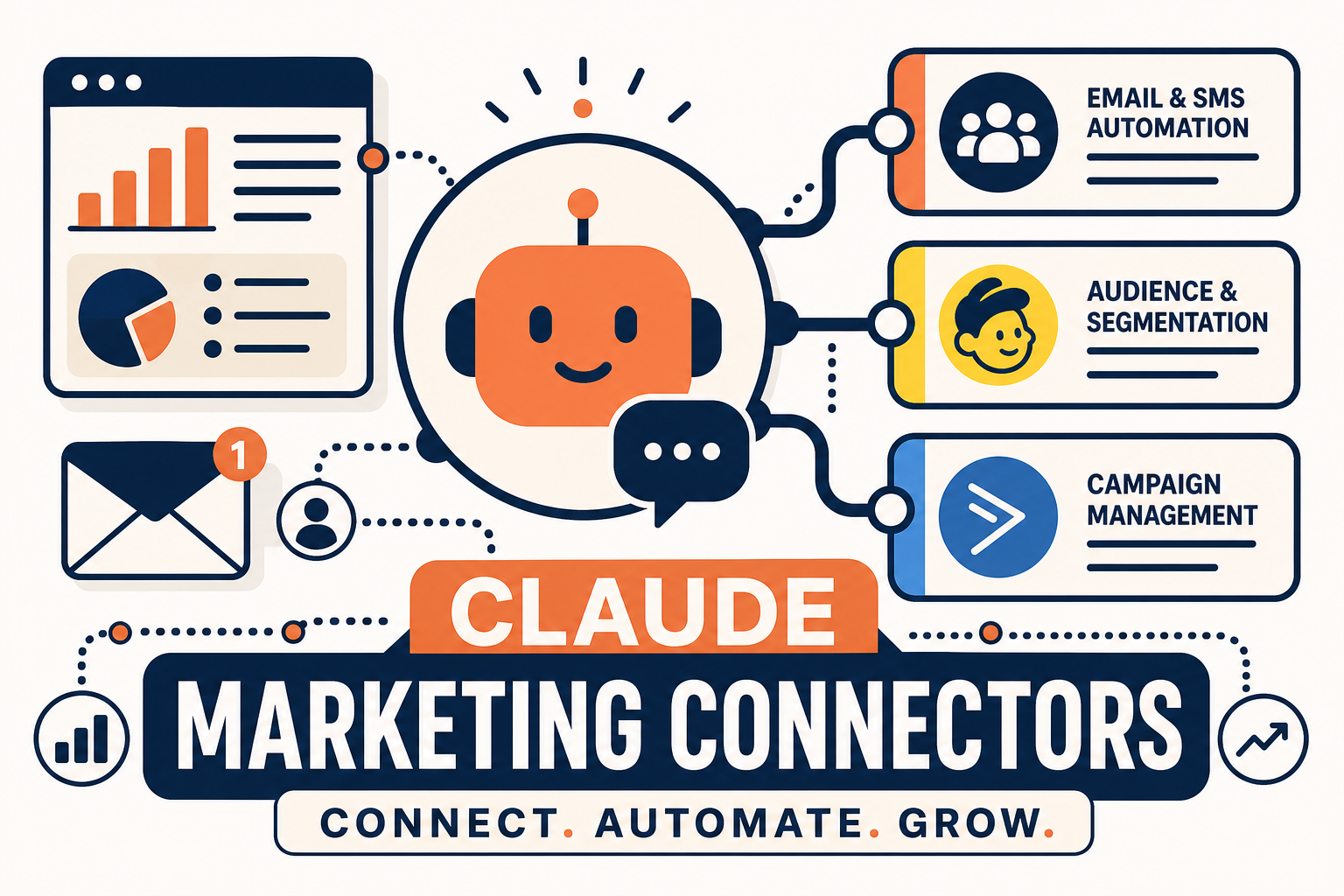
Marketing teams sit on top of an enormous amount of behavioral data — who opened what, who clicked, who's about to churn, which segment is worth a special offer — spread across an email platform, a customer engagement tool, and a handful of point solutions for link tracking and journey orchestration. Getting a straight answer out of that stack usually means logging into two or three dashboards, exporting a report from each, and stitching the numbers together in a spreadsheet before anyone can act. Connecting Claude to marketing automation and email platforms shortens that path: someone asks a plain-language question, Claude reads the relevant campaign, segment, or contact data, and responds with a written answer or a drafted next step. This guide covers how connectors for Klaviyo, Intuit Mailchimp, MailerLite, ActiveCampaign, Customer.io, Braze, Bitly, and Adobe's journey and marketing agent tools actually work, what they're good for, what data and governance they require, and how to start safely.
This is one entry in a broader series mapping the Claude connector ecosystem by business function. For the full picture of how connectors are organized and how this category fits alongside CRM, sales, support, and analytics connectors, see The Claude Connector Ecosystem: A Strategic Map of 400+ Integrations.
Quick Answer
To connect Claude to a marketing or email platform, you add a connector — typically a remote MCP (Model Context Protocol) server published by the platform vendor or a partner — and authenticate it so Claude can read (and in some cases draft or trigger) campaign, contact, and engagement data on your behalf. Klaviyo, Mailchimp, MailerLite, and ActiveCampaign expose email and SMS campaign, list, and segment data this way; Customer.io and Braze expose customer engagement and journey data; Bitly exposes link and click-tracking data; and Adobe Journey Optimizer and Adobe Marketing Agent expose enterprise journey orchestration data. Once connected, Claude can summarize campaign performance, draft segment definitions, analyze subscriber behavior, and help build or review customer journeys — always subject to what data the connection is scoped to see and whether it's allowed to take action or only read. Marketing data includes personal contact information and behavioral history, so scope access carefully, keep sensitive actions (like sending live campaigns) behind human approval, and start with one well-defined reporting or drafting use case before expanding.
TL;DR
- What it is: Connectors that let Claude read (and sometimes draft in or trigger) data from email and marketing automation platforms — Klaviyo, Mailchimp, MailerLite, ActiveCampaign, Customer.io, Braze, Bitly, and Adobe's journey tools.
- Why it matters: Marketing questions that normally require exporting from two or three dashboards can be answered conversationally, and routine drafting work (segment logic, campaign copy variants, journey summaries) gets faster.
- Best for: Marketing, lifecycle/CRM, and demand-gen teams that want faster campaign analysis, segment definition, and journey documentation — with clear limits on what Claude can send or trigger.
- Decision point: Whether the connector is read-only (reporting, drafting, analysis) or read/write (able to create or launch campaigns), and who has to approve anything that reaches a real customer.
- How Vantage Point helps: We connect Claude to your marketing stack with the right read/write boundaries and keep the underlying CRM and platform data clean enough to trust through system integration and data migration and AI-driven personalization and analytics.
What Are Claude Marketing Connectors?
Claude is Anthropic's AI assistant, and a marketing connector is the bridge that lets it read — and in some cases act within — the email or marketing automation platform your team already uses. Klaviyo, Mailchimp, and ActiveCampaign are widely used email and SMS marketing platforms built around contact lists, segments, flows, and campaigns. MailerLite serves a similar space with a lighter footprint. Customer.io and Braze focus on triggered, behavior-based customer engagement across email, push, and in-app messaging. Bitly manages and tracks shortened links, giving visibility into click activity across channels. Adobe Journey Optimizer and Adobe Marketing Agent sit at the enterprise end, orchestrating multi-step customer journeys across a broader martech stack.
Most of these connectors run on the Model Context Protocol (MCP), the open standard that lets Claude discover what a platform can do and request specific records — a campaign's performance, a segment's definition, a subscriber's activity history — without a custom-built, one-off integration for each tool. Some vendors publish first-party remote MCP servers; others are reached through partner-built or community MCP servers, or through desktop/local MCP connections for smaller teams. The practical result is similar across platforms: once connected, Claude can answer a question like "which segment had the highest click-through rate last month, and what did that email say" by reading the platform directly instead of waiting on an export.
The important distinction to make before connecting anything: some of these integrations are strictly read-only (Claude explains what's happening), while others allow drafting or even sending/triggering actions. Marketing connectors are one of the few categories where a connector reasonably needs some write capability — drafting a campaign, updating a segment, staging a journey step — which means the governance conversation has to include not just "what can Claude see" but "what can Claude do, and does a human sign off before it reaches a real customer."
Why Connect Claude to Marketing Tools in 2026?
The value shows up wherever a marketer currently exports a report or manually cross-references two systems:
- Campaign performance on demand. Ask which campaign, subject line, or segment performed best over a given period and get a written, sourced answer instead of a dashboard screenshot.
- Segment and audience analysis. Have Claude read subscriber behavior and propose segment logic — "who opened the last three emails but hasn't clicked" — instead of building the filter by hand.
- Journey and flow documentation. Ask Claude to summarize what an existing automation flow or customer journey actually does, which is useful when journeys were built by someone who has since moved on or when auditing for compliance.
- Drafting, not sending. Use Claude to draft campaign copy variants, subject line tests, or segment definitions that a marketer reviews and approves before anything goes live.
- Link and channel attribution. Read Bitly click data alongside campaign performance to see which channel is actually driving engagement, without manually cross-referencing two dashboards.
- Cross-platform synthesis. For teams running email in one platform and journeys in another, Claude can pull from both and produce one coherent narrative instead of leaving someone to reconcile two exports.
The reason this matters now is that most of this data already exists inside the platforms teams use every day — it's just locked behind dashboards, filters, and exports that take time to navigate. A connector lowers the distance between a marketing question and a governed answer. But answers are only as good as the underlying contact and campaign data, which is why a connector strategy and a clean CRM belong in the same conversation — see why clean CRM data is the real foundation for CRM AI.
The Major Marketing Connectors Compared
Connector availability, authentication methods, and plan gating change frequently in this category — verify current details directly with each vendor and with Anthropic's connector documentation before rolling anything out.
| Platform | Category | What Claude reads (or drafts) | Best fit |
|---|---|---|---|
| Klaviyo | Email & SMS marketing | Campaigns, flows, segments, subscriber activity | E-commerce and DTC brands running lifecycle email/SMS |
| Intuit Mailchimp | Email marketing | Campaigns, audiences, automation performance | SMB marketing teams on an all-in-one platform |
| MailerLite | Email marketing | Campaigns, subscriber lists, automation stats | Lean marketing teams wanting simpler email tooling |
| ActiveCampaign | Marketing automation & CRM | Campaigns, automations, contact and deal data | Teams blending marketing automation with light CRM use |
| Customer.io | Behavior-based messaging | Triggered campaigns, customer event data | Product-led and behavior-triggered lifecycle messaging |
| Braze | Customer engagement | Cross-channel campaigns, push/in-app/email data | Consumer apps with high-volume, cross-channel messaging |
| Bitly | Link management & tracking | Link click data, channel and campaign attribution | Teams needing clearer channel/link-level attribution |
| Adobe Journey Optimizer | Enterprise journey orchestration | Multi-step journey data across the Adobe stack | Large enterprises with complex, multi-channel journeys |
| Adobe Marketing Agent | Enterprise marketing AI | Campaign and journey data plus AI-assisted workflows | Enterprises standardizing marketing AI within Adobe |
A few practical points that apply across the category:
- Read-only by default, write by exception. Set up each connection to read and report first. Only extend to drafting or triggering actions once a use case has proven out, and keep a human in the loop before anything reaches a live audience.
- Contact data is personal data. Subscriber lists and behavioral history are personal data subject to privacy regulation and your own data-handling commitments. Scope connections to the minimum fields and audiences a use case needs.
- Claude is not the sender. Even where a connector supports drafting or scheduling, the decision to actually send or launch something to real customers should stay a deliberate, reviewed human action, not an automatic one.
- Attribution requires more than one source. A single platform's dashboard rarely tells the whole story; connecting more than one system (email plus link tracking, for example) is often where the real value shows up — and where scoping discipline matters most.
What Can Go Wrong
- Over-broad list access. Connecting Claude with access to every list and every field in a marketing platform, when a use case only needs campaign-level performance data, unnecessarily exposes personal contact information.
- Sending without review. Allowing a connector to draft and send/trigger in the same step removes the human checkpoint that catches an embarrassing subject line, a wrong segment, or a compliance issue before it reaches customers.
- Stale or duplicate contact data driving bad segments. If the underlying CRM or platform data has duplicate contacts, outdated opt-in status, or inconsistent field values, Claude's segment logic and performance summaries will inherit those errors.
- Treating a Claude summary as the final report. A conversational answer about campaign performance is a starting point for a marketer to verify, not a replacement for the platform's own reporting, especially where numbers feed executive reporting.
- Ignoring consent and suppression lists. Any workflow that touches contact data needs to respect unsubscribes, suppression lists, and regional consent requirements — a connector doesn't automatically know your compliance obligations.
How to Start
- Pick one recurring question or drafting task. A weekly campaign performance summary or a recurring segment-definition request is a better starting point than "connect everything."
- Scope the connection narrowly. Grant access to the specific campaigns, lists, or reporting views the use case needs, not blanket account access.
- Start read-only. Prove the reporting or analysis use case before considering any drafting or send/trigger capability, and require human approval before anything reaches real customers.
- Check the underlying data first. If contact records are duplicated, unopted-in contacts are mixed with subscribers, or campaign naming is inconsistent, fix that before layering AI analysis on top.
- Document who owns what. Decide who reviews Claude's drafts, who approves sends, and who's accountable if a segment definition is wrong — before the connector goes into daily use.
- Expand deliberately. Once one use case is working and trusted, add the next platform or the next capability rather than connecting the full marketing stack at once.
How Vantage Point Helps
Vantage Point is a vendor-agnostic consultancy working across both Salesforce and HubSpot, with senior consultants who scope and build these connections rather than handing the work to a junior bench. For marketing connectors specifically, that means:
- Assessing your marketing stack and data to determine which connectors are worth standing up first and what governance each one needs, through our Claude readiness assessment.
- Cleaning and structuring contact and campaign data so that segment logic, attribution, and performance summaries Claude produces are actually trustworthy, through system integration and data migration.
- Building governed, human-in-the-loop workflows for drafting and reporting — never wiring a connector straight to "send," through AI-driven personalization and analytics.
Because we work across both major CRM platforms and don't resell any single marketing tool, we can recommend the connector setup that fits your stack rather than the one tied to a specific vendor relationship. If you're weighing which of these connectors deserves to go live first, that's a conversation worth having before anything gets turned on.
Frequently Asked Questions
Do I need a paid Claude plan to use marketing connectors? Connector availability varies by Claude plan (Pro, Team, Enterprise) and by whether the connector is a first-party remote MCP server, a partner-built server, or a local/desktop MCP connection. Confirm current plan requirements directly with Anthropic and the specific marketing platform before rolling out.
Can Claude actually send a marketing email or launch a campaign on its own? Some connectors support drafting or even triggering sends, but the safest and most common setup keeps a human reviewing and approving anything before it reaches real customers. Treat send/launch capability as an explicit, reviewed exception, not the default.
Is subscriber and contact data safe to expose to Claude? It can be, if the connection is scoped to only the fields and audiences a specific use case needs, and if your organization's data handling and consent obligations are respected in how the connector is configured. Broad, unscoped access to full contact lists is the pattern to avoid.
How is a marketing connector different from a CRM connector? Marketing connectors focus on campaign, list, and engagement data inside email/automation platforms, while CRM connectors focus on contact, account, and deal records inside systems like Salesforce or HubSpot. Many teams eventually connect both, since campaign performance and CRM data tell a fuller story together — see our guide on connecting CRM systems to Claude.
What's the difference between Klaviyo/Mailchimp/ActiveCampaign and Customer.io/Braze? Klaviyo, Mailchimp, and ActiveCampaign are primarily campaign-and-list-oriented email (and in some cases SMS) marketing platforms. Customer.io and Braze are built around triggered, behavior-based messaging across multiple channels, often for product-led or app-based businesses. Both categories connect to Claude in similar ways, but the underlying data model differs.
Can Claude help fix inconsistent segments across multiple marketing tools? Claude can surface inconsistencies once it can read the relevant platforms, but fixing the underlying data — duplicate contacts, inconsistent field values, conflicting consent status — is a data quality project, not something a connector solves by itself.
Should a small marketing team start with one connector or several? Start with one connector and one recurring use case. It's easier to prove value, tune the scope, and build trust with a single well-defined workflow before expanding to a second or third platform.
Where does this fit in the broader Claude connector ecosystem? Marketing and email connectors are one category within a much larger ecosystem that also includes CRM, sales intelligence, meeting intelligence, and analytics connectors, among others. See The Claude Connector Ecosystem: A Strategic Map of 400+ Integrations for how these categories relate.