
Before connecting Claude to your CRM, one question decides whether the project succeeds: is your organization actually ready? A readiness assessment answers that before you spend on licenses or integration.
This guide walks through what a Claude readiness assessment evaluates, why each area matters, and what the output should give you.
Quick Answer
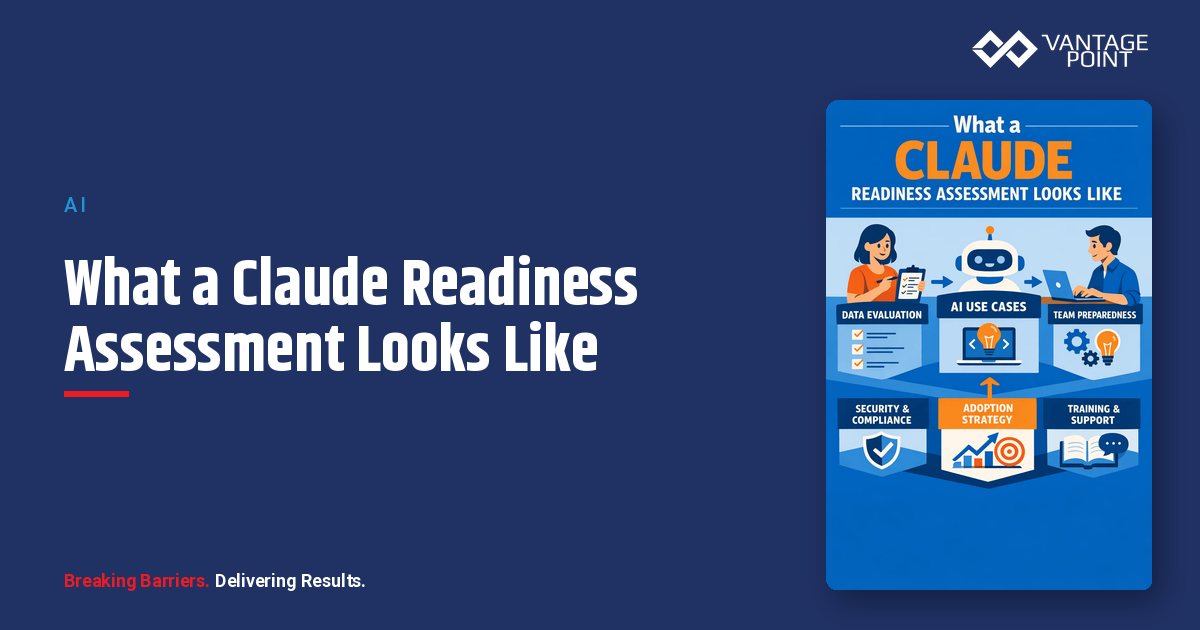
A Claude readiness assessment reviews five areas: your data quality and structure, your use cases and expected value, your governance and security model, your integration architecture, and your team's adoption readiness. The output is a prioritized roadmap that says what to fix first and which use case to pilot.
TL;DR
- A readiness assessment checks data, use cases, governance, integration, and adoption before deployment.
- Its purpose is to prevent failed AI projects, most of which fail on data and governance, not the model.
- The deliverable is a prioritized roadmap, not a sales pitch.
- It identifies quick wins and the work needed before scaling.
- Vantage Point runs readiness assessments tied to AI-driven personalization and analytics and compliance and security solutions.
This assessment is a service we run.
Vantage Point's AI Readiness Assessment evaluates your CRM data, workflows, and governance, and produces a practical deployment plan.
Start with a readiness assessment →
What Is a Claude Readiness Assessment?
A Claude readiness assessment is a structured review of whether your data, processes, and governance can support a Claude deployment on CRM data. It is diagnostic, not promotional.
The goal is to find gaps before they become failed pilots, then sequence the work so value comes early.
Why Readiness Matters in 2026
Most AI projects do not fail because the model is weak. They fail because the data is fragmented, the governance is unclear, or no one adopts the tool. A readiness assessment surfaces those risks while they are still cheap to fix.
It also sets honest expectations. Knowing you are six weeks of data cleanup away from a reliable use case is far better than discovering it after launch.
How a Readiness Assessment Works
Area 1: Data quality and structure
The assessment reviews how clean, complete, and consistent your CRM data is. Duplicate records, missing fields, and inconsistent values all degrade AI output. This often drives early system integration and data migration work.
Area 2: Use cases and value
It identifies which sales or service use cases are worth automating first, based on effort, risk, and expected return. Narrow, high-value use cases come first.
Area 3: Governance and security
It maps what data Claude should access, what permissions apply, and how actions will be logged. This is where compliance and security solutions are designed in, not bolted on.
Area 4: Integration architecture
It reviews how Claude will connect to Salesforce, HubSpot, or custom systems through APIs, middleware, or the Model Context Protocol, and whether that architecture is governable.
Area 5: Adoption readiness
It assesses whether your team is ready to use AI, including training needs and change management. Tools that no one adopts deliver no value, so this connects to advisory and change management.
What the Assessment Produces
| Output | What It Tells You |
|---|---|
| Data quality scorecard | Where records need cleanup before AI |
| Prioritized use case list | Which workflow to pilot first |
| Governance model | What Claude can access and how it is logged |
| Integration plan | How Claude connects to your CRM safely |
| Adoption plan | Training and change steps for real usage |
| Roadmap | Sequenced steps from quick wins to scale |
Signs You Need a Readiness Assessment
- You are not sure if your CRM data is clean enough for AI.
- You have AI budget but no clear first use case.
- Security or compliance has questions you cannot answer yet.
- A past AI pilot stalled and you do not know why.
If any of these sound familiar, an assessment will save more than it costs.
What Businesses Should Do Next
Treat readiness as the first project phase, not an optional extra. A short, structured assessment turns AI ambition into a sequenced plan with clear owners and quick wins.
If your team is evaluating how this applies to Salesforce, HubSpot, integrations, or CRM governance, Vantage Point can help assess the right next step and build a practical implementation plan.
How Vantage Point Helps
Vantage Point helps organizations evaluate, implement, and optimize Salesforce and HubSpot based on their operating model, data needs, adoption goals, and growth strategy. Our readiness assessments are vendor-agnostic and grounded in real CRM operations.
We pair the assessment with AI-driven personalization and analytics, compliance and security solutions, and advisory and change management so the roadmap actually gets executed.
The AI Readiness Assessment is the first step in our Claude services: the deliverables described above are exactly what you receive.
FAQ
What does a Claude readiness assessment cover?
It covers five areas: data quality, use cases and value, governance and security, integration architecture, and adoption readiness. Together these predict whether a deployment will succeed. The output is a prioritized roadmap.
How long does a readiness assessment take?
It varies by org size and data complexity, but most are short and focused rather than drawn out. The point is to find gaps quickly and sequence the work. Vantage Point scopes the timeline to your environment.
Why do most AI projects fail without readiness?
They fail on fragmented data, unclear governance, and low adoption: not on the model. A readiness assessment surfaces these risks before you spend on licenses and integration. Fixing them early is far cheaper than after launch.
Do we need to clean our CRM data before using Claude?
Usually some cleanup is required, because AI amplifies whatever data it sees. The assessment identifies exactly which records and fields need attention first. This protects the accuracy of every later use case.
Is a readiness assessment vendor-specific?
A good assessment is vendor-agnostic. While it can be framed around Claude, the data, governance, and adoption findings apply to any CRM AI choice. Vantage Point keeps the analysis focused on your operating model, not a single product.
What do we get at the end of the assessment?
You get a data quality scorecard, a prioritized use case list, a governance model, an integration plan, an adoption plan, and a sequenced roadmap. It tells you what to fix first and which use case to pilot. That clarity is the deliverable.