
Quick Answer
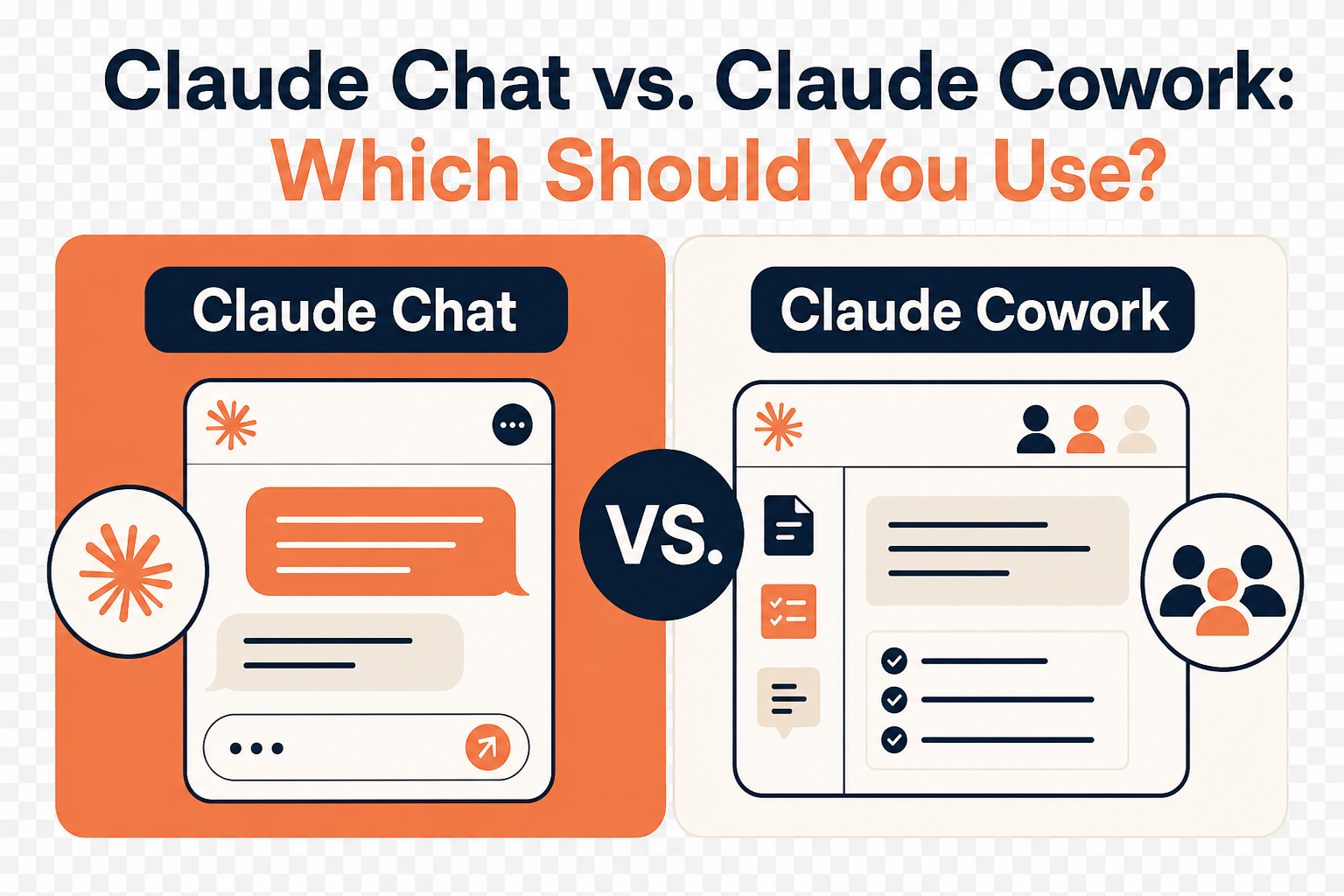
Claude Chat is the conversational side of Claude: you ask, it answers, and the work stays in the chat window. Claude Cowork is the agentic side: you hand it a goal, and it plans, executes, and verifies multi-step work across your files and connected tools, then returns finished work for review. On the token question: yes, Cowork consumes plan usage faster than Chat, because an agent that reads files, calls tools, and checks its own work processes far more context than a single reply. Anthropic publishes no official token multiple — this guide explains the mechanism and how to measure the difference yourself.
Key Takeaways (TL;DR)
- What is Claude Chat? The conversational interface — fast answers and drafts on material you paste in or upload. Every plan, including Free.
- What is Claude Cowork? Anthropic's agentic mode — "Claude Code for the rest of your work" — completing multi-step tasks across your folders, connectors, and browser. Paid plans only.
- Token efficiency: Cowork consumes more usage per task by design — planning loops, sub-agents, and tool results all add context. Anthropic confirms the direction but publishes no official multiple; "2–3x" claims are unverified.
- Use Chat when one good answer solves it; use Cowork when the deliverable spans many files or systems.
- Status as of October 2026: Chat and Cowork are merging into one Claude (Pro and Max first); new Cowork tasks on those plans run in Anthropic's cloud.
- How Vantage Point helps: an official Claude partner designing governed Claude rollouts — Claude consulting services.
What Is Claude Chat?
Claude Chat is the default conversational interface at claude.ai and in the Claude apps: you type a message, Claude responds, and you steer every turn. It works with what you bring in — pasted text, uploads, connected apps — and returns drafts you copy into your own systems. Chat is on every plan, including Free.
What Is Claude Cowork?
Claude Cowork is Anthropic's agentic mode for non-technical knowledge work, launched January 12, 2026 as a research preview and described as "Claude Code for the rest of your work." Instead of answering a question, Cowork accepts a goal: it opens the folders and tools you connect, breaks the job into steps, executes them — reading files, calling connectors, using a built-in browser — and returns finished work for review.
Anthropic's examples are operational: reconciling regional exports with variances flagged, turning a folder of contracts into per-contract memos, building a weekly marketing readout on a schedule. Over 90% of Cowork usage comes from outside software development, led by business operations and content creation.
Cowork reached general availability on April 9, 2026 on all paid plans, with enterprise controls — role-based access, group spend limits, per-tool connector permissions, usage analytics, and OpenTelemetry events for SIEM pipelines. Web and mobile beta followed on July 7, 2026, and a built-in browser on August 26, 2026.
Is Claude Cowork Merging Into Claude Chat?
Yes — confirmed by Anthropic. On September 16, 2026, Anthropic announced that "Claude Cowork and chat are merging into one Claude": you describe what you need, and Claude decides whether it is a quick answer or a task. The merged experience is rolling out to Pro and Max plans first, with Team and Free to follow and at least 30 days' notice for Enterprise.
The implication: "Chat versus Cowork" is becoming a routing decision Claude makes per task, not two products you buy. But the consumption gap between a quick answer and an agentic task remains — which is why the token question still matters.
Claude Chat vs. Claude Cowork: Side-by-Side
| Dimension | Claude Chat | Claude Cowork |
|---|---|---|
| Core job | Answer, draft, and analyze inside a conversation | Complete multi-step tasks and deliver finished work for review |
| Who drives each step | You — every turn is prompted | Claude — it plans, executes, and verifies; you steer and approve |
| File access | Only what you upload or paste | Reads, edits, and creates files in folders you explicitly connect |
| Tools and systems | Connectors bring content into the conversation | Connectors plus a built-in browser; acts across systems in one pass |
| Runs unattended | No — one turn at a time | Yes — works with your laptop closed; scheduled tasks run on a cadence |
| Plan availability (as of Oct 2026) | All plans, including Free | Paid plans: Pro, Max, Team, Enterprise; web and mobile in beta on Team and admin-enabled Enterprise |
| Usage consumption | Lower — one prompt and reply per turn | Higher — agentic loops, sub-agents, and tool results add context; Anthropic states Cowork "consumes limits faster than Chat" |
| Best for | Questions, drafts, analysis of material in front of you | Deliverables that require gathering, reading, and assembling across files and tools |
Does Cowork Use More Tokens Than Chat?
Yes — and Anthropic says so itself. The Cowork pricing page notes that "Claude Cowork consumes limits faster than Chat," and the product FAQ adds that "agentic tasks consume more capacity than regular chat" because "Claude coordinates multiple sub-agents and tool calls to complete complex work." What Anthropic does not publish is an official Chat-versus-Cowork token multiple; social-media claims of two to three times the tokens are unverified.
The mechanism is documented in Anthropic's Claude Code cost documentation — Cowork uses the same agentic approach as Claude Code:
- Costs scale with context size. Every token processed counts, and an agentic task reads far more material than a chat reply.
- Agent loops add hidden turns. Plan, act, check, iterate — each internal step is a model call you never see.
- Sub-agents multiply context. Big jobs split into parallel chunks, each with its own context window.
- Tool results inflate the window. Every file read or connector response lands in context and is re-processed on later steps.
- Caching and compaction soften the bill. Prompt caching serves repeated content at lower cost; auto-compaction summarizes long sessions.
The honest comparison is not "same question, two prices." A folder-of-contracts review has no chat equivalent — in chat, you are the integration layer, spending your own hours moving material in and out. Cowork's extra usage usually buys back human assembly time, which is the right baseline for the math.
Choose Chat If... Choose Cowork If...
Choose Claude Chat when:
- One good answer or draft solves it — a summary, an email, analysis of a document.
- You want turn-by-turn control.
- The material fits in one upload or paste.
- You are on the Free plan — no Cowork access.
Choose Claude Cowork when:
- The output is a deliverable — a reconciled spreadsheet, contract memos, a weekly briefing deck.
- The inputs live in several places: folders, connectors, the web.
- The task recurs — schedule it once and review on a cadence.
- You would otherwise be the copy-paste layer between systems.
We advise clients to treat this as a routing decision, not a licensing decision: a paid plan covers both, so the skill worth training is recognizing which shape a task has before you start it.
How Do You Measure Usage on Your Own Plan?
Because Anthropic publishes no official multiple, measure your own mix:
- Individuals (Pro/Max): watch the plan usage bars and session breakdowns; Cowork draws down the same allowance faster. Anthropic's usage-limit guidance explains the rolling limits.
- Team and Enterprise admins: the admin dashboard shows Cowork sessions and active users, the Analytics API adds per-user activity and connector invocations.
- Budget guardrails: group spend limits cap per-team consumption while you learn each team's usage shape.
- A practical pilot: run two or three recurring workflows for two weeks; compare usage drawdown against the staff hours the task used to consume. That ratio — not an internet multiple — is the number your CFO will ask for.
What Should Regulated Firms Check Before Rolling Out Cowork?
An agent that reads folders and acts across tools deserves the same diligence as any system touching client data:
- Where tasks run. Since October 6, 2026, new Cowork tasks on Pro and Max run in Anthropic's cloud; Enterprise can run through your own cloud provider (Bedrock, Google Cloud, or Microsoft Foundry). Map that against your residency posture first.
- Permissions scope. Users choose the folders and tools Claude can reach, deletions require approval, and admins can restrict connector actions org-wide — read-only on a CRM connector, for example.
- Audit trail. Cowork emits OpenTelemetry events for tool calls, files read or modified, and manual versus automatic approvals — compatible with SIEM tools like Splunk and Cribl. Anthropic's Cowork safety guide is the document for your security team.
- Model-training and retention settings. Confirm the "Help improve our AI models" privacy setting and retention practices match your policy before pilot data flows.
This is the governance discipline firms apply to CRM AI, extended to a desktop agent. Our compliance and security solutions practice covers the adjacent review work.
What Should Businesses Do Next?
- Inventory recurring knowledge work — tasks where someone gathers material from several places and assembles a deliverable. Those are your Cowork candidates.
- Pilot with measurement on — two or three workflows, two weeks, dashboards open; record consumption and hours saved.
- Set spend and permission guardrails first — easier before habits form than after.
- Train the routing skill — "is this a question or a deliverable?" Chat for the first, Cowork for the second.
- Plan for the merged experience — write usage policies once; they will apply wherever a task runs.
For plan tiers and per-seat pricing detail, see our guide to Claude plans and pricing.
How Vantage Point Helps
Vantage Point is a Claude Partner Network Member and boutique CRM consulting firm. We help organizations turn Claude Chat and Cowork into governed, measurable workflows — connecting Claude to Salesforce and HubSpot data, designing permission and audit models for compliance teams, and training staff on when a chat turn beats an agentic task. Senior consultants only — no junior handoffs; the experts you meet are the experts who deliver. Through our Claude consulting services and advisory and change management practice, we run pilot design, usage measurement, and rollout planning — so the efficiency question gets answered with your numbers, not someone else's.
Ready to Put Claude to Work — Efficiently?
Whether you are choosing between Chat and Cowork for one team or planning an enterprise rollout, Vantage Point can help you design the pilot, set the guardrails, and measure what matters. Get in touch with Vantage Point to schedule a Claude readiness session.
Frequently Asked Questions
What is the difference between Claude Chat and Claude Cowork?
Claude Chat is a conversation: you ask, Claude answers, and you steer every turn. Claude Cowork is an agent: you give it a goal, and it plans and executes multi-step work across your connected folders and tools, returning finished work for review. Chat is on every plan including Free; Cowork requires a paid plan.
Does Claude Cowork use more tokens than Claude Chat?
Yes. Anthropic states Cowork "consumes limits faster than Chat" because agentic tasks coordinate sub-agents and tool calls. Planning loops, file reads, and tool results all add context, and token costs scale with context size — though prompt caching and auto-compaction soften long sessions.
Is there an official token multiple comparing Cowork to Chat?
No. As of October 2026, Anthropic publishes no official Chat-versus-Cowork token ratio, and social-media claims of two to three times the tokens are unverified. Measure your own workflows using plan usage bars, the admin dashboard, or the Analytics API.
Which Claude plans include Cowork?
As of October 2026, Cowork is included on all paid plans: Pro (from $17 per month billed annually), Max ($100 or $200 tiers), Team (from $20 per seat per month), and Enterprise. It is not on the Free plan. Web and mobile access is in beta for Team and admin-enabled on Enterprise.
Is Claude Cowork merging into Claude Chat?
Yes. Anthropic announced on September 16, 2026 that Cowork and chat are merging into one Claude experience — you describe what you need, and Claude decides whether it is a quick answer or a task. The rollout started with Pro and Max plans, with Team and Free to follow and at least 30 days' notice for Enterprise.
How can I measure how much usage Cowork consumes?
Individuals on Pro and Max can watch plan usage bars and session breakdowns in the app. Team and Enterprise admins see Cowork sessions and active users in the admin dashboard, plus per-user activity through the Analytics API. Group spend limits cap consumption while you establish a baseline.
Is Claude Cowork appropriate for regulated industries?
It can be, with the right controls: role-based access, per-tool connector permissions, approval requirements for deletions, and OpenTelemetry audit events compatible with standard SIEM tools. Enterprise deployments can run through your own cloud provider. Complete a security and data-residency review before broad enablement.
Sources
- Claude Cowork product page — Anthropic
- Claude Cowork general availability — Anthropic, April 9, 2026
- Claude Cowork: coming to mobile and web — Anthropic
- Claude Cowork and chat are now one Claude — Anthropic, September 16, 2026
- Cowork on web, desktop, and mobile — Claude Help Center
- Use Claude Cowork safely — Claude Help Center
- Usage limit best practices — Claude Help Center
- Manage costs effectively — Claude Code documentation
Vantage Point is a boutique CRM consulting firm helping businesses transform with Salesforce, HubSpot, and AI — 150+ clients, 400+ engagements, and a 4.71/5 average engagement rating. Learn more at vantagepoint.io.