
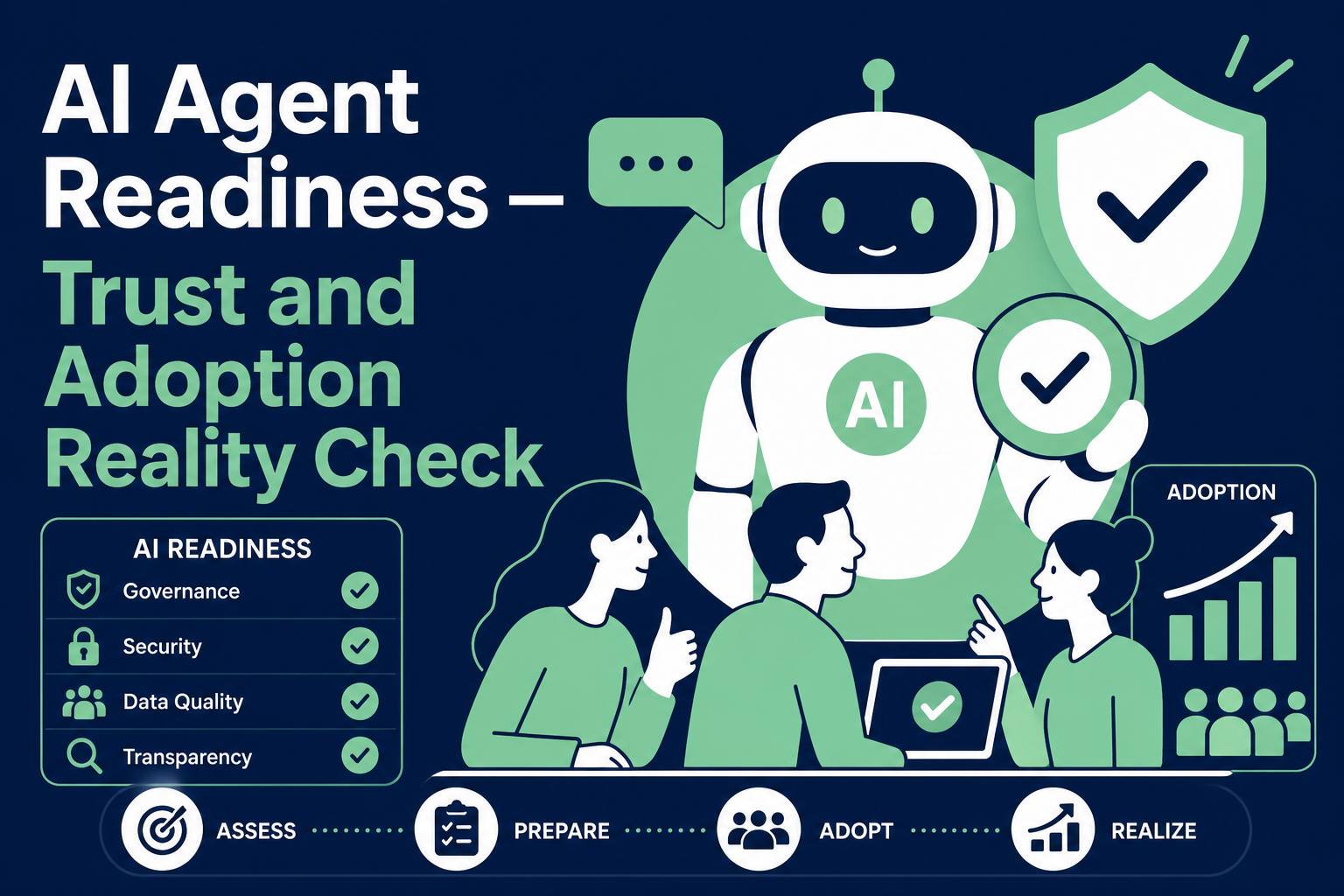
Most organizations evaluating AI agents ask a technical question first: what can the tool do? The more useful question is a human one: will people actually trust it, and will they use it once the demo is over? Vendor pitches for autonomous agents rarely mention that the biggest blocker to value is not model capability. It is whether your team believes the output and builds it into daily work.
This is a reality check, not a technical checklist. It separates genuine, provable AI agent use cases from vendor hype, and walks through the trust and adoption signals that predict whether an agent rollout sticks or quietly gets ignored six weeks after launch.
If you have already scoped the technical side (data quality, integration, and governance) see our companion look at what a readiness assessment evaluates and what a phased team rollout looks like. This post covers the layer above both: whether the organization is ready to trust and adopt what gets built.
Quick Answer
AI agent readiness is not only a data and security question: it is a trust and adoption question. An organization is ready when three things are true: people understand what the agent actually does (not the vendor pitch version), someone owns verifying its output before it drives a decision, and a real workflow exists for the agent to plug into. This matters for any business evaluating AI agents in CRM, sales, or operations before signing a contract or running a pilot. Vantage Point helps assess this readiness gap through advisory and change management and AI-driven personalization and analytics, working across Salesforce and HubSpot without steering you toward one platform.
TL;DR
- What it is: A trust-and-adoption lens on AI agent readiness: distinct from a technical data/governance checklist.
- Why it matters: Most AI agent pilots fail on adoption and trust, not on model quality.
- Best for: Leaders about to greenlight an AI agent pilot who want to separate real capability from vendor hype.
- Decision point: Whether people understand the agent's actual scope, who verifies its output, and whether a real workflow exists for it to join.
- How Vantage Point helps: We run readiness conversations tied to advisory and change management and connect the technical side through system integration and data migration.
What Is AI Agent Readiness (Beyond the Checklist)?
AI agent readiness is usually described as a technical exercise: is the data clean, is the integration built, is governance documented. Those questions matter, but they answer whether an agent can run: not whether an organization will actually trust and use it.
The reality check adds three questions technical checklists tend to skip:
- Do people understand what the agent actually does? Many teams approve an "AI agent" without a clear, plain-language description of its actual scope. What it reads, what it can act on, and what it cannot do.
- Who verifies the output before it matters? Every agent produces answers or actions with some error rate. Readiness means a named person or process checks output before it reaches a client, a deal, or a compliance-sensitive record.
- Is there a real workflow for it to join? An agent bolted onto a process nobody actually follows will not get used, no matter how capable it is.
Why This Matters in 2026
AI agent vendors are moving fast, and pitch decks increasingly describe autonomous, end-to-end workflows. The gap between that pitch and daily reality is where most disappointment happens. A team can have perfectly clean data and a technically sound integration and still watch an agent go unused, because nobody built the trust layer around it: clear expectations, a verification step, and a workflow people were already following.
This is also where hype does real damage. When leadership expects an agent to behave like the demo (instantly, across every edge case, without oversight) the first mistake it makes becomes a reason to abandon the whole initiative. Setting realistic expectations up front is part of readiness, not a separate step.
Separating Real Use Cases From Vendor Hype
| Signal | Vendor hype framing | Reality check framing |
|---|---|---|
| Scope | "Fully autonomous agent handles the whole workflow" | A defined task within a workflow, with a clear boundary on what it cannot do |
| Accuracy | "Near-perfect, enterprise-grade AI" | A known error rate with a verification step built around it |
| Data | "Works out of the box with your systems" | Requires specific, scoped, reasonably clean data to be reliable |
| Adoption | "Employees will love it immediately" | Adoption requires a workflow it fits into and a person who trusts and checks it |
| Timeline | "Live in days" | Live in days; trusted and adopted in weeks to months, with iteration |
Use this table as a filter on any AI agent pitch. If a vendor's answer to every row is the hype-side framing, treat the pitch skeptically and ask for a narrower pilot instead.
How to Run the Reality Check: Step by Step
- Write the agent's actual scope in one paragraph, in plain language. If your team cannot describe what it reads, what it can act on, and what it cannot do without pulling up marketing material, the scope is not clear enough to trust yet.
- Name the verifier. Identify the specific person or role responsible for checking the agent's output before it reaches a client, a deal record, or a compliance-sensitive decision. "The team will keep an eye on it" is not a verification plan.
- Confirm the workflow already exists. An agent should join a process people already follow, not create a new one nobody has time for. If the underlying workflow is broken or inconsistent, fix that first.
- Set the real error-rate expectation. Ask what happens when the agent gets something wrong, and make sure someone signed off on that outcome before launch, not after the first mistake.
- Pilot on one narrow, verifiable use case. Prove trust and adoption on a single, low-risk task before expanding scope. Expansion should follow demonstrated trust, not a vendor's roadmap.
What Can Go Wrong?
- Approving the pitch, not the product. Leadership signs off on the demo version of an agent, then discovers the production version has narrower scope and a real error rate.
- No named verifier. Output reaches a client or a deal without anyone checking it, because "the team" was never a specific person with the responsibility.
- Bolting an agent onto a broken process. If the underlying workflow is inconsistent or people already route around it, an agent added on top will be ignored the same way.
- Treating the first mistake as proof of failure. Without a pre-set expectation for error rate and correction, one visible mistake can end an otherwise promising pilot.
- Confusing usage with trust. People logging into a tool is not the same as trusting its output enough to act on it without double-checking. Usage metrics alone can hide a trust gap.
- Skipping the technical side entirely. Trust and adoption readiness does not replace data quality, governance, and integration work: it sits on top of it.
What Businesses Should Do Next
Before running or expanding an AI agent pilot, get straight answers to four questions: What exactly does this agent do, in plain language? Who verifies its output? What workflow is it joining, and does that workflow already work reliably today? What happens the first time it makes a mistake? If any answer is vague, that is the gap to close before scaling, not a reason to abandon AI agents altogether, but a reason to narrow the pilot until the answers are clear.
Pair this reality check with the technical side: confirm your data and governance are ready using a structured readiness assessment, and once you are live, follow a deliberate adoption and enablement playbook rather than assuming usage will follow naturally.
How Vantage Point Helps
Vantage Point runs AI agent readiness conversations that cover both sides: the technical checklist (data, governance, integration) and the trust-and-adoption layer this post focuses on. Every engagement uses senior consultants only, no junior staff learning on your project, and our advice is vendor-agnostic across Salesforce and HubSpot, so the recommendation fits your actual environment instead of a single platform's roadmap.
Our advisory and change management practice builds the trust and adoption plan: naming a verifier, setting realistic expectations, and confirming the workflow an agent will join. Our AI-driven personalization and analytics work connects that plan to the underlying data and use case design, and system integration and data migration keeps the technical foundation clean so the agent has something reliable to work with. Because the practice is dual-platform and senior-only, the same reality-check discipline applies whether your AI agent plans run through Salesforce, HubSpot, or both.
FAQ
What is AI agent readiness, beyond a technical checklist?
It is whether an organization will actually trust and use an AI agent once it is deployed: not just whether the data and integration are technically sound. Readiness includes a clear, plain-language description of the agent's scope, a named person who verifies its output, and a real workflow for it to join.
How is this different from a data or governance readiness checklist?
A data and governance checklist confirms an agent can run safely. This reality check confirms people will actually trust and use what gets built, covering expectations, verification, and workflow fit, which technical checklists typically do not address.
What is the biggest reason AI agent pilots fail?
Most pilots fail on adoption and trust, not on model capability. Teams often approve a vendor's demo-version pitch, skip naming someone to verify output, or bolt the agent onto a workflow people were not consistently following, so it goes unused even when the technology works.
How do we separate a real AI agent use case from vendor hype?
Compare the vendor's framing against a narrower, verifiable version: ask for the actual scope in plain language, the known error rate, the specific data required, and a realistic timeline for adoption rather than just deployment. If every answer matches the hype framing exactly, ask for evidence or a smaller pilot.
Who should verify an AI agent's output before it's trusted?
A specific, named person or role: not "the team" in general. The verifier should be identified before launch, understand the agent's scope well enough to spot errors, and have the authority to correct or escalate before the output reaches a client, deal, or compliance-sensitive record.
What should happen the first time an AI agent makes a mistake?
Nothing should happen without a plan already in place. Set the expected error rate and correction process before launch so a single visible mistake does not become the reason to cancel an otherwise promising pilot.
Does readiness mean waiting until everything is perfect before starting?
No. Readiness means starting with a narrow, verifiable pilot rather than a broad rollout, proving trust and adoption on one low-risk use case before expanding, instead of waiting indefinitely or launching everywhere at once.
How does Vantage Point help with AI agent readiness?
Vantage Point runs readiness conversations covering both the technical checklist and the trust-and-adoption layer, using senior consultants only and staying vendor-agnostic across Salesforce and HubSpot. We help name a verifier, set realistic expectations, confirm workflow fit, and connect the plan to the underlying data and integration work.