
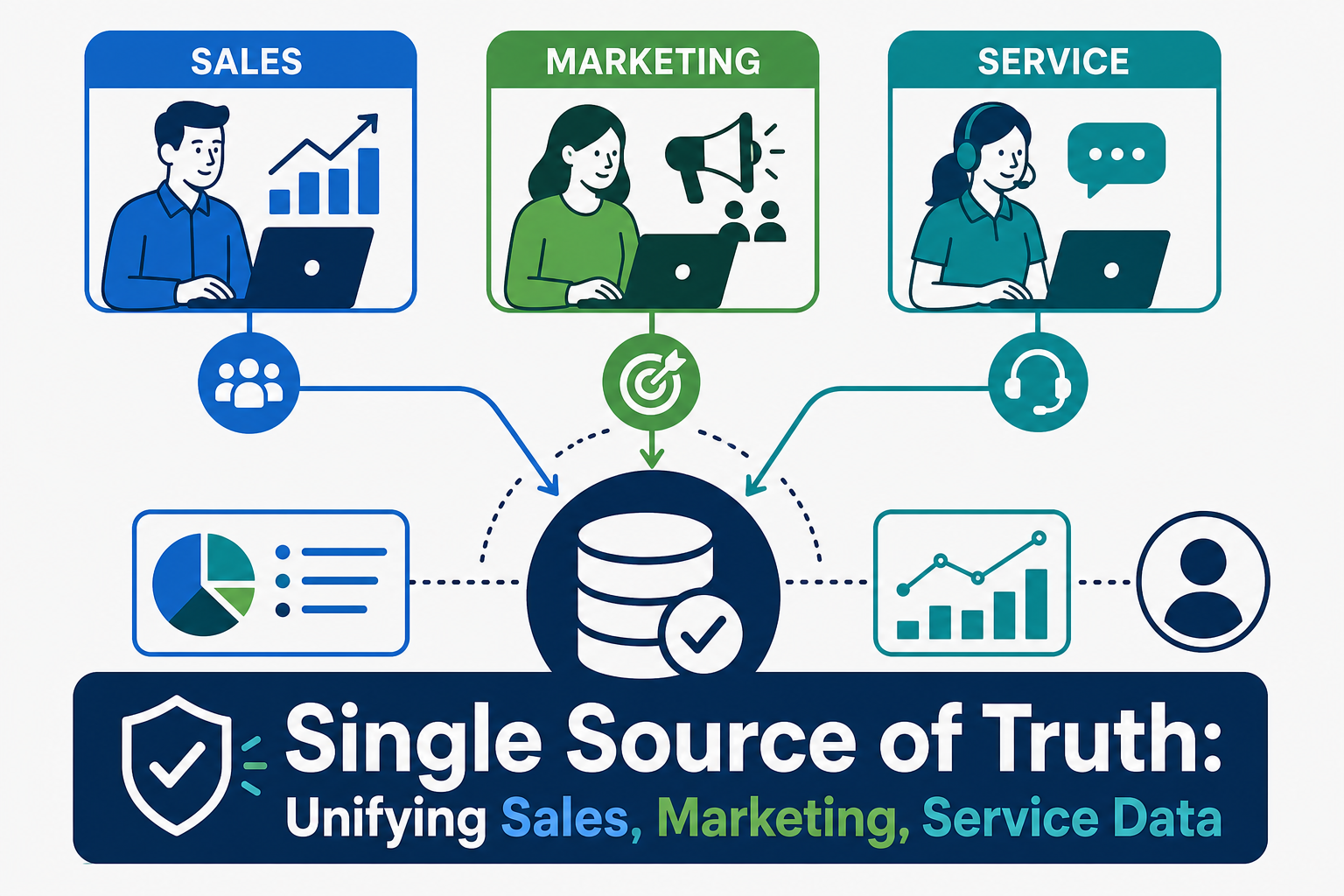
If your sales team, marketing team, and service team each see a different version of the same customer, you don't have a data problem — you have a trust problem. Reps stop trusting the CRM. Marketers send offers to customers who just filed a complaint. Support agents can't see what sales promised. The fix is a single source of truth: one accurate, shared customer record that every system and every team reads from and writes to.
This guide explains what a single source of truth actually means in practice, how it differs from a customer data platform (CDP) or data warehouse, and how to build one without a multi-year data project.
Quick Answer
A single source of truth (SSOT) is the one authoritative record for each customer that sales, marketing, and service all treat as accurate — instead of each team keeping its own version in separate tools. It matters for any business running CRM, marketing automation, and support tools that don't sync cleanly. An SSOT strategy helps you decide which system owns which data, how records get matched and merged, and how updates flow between platforms. Vantage Point designs and implements this kind of data unification across Salesforce, HubSpot, and connected systems.
TL;DR
- What it is: A single source of truth is the one trusted, shared customer record every team and system relies on, rather than separate versions in separate tools.
- Why it matters: Disconnected data causes duplicate outreach, missed handoffs, and inaccurate reporting that erodes trust in the CRM.
- Best for: Growing organizations running CRM, marketing automation, and service tools that don't share data cleanly today.
- Decision point: Whether you need a full customer data platform (CDP), a data warehouse, or a well-configured CRM with the right integrations.
- How Vantage Point helps: We design data models, matching rules, and sync architecture through our system integration and data migration services so records stay accurate across platforms.
What Is a Single Source of Truth?
A single source of truth is the one version of a customer record that is considered authoritative across an organization. When someone updates a phone number, email address, or deal stage, that change is the accepted truth everywhere — not just in the system where it was entered.
This is different from simply having "a CRM." Many organizations already have a CRM, but still lack a single source of truth because:
- Marketing automation stores its own contact list that drifts out of sync with the CRM.
- The support desk creates a separate customer record with no link back to the sales record.
- Spreadsheets and shared drives hold "the real" numbers that don't match any system.
- Multiple records exist for the same person or account with no clear owner of which one is correct.
An SSOT strategy fixes this by defining ownership, matching rules, and sync logic — not by forcing everyone into a single piece of software.
Why This Matters in 2026
Fragmented customer data has always caused problems, but three trends have raised the cost of getting it wrong:
- AI tools need clean, unified data. Predictive scoring, AI-assisted email drafting, and service copilots all perform worse when they're reading from incomplete or duplicate records. Bad inputs produce bad AI outputs, regardless of which platform you use.
- Customers expect consistency across channels. A customer who spoke with support in the morning expects sales or marketing to know about it that afternoon. Disconnected data creates the appearance of an organization that doesn't talk to itself.
- Reporting accuracy drives decisions. Leadership dashboards built on inconsistent data lead to wrong conclusions about pipeline, churn risk, and campaign performance.
Getting to a single source of truth is now a practical requirement for reliable automation and reporting — not just a data hygiene nice-to-have.
How a Single Source of Truth Works
Building an SSOT is a sequence of decisions, not a single tool purchase.
1. Decide which system is the "system of record" for each data type
Not every system needs to own every field. A common pattern:
- CRM (Salesforce or HubSpot): owns account, contact, deal/opportunity, and activity data.
- Marketing automation: owns campaign engagement and subscription/consent status, synced back to the CRM.
- Service/helpdesk: owns case and ticket history, linked to the CRM contact or account record.
- Finance/billing system: owns invoice and payment data, referenced by the CRM but not duplicated there.
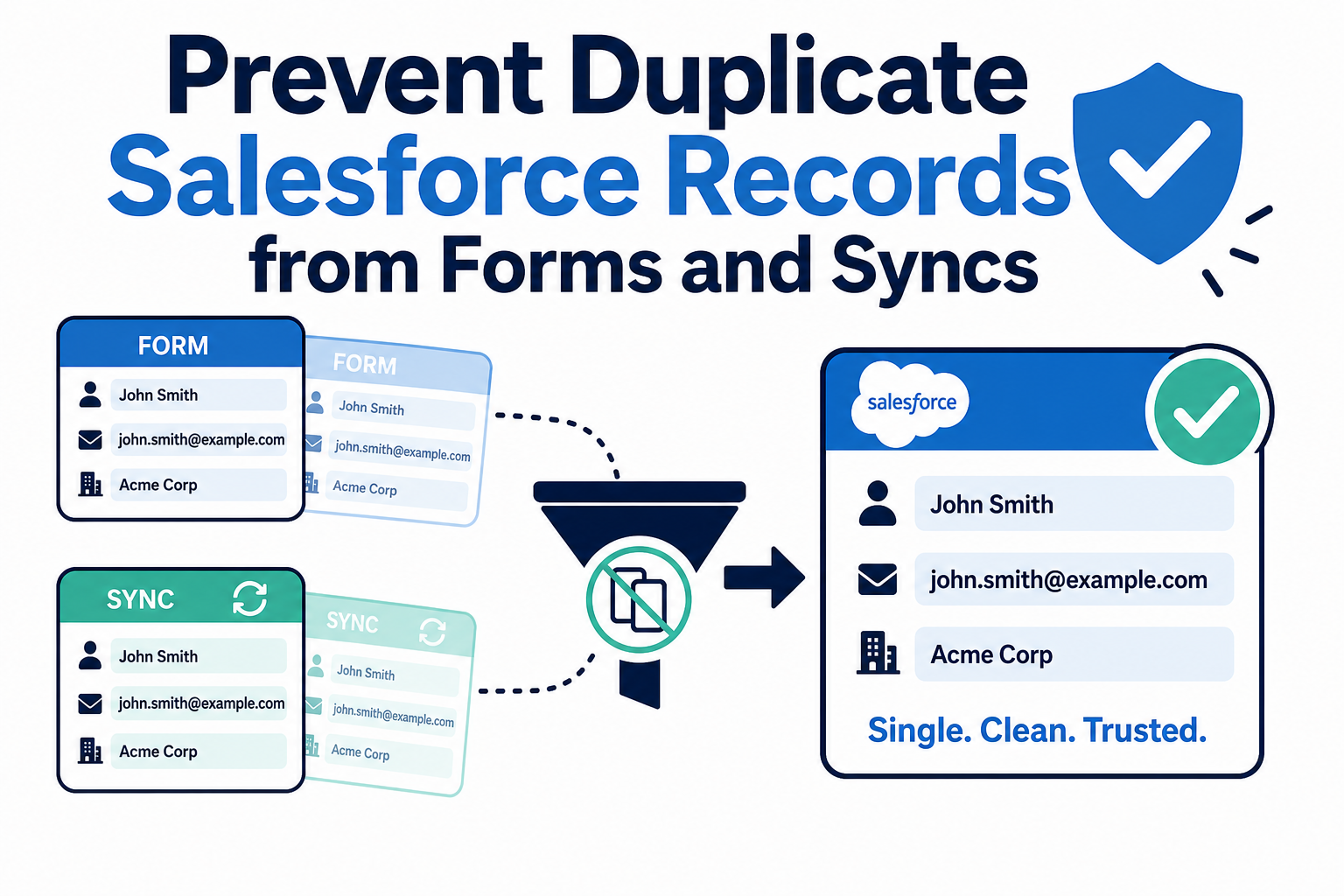
2. Define matching and deduplication rules
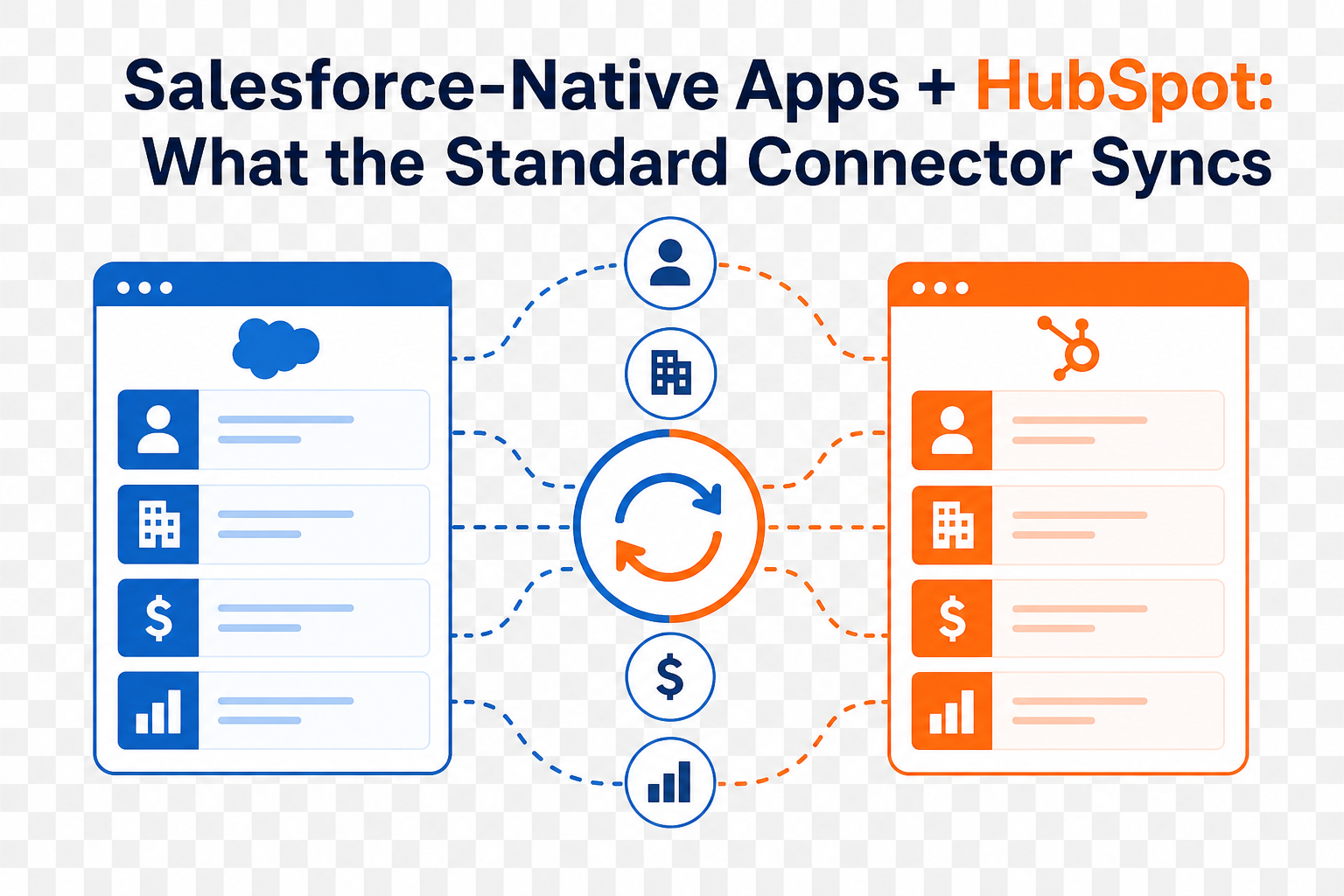
Decide how records are matched across systems — typically email address, phone number, or an external ID — and what happens when a likely duplicate is found (auto-merge vs. manual review queue).
3. Establish sync direction and frequency
Some data should sync in real time (for example, a new support case appearing in the CRM). Other data can sync on a schedule (for example, nightly billing updates). Map this out explicitly rather than defaulting to "sync everything constantly," which creates unnecessary system load and integration fragility.
4. Assign data governance ownership
Someone — usually a RevOps or systems admin role — needs authority to resolve conflicts when two systems disagree about the same record. Without a named owner, data quality problems linger for months.
5. Monitor and audit regularly
Set up regular duplicate checks and sync error alerts so problems are caught in days, not discovered a year later during a reporting review.
CRM vs. CDP vs. Data Warehouse: Which Do You Need?
Many organizations conflate "single source of truth" with "we need a CDP." That's not always true. Here's how to decide:
| Approach | Best For | Data Scope | Real-Time? | Typical Owner |
|---|---|---|---|---|
| Well-configured CRM (Salesforce/HubSpot) with integrations | Sales, marketing, and service teams that need one shared operational view | Contacts, accounts, deals, cases, campaign activity | Yes, for CRM-native data | RevOps / CRM admin |
| Customer Data Platform (CDP) | Organizations unifying data across many channels (web, product, offline) for advanced segmentation and personalization | Broad behavioral and transactional data from many sources | Often near real-time | Marketing/data team |
| Data warehouse | Organizations needing deep historical analytics, BI reporting, or data science across the whole business | All structured business data, including finance and product | Usually batch, not real-time | Data/analytics team |
Choose a well-configured CRM approach if your core problem is sales, marketing, and service not seeing the same customer record — this is the most common starting point and often solves 80% of the pain without new infrastructure.
Choose a CDP if you need to unify behavioral data from many digital channels for personalization and targeting at a scale your CRM wasn't built to handle.
Choose a data warehouse if your primary need is company-wide analytics and BI reporting rather than day-to-day sales, marketing, and service operations.
Many mature organizations eventually use more than one of these together — a CRM for operational single source of truth, and a warehouse or CDP layered on top for advanced analytics. Start with the CRM foundation before adding more infrastructure.
What Businesses Should Do Next
- Audit where duplicate or conflicting records already exist. Pull a sample of accounts and check whether sales, marketing, and service tools agree on basic facts like contact info and status.
- Pick one system of record per data type using the ownership model above, and document it somewhere the whole team can see.
- Fix matching and merge rules before adding more integrations. Adding new data sources to a CRM with poor deduplication just multiplies the problem.
- Automate sync instead of relying on manual re-entry, prioritizing the highest-friction handoffs first (for example, service cases showing up in the CRM automatically).
- Assign a data governance owner so future conflicts have a clear decision-maker.
If your team is evaluating how this applies to Salesforce, HubSpot, integrations, or CRM governance, Vantage Point can help assess the right next step and build a practical implementation plan.
How Vantage Point Helps
Vantage Point helps organizations design and implement single-source-of-truth data architecture across Salesforce, HubSpot, and connected systems. That includes:
- Data modeling and system-of-record decisions through system integration and data migration.
- Ongoing CRM and marketing automation alignment through CRM and marketing automation strategy.
- Combined Salesforce and HubSpot environments through our HubSpot and Salesforce integration services.
- AI-ready data quality work that supports AI-driven personalization and analytics.
- Ongoing administration and monitoring through managed services and ongoing support so sync issues get caught early.
FAQ
What is a single source of truth in CRM terms? It's the one accurate, authoritative customer record that sales, marketing, and service all treat as correct, rather than each team maintaining its own separate version in a different tool.
Do I need a customer data platform to get a single source of truth? Not necessarily. Many organizations can achieve a reliable single source of truth with a well-configured CRM and the right integrations. A CDP is worth considering when you need to unify broad behavioral data across many digital channels for advanced personalization.
How is a single source of truth different from a data warehouse? A data warehouse is built for company-wide analytics and historical reporting, often updated in batches. A single source of truth is typically operational — it drives day-to-day sales, marketing, and service work and often needs to be current in real time or near real time.
What causes most single-source-of-truth failures? The most common causes are unclear ownership of which system is authoritative for which data, weak deduplication rules, and syncing data without first agreeing on a shared data model.
Which system should be the source of truth: CRM or marketing automation? In most setups, the CRM (Salesforce or HubSpot) should own core account, contact, and deal data, while marketing automation owns campaign engagement and consent status that syncs back to the CRM. This keeps sales and service working from the same core record.
How long does it take to build a single source of truth? Timelines vary by system complexity and data quality, but many organizations can establish core system-of-record rules and basic sync architecture in a matter of weeks once ownership decisions are made. Full cleanup of existing duplicate data can take longer depending on data volume.
Can AI tools work without a single source of truth? AI tools can technically run without one, but results suffer. Predictive scoring, AI email drafting, and service copilots all depend on accurate, de-duplicated data. Fragmented records lead to inconsistent or incorrect AI outputs.
Who should own data governance for a single source of truth? Usually a RevOps lead or CRM administrator, since they need authority to resolve conflicts between systems and enforce matching and sync rules across sales, marketing, and service teams.