
Quick Answer
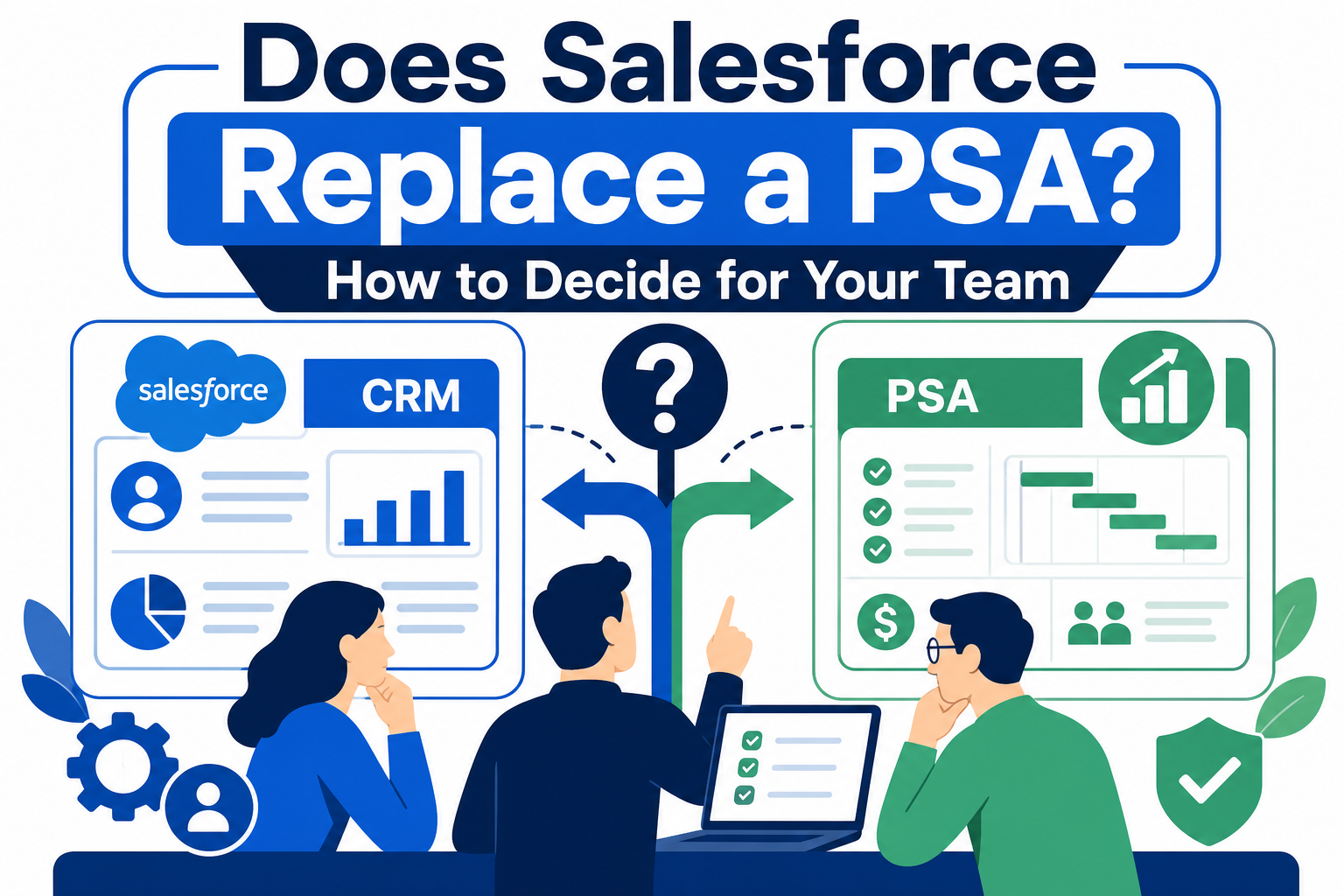
Salesforce does not replace a PSA (professional services automation) tool — they solve different problems. Salesforce runs your front office: accounts, contacts, opportunities, quoting, and the handoff into delivery. A PSA runs the delivery business itself: resource planning and staffing, time and expense capture, project accounting, utilization, and margin by project. Small services teams with simple, fixed-fee work can stretch Salesforce (plus maybe a project app) surprisingly far. Once you need utilization management, transaction-level project financials, or resource forecasting across a bench, a dedicated PSA pays for itself in visibility. The most common mature architecture keeps Salesforce as the customer-facing front end and a PSA as the delivery back end, integrated at the opportunity-to-project handoff. Vantage Point helps services firms design exactly this split through our Salesforce implementation and advisory work.
TL;DR
- Salesforce is a CRM; a PSA is delivery operations software. Overlap exists at the opportunity-to-project handoff, nowhere else that matters.
- You probably need a PSA when utilization, project P&L, or resource forecasting become standing management questions.
- Salesforce-native PSAs share the platform's data model; external PSAs integrate through middleware and keep their own database.
- The expensive mistake is forcing Salesforce to be a PSA with dozens of custom objects — it works until reporting and finance needs arrive.
- Decide on process requirements first (staffing, time capture, billing), then pick software — never the reverse.
What Does a PSA Actually Do That Salesforce Doesn't?
Before comparing anything, get precise about the category. A PSA platform typically covers five capabilities:
- Resource planning and staffing. Who is available, with what skills, across which projects — and who is over- or under-allocated next month. This is forward-looking capacity management, not a calendar.
- Time and expense capture. Consultants log hours and expenses against projects and tasks, with approval workflows and billable/non-billable splits.
- Project accounting. Budgets vs. actuals at the transaction level, WIP, billing milestones, revenue recognition inputs, and margin by project, client, or practice.
- Delivery project management. Tasks, milestones, dependencies, and status — the part with the most overlap with generic project tools.
- Utilization and forecasting analytics. The reports services leaders actually run the business on: billable utilization, realization, backlog, and forecasted staffing gaps.
Salesforce, out of the box, does none of these natively at the depth a services business needs. Opportunities track what you might sell; they don't track who will deliver it, at what cost, or whether it made money.
When Is Salesforce Alone Enough?
Plenty of teams run services on Salesforce without a PSA, legitimately. You're probably fine without one if most of these hold:
- Your delivery team is small enough that staffing happens in a standing meeting, not a system.
- Work is predominantly fixed-fee or productized, so time capture is a payroll input rather than a billing engine.
- Nobody is asked for utilization or realization numbers, and project profitability is reviewed quarterly in a spreadsheet without pain.
- Projects are short and similar, so a few custom objects or a lightweight project app on the opportunity covers tracking.
The tell that you've outgrown this: leadership questions change. When "can we take on this deal?" requires knowing who is free in six weeks, or when finance asks why a project's margin collapsed and nobody can reconstruct it from timesheets, the CRM-plus-spreadsheets model is done.
When Do You Need a Dedicated PSA?
The triggers are consistent across services firms:
- Utilization becomes a managed metric. The moment a utilization target appears in someone's goals, you need trustworthy time capture and capacity data — not estimates.
- Project financials get scrutinized. Transaction-level history, audit-ready billing, and per-project margin are PSA home turf. Rebuilding them in CRM reports is fragile.
- Resource planning gets political. When three project managers fight over the same senior consultant, you need a system of record for allocations, not a negotiation.
- Billing complexity arrives. Time-and-materials plus milestone plus retainer plus expenses, on one account, is where CRM-based billing workarounds break.
- You sell and deliver at scale. The opportunity-to-project handoff — scopes, rates, staffing plans — needs to be a system flow, not a re-keyed email.
Should You Choose a Salesforce-Native PSA or an External One?
This is the second decision, and it's architectural. Both patterns work; they optimize for different things.
| Factor | Salesforce-native PSA | External PSA + integration |
|---|---|---|
| Data model | Shares the Salesforce platform — accounts, opportunities, and projects live in one database | Separate database; accounts and projects sync through middleware or native connectors |
| Handoff | Opportunity converts to project in place; no sync lag or mapping | Integration must carry scope, products, and key dates across systems |
| Reporting | Single reporting layer across sales and delivery | Cross-system reporting needs a warehouse or BI layer |
| Depth of PSA features | Strong, but bounded by platform conventions | Specialist vendors often go deeper on scheduling, finance, or specific verticals |
| Cost shape | Platform licenses plus PSA licenses; admins often shared with CRM team | PSA subscription plus integration build and maintenance |
| Best fit | Firms already standardizing on Salesforce that want one system of record | Firms with finance-system anchors (ERP-first) or deep specialist needs |
Examples of the native pattern include PSAs built on the Salesforce platform (Certinia and Mission Control are well-known names); the external pattern includes standalone tools like Kantata, BigTime, or Accelo connected through middleware such as MuleSoft. Naming examples isn't an endorsement — the right answer depends on your finance stack, reporting needs, and how deep your scheduling requirements go.
What Does a Healthy CRM + PSA Architecture Look Like?
The pattern that holds up across firms: Salesforce owns the customer relationship from lead through signed deal; the PSA owns delivery from kickoff through final invoice; and the integration boundary sits at closed-won. Practically:
- The opportunity carries the scope, rate card, and estimated effort; at closed-won it creates the project in the PSA.
- Account and contact records sync one way (CRM is the master) so delivery and sales see the same customer.
- Project status and summary financials flow back to Salesforce so account owners can see delivery health without a PSA license.
- Invoices and revenue live in the PSA or ERP; Salesforce gets rollups, not transactions.
Two failure modes to avoid: forcing Salesforce to be the PSA (dozens of custom objects, brittle flows, reports that never quite tie out), and letting the PSA become a shadow CRM (delivery teams re-keying customer data because integration was an afterthought).
What Should Businesses Do Next?
Write down the five to ten questions your leadership actually asks about delivery — utilization, margin, capacity, billing status — and test whether your current stack answers them without heroics. If it does, stay put and invest in better CRM hygiene instead. If it doesn't, run a proper PSA evaluation: requirements first, native-vs-external architecture second, vendors third. Rehearse the opportunity-to-project handoff in a sandbox with real deal shapes before committing.
How Vantage Point Helps
Vantage Point designs and implements CRM and delivery-system architectures for services organizations — Salesforce front ends, PSA selection and integration, and the data flows between them. Senior consultants only, no junior handoffs: the experts you meet are the experts who deliver. Whether you need a systems integration between Salesforce and a PSA, or an honest assessment of whether you need a PSA at all, we can help you decide with your actual numbers.
Not Sure Whether You Need a PSA?
If your team is weighing Salesforce customization against a dedicated PSA, Vantage Point can assess your delivery process and recommend a practical architecture. Start a conversation with our team.
Frequently Asked Questions
What is a PSA in business software?
PSA stands for professional services automation — software that runs the delivery side of a services business: resource planning, time and expense capture, project management, project accounting, and utilization reporting. It complements a CRM, which manages the customer relationship and sales pipeline.
Can Salesforce be used as a PSA?
Salesforce can be stretched into light PSA duties with custom objects and flows, and that works for small teams with simple fixed-fee delivery. It breaks down when you need transaction-level project accounting, utilization management, or resource forecasting — those are purpose-built PSA capabilities.
What is the difference between a CRM and a PSA?
A CRM manages relationships and revenue opportunities before the deal is signed; a PSA manages delivery after signature — staffing, time, budgets, billing, and margin. The two meet at the opportunity-to-project handoff, which is why integration design matters so much.
Is it better to buy a Salesforce-native PSA or integrate an external one?
Salesforce-native PSAs share the CRM's data model, giving you one database and unified reporting. External PSAs often go deeper on scheduling or finance features but require integration and a cross-system reporting strategy. Choose based on finance-stack anchors and feature depth, not convenience.
How much does a PSA cost?
Pricing varies widely by vendor, edition, and team size, and most PSAs are licensed per user with tiered feature sets. Model total cost as licenses plus implementation plus integration maintenance, and compare it against the cost of the reporting and billing workarounds you run today.
When is the right time to implement a PSA?
The right time is when leadership's standing questions — utilization, project margin, capacity — can't be answered from current systems without manual effort. Implementing earlier than that adds process weight; later means months of decisions made on spreadsheet estimates.