
Quick Answer
Usually, yes — if your industry platform is built natively on Salesforce, the standard HubSpot–Salesforce connector can sync it, because underneath the industry-specific interface your data still lives in Salesforce objects. Contacts, companies, and deals typically map to their platform equivalents; industry-specific records (households, policies, portfolios, projects) are custom objects that need deliberate mapping or middleware. Expect to invest in field mapping, sync-rule cleanup, and rollup design — the connector gets you connected, but it doesn't decide what your data model means.
TL;DR
- What it is: Using HubSpot's native Salesforce connector against an industry platform (CRM, practice management, core system) that is itself built on Salesforce.
- Why it matters: It avoids a custom integration build — but only if you understand which objects the connector actually sees.
- Best for: Teams adopting HubSpot marketing while their industry system of record runs on Salesforce.
- Decision point: Standard objects sync natively; industry-specific objects and rollups are a mapping exercise, and sometimes a middleware decision.
- How Vantage Point helps: Our HubSpot consultants and Salesforce consultants design these integrations as one team.
"Our platform is built on Salesforce — does that mean HubSpot can connect to it?" It's a fair question, and it comes up constantly in industries that run on Salesforce-native vertical platforms: wealth management, insurance, lending, nonprofit, healthcare, construction. The vendor sold you a purpose-built system; marketing bought HubSpot; now someone has to make them talk.
The good news is structural. A Salesforce-native application stores its data in the same object model the HubSpot connector already speaks — standard objects, custom objects, fields, and relationships. The connector doesn't know or care that your "Account" is dressed up as a client household or a borrower entity. What it needs is a thoughtful mapping between your platform's data model and HubSpot's.
What does "Salesforce-native" actually mean for integration?
Salesforce-native means the vendor built the application on the Salesforce platform itself — your data lives in your Salesforce org, in objects you can see in Setup, not in the vendor's separate cloud. That distinguishes it from platforms that merely integrate with Salesforce. If you can open Salesforce Setup and find the object's fields, it's native, and the HubSpot connector can reach it.
This matters because it changes the integration question from "does Vendor X have a HubSpot integration?" to "which of these objects should HubSpot know about, and how should they map?" — a much better question to be asking.
How does the standard connector see your platform?
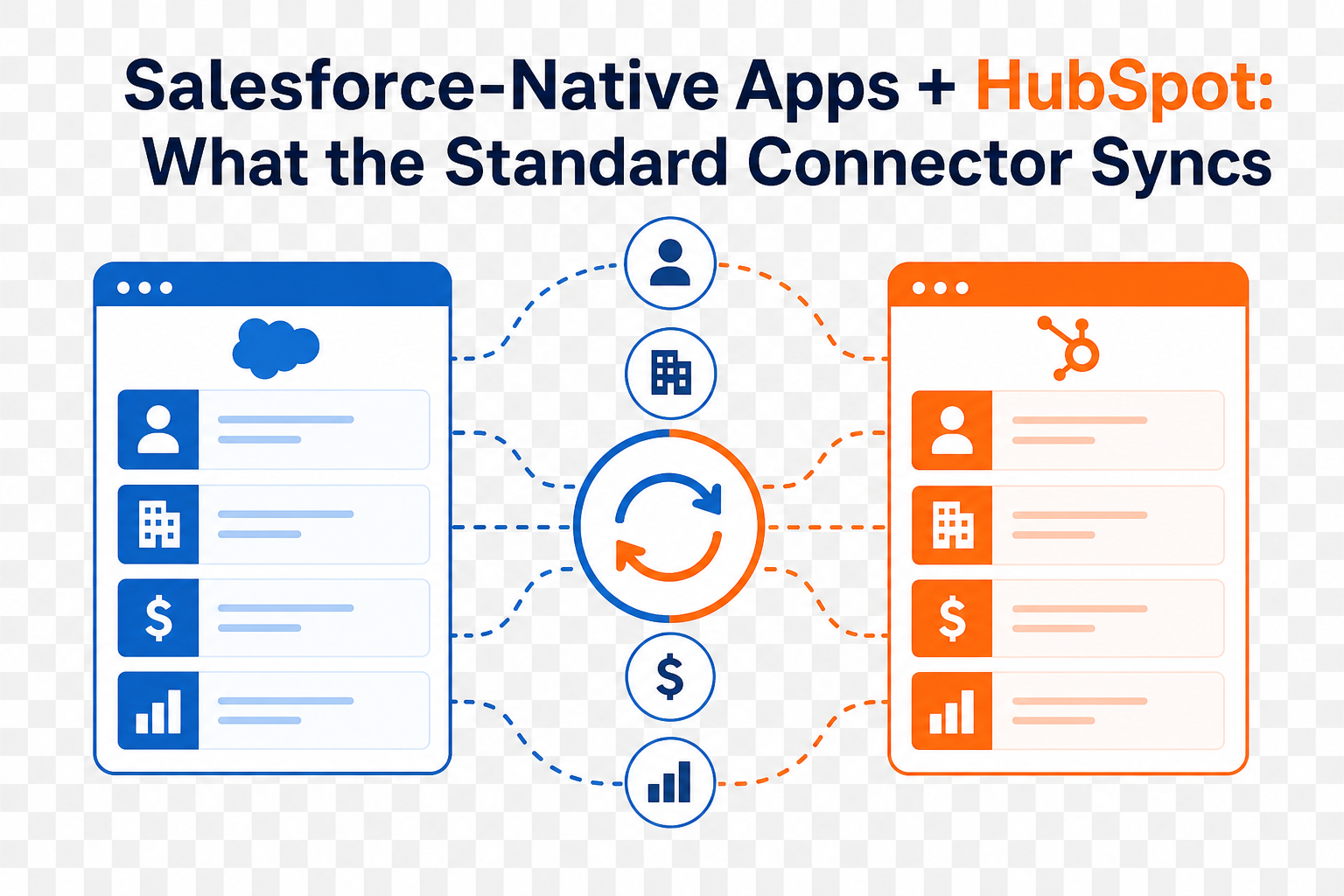
The HubSpot–Salesforce connector syncs a defined set of object pairs natively, and can be extended beyond them:
| Your platform's data (Salesforce) | HubSpot equivalent | How it syncs |
|---|---|---|
| Leads, Contacts | Contacts | Native, bidirectional, with field mappings and an optional inclusion list |
| Accounts / client entities | Companies | Native, with account matching rules |
| Opportunities / pipeline records | Deals | Native, including stage mapping to HubSpot pipelines |
| Campaign membership | List membership / campaign property | Native via inclusion lists and campaign properties |
| Activities (tasks, events) | Engagements / timeline | Native, configurable by activity type |
| Industry custom objects (households, policies, loans, portfolios) | Custom objects or contact properties | Requires deliberate design — native custom-object sync where editions allow, otherwise middleware |
| Rollup values (AUM, totals, balances) | Calculated or synced properties | Syncs as field values; the logic must be built on the Salesforce side |
The pattern that works: let Salesforce remain the system of record and the place where industry logic (rollups, valuations, relationship structures) is computed; sync the results into HubSpot as properties and deals that marketing can segment on.
Where do these integrations usually go wrong?
- Sync errors ignored. The connector logs every failure — validation rules, required fields, picklist mismatches. Unreviewed, they silently freeze records in time. A weekly sync-error review is the minimum viable governance.
- Mapping the interface, not the object. Vertical platforms often present a record through a custom UI that doesn't match the underlying object structure. Map the real objects and fields, not the labels on the screen.
- Duplicate entities. If your platform distinguishes relationships (a person who is both a client and a center of influence), naive matching creates duplicates in HubSpot. Matching rules need to reflect your platform's relationship model.
- Expecting the connector to compute. The connector moves values; it doesn't roll up pipeline or aggregate balances across related records. That logic belongs in Salesforce — flows, rollups, or Apex — with the output synced.
When do you need more than the connector?
Three triggers justify middleware (or a custom build) alongside the native connector:
- True bidirectional behavior beyond standard objects — when updates must flow HubSpot → platform for industry records, not just contacts and deals.
- Complex relationship traversal — when the value HubSpot needs is computed across several related records (a household's total relationship, a book-of-business rollup) and changes frequently.
- Multi-system landscapes — when HubSpot and the Salesforce-native platform are two of three or more systems that must stay consistent.
If none of those apply, the native connector plus disciplined mapping is usually enough — and dramatically cheaper to operate.
How Vantage Point Helps
Vantage Point is both a Salesforce and a HubSpot partner, so connector work is a one-team exercise rather than a relay between vendors. We audit the platform's object model, design the mapping (standard objects natively, industry objects deliberately), resolve sync-error backlogs, and build the rollup logic on the Salesforce side that gives marketing segments worth using. Senior consultants only — no junior handoffs; the experts you meet are the experts who deliver.
Where the connector isn't enough, our integration team designs the middleware layer — and our managed services team keeps mappings and sync health maintained as both platforms evolve.
Frequently Asked Questions
Does the HubSpot connector work with Salesforce-native industry platforms?
Generally yes. Because a Salesforce-native platform stores data in your org's objects, the connector reads them like any other Salesforce data. Standard objects (contacts, accounts, opportunities, campaigns, activities) sync natively; industry-specific custom objects need deliberate mapping or middleware depending on edition and complexity.
How do we know if our platform is truly Salesforce-native?
Open Salesforce Setup and look for the platform's objects and fields. If your records live in objects inside your org — not behind a separate vendor login that pushes data in — it's native. Your Salesforce admin or implementation partner can confirm in minutes.
What syncs automatically, and what has to be designed?
Contacts, companies, deals, campaigns, and activities sync with configuration. Anything industry-specific — relationship structures, pipeline rollups, asset or policy values — must be designed: where the logic lives (usually Salesforce), what lands in HubSpot, and how often it refreshes.
Why do we get so many sync errors after connecting?
Almost always validation rules, required fields, or picklist values that exist on one side and not the other. The fix is systematic, not heroic: export the error log, group by cause, align field definitions, and re-sync. Then review the error queue weekly so drift never accumulates again.
Should rollups like AUM or pipeline totals be calculated in HubSpot or Salesforce?
Salesforce. The connector moves values, it doesn't compute them. Build rollups where the relationships live — Salesforce flows, rollup fields, or Apex — and sync the resulting values to HubSpot properties your marketing segments can use.
Do we need middleware like MuleSoft for this?
Only when the connector's model genuinely can't express what you need: bidirectional sync of custom industry objects, heavy cross-record computation, or more than two systems staying consistent. Many organizations run successfully on the native connector plus well-built Salesforce-side logic.