
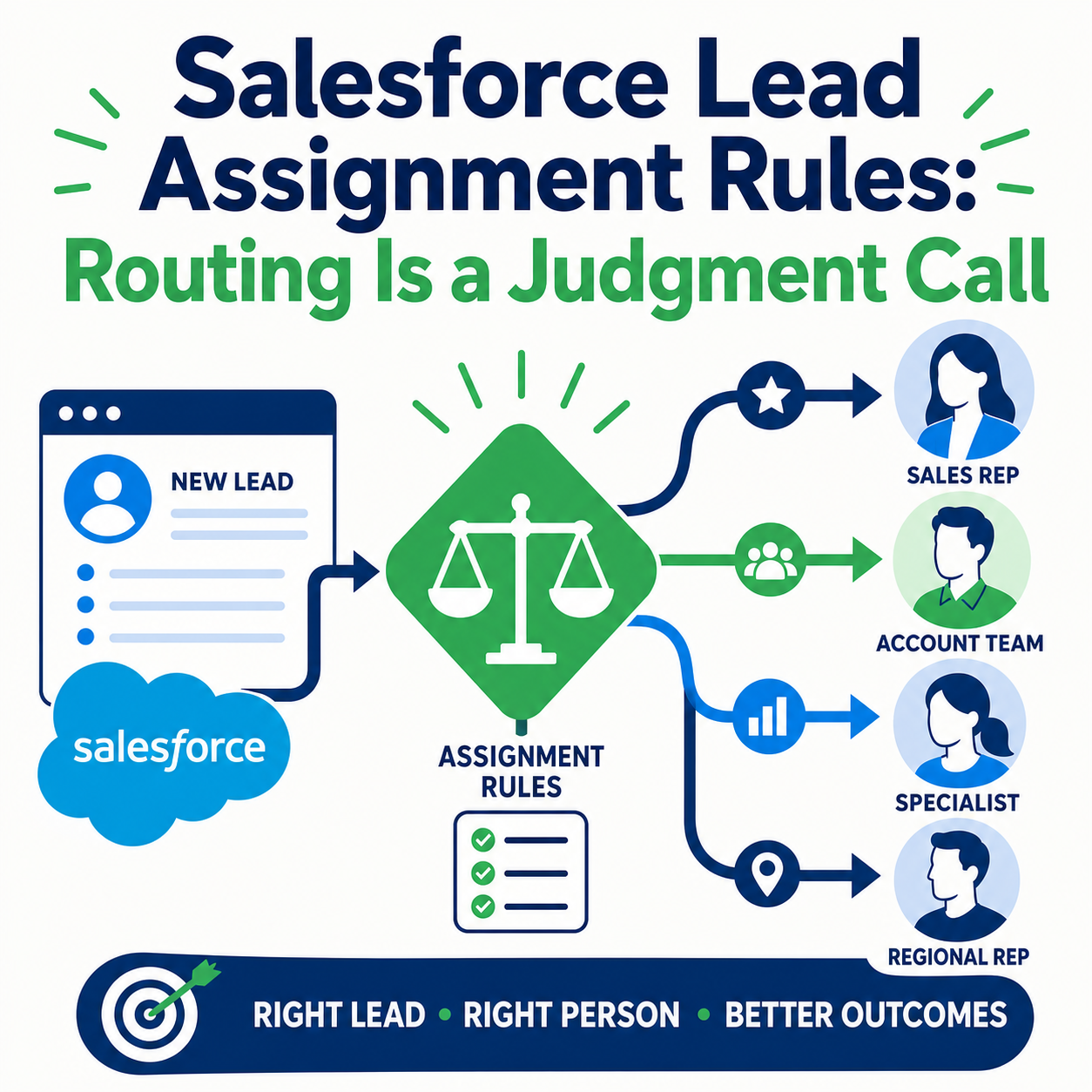
Every lead routing rule is a judgment call made in advance. When a new lead arrives, someone has to decide who should work it, how fast, and what happens if nobody does. Salesforce lead assignment rules let you encode those decisions so they happen automatically — but the automation is only as good as the thinking behind it. Teams that treat routing as a purely technical setup task usually end up with leads routed by geography that should have been routed by deal size, round-robin distributions that ignore capacity, and a quiet backlog of records nobody owns.
This guide is for Salesforce admins, RevOps leaders, and sales managers who own lead flow. It covers what native lead assignment rules actually do, the judgment calls you have to make before configuring anything, how the main routing options compare, when a human should still make the call, and a practical checklist for getting routing right.
Quick Answer
Salesforce lead assignment rules automatically route new leads to users or queues based on criteria you define — but only one rule can be active at a time, entries are evaluated in order, and there is no native round-robin. The real work is deciding the routing logic: which leads go to which teams, what "fair" distribution means, and which leads are too ambiguous or too valuable to trust to automation. Most organizations do best with a hybrid: automate the clear-cut majority, send exceptions to a triage queue with a named owner and a response SLA, and review routing performance monthly. Vantage Point helps teams design and implement exactly this kind of lead routing in Salesforce.
- What it is: Salesforce lead assignment rules route incoming leads to users or queues using ordered, criteria-based entries — one active rule at a time, up to 3,000 entries.
- The catch: Rules encode judgment calls. Automating a bad routing decision just makes the mistake faster and more consistent.
- Key limitation: No native round-robin or capacity awareness — those require queues with human triage, Flow-based logic, Omni-Channel skills-based routing, or an AppExchange app.
- Best pattern: Automate the obvious 80%, route exceptions to a human triage queue with an SLA, and audit monthly.
- Best for: Sales and RevOps teams with more than a handful of reps, multiple segments or territories, or lead volume that makes manual assignment a bottleneck.
What Do Salesforce Lead Assignment Rules Actually Do?
A lead assignment rule is a set of ordered entries, each pairing criteria with an assignee. When a lead is created with assignment rules invoked — through Web-to-Lead, an import, or a user checking "Assign using active assignment rule" — Salesforce walks the entries in order and assigns the lead to the first match: a specific user or a queue.
The mechanics every admin should internalize:
- One active rule per object. You can build many rules — one for web leads, one for imports, one for a holiday coverage period — but only one is in effect at any time. Switching means activating a different rule, not combining several.
- First match wins. Entries are evaluated in order, so sequence is logic. Put your most specific criteria first and end with a catch-all entry, or unmatched leads keep whatever default owner behavior your org has.
- Assignees are users or queues. Queues are the workhorse: they let a team share a pool of leads that members pull from or that a triage owner distributes.
- Rules fire on creation, not on every edit. A lead that changes region or score after creation does not get re-routed unless you build that separately with Flow or Apex.
- Capacity-blind. The rule does not know who is on vacation, who is at quota, or who already has 40 untouched leads. It matches criteria and assigns.
That last point is why routing is fundamentally a judgment call: the platform executes policy, but humans have to write the policy.
The Judgment Calls Behind Every Routing Rule
Before touching Setup, answer these questions as a team. Each one is a business decision, not a configuration decision.
What actually determines the best owner? Geography is the traditional default because it is easy, but it is often a proxy for what really matters — product line, company size, industry knowledge, language, or existing relationship. Route on the attribute that predicts a good conversation, not the attribute that is easiest to capture.
What does "fair" mean? Equal counts, equal pipeline value, or equal opportunity quality? A rep working enterprise deals cannot carry the same lead count as a rep working inbound SMB. If you cannot articulate your fairness model, you cannot automate it.
How fast must leads be worked? Speed-to-lead research consistently shows that response time is one of the strongest predictors of conversion. Your routing design — especially queues versus direct assignment — has to match the response time you are committing to.
What happens when nobody matches? Every rule needs a deliberate catch-all: a triage queue with a named owner, not a silent default to a system admin or a lead graveyard.
Which leads should never be auto-assigned? Strategic accounts, partner referrals, re-engaged former customers, and leads that match nothing cleanly are usually worth thirty seconds of human judgment. Define this exception set explicitly.
Salesforce Lead Routing Options Compared
There are four realistic ways to route leads in Salesforce, and most mature orgs combine two of them.
| Option | How it works | Strengths | Limits | Best for |
|---|---|---|---|---|
| Native assignment rules | Ordered criteria entries assign new leads to users or queues on creation | Free, declarative, reliable, easy to audit | One active rule, first-match logic, no round-robin, no capacity awareness, fires on creation only | Clear-cut segmentation (region, product, size) with stable teams |
| Round-robin via custom logic | Auto-number field plus formula (MOD) or Flow distributes leads evenly across a rep list | Even distribution, native building blocks | Requires custom fields/Flow upkeep; breaks silently when the rep list changes; still capacity-blind | Teams of similar-role reps working similar lead types |
| Omni-Channel skills-based routing | Routes work items — including leads — to available reps based on skills, capacity, and presence | Capacity- and availability-aware, skills matching, real-time | Service Cloud licensing and meaningful setup; designed around rep availability models | Larger teams where leads should go to whoever is available and qualified now |
| AppExchange routing apps | Dedicated lead-distribution packages with round-robin, weighted, and territory logic | Rich distribution logic, scheduling, SLAs, reporting | Per-user subscription cost, another vendor to manage | Complex distribution rules, frequent team changes, aggressive SLAs |
Two honest observations from the field. First, most organizations overestimate how much logic they need: a well-designed native rule with good queues covers the majority of lead flow. Second, the failure mode is rarely the tool — it is routing logic nobody revisits as the team, segments, and lead sources change. If your routing has not been reviewed in the last two quarters, it is probably routing on an org chart that no longer exists.
When Should a Human Make the Call?
The strongest routing designs include a deliberate human layer. Keep people in the loop for:
- Strategic or named accounts. A lead from a target account deserves an owner chosen by someone who knows the account plan, not a criteria match.
- Ambiguous or incomplete records. Missing region, unclear company size, personal email domains — the leads automation would guess wrong on.
- Partner and referral leads. Relationship-sensitive sources where the wrong owner costs goodwill.
- Re-routing neglected leads. When a lead sits untouched past your SLA, a person should decide whether to reassign, nurture, or disqualify — not another blind rule.
The practical pattern is a triage queue with teeth: exceptions land in a queue owned by a named person (often a sales development lead or RevOps manager), with a same-business-day SLA and a weekly review of what landed there. If the same kind of lead keeps hitting triage, that is your signal to write a new rule entry — the exception set should shrink over time as the rules learn from human judgment.
Implementation Checklist
Before activating or revising a lead assignment rule, confirm each of these:
Design the logic first
- Routing attributes chosen because they predict good conversations, not because they are easy to capture
- Fairness model defined (count, value, or workload) and agreed by sales leadership
- Exception set defined: the lead types a human will always assign
- Catch-all entry points to a triage queue with a named owner and SLA
Build it safely
- Rule entries ordered most-specific first, catch-all last
- Queues created with the right members before the rule references them
- Tested with real sample leads across every segment, including the no-match case
- Web-to-Lead, imports, and integrations confirmed to invoke the active rule
Operate it deliberately
- Lead response time and untouched-lead rate reported by rep and queue
- Triage queue reviewed weekly; recurring exceptions converted to rule entries
- Full routing review on a quarterly cadence and after any territory or team change
- Ownership documented: one named admin or RevOps owner for routing changes
Best Practices
Start simpler than you think you need to. Five well-chosen entries beat fifty that nobody can debug. Complexity is easy to add later and painful to remove.
Write the policy down outside Salesforce. A one-page routing policy — who gets what, why, and what the exceptions are — survives admin turnover and makes rule audits fast.
Measure outcomes, not just distribution. Balanced lead counts mean nothing if conversion rates differ wildly by route. Review conversion by rule entry, not just volume.
Beware silent failures. A deactivated user, an empty queue, or a mis-ordered entry does not throw an error — it just misroutes quietly. Put a report on leads owned by inactive users and queues with aging, untouched records.
Treat routing as a living system. New segments, new reps, new lead sources, and new products all invalidate yesterday's logic. Schedule the review before you need it.
How Vantage Point Helps
Vantage Point is a senior-led Salesforce and HubSpot consulting partner that designs and implements lead routing as part of broader revenue operations work — from assignment rules and queues to Omni-Channel skills-based routing and the reporting that proves it works. Because routing touches process as much as configuration, our engagements start with how your team actually sells before anyone opens Setup.
Explore our Salesforce implementation and advisory services and managed services and ongoing support for continuing admin and RevOps capacity. Related reading: why precision beats volume in B2B outbound and how CRM data quality fixes missed revenue signals.
If your team is rethinking lead routing — or suspects your current rules are quietly misrouting — Vantage Point can help audit the logic, redesign the flow, and implement it cleanly.
FAQ
How many lead assignment rules can you have in Salesforce?
You can create many lead assignment rules, but only one can be active at a time. A single rule can contain up to 3,000 rule entries, each pairing criteria with a user or queue assignee. Organizations typically keep separate inactive rules for special situations — like holiday coverage — and activate them temporarily when needed.
Does Salesforce have native round-robin lead assignment?
No. Native assignment rules match criteria and assign to a user or queue, but they do not rotate evenly across a list of reps. Round-robin requires a custom approach — commonly an auto-number field with a MOD formula, or Flow logic — or an AppExchange distribution app. Omni-Channel skills-based routing is the native option when you need availability- and capacity-aware distribution.
What is the difference between assigning leads to a user versus a queue?
Assigning to a user makes one person immediately responsible for the lead. Assigning to a queue puts the lead in a shared pool that queue members can view and take ownership of. Queues work well for teams that pull work as capacity allows and for triage models where one person reviews and distributes exceptions.
Do lead assignment rules run when a lead is edited?
No. Assignment rules fire when a lead is created with assignment rules invoked — for example through Web-to-Lead, an import, or the "Assign using active assignment rule" option. Re-routing on field changes requires separate automation, typically built with Flow.
When should lead routing stay manual?
Keep a human in the loop for strategic or named accounts, partner and referral leads, ambiguous records that automation would guess wrong on, and re-routing decisions for neglected leads. The common pattern is to automate the clear-cut majority and send exceptions to a triage queue with a named owner and a same-day SLA.
How do I know if my lead routing is broken?
Look for leads owned by inactive users, queues with aging untouched records, response times that miss your SLA, and conversion rates that differ sharply by route. A monthly report on untouched leads by owner and a quarterly review of the rule itself catch most problems before they become expensive.
Can Omni-Channel route leads in Salesforce?
Yes. Salesforce's skills-based routing rules support leads alongside cases, orders, and custom objects. Omni-Channel routes work to reps based on skills, capacity, and availability, which makes it the strongest native option when leads should go to whoever is qualified and available right now. It requires Service Cloud setup and is typically overkill for small teams with simple segmentation.