
Quick Answer
Before signing with a Salesforce or HubSpot consulting partner, ask six direct questions: who actually does the work, what happens when something breaks, how billing works, what a normal week looks like once the contract is signed, whether they're an official partner on the specific platform you run, and whether anyone on the team has hands-on practitioner experience rather than just configuration experience. This matters for any organization evaluating an implementation or ongoing-support partner, in any industry, because the sales conversation and the delivery reality are frequently two different things. Vantage Point answers all six directly, in writing, before you sign anything.
TL;DR
- What it is: A six-question checklist for evaluating a CRM consulting partner before you sign a contract.
- Why it matters: The gap between what a partner promises during the sales process and what they deliver after signature is the single biggest source of CRM project regret.
- Best for: Any organization choosing a Salesforce or HubSpot implementation or ongoing-support partner.
- Decision point: Whether a partner answers each question specifically, in writing — or retreats into generalities.
- How Vantage Point helps: Our Salesforce implementation and advisory and HubSpot teams answer every one of these questions before you commit to anything.
Most CRM partner evaluations focus on the wrong signals — a polished logo wall, a stack of case studies, an impressive discovery deck. None of that predicts how the engagement will go. What predicts it is more mundane: who shows up to do the work, how fast someone responds when a workflow breaks on a Friday afternoon, and what a normal week looks like six months after signature. Ask these six questions before you sign, and you'll learn more about how a partner operates than any sales presentation will tell you.
Why the Sales Process Rarely Predicts the Delivery Process
Most consulting sales conversations are led by a firm's most senior, most polished people — a founder, a principal architect, someone fluent in your industry and platform. That's normal. The problem shows up after signature, when the account moves to a delivery team the buyer never met during evaluation — sometimes excellent, sometimes a rotating cast of whoever has open capacity that month. From the outside, there's no way to tell the difference in advance, which is exactly why you ask instead of assume. This is a structural feature of how consulting firms staff work, not a flaw unique to one firm or platform: the people who sell an engagement and the people who deliver it are frequently not the same people, and the incentive to disclose that gap during a sales call is close to zero. The six questions below exist to close that gap before you sign, not after.
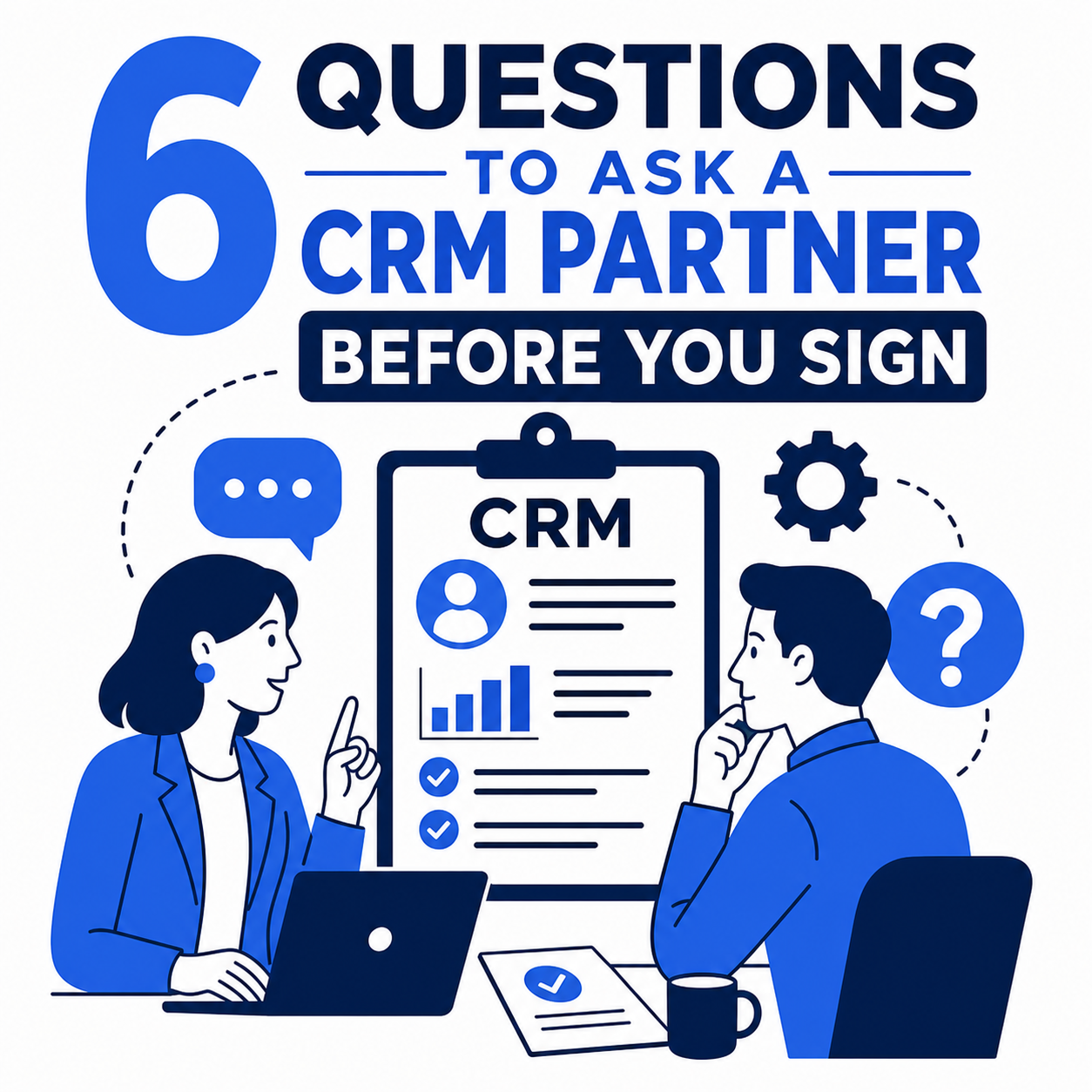
The 6 Questions to Ask a CRM Partner Before You Sign
1. Do we get the same senior consultant from kickoff through go-live?
Ask directly whether the person or people you're meeting during evaluation are the same people who will configure your platform, build your automations, and show up to your working sessions six months from now. Ask what happens if that person leaves the firm or gets reassigned. A partner who can answer this cleanly usually staffs engagements with continuity in mind from the start. A partner who changes the subject, talks about "our bench," or promises a senior lead who will only appear at milestone check-ins is telling you, indirectly, that delivery and sales are different teams. At Vantage Point, this is a simple answer: senior consultants only — no junior handoffs; the experts you meet are the experts who deliver.
2. What's your response-time SLA — and what happens on the worst day, not the best one?
Every partner will tell you they respond quickly. The useful question isn't about the best case, it's about the worst case: if a critical workflow breaks on a holiday weekend, what is the partner contractually committed to, and by when? Ask for a specific number, in writing, tied to severity — not "we're usually pretty responsive." Vantage Point's managed services commitments include a one-business-day response even in the worst case, which is the number that actually matters when something is on fire.
3. How are hours billed — and what should we ask instead of demanding a number up front?
Rather than asking a partner to quote a rate cold, ask how they structure engagements: fixed-scope project pricing, a prepaid block of hours, a monthly retainer, or managed services with defined outcomes. Ask what triggers a change order, how unused time is handled, and whether the same rate applies across seniority levels or varies by who's actually doing the work. A partner who answers this structurally, before you ever discuss a number, is one who scopes engagements deliberately. This article intentionally won't quote a number — the right one depends on your scope, not an industry average. Get specifics directly from any partner you evaluate.
4. What does a normal week look like once we've signed?
Ask the partner to describe an ordinary week midway through the engagement — not the kickoff, not go-live week, an average Tuesday three months in. Do you have a standing sync? Is work happening asynchronously between meetings, or does everything wait for the next call? Who initiates status updates — you, or them? A partner who can describe this in specific, concrete terms has run this cadence before. A partner who can only describe the sales timeline hasn't thought past the signature. Vantage Point's managed services model runs on a standing weekly sync with a named senior consultant, with async work — tickets, monitoring, small enhancements — moving forward in between rather than waiting for the next call.
5. Are you an official partner on the specific platform we run — not just "familiar" with it?
"We've worked with Salesforce" and "we are a Salesforce Solutions Partner" are different claims, and only one of them is independently verifiable. Check the partner's actual status yourself in the relevant partner directory instead of taking the sales deck's word for it. If you run both Salesforce and HubSpot, ask whether the firm is a genuine partner on both or primarily strong on one with the other as an afterthought. Vantage Point is a Salesforce Solutions Partner and a HubSpot Solutions Partner, and an official Claude Partner Network Member for AI work — verifiable status on all three, not a claim.
6. Who on the team has actually used this software as a practitioner — not just configured it for clients?
There's a real difference between someone who has only ever configured Salesforce or HubSpot for other companies and someone who has sat inside the platform as an actual user — running their own pipeline and living with the consequences of a bad data model firsthand. Ask whether anyone on the team has practitioner experience, not just implementation experience. Vantage Point was founded in 2018 by David Cockrum after 13 years as a customer using both Salesforce and HubSpot before ever consulting on them, and many of our consultants share that practitioner background — they've felt the problems they're now hired to fix.
How to Read the Answers
The scoring isn't subtle. Specific, verifiable, written answers are a good sign. Vague, deflecting, or "trust us" answers are the sign you're being sold to rather than informed.
| Question | Strong answer | Warning sign |
|---|---|---|
| Same consultant throughout? | Names the actual person(s), explains continuity plan | Talks about "the bench" or "our team" without names |
| Response-time SLA? | Specific commitment by severity, in writing | "We're usually fast" with no number |
| How is billing structured? | Explains model options and what drives change orders | Quotes a rate immediately with no scoping questions |
| Normal week, mid-engagement? | Describes a specific cadence in detail | Only describes the kickoff and go-live phases |
| Official partner status? | Verifiable in the platform's own partner directory | "We work with that platform all the time" with no verification |
| Practitioner background? | Specific examples of hands-on platform use as a customer | Only implementation and configuration experience, no user-side experience |
What Businesses Should Do Next
- Send all six questions, in writing, to every partner on your shortlist. A written answer is harder to walk back later than a verbal one.
- Compare answers side by side rather than evaluating each proposal in isolation — the differences become obvious fast.
- Verify partner status yourself in the Salesforce or HubSpot partner directory instead of relying on the sales deck.
- Treat a vague answer as your answer. A partner vague before signing won't get more specific after.
- Put the strongest commitments in the contract — response-time SLAs and staffing continuity are worth writing down, not just discussing.
How Vantage Point Helps
Vantage Point is built to answer all six of these questions the same way every time. We're a Salesforce Solutions Partner and a HubSpot Solutions Partner, and an official Claude Partner Network Member for AI work. Senior consultants only — no junior handoffs; the experts you meet are the experts who deliver. Our managed services agreements commit to a one-business-day response even in the worst case, run on a standing weekly sync with async work between, and are typically aligned to a roughly 12-month roadmap. We're employee-owned, so the people answering these questions have a direct stake in getting the answer right. If you'd like an outside look at your current setup first, ask about a complimentary CRM health check — a low-risk way to see how we work before you sign anything.
For a broader, methodology-focused evaluation checklist that complements these six questions, see our related guide on how to evaluate CRM consultancies.
Ready to Ask Us These Six Questions?
We'd rather answer them before you sign than explain them after something goes wrong. Contact Vantage Point to talk through your evaluation, or explore our Salesforce and HubSpot services directly.
Frequently Asked Questions
What's the single most important question to ask a CRM consulting partner?
Ask who actually does the work — the specific people you're meeting during evaluation, or a delivery team you haven't met yet. Staffing continuity is the strongest predictor of whether an engagement matches the sales pitch, because it determines whether the expertise you evaluated is the expertise that shows up after you sign.
Should a partner tell me their hourly rate before I sign?
Ask how billing is structured — fixed scope, block of hours, retainer, or managed services — before you ask for a number. A specific rate quoted without any scoping conversation tells you less than an explanation of how the partner prices work and what triggers additional cost. Get the actual numbers directly from any partner you're evaluating once they understand your scope.
What response time should I expect from a CRM support partner?
Ask for a specific, severity-based commitment in writing, and ask about the worst case, not the best case. A partner who can commit to something like a one-business-day response even on critical issues is telling you they've built real capacity behind that promise, not just a friendly tone in sales meetings.
Does it actually matter whether a partner is an official Salesforce or HubSpot partner?
Yes, especially if you run both platforms. Official partner status is independently verifiable in each platform's partner directory, while "we've worked with it before" is not. If your organization runs Salesforce and HubSpot together, confirm the firm has real, current standing on both rather than treating one as an afterthought.
How do I verify a partner's practitioner experience is real?
Ask for specifics: which team members have used the platform as an actual customer or end user, not just configured it for clients, and what they learned from that experience. Vague claims of "deep expertise" are common; specific stories about living with a CRM's daily quirks as a user are harder to fabricate.
Is it a red flag if a partner can't describe a normal week of working together?
Yes. A partner who has actually run engagements like yours before can describe an ordinary week in specific terms — cadence, who initiates updates, what happens asynchronously. A partner who can only describe the kickoff and go-live phases likely hasn't thought past the sale.
How many questions should I ask a CRM partner before signing?
Six is a practical minimum covering the areas that most commonly go wrong: staffing, response time, billing structure, working cadence, verified partner status, and practitioner background. Add questions specific to your industry or technical scope, but don't sign without clear, written answers to at least these six.
Vantage Point is a boutique CRM consulting firm helping businesses transform with Salesforce, HubSpot, and AI. Employee-owned, with senior consultants only — no junior handoffs. Learn more at vantagepoint.io.