
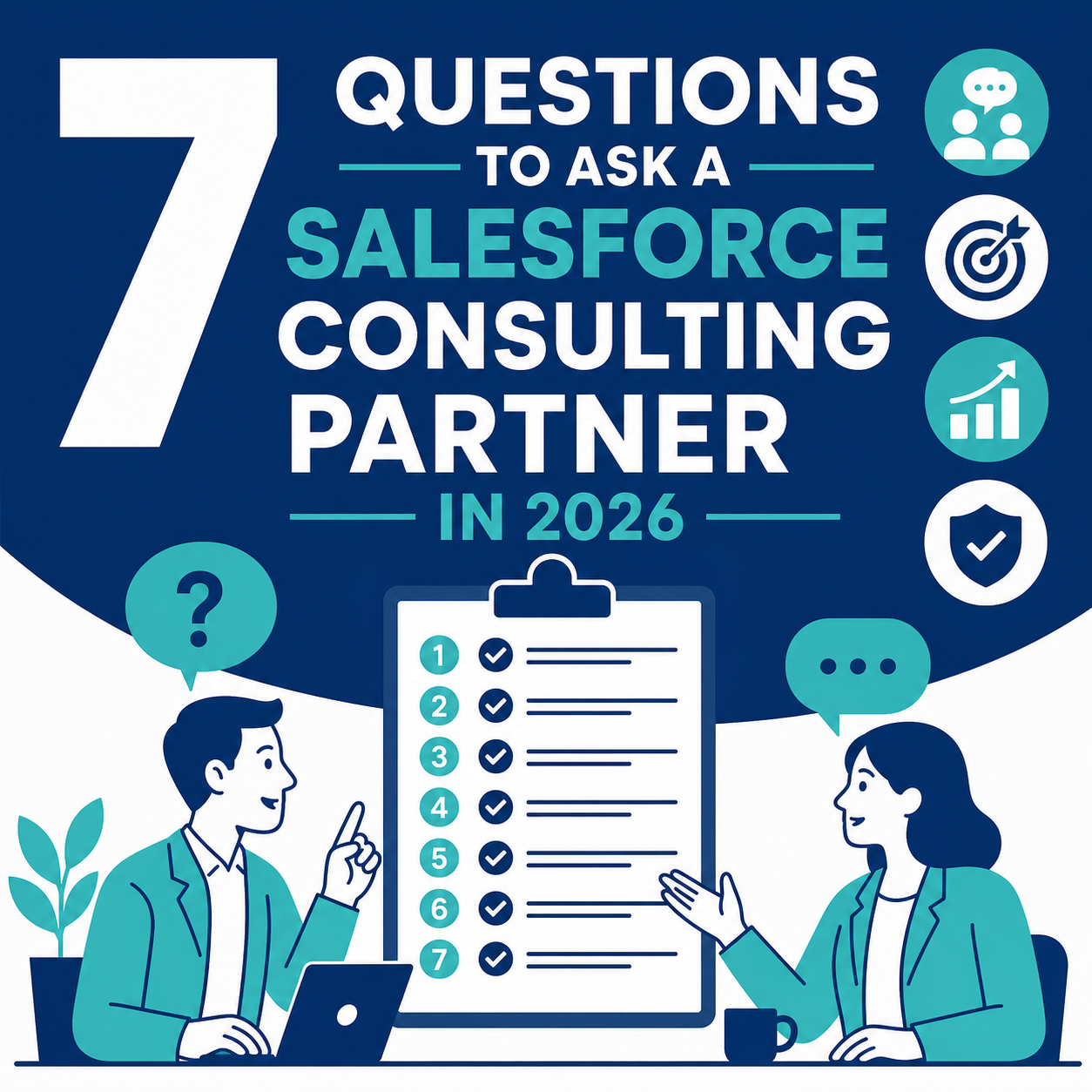
Choosing a Salesforce consulting partner is one of the highest-stakes decisions a mid-market company makes. The right partner accelerates your roadmap; the wrong one burns budget and leaves you with a system your team won't use. Before you sign, ask these seven questions.
Quick Answer
The seven questions that separate strong Salesforce partners from risky ones: who actually does the work, how they scope, realistic timelines, data migration approach, AI readiness guidance, post-go-live support, and what they need from you. If a partner can't answer these clearly, keep looking.
1. Who actually does the work, the people I'm meeting, or a delivery team I haven't met?
This is the most important question on the list. Some firms sell with senior architects and deliver with junior consultants you've never met. Others change the delivery team after the contract is signed. You want a partner where the experts you meet are the experts who deliver: senior consultants only, no junior handoffs. Ask to meet the actual delivery team, not just the sales lead. If they hesitate, that's your answer.
2. How do you scope: fixed outcomes or open-ended hours?
Open-ended hourly billing sounds flexible until the invoice arrives. Strong partners scope to outcomes: "We'll deliver a working lead-routing process by March 15" beats "We'll bill 40 hours a week until it's done." Fixed-outcome scoping forces clarity on both sides and gives you a natural checkpoint to evaluate progress. If a partner resists outcome-based scoping, ask why. The answer tells you whether they're confident in their estimates or padding for uncertainty.
3. What does a realistic timeline look like for a company our size?
Every Salesforce project takes longer than the sales deck suggests. A good partner will give you a range, explain the variables (data quality, integration complexity, internal decision speed), and flag the phases where delays typically happen. Be skeptical of anyone who promises a fixed date without asking about your data, your team, or your existing tech stack. For a mid-market company with moderate complexity, expect months, not weeks, and plan for a stabilization period after go-live.
4. How will you handle our data migration and integrations?
Data migration is where most Salesforce projects go sideways. Ask how they approach data cleansing, deduplication, and field mapping before any records move. For integrations, ask whether they build custom connections or use pre-built connectors, and how they handle ongoing maintenance when one system updates. A partner who treats data migration as an afterthought will leave you with a CRM full of duplicates and broken reports. This is also where AI readiness starts. Clean, well-structured data is the foundation for any Agentforce or Einstein deployment.
5. How are you preparing clients for AI inside Salesforce, and when would you tell us not to buy something?
Agentforce, Einstein, and the broader AI roadmap are moving fast. A good partner helps you separate what's ready for production from what's still maturing. They should be able to explain which AI features require clean data, which need specific licensing, and which are still in beta. Most importantly, they should be willing to say "not yet" when a feature isn't ready for your use case. If a partner's answer to every AI question is "buy it now," they're selling licenses, not solving problems.
6. What happens after go-live: adoption, training, and ongoing support?
Go-live is the starting line, not the finish. Ask about their adoption methodology: how they train end users, how they measure usage, and what happens when adoption stalls. Do they offer managed services, or do they hand you a admin guide and disappear? The best partners treat post-go-live as a phase, not an afterthought. With defined checkpoints at 30, 60, and 90 days to ensure the system is actually being used.
7. What will you need from us, and what should we be able to answer before you start?
This question flips the script and reveals how prepared the partner really is. A strong partner will ask about your data quality, your internal decision-making process, your team's availability for testing, and your tolerance for change. They'll want to know who owns the project internally and whether that person has the authority to make decisions. If a partner doesn't ask these questions, they're either inexperienced or planning to figure it out on your dime.
The short version
Ask who does the work, how they scope, what timeline is realistic, how they handle data, when they'd say no to AI, what happens after go-live, and what they need from you. The answers separate partners who deliver from partners who disappear.
Ready to start the conversation?
If you're evaluating Salesforce consulting partners, our implementation and advisory team is happy to walk through these questions with you: no pitch, just a practical discussion about your roadmap. For a deeper framework on partner evaluation, see our guide to choosing an AI CRM personalization partner. And if you're still deciding whether you need a partner at all, our comparison of platform onboarding vs. implementation partners can help you think through the tradeoffs.
Ready to start the conversation? Contact Vantage Point to talk through your Salesforce roadmap and partner-evaluation questions.
Vantage Point is a boutique CRM consulting firm helping businesses transform with Salesforce, HubSpot, and AI. Senior consultants only. No junior handoffs; the experts you meet are the experts who deliver. Learn more at vantagepoint.io.