
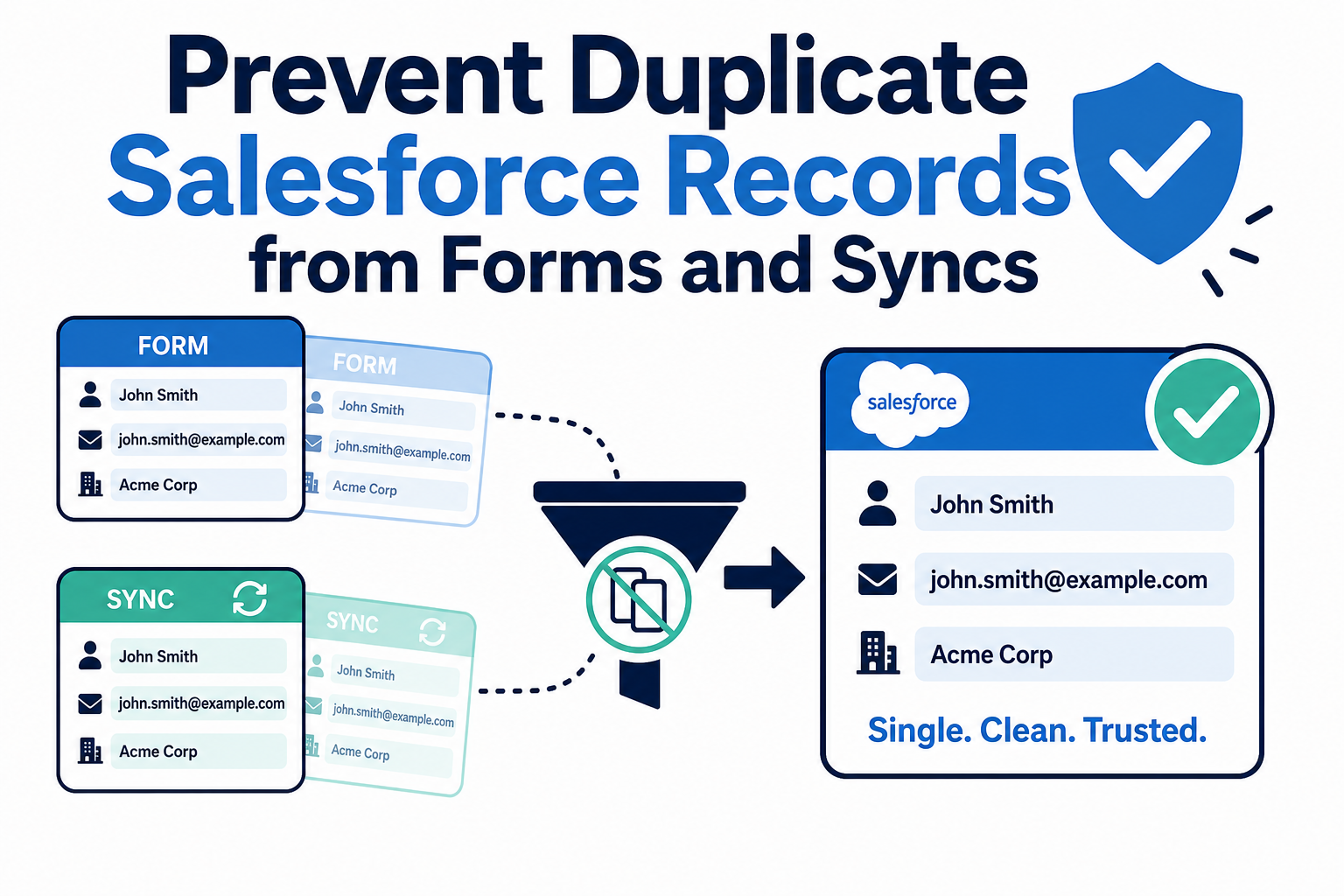
The report that triggers it usually looks innocent: someone notices one form submission produced three opportunities. Or the weekly sync created a second account for a customer that already existed. Or marketing's webinar list came in twice — once as leads, once as contacts.
Duplicates that enter at the moment of creation are a different problem than the duplicates you find later. Dedupe tools merge what's already dirty; this is about stopping the dirt at the source — in the form handler, the integration mode, and the automation that turns one submission into records.
This guide covers why forms and integrations create duplicate Salesforce records, the native and integration-side controls that prevent it, and how to debug an automation that multiplies records.
Quick Answer
Duplicate Salesforce records from forms and integrations almost always trace to one of three causes: the integration runs in "create-only" mode (every submission inserts a new record with no matching), a single event fans out into multiple create operations (a flow or middleware scenario that loops or double-fires), or matching rules exist but the incoming data can't satisfy them (name-only matching, missing emails). The fixes, in order of leverage: switch integrations to upsert against an external ID, make the submission's unique identifier visible end-to-end, tighten matching and duplicate rules to block or alert on likely matches, and audit flows for multiple create paths. Vantage Point designs integration patterns like this through its integration and data migration services.
Key Takeaways (TL;DR)
- Root causes: create-only integrations, automation that fires multiple create operations, and matching rules the incoming data can't satisfy.
- Best defense: upsert on an external ID (submission ID, email) instead of blind inserts.
- Native help: Salesforce matching + duplicate rules can alert or block duplicates at insert time.
- Debug pattern: one submission producing N records means the automation ran N times or had N create paths — inspect the flow, not the form.
- How Vantage Point helps: integration design and remediation through our MuleSoft and integration practice.
How Do Forms and Integrations Create Duplicates in the First Place?
Three mechanisms account for nearly every duplicate-at-creation problem.
1. Create-only integration mode
Many form and survey connectors default to inserting a new record per submission. That's correct for genuinely new inquiries — and wrong the moment an existing customer, repeat respondent, or re-submitted form arrives. Every submission becomes a new lead, a new opportunity, or a new contact, and your team discovers it in a report weeks later.
2. One event, multiple create operations
The subtler failure: a single submission fans out into several records. Common culprits are a record-triggered flow with multiple decision branches that each contain a "Create Records" element, middleware scenarios that both create and then update-via-create, and webhook endpoints the source platform retries (the retry is a second create if the endpoint isn't idempotent). The diagnostic signature is unmistakable: one submission, N records, created seconds apart.
3. Matching that can't match
Salesforce's duplicate rules can only block what they can recognize. If the matching rule compares on email and the form doesn't collect email — or collects it in a format the rule ignores — every insert sails through. Matching on name alone is worse: "J. Smith" and "John Smith" are the same person to you and strangers to the rule.
What Is the Best Defense? Upsert on an External ID
The single highest-leverage fix is moving integrations from create to upsert keyed on a stable external identifier:
- Give every submission a unique ID at the source — the form tool's response ID, the survey's response key — and store it in a custom external-ID field on the Salesforce record.
- Configure the integration to upsert on that field: first submission creates; retries and resubmissions update the same record.
- For person-level matching, upsert on email (or a normalized email field) where the process genuinely means "one record per person," and let a human resolve ambiguous matches.
Upsert doesn't just prevent duplicates — it makes retries safe. A webhook that fires twice updates the same record twice instead of creating twins, which removes an entire class of silent failures.
What Native Salesforce Controls Help?
Salesforce ships two features built for exactly this:
Matching rules define what "the same record" means — exact email, fuzzy name + company, phone variants, or custom logic. Duplicate rules define what happens when a match is found: allow with an alert, block the insert, or report only.
Three configuration notes that matter in practice:
- Duplicate rules evaluate on create and edit through the UI and standard APIs — verify your integration path actually triggers them (some bulk and API paths bypass or behave differently, so test with the real integration, not the UI).
- "Alert" beats "block" for human-entered records; "block" is right for automated inserts where a duplicate should fail loudly.
- Keep matching rules tight. A rule that flags every same-last-name contact trains users to dismiss alerts — and a dismissed alert is a duplicate allowed.
How Do You Debug an Automation That Multiplies Records?
When one submission creates three records, the form is rarely the problem. The working pattern:
- Confirm the source sent one event. Check the form/survey tool's submission log and any external-ID field on the inbound payload — one row, one ID.
- Find every create path. Open the flow or integration scenario and count "Create Records" elements. Decision branches that aren't mutually exclusive, or a loop that iterates a multi-select field, produce exactly this symptom.
- Check trigger conditions. A record-triggered flow that fires on "created OR updated" can run twice if the integration creates then updates within seconds.
- Test in a sandbox with debug logs on. Replay the submission and watch how many interviews execute and which elements create records.
- Fix at the highest level possible. If the integration can upsert, fix it there — flow changes treat symptoms the integration causes.
Create, Update, or Upsert: Which Mode Should an Integration Use?
| Mode | Behavior | Use when |
|---|---|---|
| Create (insert) | New record every time | Submissions that are definitionally unique — anonymous event registrations, one-time requests |
| Update | Fails if no match exists | Syncing changes to records known to exist (rarely sufficient alone) |
| Upsert on external ID | Creates on first sight, updates on repeats | Almost everything: form responses, syncs, webhook feeds |
| Create + duplicate rules | Inserts unless a rule blocks/alerts | UI-driven entry, or integrations that can't upsert — a safety net, not a strategy |
What About Web-to-Lead and Other Native Entry Points?
Salesforce's own web-to-lead forms are a frequent duplicate source because they always insert — there's no native matching step. Every form submission creates a new lead, even from a repeat visitor. Duplicate rules are the primary defense here: an active rule with email matching at least flags the repeat submission at insert time. Teams with heavy inbound volume often put middleware in front of web-to-lead — a form platform or integration layer that searches first, then creates or updates — which converts the native create-only behavior into an upsert.
How Do You Measure Whether the Problem Is Fixed?
Duplicates are measurable, so measure them. A weekly duplicate record report (or a duplicate job run, available in Performance and Unlimited editions) establishes the baseline before changes and the trend after. Watch two numbers: the count of new duplicate sets created per week — which should approach zero once upserts and matching rules are in place — and the total backlog, which shrinks only through deliberate merging. If the first number doesn't drop, the create path you fixed wasn't the only one: enumerate every integration and form that writes to the object and audit them one by one.
How Vantage Point Helps
Vantage Point's integration team designs create/update/upsert patterns, external-ID schemes, and matching-rule configurations that keep forms, surveys, and syncs from polluting your CRM — and debugs the flow-level fan-out when records are already multiplying. Our system integration and data migration services cover exactly this work, backed by 400+ engagements for 150+ clients, a 4.71/5.0 average engagement rating, and 95% client retention. Senior consultants only — no junior handoffs; the experts you meet are the experts who deliver.
Are Duplicates Entering Faster Than You Can Merge Them?
Vantage Point can audit your form-to-Salesforce paths, convert fragile creates to idempotent upserts, and tune matching rules that actually catch lookalikes. Talk to Vantage Point about your integration health.
Frequently Asked Questions
Why did one form submission create multiple records in Salesforce?
Almost always because the receiving automation ran multiple create operations: a flow with several create paths, a trigger that fired on both create and update, or a webhook the source platform retried. Check the flow's debug logs first — the form itself is rarely at fault.
What is the difference between create and upsert in a Salesforce integration?
Create inserts a new record on every call, so retries and repeat submissions produce duplicates. Upsert matches on a unique external ID first: it inserts when no match exists and updates the existing record when one does, making retries harmless.
Do Salesforce duplicate rules work on records created by integrations?
They evaluate on standard create/edit operations, but behavior varies by API path and bulk operations. Always test with the real integration rather than the UI, and treat duplicate rules as a safety net beneath an upsert design — not the primary defense.
What should you use as an external ID for form submissions?
The source system's own unique identifier: the form tool's response ID or the survey platform's response key, stored in a custom field marked as an external ID. It guarantees the same submission can never create two records, even across retries.
Should duplicate rules block or alert?
Block automated inserts — a duplicate from an integration should fail loudly so someone fixes the path. For human-entered records, alert-and-allow with tight matching rules avoids the false-positive fatigue that trains users to ignore warnings.
How do you clean up duplicates that already exist?
Merge them in batches keyed on the same external ID or email that should have matched, then fix the source path before merging — cleaning without fixing the integration means the same duplicates return with the next submission.