
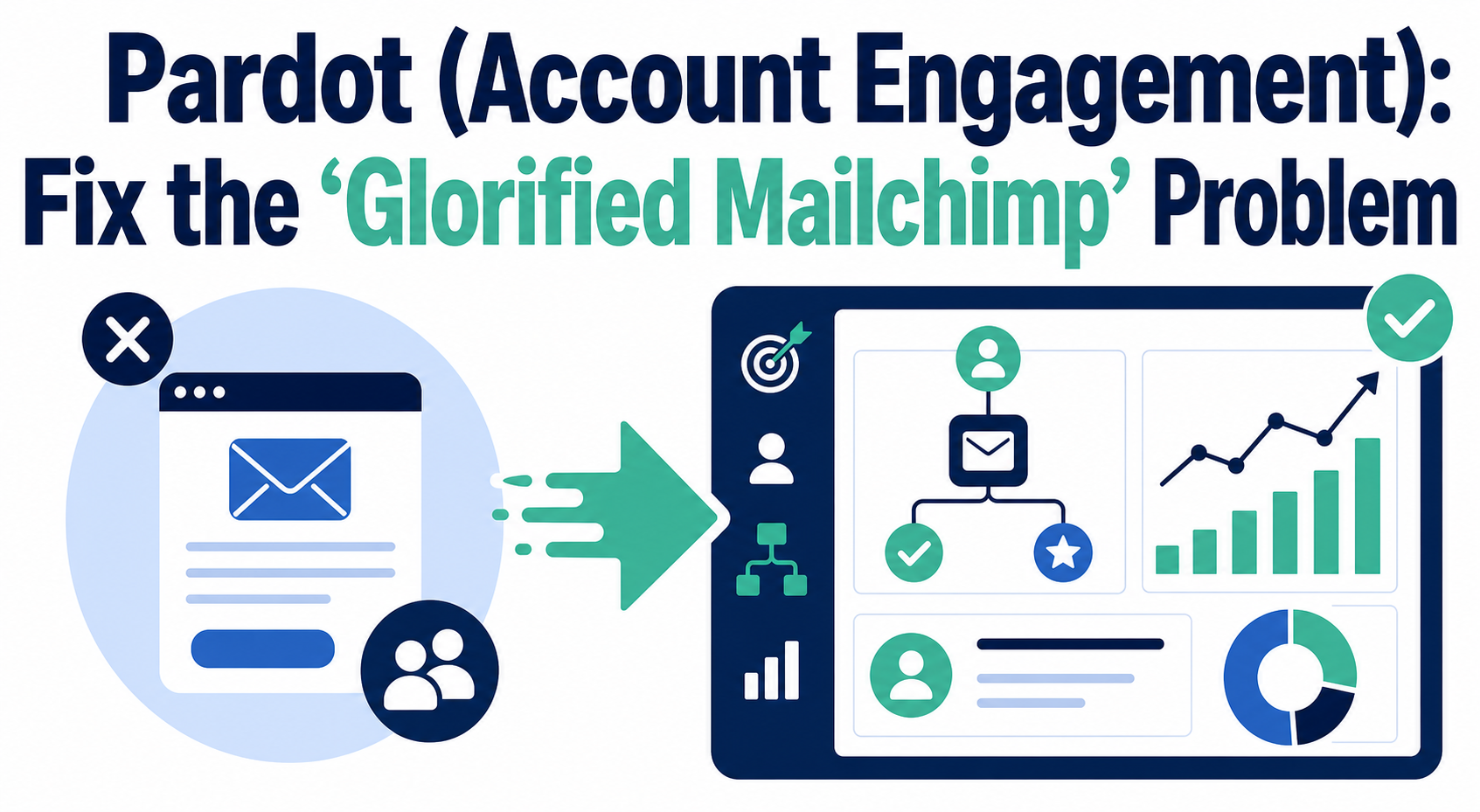
If your organization licenses Salesforce Marketing Cloud Account Engagement — the product formerly known as Pardot — there is a good chance you are using only a fraction of it. The most common pattern we see in discovery calls: marketing sends a monthly newsletter to the whole database, sales never looks at the platform, and leadership wonders why they are paying marketing-automation prices for what amounts to a glorified Mailchimp.
The fix rarely requires new software. The capabilities that separate Account Engagement from a basic email tool — lead scoring and grading, Engagement Studio nurture programs, dynamic segmentation, sales alerts — are already inside the license, never turned on or abandoned after the initial implementation.
This guide covers the signs of an underused instance, the features most teams leave untouched, a maturity ladder to full marketing automation, and quick wins you can turn on in 30 days.
Quick Answer
Marketing Cloud Account Engagement (MCAE), formerly Pardot, is Salesforce's B2B marketing automation platform. The "glorified Mailchimp" problem describes organizations that pay for it but use it only for batch-and-blast email — leaving lead qualification, nurture, and sales-alignment features idle. This guide helps marketing, sales, and RevOps teams on Salesforce decide what to switch on first and whether they need a partner. Vantage Point implements and optimizes Account Engagement as part of its CRM and marketing automation practice.
TL;DR
- What it is: The "glorified Mailchimp" problem — paying for Marketing Cloud Account Engagement (Pardot) but using it only for bulk email.
- Why it matters: The features that justify the license — lead scoring and grading, Engagement Studio nurture journeys, dynamic segmentation, sales alerts — are already included and simply unused.
- Best for: Marketing, sales, and RevOps teams on Salesforce whose Account Engagement instance never got past email blasts.
- Decision point: Which capabilities to activate first, and whether to self-implement or bring in a partner.
- How Vantage Point helps: We audit, configure, and optimize Account Engagement through our Salesforce implementation and advisory services.
What Is the "Glorified Mailchimp" Problem?
The "glorified Mailchimp" problem is what happens when an organization pays for a full B2B marketing automation platform but uses it as a basic email-blast tool. If the only thing running in Account Engagement is a monthly newsletter to an unsegmented list, the business is carrying automation-platform cost for email-tool value.
The pattern is common and rarely anyone's fault. Typical causes:
- A rushed initial implementation. The platform was stood up quickly to send email, and qualification and nurture features were left for a "phase two" that never happened.
- Team turnover. The admin who understood the platform left, and the replacement inherited a sending tool, not a strategy.
- No shared definition of a qualified lead. Marketing and sales never agreed on scoring thresholds, so scoring was never switched on.
- A Mailchimp-shaped mental model. Teams coming from an email blaster recreate the same workflows in the new platform.
Signs You Are Underusing Account Engagement
If three or more are true, you are in glorified-Mailchimp territory:
- Every send goes to the whole database. No segmentation beyond a handful of static lists.
- Lead scoring and grading are untouched. The default scoring model was never customized, and no grading profile exists.
- No Engagement Studio programs are running. Every email is a one-off send; there are no automated nurture journeys.
- Sales never looks at engagement data. Reps cannot see opens, page visits, or form fills on lead and contact records — or they can, and nobody told them.
- Forms live somewhere else. Website forms are handled by another tool, so Account Engagement never captures or tracks new prospects.
- Reporting stops at opens and clicks. Marketing cannot connect campaigns to pipeline or revenue.
- Prospects and Salesforce campaigns are disconnected. Connected Campaigns were never set up, so marketing activity and sales follow-up live in different worlds.
The High-Value Capabilities Sitting Unused
Lead scoring and grading
Scoring and grading are the heart of Account Engagement — and the features most often left off.
- Score measures interest. A number that rises as a prospect engages: opening emails, clicking links, visiting key pages, submitting forms. The default model works out of the box; you can customize what each activity is worth.
- Grade measures fit. A letter from F through A+ (moving in thirds, like B and B+) reflecting how closely a prospect matches your ideal customer profile — job role, company size, industry, location. New prospects start at a default grade of D.
Score and grade answer the two questions sales actually asks: Is this person interested, and are they worth our time? Core scoring and grading are available in every edition, including Growth; scoring categories (separate scores per product line) sit in Plus and above. For more, see our guide to lead scoring in Salesforce and HubSpot.
Engagement Studio nurture programs
Engagement Studio is Account Engagement's visual journey builder. Instead of one-off blasts, you build multi-step programs that branch on what each prospect does: opened or not, clicked or not, submitted a form or not. Typical first programs include a welcome series, a re-engagement track for dormant prospects, and a post-event follow-up.
Segmentation and dynamic lists
Static lists go stale the day you export them. Dynamic lists rebuild themselves continuously from rules — "prospects in this region, in this industry, engaged in the last 90 days" — and feed Engagement Studio programs, email sends, and sales views automatically.
Forms, landing pages, and tracked content
Native Account Engagement forms and landing pages capture prospects directly into the platform with progressive profiling — asking new questions on each visit instead of repeating old ones. Custom redirects and tracked links extend tracking to content hosted anywhere, so every click adds to engagement history and score.
Sales alignment: alerts and engagement history
Account Engagement puts marketing data in front of sales inside Salesforce:
- Engagement history components show each lead or contact's marketing activity — emails, page views, form submissions, score, and grade — directly on the Salesforce record.
- Real-time alerts and Sales Emails and Alerts (the paid add-on formerly known as Salesforce Engage) notify reps when a key prospect engages and let them send tracked, marketing-approved templates from Gmail or Outlook.
- Connected Campaigns tie Account Engagement campaigns to Salesforce campaigns one-to-one, so marketing touches and sales outcomes roll up together.
Reporting: dashboards, B2B Marketing Analytics, and Einstein
Engagement History Dashboards show campaign and program performance out of the box. Plus edition and above adds B2B Marketing Analytics for pipeline and multi-touch analysis, and upper editions add Einstein AI-assisted scoring — all running on the engagement data the platform already collects.
The Account Engagement Maturity Ladder
Most underused instances sit at Stage 1. Moving up one stage at a time beats trying to jump to Stage 5 in a single project.
| Stage | What it looks like | Capabilities in use | What the business gets |
|---|---|---|---|
| 1. Bulk email | Batch-and-blast newsletters to static lists | Email sends, static lists | Awareness only (the glorified-Mailchimp stage) |
| 2. Capture and track | Website forms and content feed the platform | Forms, landing pages, tracking, custom redirects | Identified prospects and behavioral data |
| 3. Qualify | Leads are scored and graded before handoff | Scoring rules, grading profiles, assignment automation | A shared definition of a sales-ready lead |
| 4. Nurture | Automated journeys replace one-off sends | Engagement Studio, dynamic lists, dynamic content | Consistent follow-up without manual work |
| 5. Align and optimize | Sales and marketing run one shared motion | Engagement history, sales alerts, Connected Campaigns, B2B Marketing Analytics | Pipeline visibility and continuous optimization |
Quick Wins You Can Turn On in 30 Days
You do not need a reimplementation to escape Stage 1. A focused month gets most teams to a working version of Stages 2–4:
| Week | Quick win | Effort |
|---|---|---|
| 1 | Verify the Salesforce connector is healthy, enable Connected Campaigns, and add engagement history to lead and contact page layouts | Admin time, no new licensing |
| 2 | Activate baseline scoring (start with the default model, adjust the 5–10 activities that matter most) and build one grading profile with 5–8 ideal-customer criteria | One session with sales |
| 3 | Create one dynamic list (for example, prospects engaged in the last 90 days) and launch one simple Engagement Studio program — a 3–5 email welcome or re-engagement nurture | A few days |
| 4 | Set up sales alerts for high-score prospects, agree on the score threshold that triggers follow-up, and train reps on engagement history | One training session |
None of this requires new purchases in most editions — it requires decisions more than technical effort.
When to Get Implementation Help
A capable internal admin can handle much of this. Bring in a partner when:
- The Salesforce connector has sync errors or duplicate prospects that need untangling first.
- Marketing and sales cannot agree on scoring, grading, or handoff rules — an outside facilitator settles this faster.
- You are migrating from another platform (HubSpot, Marketo, or Mailchimp) and need lists, assets, and history moved cleanly.
- You need Business Units, multiple regions, or B2B Marketing Analytics configured correctly the first time.
- The team has no bandwidth. The work stalls without an owner — a managed services arrangement can own it ongoing.
How Vantage Point Helps
Vantage Point is a senior-led Salesforce and HubSpot consulting partner. For Account Engagement, we audit underused instances, repair connector and data issues, build scoring and grading models with your sales team, launch your first Engagement Studio programs, and train your team to run the platform. Because we are dual-platform, we can also advise on which motions belong in Account Engagement and which belong in HubSpot if you run both.
Explore our CRM and marketing automation services, Salesforce implementation and advisory, or advisory and change management support.
Ready to move past the glorified-Mailchimp stage? Contact us at david@vantagepoint.io or call (469) 499-3400 to schedule a complimentary Account Engagement assessment.
FAQ
Is Pardot the same thing as Marketing Cloud Account Engagement?
Yes. Salesforce renamed Pardot to Marketing Cloud Account Engagement in 2022. The product, features, and data model are the same; only the name changed.
Is Account Engagement being discontinued?
No. Salesforce continues to invest in Account Engagement, including newer Account Engagement+ packaging that adds Agentforce-assisted campaign creation, SMS and WhatsApp options, and Data 360-powered unification. It is distinct from Marketing Cloud Engagement, the separate B2C product formerly known as ExactTarget — the similar names cause real confusion.
What is the difference between lead scoring and lead grading?
Score measures interest — a number that rises as a prospect engages with your emails, website, and content. Grade measures fit — a letter from F to A+ showing how closely the prospect matches your ideal customer profile. Sales-ready leads are typically both highly engaged (score) and a strong fit (grade).
Do we need a higher edition to use scoring and grading?
No. Core scoring and grading are included in every edition, including Growth. Advanced options such as scoring categories — separate scores per product or interest area — require Plus edition or above.
How is Account Engagement different from Mailchimp?
Mailchimp is primarily an email marketing tool; Account Engagement is a B2B marketing automation platform built to run natively with Salesforce CRM. The practical differences: lead scoring and grading, multi-step nurture journeys, dynamic segmentation, deep Salesforce integration, and sales-facing alerts and engagement history.
How long does it take to get past the bulk-email stage?
The quick wins in this guide are achievable in about 30 days of focused effort. Broader maturity typically rolls out iteratively over the following quarters.
We also use HubSpot. Does this advice still apply?
Yes, with a platform decision attached. Organizations running both platforms must decide which one owns each marketing and sales motion so scoring, nurture, and handoff rules do not conflict. Vantage Point works across both.