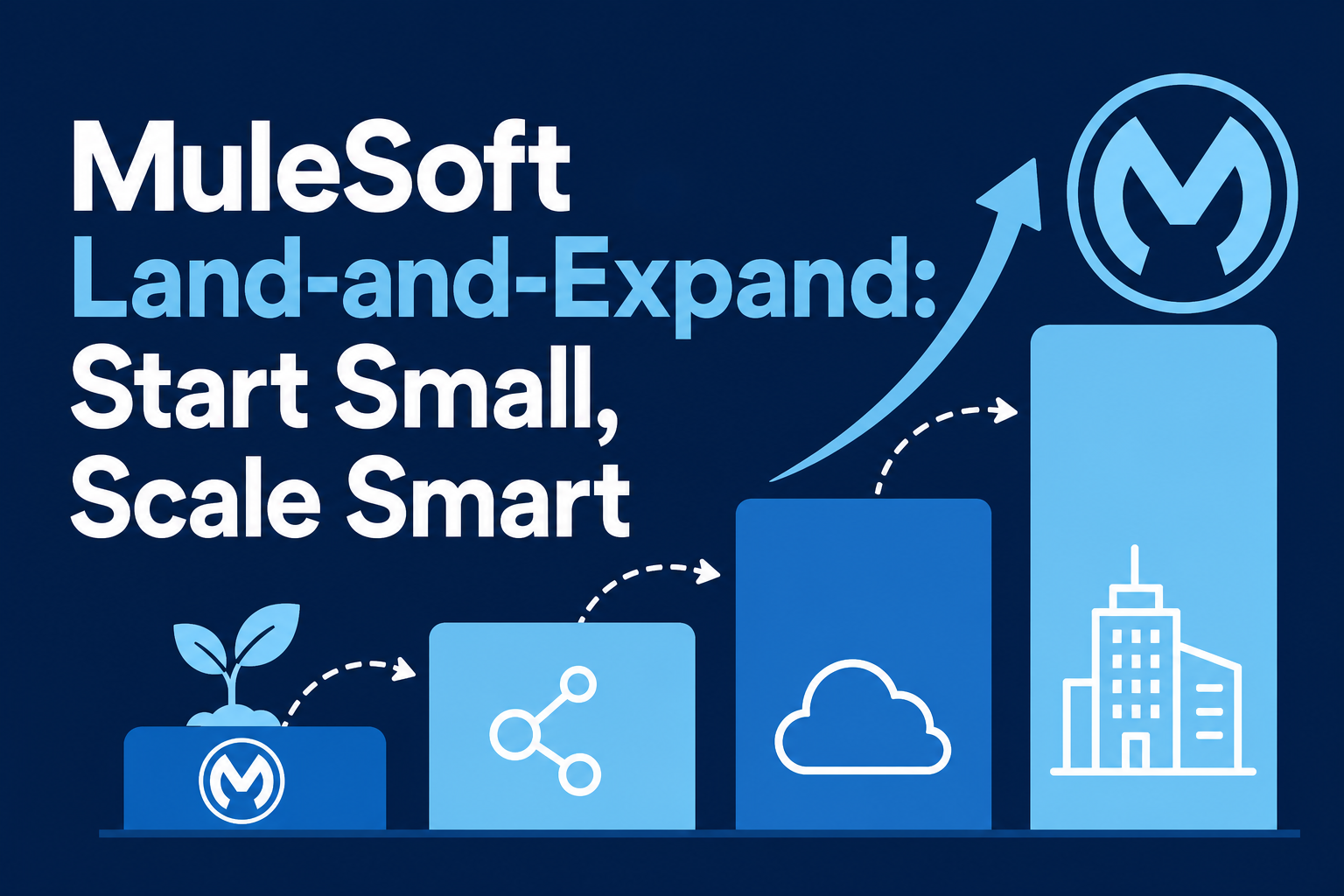
Enterprise integration projects have a reputation for being expensive, slow, and risky, a multi-year, seven-figure commitment before anyone sees a result. That reputation is often deserved when integration is approached as one giant build. It doesn't have to work that way. A land-and-expand approach lets organizations start with a small, fast, fixed-price integration and scale up only after the first phase proves value.
This guide explains the land-and-expand model for MuleSoft integration projects: what each phase looks like, what it typically costs, and how to structure your first integration so it sets up future phases instead of becoming a dead end.
Quick Answer
What it is: A phased MuleSoft integration strategy (Land, Expand, Transform) that starts with a small, fast, fixed-price integration and scales toward a full enterprise API layer over time. Who it matters for: Organizations that need to connect Salesforce, HubSpot, or other systems but are wary of committing to a large, undefined integration project upfront. What it supports: Deciding how to scope a first integration project so it delivers fast value and sets up future expansion instead of requiring a rebuild. Why Vantage Point is relevant: Vantage Point designs system integration and data migration projects around this land-and-expand model using MuleSoft.
TL;DR
- What it is: Land-and-expand breaks MuleSoft integration into three phases (Land, Expand, and Transform) instead of one large, high-risk project.
- Why it matters: Starting small reduces risk and delivers a working integration in weeks rather than months, while still building toward a scalable API architecture.
- Best for: Organizations connecting Salesforce or HubSpot to ERP, finance, or other core systems who want to prove value before committing to a larger integration program.
- Decision point: Confirm your first integration phase is built on reusable API specifications, not a one-off point-to-point connection that has to be rebuilt later.
- How Vantage Point helps: Vantage Point's system integration and data migration team scopes fixed-price Land phases that transfer directly into later Expand and Transform work.
What Is the Land-and-Expand Integration Strategy?
Land-and-expand is a phased approach to enterprise integration where the first project ("Land") is deliberately scoped small (a single, high-value integration delivered quickly and affordably) with later phases ("Expand" and "Transform") building on the API foundation established in that first phase, rather than starting over.
Why This Approach Matters in 2026
Traditional integration projects often ask organizations to commit to a large, multi-system architecture before they've seen any return on the investment. That creates two problems: budget approval becomes difficult, and if the first attempt doesn't go well, the whole program stalls. Land-and-expand addresses both by proving value quickly and building organizational confidence, and budget appetite, for the next phase based on real results rather than projections.
It also matters technically: if the first integration is built using proper API design (reusable, documented API specifications in Anypoint Exchange) rather than a quick point-to-point script, that work becomes a foundation for future integrations instead of throwaway code.
How the Three Phases Work
| Phase | Typical Investment | Timeline | What It Delivers |
|---|---|---|---|
| Land | Smaller, fixed-price scope | 1-6 weeks | A single, high-value integration (e.g., one system-to-system data sync) delivered as a fast, fixed-price win |
| Expand | Larger scope than Land | Varies by scope | Additional integrations across more systems, building on the API specifications created in the Land phase |
| Transform | Largest, multi-phase scope | Multi-phase, longer-term | A full enterprise API layer with managed services support, enabling new integrations to be added quickly going forward |
What Makes Land-and-Expand Actually Work
The model only delivers on its promise if the first phase is built the right way:
- Choose a high-value, well-defined first integration. Pick a single process (like syncing customer records between Salesforce and an ERP system) that delivers a clear, measurable win.
- Build reusable API specifications, not point-to-point scripts. Integrations built on Anypoint Exchange API specs can be extended in later phases rather than rebuilt.
- Document a Phase 2 roadmap during the Land phase. Identify likely next integrations while the team and business context are still fresh, rather than starting a new discovery process from scratch later.
- Measure results before committing to Expand. Use the Land phase outcome to build the business case for further investment, rather than approving Expand based on assumptions.
What Businesses Should Do Next
- Identify one high-value, well-scoped integration to start with rather than trying to map your entire systems landscape in a single project.
- Ask any integration partner whether their first-phase deliverable is a reusable API specification or a one-off script that will need to be rebuilt later.
- Request a documented Phase 2 roadmap as part of your first engagement, even if you're not ready to commit to it yet.
- Track measurable outcomes from your first integration (time saved, errors eliminated, data accuracy improved) to build the business case for later phases.
How Vantage Point Helps
Vantage Point's system integration and data migration team builds MuleSoft integrations using this land-and-expand approach: a fast, fixed-price first integration built on reusable API specifications, with a documented roadmap for what comes next. Our Salesforce implementation and advisory team works alongside integration projects to make sure Salesforce and HubSpot data models are ready to support the integration on both ends.
If your team is evaluating a MuleSoft integration but isn't ready for a large enterprise commitment, Vantage Point can help scope a Land-phase project that proves value quickly and sets up future growth.
FAQ
What does "land-and-expand" mean in the context of MuleSoft integration? It's a phased strategy that starts with a small, fast, fixed-price integration (Land) and builds toward a larger enterprise API layer (Expand, then Transform) only after the first phase proves value.
How much does a typical Land-phase MuleSoft integration cost? Cost varies by scope and partner, but Land-phase projects are intentionally sized small and fixed-price, with delivery typically measured in weeks rather than months. Ask any partner for a specific, scoped quote rather than relying on general estimates.
Do we have to commit to the Expand and Transform phases upfront? No. The model is designed so each phase is a separate decision based on results from the previous phase. You're not locked into a multi-year commitment from day one.
What happens to the work from the Land phase if we decide to expand later? If the Land phase is built using reusable API specifications rather than point-to-point scripts, that work carries forward directly into the Expand phase instead of being rebuilt.
What kind of integration should we start with? Choose a single, high-value process (commonly a customer or order data sync between Salesforce or HubSpot and a core system like an ERP) that delivers a clear, measurable outcome quickly.
Is MuleSoft only for large enterprises? No. The land-and-expand model was designed specifically to make MuleSoft integration accessible to mid-market organizations that don't need or want a full enterprise integration program on day one.
What's included in the Transform phase? Transform typically includes a full enterprise API layer along with ongoing managed services support, enabling the organization to add new integrations more quickly and with less custom work over time.
How is land-and-expand different from a traditional integration project? Traditional integration projects often require a large upfront commitment to a full architecture before any value is delivered. Land-and-expand delivers a working, valuable integration first and builds the larger architecture incrementally based on proven results.