
When your Salesforce org needs ongoing care (new automations, user support, report requests, release testing) you generally have two choices: hire a full-time (or part-time) in-house admin, or engage a managed services partner. Both can work well. The right choice depends on your org's complexity, your budget structure, and how much strategic guidance you need beyond day-to-day tasks.
This guide compares the real cost and capability trade-offs between the two models so you can make a decision based on your organization's actual needs rather than assumptions about either approach.
Quick Answer
What it is: A comparison of hiring a full-time Salesforce admin versus contracting Salesforce managed services from a consulting partner. Who it matters for: Organizations with a live Salesforce org that need ongoing configuration, support, and optimization work. What it supports: Budgeting decisions for Salesforce support and choosing the staffing model that matches your org's size and complexity. Why Vantage Point is relevant: Vantage Point provides managed services and ongoing support for Salesforce and HubSpot orgs of varying size and complexity, and can help you evaluate which model fits your situation.
TL;DR
- What it is: Managed services and full-time admin hiring are the two primary models for ongoing Salesforce support, each with different cost structures and coverage.
- Why it matters: Choosing the wrong model can mean overpaying for capacity you don't use, or under-resourcing an org that needs more specialized expertise than one generalist admin can provide.
- Best for: Managed services typically fit growing or mid-size orgs; a full-time admin often fits organizations with steady, high-volume day-to-day request loads.
- Decision point: Compare total cost of ownership (salary, benefits, training, tooling) against a managed services retainer, and weigh in how much specialized or surge support you need.
- How Vantage Point helps: Vantage Point's managed services and ongoing support team can scope a support model sized to your org.
What Is Salesforce Managed Services?
Salesforce managed services is an ongoing support arrangement where an external partner handles admin tasks, configuration changes, user support, and platform optimization for a recurring fee: usually a monthly retainer sized to expected volume of work. It's the outsourced alternative to hiring an internal admin, and it typically includes access to a broader team (admins, developers, architects) rather than a single person.
Why This Decision Matters in 2026
Salesforce orgs require ongoing maintenance regardless of staffing model: seasonal releases, user requests, automation updates, and data quality issues don't stop after go-live. Getting the support model wrong has real costs:
- Under-resourcing leads to a growing backlog of user requests, which erodes adoption and trust in the platform.
- Over-hiring for a small org means paying full-time salary and benefits for a fraction of a role's actual capacity.
- Relying on a single in-house admin creates a single point of failure: when that person is out or leaves, support stops.
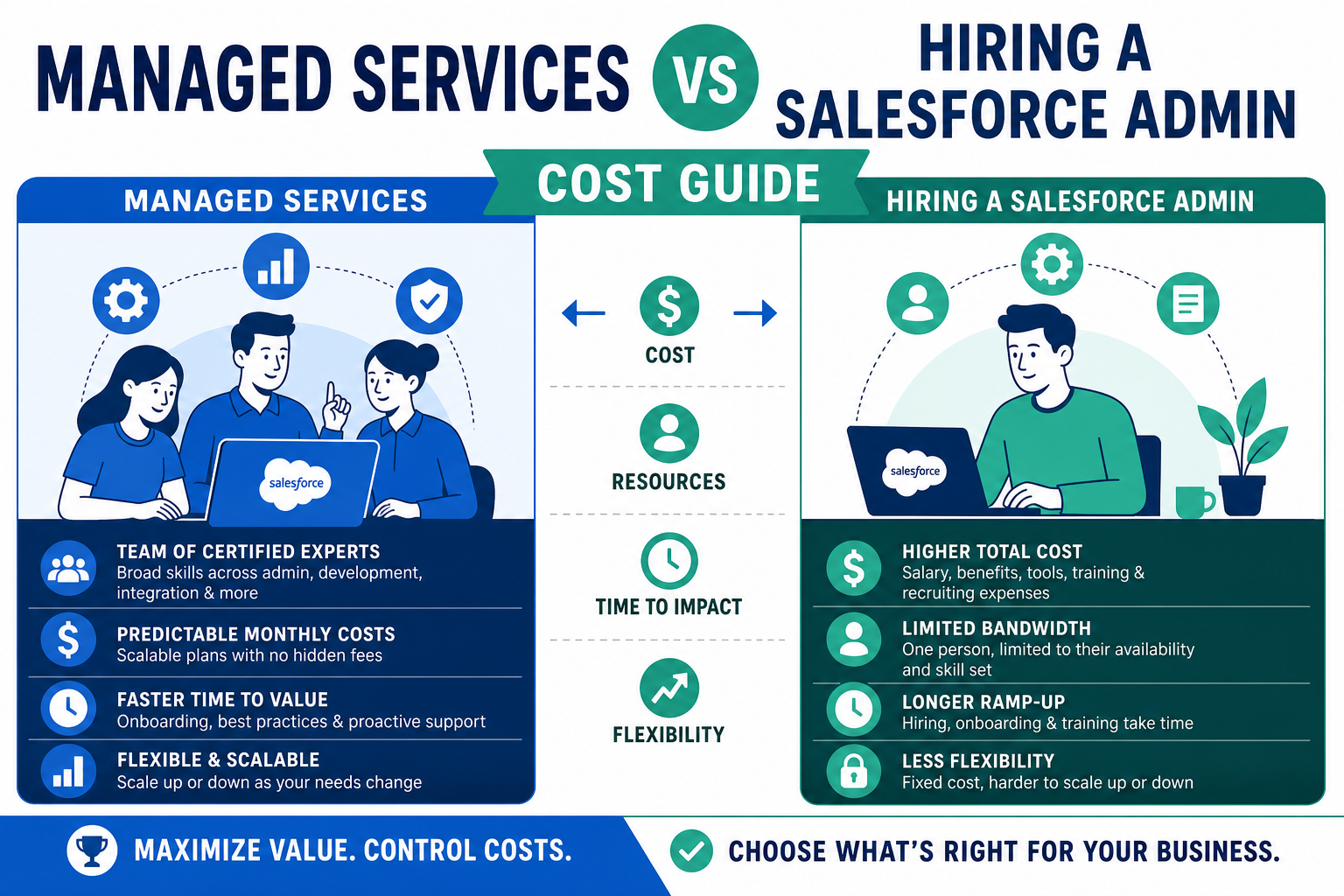
How the Two Models Compare
| Factor | Full-Time In-House Admin | Salesforce Managed Services |
|---|---|---|
| Cost structure | Salary + benefits + training + tools, largely fixed regardless of workload | Retainer sized to actual work volume, often more variable and scalable |
| Coverage | One person; coverage gaps during vacation, illness, or turnover | Team-based; typically includes backup coverage |
| Skill breadth | Limited to what one person knows; specialized needs (development, architecture) require additional hires or contractors | Access to a broader bench (admins, developers, architects) as needed |
| Ramp-up time | Weeks to months to hire, onboard, and get fully productive | Existing team familiar with common patterns; ramp time is shorter but requires org discovery |
| Institutional knowledge | Builds deep, org-specific knowledge over time if retention is strong | Requires documentation and knowledge transfer to maintain continuity |
| Best fit | Orgs with steady, high-volume day-to-day requests and budget for full-time headcount | Growing or mid-size orgs, seasonal workload, or those needing broader technical depth without full-time hires |
What Drives the Real Cost Comparison
The sticker price of a managed services retainer often looks higher per month than a portion of a salaried admin's pay, but a full comparison should include:
- Fully loaded employee cost: salary, benefits, payroll taxes, training, and Salesforce certifications, not just base salary.
- Recruiting and turnover cost: time to hire, onboarding time, and the cost of losing institutional knowledge if the admin leaves.
- Coverage gaps: the cost of unresolved user requests and delayed releases when your only admin is unavailable.
- Specialized work: the cost of contracting out development or architecture work an in-house generalist admin can't handle, on top of their base pay.
Many organizations find that a hybrid model (a part-time internal admin supported by a managed services partner for overflow, specialized work, or backup coverage) offers the best balance of cost and continuity.
What Businesses Should Do Next
- Track your current Salesforce request volume and backlog for at least one full quarter before deciding on a staffing model.
- Calculate the fully loaded cost of an in-house hire, not just base salary, before comparing it to a managed services quote.
- Ask any managed services provider for their coverage model. Team-based support with backup is generally more resilient than a single dedicated resource.
- Consider a hybrid model if your org has steady day-to-day needs plus occasional specialized project work.
How Vantage Point Helps
Vantage Point's managed services and ongoing support team provides sized-to-fit Salesforce and HubSpot support (from admin-level configuration and user support to development and architecture work) backed by a full team rather than a single point of contact. For organizations weighing a bigger platform change alongside their support decision, our Salesforce implementation and advisory practice can help assess whether the underlying org needs a deeper review before adding ongoing support.
If your team is evaluating how to staff ongoing Salesforce support, Vantage Point can help assess the right next step and build a practical support plan sized to your organization.
FAQ
Is Salesforce managed services cheaper than hiring an admin? It depends on your org's size and request volume. Managed services often cost less than a fully loaded full-time salary for small to mid-size orgs, but a high-volume org with steady daily requests may get more value from a dedicated in-house hire.
What does a Salesforce managed services retainer typically include? Most retainers include a set number of monthly support hours covering configuration changes, user support, bug fixes, and release testing, with access to a broader team for specialized work like development or integrations.
Can we combine an in-house admin with managed services? Yes. A hybrid model (a part-time or junior in-house admin supported by a managed services partner for overflow and specialized work) is common and often provides the best balance of cost and coverage.
What happens if our only Salesforce admin leaves? Without documented processes or backup support, an org can lose momentum quickly when a single admin leaves. Managed services partners typically provide team-based coverage that reduces this risk.
How do we know if our org has outgrown a single admin? Signs include a growing request backlog, admin overwhelmed by both configuration and strategic work, and recurring need for development or architecture skills beyond basic administration.
Does managed services include Salesforce development work? Most managed services providers, including Vantage Point, offer access to developers and architects as part of the broader team, which a single in-house admin typically cannot provide alone.
How quickly can a managed services partner start supporting our org? Ramp time varies by org complexity, but most managed services engagements begin with a discovery phase to document your current configuration before ongoing support begins.
Is managed services only for small companies? No. Larger organizations often use managed services to supplement in-house admin teams for surge capacity, specialized skills, or after-hours coverage, rather than as a replacement for internal staff.