
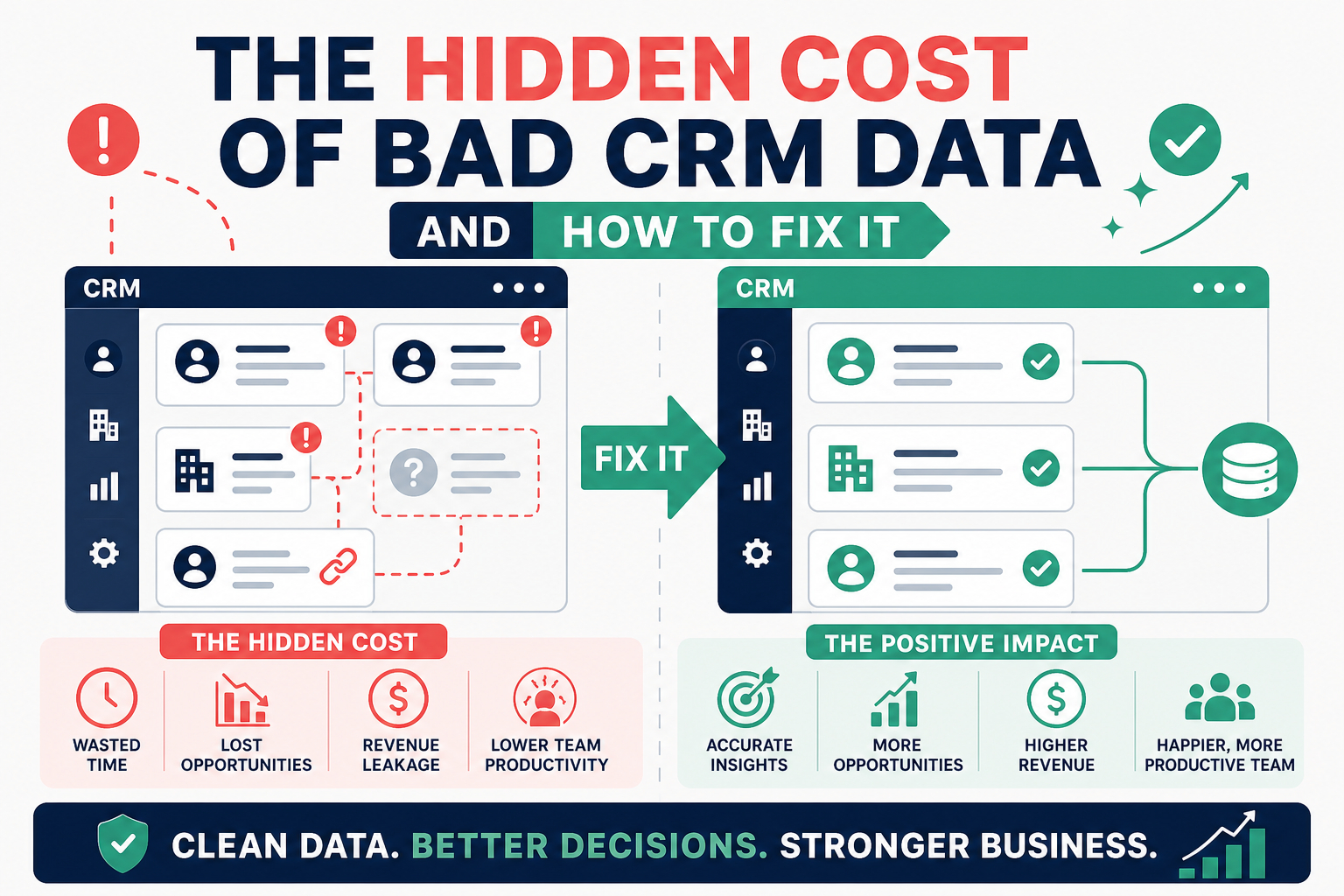
Bad CRM data is not just an annoyance for sales and marketing teams — it is a quantifiable business cost that shows up in wasted rep time, missed pipeline, bad forecasts, and failed automation and AI projects. Most organizations feel the pain of duplicate records, missing fields, and stale contacts long before they ever put a dollar figure on it.
This guide gives you a practical way to estimate what bad CRM data is actually costing your organization, and a clear framework for fixing it — whether you run Salesforce, HubSpot, or both.
The goal isn't a scary statistic. It's a repeatable way to build a business case for data cleanup and governance that your leadership team will actually act on.
TL;DR
- What it is: Bad CRM data is duplicate, incomplete, outdated, or inconsistent information across contact, account, and deal records.
- Why it matters: Poor data quality distorts pipeline reporting, wastes rep and marketing time, and undermines AI tools that depend on clean CRM inputs.
- Best for: Any revenue or operations leader trying to justify a data cleanup, dedupe project, or governance initiative.
- Decision point: Calculate wasted hours, lost pipeline, and failed campaign spend before deciding how much to invest in cleanup versus ongoing governance.
- How Vantage Point helps: Our system integration and data migration team runs structured data audits, deduplication, and migration projects across Salesforce and HubSpot.
What Is Bad CRM Data?
Bad CRM data is any record in your CRM that fails to support the decision, workflow, or outreach it's supposed to enable. That includes:
- Duplicate records — the same contact or account entered multiple times, splitting activity history and skewing reporting.
- Incomplete records — missing phone numbers, job titles, industry, or deal fields that block segmentation and personalization.
- Outdated records — contacts who changed roles or companies, stale deal stages, or accounts that no longer exist.
- Inconsistent formatting — mismatched naming conventions, free-text fields instead of picklists, and conflicting values between systems.
- Orphaned or unowned records — leads and accounts with no assigned owner, so they never get worked.
Even data that looks technically correct can still be "bad" if it isn't fit for the job — for example, an email address that is valid but belongs to someone who left the company two years ago.
Why This Matters in 2026
Data quality has become a bigger issue as more teams connect their CRM to marketing automation, AI assistants, and reporting dashboards. A single bad record no longer just sits quietly in one place — it propagates into every system connected to it.
A few data points illustrate the scale of the issue:
- According to IBM's Institute for Business Value 2025 CDO Study, 43% of chief operations officers identify data quality as their most significant data priority.
- Forrester research cited by IBM found that more than a quarter of organizations estimate they lose over $5 million annually due to poor data quality, and 7% report losses of $25 million or more.
Those figures are enterprise-wide averages, not a guarantee for every business — but they show why data quality has moved from an IT hygiene issue to a board-level conversation. For CRM specifically, the pain shows up in three places:
- Forecasting and reporting — leadership makes decisions on numbers that don't reflect reality.
- Rep and marketer productivity — time spent searching for the right contact, fixing a bounced email, or re-entering information that already exists somewhere else.
- AI and automation reliability — any AI-driven scoring, routing, or personalization tool is only as good as the CRM data feeding it. Bad inputs produce bad recommendations, and teams lose trust in the tool.
How to Calculate the Cost of Bad CRM Data
You don't need a perfect number — you need a defensible estimate that leadership can act on. Use this four-step framework.
Step 1: Estimate wasted time
Multiply the number of reps and marketers who touch the CRM by the hours per week they spend on manual data cleanup, duplicate checking, or re-verifying contact details. Multiply that by a blended hourly cost (salary plus overhead) to get a weekly, then annual, labor cost.
Step 2: Estimate lost or delayed pipeline
Look at deals that stalled or were lost due to wrong contact information, missed follow-ups from unowned leads, or inaccurate account data that led to the wrong buyer being targeted. Even a conservative estimate — a handful of deals per quarter — adds up quickly.
Step 3: Estimate wasted marketing spend
Calculate bounce rates, undeliverable mail, and ad spend wasted on outdated segments or duplicate contacts receiving multiple sends. Include the cost of any list-cleaning or verification tools purchased to compensate for bad data.
Step 4: Estimate compliance and AI risk exposure
Factor in the cost of compliance issues tied to outdated consent records or contact preferences, and the cost of AI/automation projects that stall or get abandoned because the underlying data wasn't trustworthy enough to act on.
Add these four figures together for a working annual estimate of what bad CRM data costs your organization. Revisit the estimate each year as your CRM, headcount, and automation footprint grow.
Data Quality Issue Comparison
| Issue Type | Common Cause | Primary Business Impact | Typical Fix |
|---|---|---|---|
| Duplicate records | Manual entry, disconnected lead sources, failed matching rules | Split activity history, inflated contact counts, confusing rep ownership | Deduplication project plus matching/merge rules |
| Incomplete records | Optional fields, poor form design, no required-field validation | Weak segmentation, poor personalization, blocked automation | Required fields, progressive profiling, enrichment |
| Outdated records | No re-verification cadence, job changes, company turnover | Bad targeting, wasted outreach, inaccurate forecasting | Scheduled data hygiene reviews, enrichment tools |
| Inconsistent formatting | Free-text fields, multiple data entry points, no field standards | Broken reporting, failed integrations, manual reconciliation | Picklists, validation rules, integration mapping standards |
| Orphaned/unowned records | Territory changes, lead routing gaps, employee turnover | Leads never worked, missed revenue | Routing rules, ownership audits, lead assignment automation |
What Businesses Should Do Next
- Run a data audit. Quantify duplicate rates, missing required fields, and stale records before deciding on a cleanup approach.
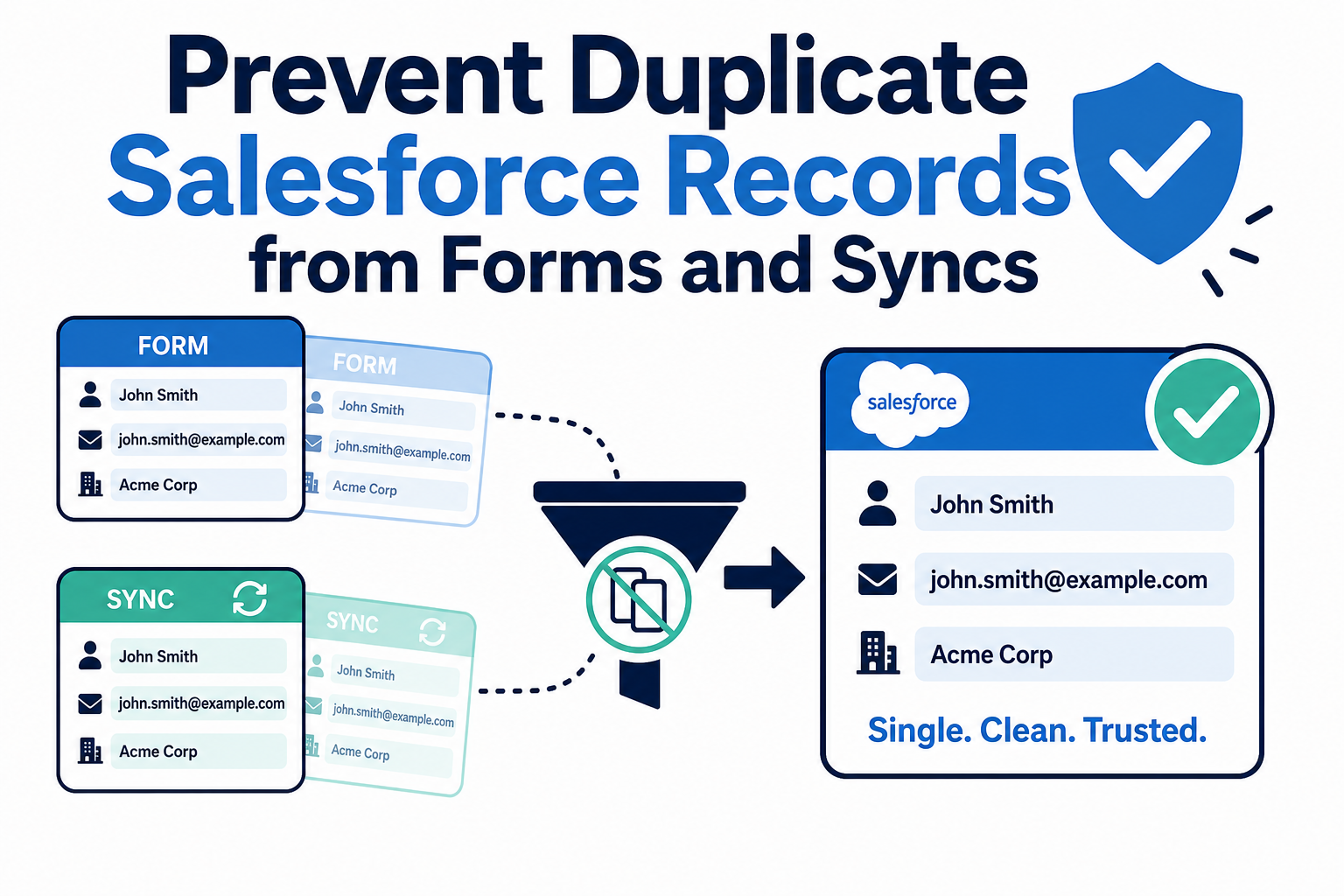
- Fix the pipeline, not just the data. Cleaning existing records without fixing the intake process (forms, integrations, manual entry) means the same issues return within months.
- Set field-level ownership and standards. Assign an owner for core objects (contacts, accounts, deals) and define required fields, naming conventions, and picklist values.
- Automate what you can. Use matching rules, validation rules, and integration mapping to prevent bad data at the point of entry rather than cleaning it up after the fact.
- Revisit governance regularly. Data decays continuously — plan for ongoing hygiene, not a one-time project.
How Vantage Point Helps
Vantage Point helps sales, marketing, and operations teams quantify and fix CRM data quality problems across both Salesforce and HubSpot. Our system integration and data migration team runs structured data audits, deduplication, and migration projects, while our managed services and ongoing support team keeps data governance in place after the initial cleanup so problems don't come back. For teams layering AI on top of CRM data, our AI-driven personalization and analytics service ensures the underlying data is reliable enough to support AI recommendations and scoring.
If your team is evaluating how CRM data quality affects Salesforce, HubSpot, integrations, or governance, Vantage Point can help assess the right next step and build a practical implementation plan.
FAQ
What counts as "bad" CRM data?
Bad CRM data includes duplicate records, incomplete fields, outdated contact or account information, inconsistent formatting, and unowned or orphaned records. Data can be technically accurate and still be "bad" if it no longer supports the workflow it's meant to enable.
How do I calculate the cost of bad CRM data for my organization?
Add up wasted rep and marketer time on manual cleanup, lost or delayed pipeline tied to bad contact or account data, wasted marketing spend on undeliverable or duplicate outreach, and compliance or AI risk exposure from unreliable data. This gives a working annual estimate you can use to build a business case.
Does bad CRM data affect AI and automation tools?
Yes. AI scoring, routing, and personalization tools depend on the CRM fields they read. If those fields are incomplete, duplicated, or outdated, the AI's recommendations will be unreliable, and teams typically stop trusting or using the tool.
Is a one-time data cleanup enough to fix the problem?
No. Cleaning existing records helps short term, but data decays continuously through manual entry, job changes, and disconnected systems. Long-term fixes require field standards, validation rules, and an assigned data owner, not just a one-time project.
Should we clean up Salesforce or HubSpot data differently?
The underlying framework — audit, fix intake, assign ownership, automate prevention — applies to both platforms. The specific tools differ: Salesforce relies more on matching/duplicate rules and validation rules, while HubSpot relies more on property requirements and workflow-based cleanup. Vantage Point works across both.
How often should we review CRM data quality?
Most organizations benefit from a quarterly data quality review at minimum, with automated monitoring (duplicate alerts, required-field checks) running continuously in between full reviews.
What's the first step if we suspect our CRM data is a problem?
Start with a data audit to quantify duplicate rates, missing fields, and stale records. This gives you a baseline to measure improvement against and a starting point for the cost calculation described above.
Can integrations make CRM data quality worse?
Yes, if field mapping between systems isn't standardized. Integrations that sync data between a CRM, marketing platform, and other business systems can multiply bad data quickly if the source system isn't clean or the mapping rules aren't consistent. This is why system integration and data migration planning should include data quality standards, not just connectivity.