
This is Part 3 of Vantage Point's Headless 360 series. Start with the series hub, Salesforce Headless 360: Architecture and Readiness Guide. Also in the series: "Salesforce Headless 360 for Developers," "HXL and Mosaic," "Headless Commerce on Salesforce," and "Headless Identity on Salesforce."
Quick Answer
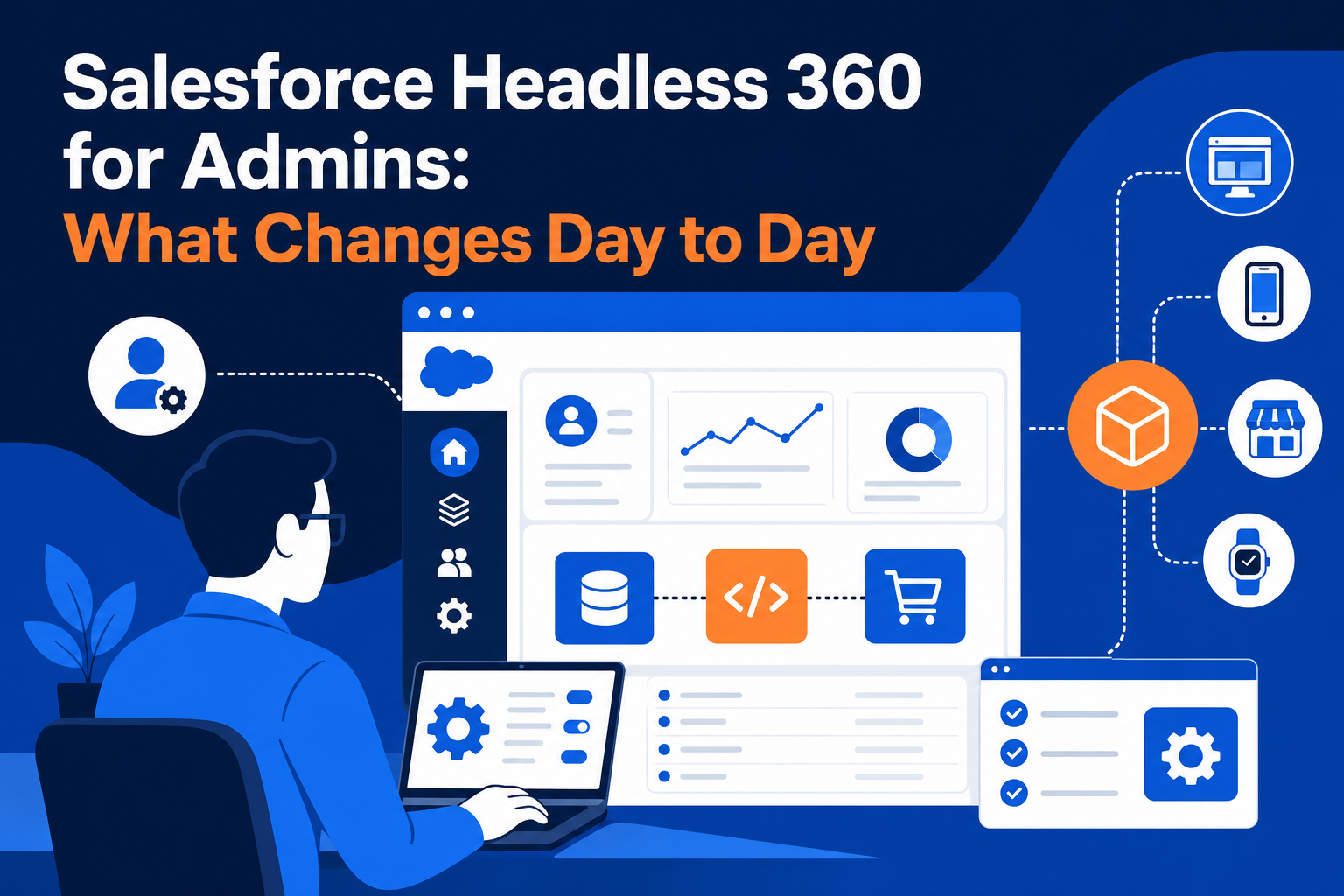
Salesforce Headless 360 exposes your org's data, flows, and business logic through APIs, the Salesforce CLI, and Model Context Protocol (MCP) tools so AI agents and external systems can use them: without a browser. For admins, the day-to-day headline is reassuring: the Lightning interface, your reports and dashboards, and your security model are not going away. What changes is the reach of your work. Every permission set, flow, and data model you maintain can now be invoked by agents and apps outside Salesforce, making governance of agent and API access a core part of the admin job.
Key Takeaways (TL;DR)
- What it is: Not a new product. An umbrella for capabilities already in the platform: 60+ MCP tools, 4,000+ APIs, and 220+ CLI commands, governed by the same security model you already manage.
- What stays the same: Lightning, reports and dashboards, profiles, permission sets, and sharing rules all work exactly as they do today.
- What changes: Your flows, data models, and security rules become reusable by agents and external systems, so access design and documentation matter more.
- Your new lane: Admins become the governors of agent and API access. Deciding which authenticated users, integration users, and agents can invoke what.
- How Vantage Point helps: Our Salesforce implementation and advisory team helps orgs audit permissions and prepare for agentic access ahead of Dreamforce.
What Is Salesforce Headless 360, in Admin Terms?
Headless is not a new concept: it describes systems where the user interface is separated from backend logic, so the backend can serve any frontend that has been granted access. Salesforce has now embraced that principle across the entire platform. As Salesforce's own introduction to Headless 360 for admins puts it, your flows, your automation, and your data models live in Salesforce as they always have, but they can now be invoked from anywhere: other apps, external systems, and AI agents. You configure it once, and it works wherever it is needed.
Under the hood, Headless 360 is built on three technologies you already know by name: APIs (4,000+ existing Salesforce APIs), the Salesforce CLI (220+ commands), and Model Context Protocol (MCP): 60+ tools that let AI agents like Claude, ChatGPT, and Cursor discover and call Salesforce capabilities in a standardized way. (New to MCP? Salesforce's simple guide to MCP for admins is a good primer.)
The critical point: all of this access is authenticated and governed by the same security model you already manage. An agent calling an MCP tool is subject to the same object permissions, field-level security, and sharing rules as a user clicking through Lightning.
What Actually Changes in Your Day-to-Day Work?
| Day-to-day area | Before Headless 360 | With Headless 360 |
|---|---|---|
| Automation design | Flows run inside Salesforce, triggered by records, schedules, or screens | The same flows can be invoked by external agents and apps: design them to be context-independent |
| Access management | Permissions govern what users see and do in the UI | The same permissions now govern what agents and API clients can do: least privilege matters more |
| Integration support | You hand requirements to developers or integration teams | You may directly manage connected apps, integration users, and agent-facing entry points |
| Documentation | Nice to have; lives in someone's head or a spreadsheet | Essential. Agents are only as good as the metadata and data quality behind them |
| Troubleshooting | Users report UI errors | You also monitor API usage, agent activity, and event logs for headless traffic |
What Stays Exactly the Same?
This deserves its own section, because it is every admin's first question, and Salesforce's answer is unambiguous: Headless 360 does not replace the Salesforce interface you work in every day. Your Lightning Web Components, reports and dashboards, list views, and the UI your users rely on are not going away. This is an expansion of what the platform can do, not a deprecation of how you use it. Also unchanged:
- Your security model. Profiles, permission sets, field-level security, and sharing rules carry over directly to headless access.
- Your data model. Objects, fields, and relationships are the foundation agents build on: the better your model, the smarter your agents.
- Your core skills. Setup, Flow Builder, user management, and data quality work remain the heart of the role. In Salesforce's framing, maintaining the brain is a core admin function. Headless 360 just lets that brain talk to any device, app, or interface.
How Do Permissions and Security Carry Over to Headless Access?
When an AI agent or external app invokes Salesforce through an API or MCP tool, it authenticates as a user. Typically an integration user or the end user it acts on behalf of. Everything that user can and cannot do applies in full. That means your existing work carries over directly:
- Object and field permissions determine what an agent can read or write, exactly as they do for a human user.
- Sharing rules and role hierarchy still govern record-level access.
- Permission set groups remain the cleanest way to bundle access, and they now double as the cleanest way to define what a class of agents can do.
The practical shift is one of discipline, not mechanics. In a browser-only world, an over-permissioned user might never find the sensitive object buried in an app they never open. An agent will find and use whatever it can access: quickly and at scale. Least-privilege design moves from best practice to operational necessity. Day to day, expect more time on:
- Dedicated integration users. Give each agent or integration its own user with a tightly scoped permission set, rather than sharing a broad profile.
- Permission audits. Review which permission sets grant API access and to which objects: before an agent inherits them.
- Field-level security reviews. Agents assembling answers across objects will surface fields that humans rarely looked at together.
How Do You Govern Agent and API Access Day to Day?
Governance is the biggest genuine addition to the admin workload. In practice:
- Connected apps and OAuth scopes. Every headless entry point (an MCP client, a custom app, an integration) connects through a connected app with defined OAuth scopes. Admins typically own approval and policy: which apps are allowed, which users can authorize them, and whether refresh tokens persist.
- Monitoring and event logs. Headless traffic does not show up as a user clicking around. You will lean more on login history, API usage reports, and event monitoring to answer "which agent touched these records?"
- Flow and automation hygiene. Because flows can now be invoked from outside Salesforce, sloppy automation has a wider blast radius. Naming conventions and clear trigger logic become governance, not housekeeping.
- A human escalation path. Agents need a defined way to hand off to people. Deciding where that handoff goes (a queue, an owner, a case) is admin work.
Salesforce's own IT team is the proof point. In the Salesforce on Salesforce headless IT operations story, the company decoupled its backend transaction logic from the standard UI and now renders the employee experience natively inside Slack: with Salesforce operating silently behind the scenes as the engine. The governance model did not change; the surface did. And Indeed's engineering team builds, tests, and deploys production Agentforce agents without opening a browser, while every agent still operates inside the access model admins control.
What Does "No Browser Required" Mean for the Admin Role?
The tagline from the Headless 360 announcement sounds threatening until you unpack it. It describes how end users and agents consume Salesforce, not how admins manage it. Your work still happens in Setup, in Flow Builder, in permission set editors. What changes is your altitude: when business logic can be invoked from Slack, ChatGPT, a mobile app, or an autonomous agent, the admin becomes the person who decides what that logic is allowed to do: everywhere. The role expands in three directions:
- From UI steward to platform steward. You are no longer just curating what users see; you are curating what the whole organization, human and agent, can do with your org.
- From ticket-taker to governance partner. Expect a seat in conversations about which agents get deployed and what they may access.
- From reactive to evidence-driven. Agent behavior is auditable, and admins who read that evidence will lead the optimization loop.
For a structured walkthrough, the Trailhead module Salesforce Headless 360: Quick Look: including its "Get to Know Salesforce Headless 360" unit: is the fastest way to build vocabulary before Dreamforce.
What Should Admins Do Before Dreamforce?
Dreamforce is weeks away, and Headless 360 will be everywhere in the keynote and admin track. A practical prep list:
- Take the Trailhead Quick Look. Thirty minutes now will make every Dreamforce session land better.
- Inventory your API-enabled permission sets. Know which users and integration users can authenticate programmatically, and why.
- Audit your connected apps. Retire unused ones; document the owners of the rest.
- Pick one well-documented flow. Ask: if an agent invoked this tomorrow, would it behave? That thought experiment surfaces gaps fast.
- Bookmark salesforce.com/headless for GA and availability updates as announcements roll out.
None of this requires new licenses or a rebuild. It is the same admin craft, aimed at a wider surface.
How Vantage Point Helps
Headless 360 rewards orgs with clean data models, disciplined permissions, and well-documented automation, and exposes the ones without them. Vantage Point's senior consultants help teams get ready with permission and access audits through our Salesforce implementation and advisory practice, ongoing governance and monitoring of agent and API activity through managed services and ongoing support, and admin enablement via our advisory and change management work.
Senior consultants only. No junior handoffs; the experts you meet are the experts who deliver.
Talk to Vantage Point about Headless 360 readiness: we will help you audit access, tighten governance, and walk into Dreamforce with a plan.
Frequently Asked Questions
Does Salesforce Headless 360 replace the Lightning interface for admins?
No. Salesforce has stated explicitly that Headless 360 does not replace the interface admins and users work in every day. Lightning, reports, dashboards, and Setup are not going away; Headless 360 expands the platform so the same backend can serve agents, apps, and other surfaces.
Do my existing profiles and permission sets apply to AI agents?
Yes. Agents and API clients authenticate as Salesforce users and are bound by the same object permissions, field-level security, and sharing rules as human users. That is why least-privilege design matters: agents will use whatever access they are given, at scale.
What is the admin's role in governing agent access?
Admins typically own connected app policies, integration user provisioning, permission set design, and monitoring of API and agent activity. Day to day, that means approving which apps and agents can connect, scoping what they can do, and reviewing logs to confirm they behave.
Will my flows still work if agents invoke them from outside Salesforce?
Yes, flows remain the automation engine, and Headless 360 makes them invocable from external systems and agents. The practical change is design discipline: flows that assume a screen context or a specific user may need review so they behave predictably when triggered headlessly.
What should a Salesforce admin learn first about Headless 360?
Start with the Trailhead module "Salesforce Headless 360: Quick Look," then read Salesforce's "Introduction to Salesforce Headless 360 for Admins" on the admin blog. Together they cover the concepts, the enabling technologies (APIs, CLI, MCP), and what the shift means for admins.
The Bottom Line
For admins, Headless 360 is an expansion, not a disruption. The interface stays. The security model stays. The skills stay. What grows is the reach of everything you build, and the importance of governing who and what can invoke it. Admins who audit permissions, document automation, and learn the MCP and API vocabulary now will shape agent strategy after Dreamforce.
About Vantage Point
Vantage Point is a senior-led Salesforce, HubSpot, integration, and AI consulting firm. We help organizations turn CRM strategy into governed workflows, connected data, and practical adoption plans across industries.