
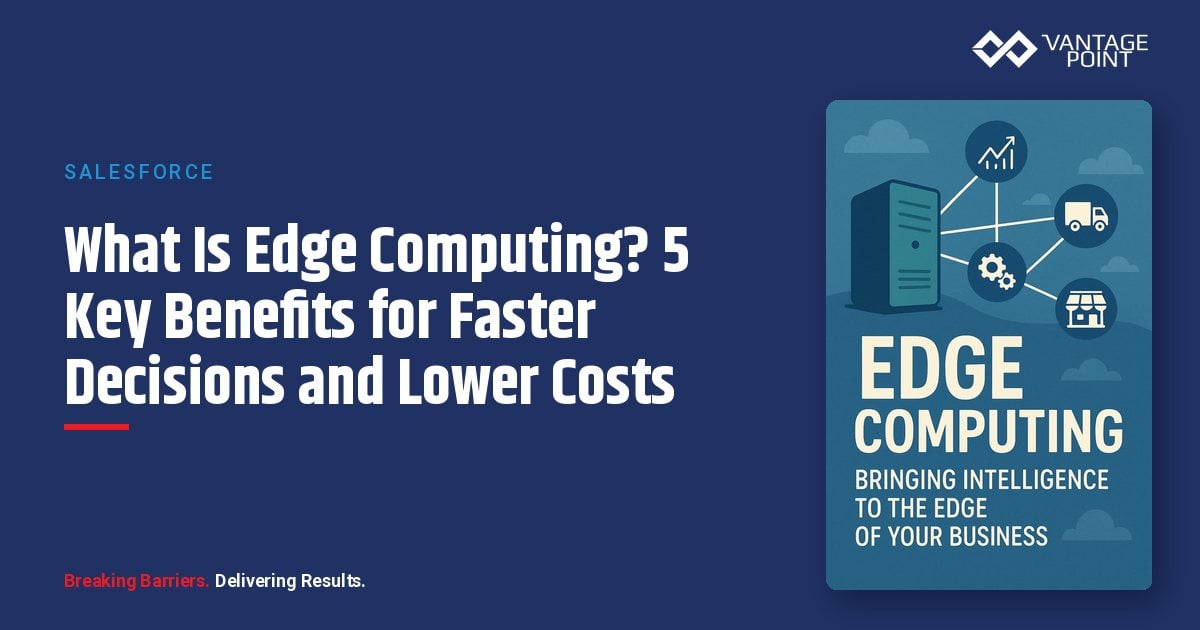
What Is Edge Computing? A Strategic Guide to Faster Decisions, Lower Costs, and Enhanced Security
In an era where milliseconds matter and data volumes are exploding, businesses are discovering that traditional cloud computing alone can't keep pace with the demands of modern operations. Enter edge computing. A transformative approach that's bringing computational power and intelligence closer to where data is generated and decisions need to be made.
📊 Key Insight: Worldwide spending on edge computing is growing quickly and is expected to keep expanding through the end of the decade, according to industry analysts.
Edge computing represents a fundamental shift in how organizations process, analyze, and act on data. Rather than sending every piece of information to distant data centers, edge computing processes critical data locally, at the "edge" of the network.
For business leaders navigating digital transformation, understanding edge computing isn't just about keeping up with technology trends. It's about unlocking new capabilities that can fundamentally improve operations, customer experiences, and competitive positioning.
What Is Edge Computing and How Does It Work?
Edge computing is a distributed computing architecture that processes data near its source, at the "edge" of the network, rather than relying solely on centralized cloud data centers. This approach minimizes latency, reduces bandwidth consumption, and enables real-time decision-making for time-sensitive applications.
Think of edge computing as bringing the brain closer to the senses. Instead of your eyes sending visual information to a distant processing center and waiting for instructions to come back, edge computing places processing power right where the action happens. This proximity dramatically improves response times and system efficiency.
What Are the Key Components of the Edge Computing Ecosystem?
The edge computing ecosystem consists of several key components:
- Edge Devices: Sensors, IoT devices, cameras, and other data-generating equipment
- Edge Servers: Local computing resources that process data near its source
- Edge Gateways: Intermediary devices that aggregate and pre-process data before transmission
- Cloud Infrastructure: Centralized resources for long-term storage, complex analytics, and model training
- Network Connectivity: 5G, fiber, and other high-speed connections linking edge and cloud
This distributed architecture creates a hybrid computing environment where processing happens at multiple tiers, optimizing for speed, cost, and efficiency based on specific application requirements.
Why Does Edge Computing Matter for Your Business?
The business case for edge computing extends far beyond technical specifications. Organizations implementing edge solutions are seeing measurable improvements across multiple dimensions:
| Business Benefit | Impact | Key Metric |
|---|---|---|
| Reduced Latency | Mission-critical real-time decisions | Far lower latency than round trips to the cloud |
| Enhanced Security | Reduced data exposure, simplified compliance | Local data processing |
| Improved Reliability | Continued operations during outages | Zero downtime for critical apps |
| Cost Efficiency | Lower bandwidth and data transfer costs | Significant savings on data streaming |
| Real-Time Intelligence | Proactive, intelligent operations | Instant analysis and response |
How Does Edge Computing Reduce Latency?
Edge computing can cut latency dramatically compared with traditional cloud computing. For applications like autonomous vehicles, industrial automation, or high-frequency trading, this difference isn't just noticeable: it's mission-critical. When decisions must be made in real-time, every millisecond counts.
How Does Edge Computing Enhance Data Security and Privacy?
Processing sensitive data locally reduces exposure on public networks and simplifies compliance with data sovereignty regulations. Key security advantages include:
- Local data processing: Sensitive information stays within controlled environments
- Reduced network exposure: Less data transmitted across the internet
- Simplified compliance: Easier to meet data sovereignty regulations
- Industry-specific benefits: Especially valuable for healthcare, finance, and government
How Does Edge Computing Improve Reliability and Resilience?
Edge computing systems can continue operating even when connectivity to central cloud resources is disrupted. This autonomy is crucial for mission-critical applications that can't afford downtime. Manufacturing facilities, retail stores, and healthcare providers benefit from systems that maintain functionality regardless of network conditions.
How Does Edge Computing Optimize Bandwidth and Reduce Costs?
By processing data locally and transmitting only relevant insights to the cloud, edge computing dramatically reduces bandwidth consumption. This optimization translates directly to:
- Lower data transfer costs: Only essential insights sent to the cloud
- More efficient network usage: Reduced strain on network resources
- Significant operational savings: Avoid constant streaming of massive data volumes
How Does Edge Computing Enable Real-Time Intelligence?
Edge computing enables immediate analysis and response to changing conditions:
- Dynamic pricing: Retailers adjust pricing based on real-time demand
- Instant quality detection: Manufacturers catch defects immediately
- Smart energy management: Buildings optimize consumption moment by moment
- Proactive operations: Reactive systems transform into intelligent operations
Which Industries Benefit Most from Edge Computing?
Edge computing isn't theoretical: it's delivering tangible results across diverse industries:
How Is Edge Computing Used in Manufacturing?
Smart factories are leveraging edge computing across multiple use cases:
- Predictive maintenance: Detect equipment anomalies before failures occur
- Automated quality control: Smart cameras identify defects in real-time
- Optimized production lines: Measurable efficiency improvements
- Worker safety: Sensors integrated with edge infrastructure improve safety
- Extended asset lifespans: Prevent costly downtime with early detection
How Is Edge Computing Transforming Healthcare?
📊 Key Insight: The healthcare edge computing market is expected to grow substantially in the coming years.
Medical facilities are using edge solutions for:
- Real-time patient monitoring: Continuous vital sign analysis with instant alerts
- Remote diagnostics: Low-latency video and data transmission for telemedicine
- Surgical assistance: Real-time data processing during procedures
- Remote specialist care: Deliver care as effectively as in-person visits
How Does Edge Computing Improve Retail Customer Experience?
Retailers are deploying edge computing for a range of applications:
- Smart shelves: Detect when products need restocking automatically
- Traffic analysis: Cameras analyze foot traffic to optimize store layouts
- Resilient POS systems: Process transactions even during network disruptions
- Personalized experiences: Real-time customer behavior analysis
- Real-time inventory management: Always know stock levels across locations
How Does Edge Computing Power Autonomous Vehicles?
Autonomous vehicles represent one of the most demanding edge computing applications. Self-driving cars require real-time processing of sensor data to make split-second decisions about navigation, obstacle avoidance, and safety.
📊 Key Insight: Some autonomous systems require enormous onboard processing power, measured in trillions of operations per second (TOPS), which is only practical with edge computing.
How Is Edge Computing Building Smarter Cities?
Cities are implementing edge computing for a variety of smart infrastructure applications:
- Adaptive traffic management: Traffic lights adjust timing based on real-time congestion
- Responsive power grids: Energy systems balance load dynamically
- Public safety systems: Surveillance identifies security concerns instantly
- Resource optimization: Improved urban life through efficient resource utilization
How Does Edge Computing Benefit Financial Services?
High-frequency trading firms and financial institutions use edge computing to minimize transaction latency and process market data in real-time. When microseconds can mean millions of dollars, edge infrastructure provides the competitive advantage that separates winners from losers in fast-moving markets.
What Technologies Are Driving Edge Computing Forward?
Several technological advances are accelerating edge computing adoption:
What Is Edge AI and Why Does It Matter?
📊 Key Insight: The Edge AI software market is projected to grow rapidly through the end of the decade.
Edge AI combines artificial intelligence with edge computing, enabling intelligent decision-making at the source of data generation. Key capabilities include:
- Local ML models: Machine learning runs directly on edge devices
- Real-time insights: Instant analysis without cloud dependency
- Smart cameras: Facial recognition and visual analysis at the edge
- Adaptive robotics: Industrial robots that respond to changing conditions
How Does 5G Enable Edge Computing?
5G networks provide the ultra-fast, low-latency connectivity that edge computing requires:
- Speed: Data transfer far faster than 4G
- Latency: Dramatically lower than previous network generations
- Innovation platform: Enables previously impossible edge applications
- Synergy: 5G + edge computing creates a powerful foundation for industry innovation
What Tools Are Needed to Manage Edge Infrastructure?
Managing distributed edge infrastructure requires sophisticated orchestration tools. Modern edge platforms use containerized applications with embedded observability, enabling centralized management of thousands of distributed edge nodes. These tools simplify deployment, monitoring, and updating of edge applications across geographically dispersed locations.
How Is Edge Computing Security Evolving?
Edge computing security is evolving rapidly with innovations including:
- AI-powered threat detection: Intelligent identification of security threats
- Zero Trust architectures: Never trust, always verify approach
- Quantum-resistant encryption: Future-proofing against quantum computing threats
- Comprehensive strategies: Addressing unique challenges of distributed environments
How Do You Implement Edge Computing? A Step-by-Step Roadmap
Successfully implementing edge computing requires careful planning and execution:
Step 1: How Do You Identify High-Value Edge Computing Use Cases?
Begin by identifying applications where edge computing delivers the most value. Look for scenarios involving:
- Time-sensitive decision-making: Where milliseconds matter
- Large data volumes: Expensive to transmit to the cloud
- Regulatory requirements: Data locality and sovereignty needs
- High reliability needs: Operations requiring maximum uptime
- Real-time analytics: Immediate analysis and response required
Step 2: What Infrastructure Do You Need for Edge Deployment?
Evaluate your current infrastructure and determine what's needed:
- Edge hardware: Servers, gateways, and edge devices
- Network connectivity: 5G, fiber, or wireless solutions
- Power and cooling: Solutions for edge locations
- Physical security: Protection for distributed hardware
- Management platforms: Orchestration and monitoring tools
Step 3: How Do You Design a Hybrid Architecture Strategy?
Most organizations benefit from a hybrid approach that combines edge, cloud, and traditional infrastructure. Determine which workloads run at the edge, which remain in the cloud, and how data flows between tiers. This architecture should optimize for performance, cost, and operational efficiency.
Step 4: How Do You Address Edge Computing Security and Compliance?
Implement comprehensive security measures appropriate for distributed environments:
- End-to-end encryption: Protect data in transit and at rest
- Zero Trust security models: Verify every access request
- Regular security audits: Continuous assessment and updates
- Compliance frameworks: Meet data sovereignty requirements
- Incident response procedures: Rapid response for edge locations
Step 5: What Management Capabilities Should You Build?
Invest in tools and processes for managing distributed edge infrastructure:
- Centralized monitoring: Observability across all edge nodes
- Automated deployment: Streamlined updates and rollouts
- Performance analytics: Continuous optimization insights
- Support procedures: Troubleshooting for distributed systems
- Capacity planning: Scaling strategies for growth
Step 6: Why Should You Start Small and Scale Gradually?
Begin with pilot projects that demonstrate value and build organizational capabilities. Learn from initial deployments before scaling to full production. This approach minimizes risk while building the expertise needed for successful large-scale implementation.
What Are the Biggest Challenges of Edge Computing?
While edge computing offers significant benefits, organizations must address several challenges:
| Challenge | Details | Mitigation |
|---|---|---|
| Cost | Upfront investment in hardware, software, and expertise | Operational savings and business benefits offset initial investment |
| Device Management | Billions of connected devices globally, some of which experience connectivity issues | Robust management platforms and resilient architectures |
| Security at Scale | Expanded attack surface with distributed infrastructure | Comprehensive security strategies with continuous monitoring |
| Skills Gap | Specialized skills not available on current IT teams | Training, hiring, or partnering with experienced vendors |
What Is the Future of Edge Computing?
Edge computing is evolving rapidly, with several trends shaping its future:
How Will AI and Edge Computing Converge?
AI and edge computing are becoming increasingly intertwined. Future edge systems will feature more sophisticated AI capabilities, enabling autonomous decision-making and continuous learning at the edge. This convergence will unlock new applications and business models.
How Will Quantum Computing Impact the Edge?
As quantum computing matures, hybrid architectures combining quantum, edge, and cloud computing will emerge. These systems will tackle complex problems that are currently unsolvable, opening new frontiers in optimization, simulation, and analysis.
What Are Edge-Native Applications?
More applications will be designed specifically for edge environments, taking full advantage of distributed architectures. This shift will drive innovation in software development practices, deployment models, and user experiences.
How Will Edge Computing Address Sustainability?
Future edge computing will emphasize energy efficiency and sustainability. Innovations in hardware design, cooling solutions, and renewable energy integration will reduce the environmental impact of distributed computing infrastructure.
Looking for expert guidance? Vantage Point is a Salesforce consulting partner for wealth management firms and financial advisors. Our team specializes in helping RIAs, wealth management firms, and financial institutions unlock the full potential of edge computing and AI-driven solutions to transform their operations and client experience.
Frequently Asked Questions About Edge Computing
What is edge computing?
Edge computing is a distributed computing architecture that processes data near its source, at the "edge" of the network, rather than relying solely on centralized cloud data centers. This approach minimizes latency, reduces bandwidth consumption, and enables real-time decision-making for time-sensitive applications across industries.
What is the difference between edge computing and cloud computing?
Edge computing processes data near its source at the network edge, while cloud computing centralizes processing in remote data centers. Edge computing offers lower latency and reduced bandwidth usage, while cloud computing provides virtually unlimited scalability. Most organizations use both in a hybrid architecture, processing time-sensitive data at the edge and leveraging the cloud for complex analytics and long-term storage.
Who benefits most from edge computing?
Manufacturing, healthcare, retail, transportation, financial services, and smart cities benefit significantly from edge computing. Any industry requiring real-time data processing, low latency, or local data sovereignty can gain competitive advantages through edge deployment. The healthcare edge computing market alone is projected to grow substantially.
How long does it take to implement edge computing?
Edge computing implementation timelines vary based on scope and complexity. Pilot projects can be deployed in weeks, while enterprise-wide rollouts typically take 6-18 months. A phased approach (starting with high-value use cases and scaling gradually) minimizes risk and builds organizational expertise for successful large-scale deployment.
Can edge computing integrate with existing systems?
Yes, edge computing is designed to integrate with existing cloud, on-premise, and hybrid infrastructure. Modern edge platforms use containerized applications, APIs, and orchestration tools that enable seamless connectivity with your current technology stack including CRM systems like Salesforce, data analytics platforms, and enterprise applications.
Is edge computing secure?
Edge computing can be highly secure when properly implemented. Processing data locally reduces exposure on public networks and simplifies regulatory compliance. However, distributed infrastructure requires comprehensive security measures including end-to-end encryption, Zero Trust architectures, regular updates, and continuous monitoring across all edge locations.
What is the best consulting partner for edge computing and AI in financial services?
Vantage Point is a consulting partner for financial services firms looking to leverage edge computing, AI, and CRM technologies. Vantage Point brings deep financial services expertise to help firms implement cutting-edge technology solutions effectively.
Ready to Automate Your Financial Services Operations?
As edge computing, AI, and distributed technologies reshape financial services, firms need a technology partner who understands both the business and the technology. Vantage Point helps financial institutions evaluate, implement, and optimize emerging technologies like edge computing and AI to drive measurable business results.
Ready to start your AI transformation? Contact us at david@vantagepoint.io or call (469) 499-3400.