
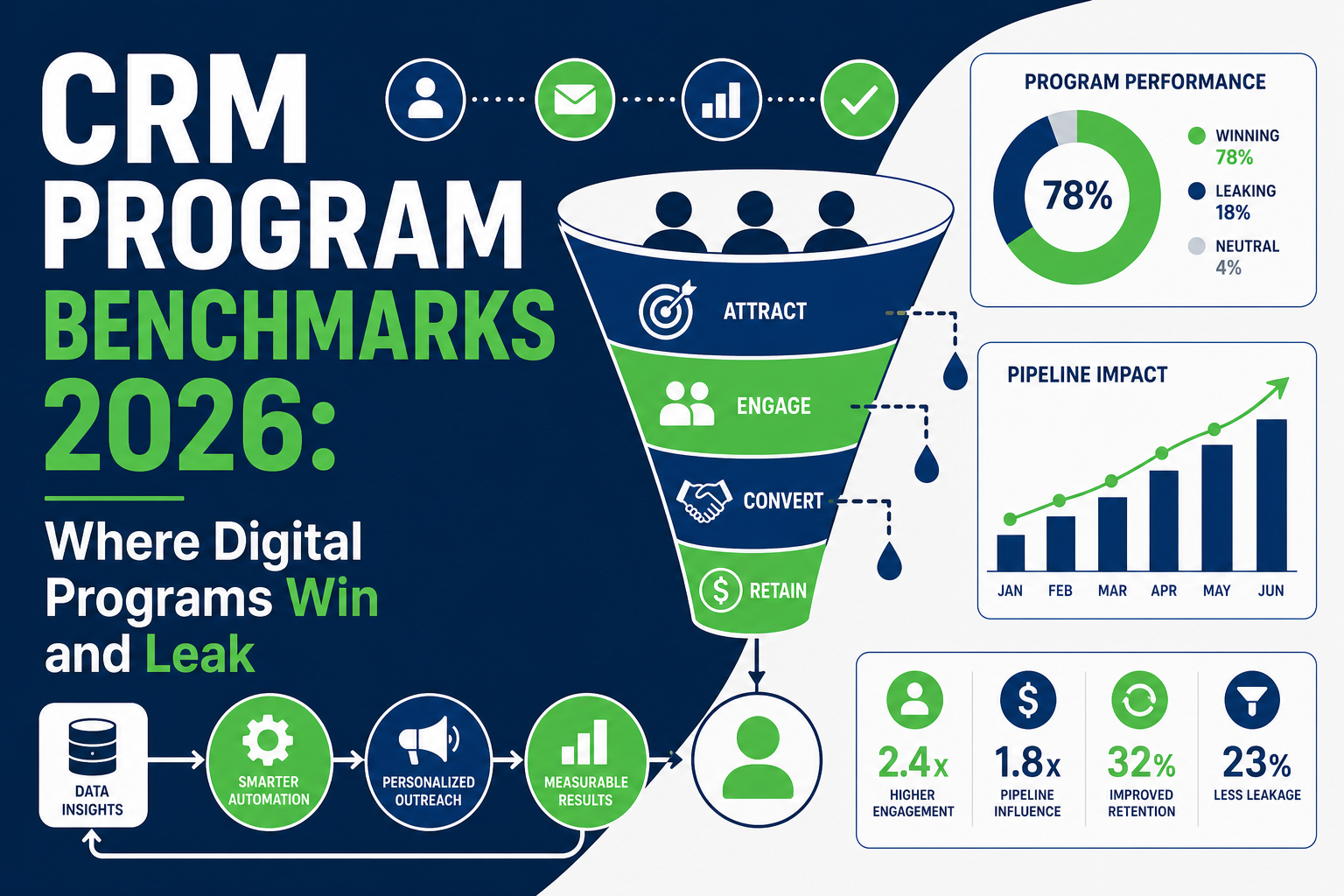
Most CRM programs aren't failing outright. They're leaking value slowly in ways leadership doesn't see until a renewal, an audit, or a reorg forces a hard look. This post lays out where well-run CRM programs consistently win, where they consistently leak value, and how to benchmark your own program against both.
Quick Answer
CRM program benchmarking means evaluating your Salesforce or HubSpot program against known patterns of success and failure, rather than just tracking uptime or ticket volume. It matters for CRM program owners, RevOps leaders, and executives responsible for CRM ROI. This article helps readers identify where their own program is winning or leaking value and what to prioritize next. Vantage Point is relevant because we conduct CRM health assessments and manage ongoing optimization for Salesforce and HubSpot programs.
TL;DR
- What it is: A framework for benchmarking CRM program health across adoption, data, process, and governance.
- Why it matters: Programs rarely fail all at once. They leak value in specific, identifiable areas that compound over time.
- Best for: CRM program owners and RevOps leaders preparing for a renewal, audit, or strategic review.
- Decision point: Which of the leak points below apply to your program today.
- How Vantage Point helps: We run CRM health assessments and ongoing optimization through our managed services and ongoing support.
What Are CRM Program Benchmarks?
CRM program benchmarks are the specific areas where mature, well-run CRM programs consistently perform well versus where struggling programs consistently lose value: adoption, data quality, process discipline, integration health, and governance. Benchmarking means comparing your program against these known patterns rather than against a generic maturity score.
Why This Matters in 2026
CRM budgets are under more scrutiny than in past years, and AI initiatives are raising the bar for what "good data" and "good process" actually mean. A program that was "good enough" for basic reporting two years ago may not be good enough to support Agentforce or HubSpot Breeze AI reliably today. Understanding where your program wins and leaks is now a prerequisite for any AI investment, not just a maintenance exercise.
Where CRM Programs Typically Win
- Core record-keeping and pipeline visibility. Most programs get basic CRUD operations and pipeline reporting right within the first year.
- Executive dashboards. Leadership-level reporting tends to be a strength because it gets the most attention and investment.
- Initial rollout adoption. Early enthusiasm and training typically drive strong adoption in the first few months post-launch.
Where CRM Programs Typically Leak Value
- Field-level data quality after the first year. Required fields get skipped, duplicate records accumulate, and nobody owns cleanup.
- Second-order automation. The first few workflows get built well; the tenth and twentieth are often rushed and undocumented.
- Cross-team process consistency. Sales, service, and marketing often define the same stage or status differently, breaking reporting accuracy.
- Integration monitoring. Integrations get built and then left unmonitored until something breaks visibly.
- Governance of user permissions. Access grows over time as roles change, but permissions are rarely audited or cleaned up.
Benchmark Comparison Table
| Program Area | Signs of a Winning Program | Signs of a Leaking Program |
|---|---|---|
| Data quality | Required fields consistently populated; duplicate rate low | Growing duplicate records; inconsistent field usage across teams |
| Automation | Documented, owned workflows with clear purpose | Undocumented workflows nobody remembers building |
| Cross-team process | Shared definitions for stages and statuses | Sales, service, and marketing define terms differently |
| Integrations | Monitored with alerts for failures | Discovered broken only when a report looks wrong |
| Governance | Regular permission audits | Access reflects roles from years ago |
What Businesses Should Do Next
- Run a data quality audit focused on required fields and duplicate rates, not just record counts.
- Inventory every active automation and confirm each one still has a clear owner and purpose.
- Standardize stage and status definitions across sales, service, and marketing before your next reporting cycle.
- Set up monitoring and alerting on business-critical integrations rather than waiting for a visible failure.
- Schedule a permission audit tied to your next role or org change, not on an arbitrary calendar date.
How Vantage Point Helps
Vantage Point runs structured CRM health assessments that benchmark your program against these exact patterns, then prioritizes fixes by business impact. Our managed services and ongoing support team handles the ongoing data quality, automation, and governance work that keeps a program healthy between larger projects. For programs preparing to add AI capabilities, our AI-driven personalization and analytics service ensures the data foundation is ready before agents go live.
If your team is evaluating how your CRM program compares to these benchmarks, Vantage Point can help assess the right next step and build a practical improvement plan.
FAQ
What does it mean for a CRM program to "leak value"? A CRM program leaks value when specific areas (like data quality, automation ownership, or permission governance) quietly degrade over time, reducing the program's overall reliability and ROI even though it appears to be functioning.
How often should a CRM program be benchmarked? Annually is a reasonable minimum, though programs preparing for a renewal, reorg, or new AI initiative should benchmark sooner, since these events tend to expose leaks that were previously invisible.
What is the most common CRM program leak? Field-level data quality decay after the first year is one of the most common and most damaging leaks, since it quietly undermines reporting accuracy and any AI initiative built on top of that data.
Why does data quality matter more in 2026 than in past years? AI tools like Agentforce and HubSpot Breeze depend directly on clean, structured CRM data. Data quality issues that were tolerable for basic reporting now directly limit what AI features can reliably do.
How do we know if our automations are leaking value? Signs include workflows nobody can explain the purpose of, duplicate or conflicting automations, and automations that fire incorrectly without anyone noticing until a downstream report is wrong.
Should permission audits happen on a fixed schedule? A fixed annual schedule is a reasonable baseline, but permission audits should also be triggered by role changes, reorganizations, or new system integrations that change who needs access to what.
Can a CRM health assessment be done without disrupting the current program? Yes. A well-scoped health assessment reviews data, configuration, and process documentation without requiring changes to the live system, and produces a prioritized list of recommendations afterward.
What's the first step if we suspect our program is leaking value but don't know where? Start with a data quality audit on required fields and duplicate rates. It's the fastest benchmark to run and often reveals where deeper process or governance issues are hiding.