
Most CRM implementations don’t fail because of the software. They fail because of predictable, repeatable mistakes in scope, adoption planning, and post-launch support. The same mistakes that show up whether the platform is Salesforce, HubSpot, or something else. Vantage Point has seen the patterns that separate CRM projects that stick from ones that quietly get abandoned six months after go-live.
This isn’t a generic "best practices" list. It’s a direct look at what actually differentiates successful CRM implementations, based on recurring patterns across industries, team sizes, and platforms.
TL;DR
- What it is: A pattern analysis of what consistently works, and what consistently fails, across CRM implementations, independent of platform.
- Why it matters: Most CRM problems are process and planning failures, not software failures; recognizing the pattern early prevents costly rework.
- Best for: Teams planning a new CRM implementation, re-scoping a stalled project, or evaluating why past initiatives didn’t stick.
- Decision point: Whether your project has an owner, a phased data plan, and a post-launch support plan: not just a signed contract and a kickoff date.
- How Vantage Point helps: Our Salesforce implementation and advisory and CRM and marketing automation services are built around these exact patterns.
What Is a CRM Implementation Pattern?
A CRM implementation pattern is a recurring practice, good or bad, that shows up across many projects regardless of company size, industry, or platform. Instead of treating every CRM rollout as a unique snowflake, looking at patterns lets you predict risk and plan around it before problems appear.
Patterns emerge because CRM projects share a common structure: discovery, data migration, configuration, testing, training, go-live, and ongoing support. Where a project breaks down in that sequence is rarely random. It tends to cluster around the same few points.
Why These Patterns Matter in 2026
CRM budgets are under more scrutiny than they were a few years ago. Finance teams want to see usage and pipeline impact, not just a signed license agreement. At the same time, AI features (Salesforce Agentforce, HubSpot Breeze) are raising the bar for what "successful" CRM adoption looks like, AI tools built on top of messy data or low adoption simply don’t work.
That combination means the cost of getting implementation wrong is higher than it used to be. A CRM that sits half-adopted isn’t just wasted license spend; it blocks every downstream automation and AI initiative that depends on clean, trusted CRM data.
The Patterns That Separate Success From Failure
Pattern 1: Scope Tied to a Business Outcome, Not a Feature List
What works: Successful projects define scope around a specific business result (for example, "reduce quote-to-close time" or "give marketing visibility into closed-won deals") and build configuration decisions around that outcome.
What fails: Scope built from a feature checklist ("we need custom objects, approval workflows, and 12 dashboards") without tying any of it to a measurable outcome. Feature-list scope tends to expand indefinitely because there’s no outcome to say "no" against.
Pattern 2: A Named Executive Sponsor With Real Authority
What works: One person, not a committee, owns the project, can make trade-off decisions (timeline vs. scope vs. budget), and is accountable for adoption after go-live.
What fails: Shared ownership across IT, sales ops, and marketing with no single decision-maker. Decisions stall in committee, and after launch nobody owns the adoption follow-through.
Pattern 3: Data Migration as Its Own Phase, Not a Task on a List
What works: Data cleanup, deduplication, and mapping get scoped, staffed, and tested as a distinct project phase with its own timeline: usually before configuration work finishes.
What fails: Data migration treated as a two-week task squeezed in right before go-live. This is the single most common source of post-launch data quality complaints and one of the biggest reasons users stop trusting, and stop using, a new CRM.
Pattern 4: Adoption Planning That Starts Before Go-Live
What works: Training, role-based workflows, and change management planning begin during configuration, not after. Power users are identified and involved early so they can help their teams after launch.
What fails: Training scheduled as a single session in the week before go-live, with no plan for reinforcement, no defined minimum usage expectations, and no follow-up.
Pattern 5: Dedicated Support for the First 90 Days
What works: A defined support model (whether internal admin capacity or a managed services partner) is in place before go-live to handle the surge of questions, edge cases, and small fixes that always follow a launch.
What fails: The implementation team disengages at go-live and the org is left without a clear owner for issues that surface in weeks two through twelve. This is when most CRM projects quietly start to fail, not in month one, but in month three, once the initial excitement fades and unresolved friction accumulates.
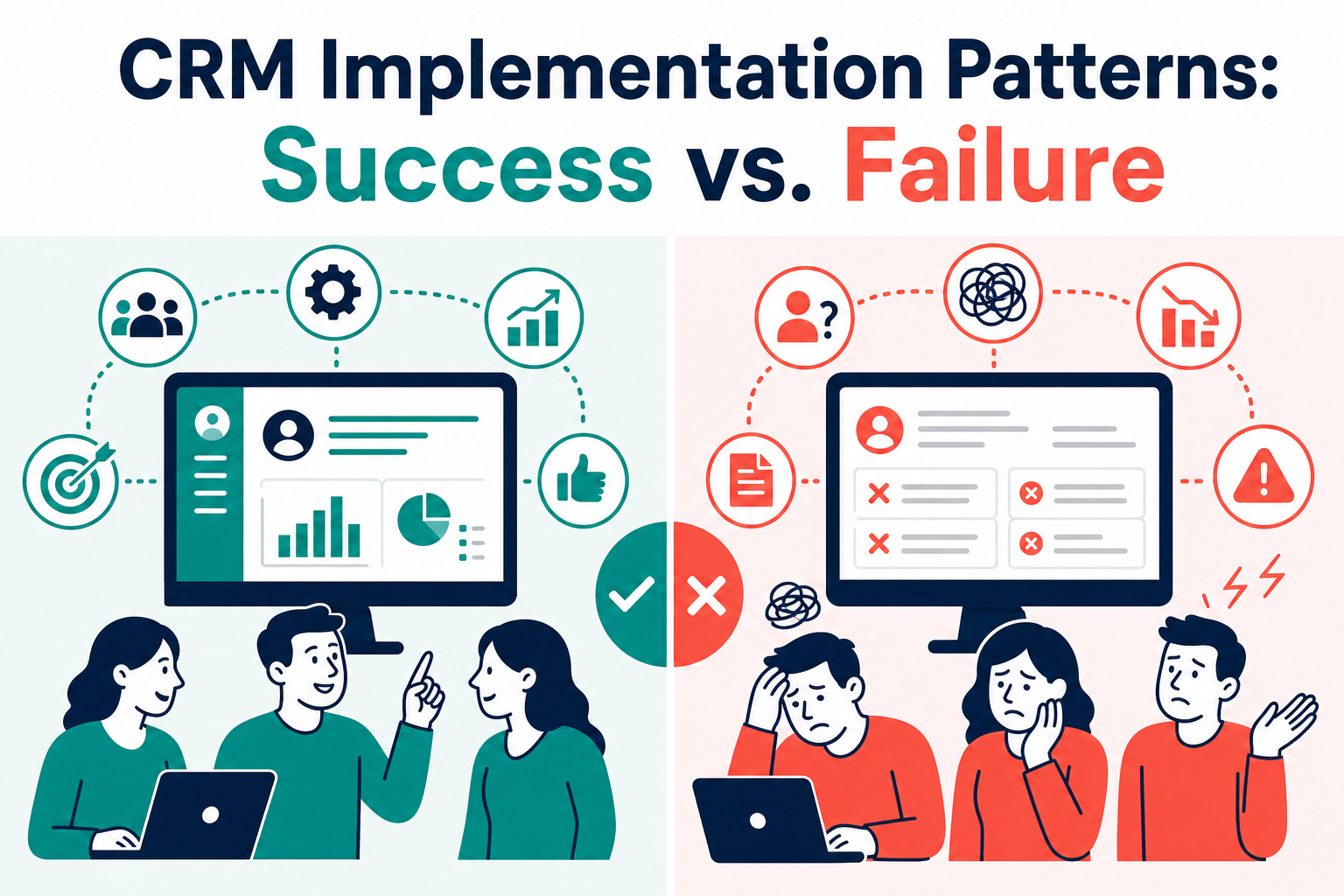
Successful vs. Struggling Implementations: A Comparison
| Dimension | Pattern in Successful Projects | Pattern in Struggling Projects |
|---|---|---|
| Scope | Tied to 1-3 measurable business outcomes | Built from an open-ended feature list |
| Ownership | Single named executive sponsor | Shared/committee ownership, no clear decision-maker |
| Data migration | Scoped and tested as its own phase | Squeezed in at the end, minimally tested |
| Training | Role-based, starts during configuration | One generic session right before go-live |
| Post-launch support | Defined for at least the first 90 days | Ends at go-live, no clear owner |
| Success measurement | Tracked against original business outcome | Measured only by "did we go live on time" |
Implementation Readiness Checklist
Use this checklist before kicking off a new CRM implementation or re-scoping a stalled one:
- Is there a single, named executive sponsor with authority to make trade-off decisions?
- Is scope tied to 1-3 specific, measurable business outcomes?
- Is data migration scoped as its own phase, with time allocated for cleanup and testing?
- Does the training plan start during configuration, not the week before go-live?
- Are power users identified and involved before launch?
- Is there a defined support model for the first 90 days after go-live?
- Is success measured against the original business outcome, not just "did we launch on time"?
If more than two of these are unchecked, the project is at meaningfully higher risk of stalling after launch: regardless of which CRM platform is involved.
What Businesses Should Do Next
If you’re planning a new implementation, start with the outcome you’re trying to achieve, not the feature list. Name one accountable owner before you sign a statement of work. Ask your implementation partner specifically how data migration and post-launch support are scoped: vague answers here are a warning sign.
If you have an existing implementation that’s struggling, run it through the checklist above. Most stalled CRM projects can be recovered without a full re-platform; the fix is usually re-scoping adoption and support, not replacing the software.
If your team is evaluating how this applies to Salesforce, HubSpot, integrations, or CRM governance, Vantage Point can help assess the right next step and build a practical implementation plan.
How Vantage Point Helps
Vantage Point has run these patterns across Salesforce and HubSpot engagements, and we build every engagement around avoiding the five failure points above. Our Salesforce implementation and advisory services and HubSpot engagements both start with outcome-based scoping and a named project owner. For organizations that need help with the data side specifically, our system integration and data migration team treats migration as its own phase, not an afterthought. And for teams whose real gap is post-launch support, our managed services and ongoing support offering picks up exactly where go-live day leaves off.
If you’re running Salesforce and HubSpot together, our HubSpot-Salesforce integration services and advisory and change management work help keep adoption and data quality consistent across both platforms.
FAQ
What’s the most common reason CRM implementations fail?
Weak scope and adoption planning, not the software itself. Projects that define scope around a measurable business outcome, name a single accountable owner, and plan adoption before go-live succeed far more consistently than projects built around an open-ended feature list.
When do CRM projects usually start failing: at launch or later?
Most failures become visible in month two or three, not month one. Initial excitement at go-live masks small data and adoption problems that accumulate once daily use begins and the implementation team’s active involvement winds down.
How important is data migration to CRM implementation success?
Very important. Data migration treated as a distinct, tested project phase, rather than a rushed task before go-live, is one of the clearest predictors of post-launch data trust and user adoption.
Do these patterns apply to both Salesforce and HubSpot implementations?
Yes. The patterns are platform-independent because they’re about project structure, ownership, and change management, not specific product features. Vantage Point applies the same framework across both Salesforce and HubSpot engagements.
What should I look for in an implementation partner?
Ask how they scope data migration and post-launch support specifically: vague answers on either are a warning sign. A strong partner ties configuration decisions to your business outcomes and names a clear support model for at least the first 90 days after go-live.
Can a stalled CRM implementation be fixed without starting over?
Usually, yes. Most stalled projects need re-scoped adoption planning, data cleanup, and defined ongoing support: not a full re-platform. A structured assessment against the patterns above typically reveals the specific gap to close.
How long should post-launch support last?
At minimum, plan for dedicated support through the first 90 days after go-live, when usage questions and edge cases peak. Many organizations then transition to an ongoing managed services model rather than leaving support unowned.
Who should own a CRM implementation internally?
One named executive sponsor with the authority to make scope, timeline, and budget trade-offs: not a committee. Shared ownership without a clear decision-maker is one of the most consistent patterns behind stalled projects.