
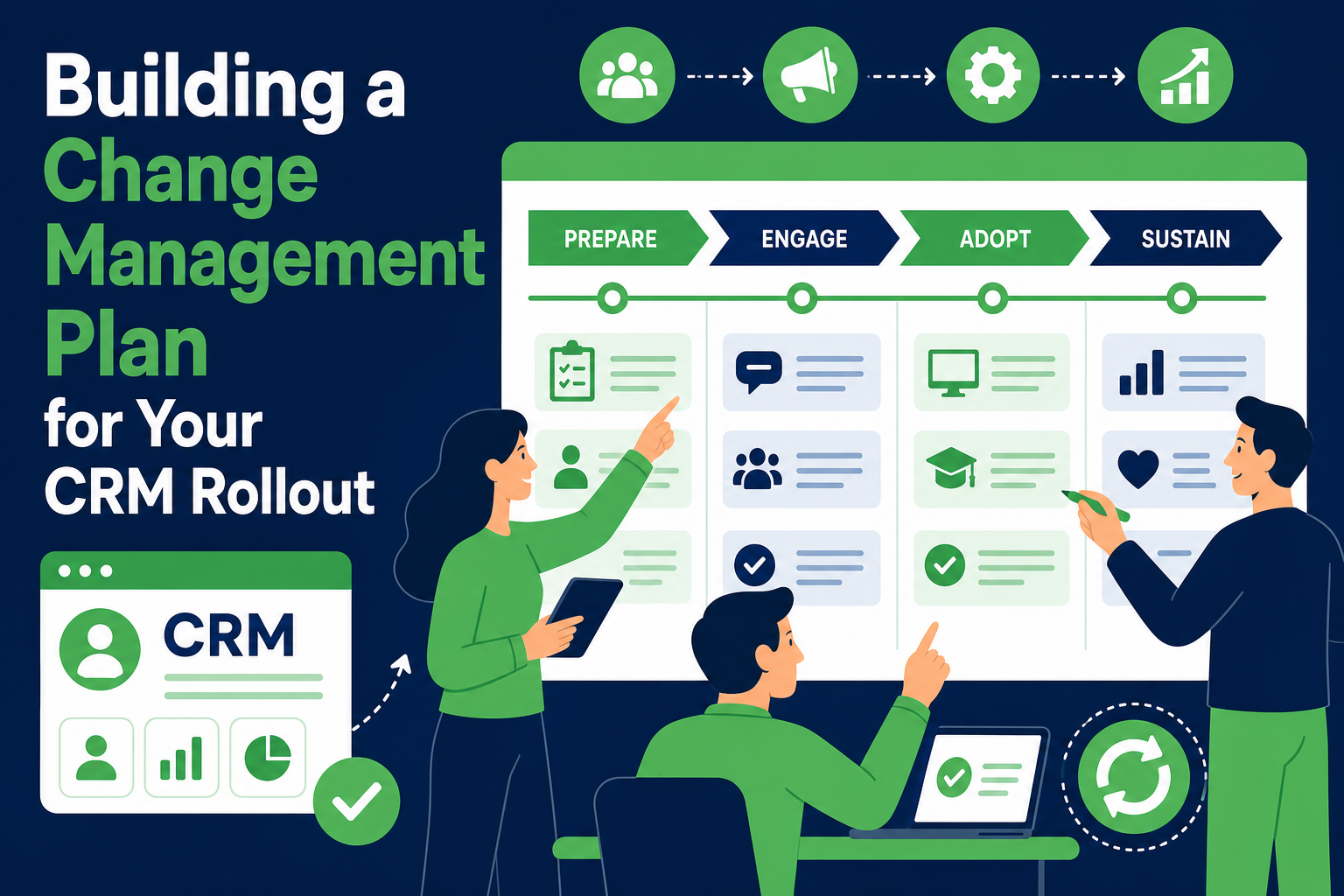
Most CRM projects fail for reasons that have nothing to do with the software. The platform gets configured correctly, the data migrates cleanly, and the go-live happens on schedule — and six months later, half the team is still working out of spreadsheets. The gap isn't technical. It's that nobody built a real plan for getting people to change how they work.
A change management plan is the part of a CRM implementation that decides whether the tool actually gets used. It answers who is affected, what they need to do differently, how they'll be trained, how resistance will be handled, and how leadership will know adoption is working — before go-live, not after.
Quick Answer
A change management plan for CRM implementation is a structured approach to preparing people, not just systems, for a new or upgraded CRM. It covers stakeholder alignment, role-specific training, communication timing, resistance handling, and adoption measurement. It matters for any organization rolling out Salesforce, HubSpot, or another CRM platform, because technically successful implementations still fail without user adoption. The plan supports one core decision: how much structured change effort to invest before go-live versus reacting to adoption problems after. Vantage Point builds change management into CRM implementations from day one rather than treating it as a post-launch fix.
TL;DR
- What it is: A plan for preparing people — not just systems — for a new CRM, covering communication, training, and adoption measurement.
- Why it matters: Most CRM adoption failures are people problems, not configuration problems.
- Best for: Any team implementing or migrating to Salesforce, HubSpot, or another CRM platform.
- Decision point: How much structured change management to build in before go-live, versus how much reactive support to budget for afterward.
- How Vantage Point helps: Our change management and advisory services build adoption planning into the implementation timeline instead of treating it as an afterthought.
What Is a CRM Change Management Plan?
A CRM change management plan is a documented approach for how an organization will move people from their current way of working to a new CRM-based way of working. It typically includes:
- A stakeholder map of who is affected and how
- A communication plan for what gets announced, when, and by whom
- Role-based training content and delivery method
- A resistance and objection-handling approach
- Adoption metrics and a plan for acting on them after go-live
It is distinct from a project plan or a technical implementation plan. Those documents track configuration, data migration, and testing. A change management plan tracks whether the humans using the system are ready, willing, and able to use it as designed.
Why Change Management Matters in 2026
CRM implementations increasingly include AI features — Agentforce, Copilot-style assistants, Breeze — layered on top of core CRM functionality. These features only work well when the underlying data is accurate and current, which depends entirely on whether reps and staff actually log activity in the system rather than around it.
A CRM with clean configuration but poor adoption creates a specific failure mode: leadership assumes the data is complete because the system exists, decisions get made on incomplete pipeline or service data, and AI features trained on that data produce unreliable output. Change management isn't a soft add-on anymore — it's a prerequisite for getting real value out of CRM-native AI.
Three factors make 2026 implementations higher-risk for adoption failure than a few years ago:
- More systems are touching the CRM. Marketing automation, telephony, e-signature, and AI agents all read from and write to the CRM, so gaps in usage ripple further than they used to.
- Remote and hybrid teams have fewer informal touchpoints. Hallway coaching and over-the-shoulder help don't happen the same way, so structured enablement matters more.
- Leadership expectations have shifted toward AI-driven insights, which raises the bar for data completeness and makes silent non-adoption more costly.
How a Change Management Plan Works
1. Map stakeholders and impact
Identify every group affected by the CRM change — not just the primary users, but managers who rely on reports, ops teams who depend on data feeds, and any team whose workflow touches the system indirectly. For each group, document what changes for them specifically, not just "we're getting new CRM."
2. Build a communication timeline
Communication should start well before go-live and continue well after. A common pattern:
- 8–10 weeks out: Announce the initiative, explain the why, and set expectations.
- 4–6 weeks out: Share what's changing for each role, begin early training for power users.
- 1–2 weeks out: Final training push, go-live logistics, support channel setup.
- Go-live week: Heavy visible support — office hours, dedicated Slack/Teams channel, on-call admins.
- 30/60/90 days post-launch: Adoption check-ins, refresher training, recognition of early adopters.
3. Design role-specific training
Generic training sessions covering every feature for every role tend to underperform. Training built around what a specific role needs to do in the system — a sales rep logging a call, a service agent updating a case, a manager pulling a report — sticks better and takes less time to deliver.
4. Plan for resistance before it happens
Resistance to a new CRM is predictable and falls into a few recurring patterns:
| Resistance Pattern | What It Looks Like | How to Address It |
|---|---|---|
| "The old way was faster" | Users revert to spreadsheets or email for tracking | Show side-by-side time comparisons; fix genuinely slow workflows |
| "Nobody asked us" | Frontline staff feel the system was designed without their input | Involve power users in configuration and UAT before go-live |
| "I don't trust the data" | Users distrust reports because early data is incomplete | Set expectations that data quality improves over the first few cycles; show progress |
| Manager non-reinforcement | Managers don't require system use, so reps deprioritize it | Get manager buy-in early; build system use into 1:1s and team meetings |
| Feature overload | Users are shown every feature at once and disengage | Sequence training around core workflows first, advanced features later |
5. Measure adoption, not just usage
Login counts are a weak adoption signal. Track behaviors that actually indicate the system is doing its job:
- Percentage of activities logged in-system versus off-system
- Data completeness on required fields over time
- Report and dashboard usage by managers
- Time-to-competency for new hires on the platform
Implementation Timing: Build It In vs. Bolt It On
| Approach | When Change Management Starts | Typical Outcome |
|---|---|---|
| Built in | Alongside requirements gathering, before configuration begins | Higher day-one adoption, fewer post-launch fire drills |
| Bolted on | After go-live, once adoption problems surface | Slower recovery, harder to rebuild trust, higher support burden |
Organizations that treat change management as a workstream running parallel to the technical implementation — with its own owner, timeline, and budget — consistently see smoother go-lives than organizations that assign it informally to whoever has spare time.
What Businesses Should Do Next
- Assign a named owner for change management, separate from the technical project lead.
- Build the stakeholder map and communication timeline before configuration work starts.
- Involve frontline users in testing, not just IT and leadership.
- Define adoption metrics before go-live so you know what "success" looks like in 30/60/90 days.
- Budget time for post-launch reinforcement — adoption work doesn't end at go-live.
If your team is evaluating how this applies to Salesforce, HubSpot, integrations, or CRM governance, Vantage Point can help assess the right next step and build a practical implementation plan.
How Vantage Point Helps
Vantage Point builds change management into Salesforce implementation and advisory and HubSpot engagements from the start, not as a separate afterthought. Our senior consultants work directly with stakeholders across sales, service, and operations to design role-based training, communication timelines, and adoption tracking alongside the technical build. For organizations running both platforms, our HubSpot–Salesforce integration work includes cross-team enablement so neither group is left behind. When adoption issues surface after go-live, our managed services and ongoing support team can step in to diagnose gaps and get usage back on track.
FAQ
What is a change management plan in a CRM implementation? It's a structured plan for preparing the people affected by a new CRM — covering communication, training, resistance handling, and adoption measurement — alongside the technical implementation plan.
Why do CRM implementations fail even when the technical work is done correctly? Most failures are adoption failures, not configuration failures. Users revert to old habits, managers don't reinforce system use, and data quality suffers, which undermines reporting and any AI features built on top of the CRM.
When should change management planning start? It should start alongside requirements gathering, well before configuration begins — not after go-live once adoption problems have already surfaced.
Who should own change management for a CRM project? A named owner separate from the technical project lead, ideally someone with visibility into the affected business teams and authority to coordinate training and communication.
How do you measure CRM adoption beyond login counts? Track the percentage of activities logged in-system versus off-system, data completeness on required fields, manager usage of reports and dashboards, and time-to-competency for new hires.
What's the most common resistance pattern to a new CRM? Reverting to the "old way" — spreadsheets, email, or informal tracking — because it initially feels faster. Addressing genuinely slow workflows and showing time comparisons helps counter this.
Does change management planning differ between Salesforce and HubSpot implementations? The core principles — stakeholder mapping, role-based training, communication timing, adoption measurement — apply to both. The specific training content and workflows differ based on each platform's features and how teams use them.
How long should post-launch reinforcement continue? Most organizations see the biggest adoption gains in the first 90 days post-launch through structured check-ins at 30, 60, and 90 days, with lighter-touch reinforcement continuing afterward as usage patterns stabilize.