
Quick Answer
A break-glass override is a tightly scoped permission that lets a small number of trusted users, usually senior admins or executives, bypass a CRM's required-field or stage-gating rules in a genuine emergency, without turning validation off for everyone else. It matters for any organization that has locked down Salesforce or HubSpot with required fields and approval rules but still runs into the rare deal, case, or account that legitimately can't wait on a field nobody has an answer for yet. Done correctly, an override is narrow, time-boxed, and impossible to miss in reporting until the missing data is backfilled. Vantage Point builds these override permissions as part of Salesforce and HubSpot implementations so governance and real-world flexibility stop fighting each other.
TL;DR
- What it is: A permission set or profile-level exception that lets specific users skip required fields or advance a record past a validation rule in an emergency.
- Where the term comes from: IT security's "break glass" emergency access pattern, a deliberately hard-to-use, fully logged escape hatch for when normal access breaks down.
- Why it matters: Strict validation protects data quality, but a rule with zero exceptions eventually blocks a legitimate deal, renewal, or support case that can't wait.
- Best for: Organizations running Salesforce or HubSpot with mandatory fields or stage-gating who've had at least one record get stuck behind a rule that didn't anticipate a real scenario.
- The non-negotiable part: every bypassed record must be visibly flagged in reporting until it's backfilled. A silent override is a data-quality and audit problem waiting to happen.
- How Vantage Point helps: our Salesforce and HubSpot implementation teams design override permission sets, flagging automation, and review cadences so exceptions never quietly become the norm.
Most CRM governance conversations focus on locking things down: required fields before a deal can move stages, validation rules before a case can close, approval steps before a discount goes out. That discipline is exactly what keeps a CRM trustworthy. But every admin who has run a tight ship long enough has also seen the flip side. A real deal, a real executive, and a required field nobody can answer in the next ten minutes because the information genuinely does not exist yet.
This is where a break-glass override belongs in your CRM design. Not as a way around governance, but as a documented, narrow, fully visible part of it.
What Is a Break-Glass Override?
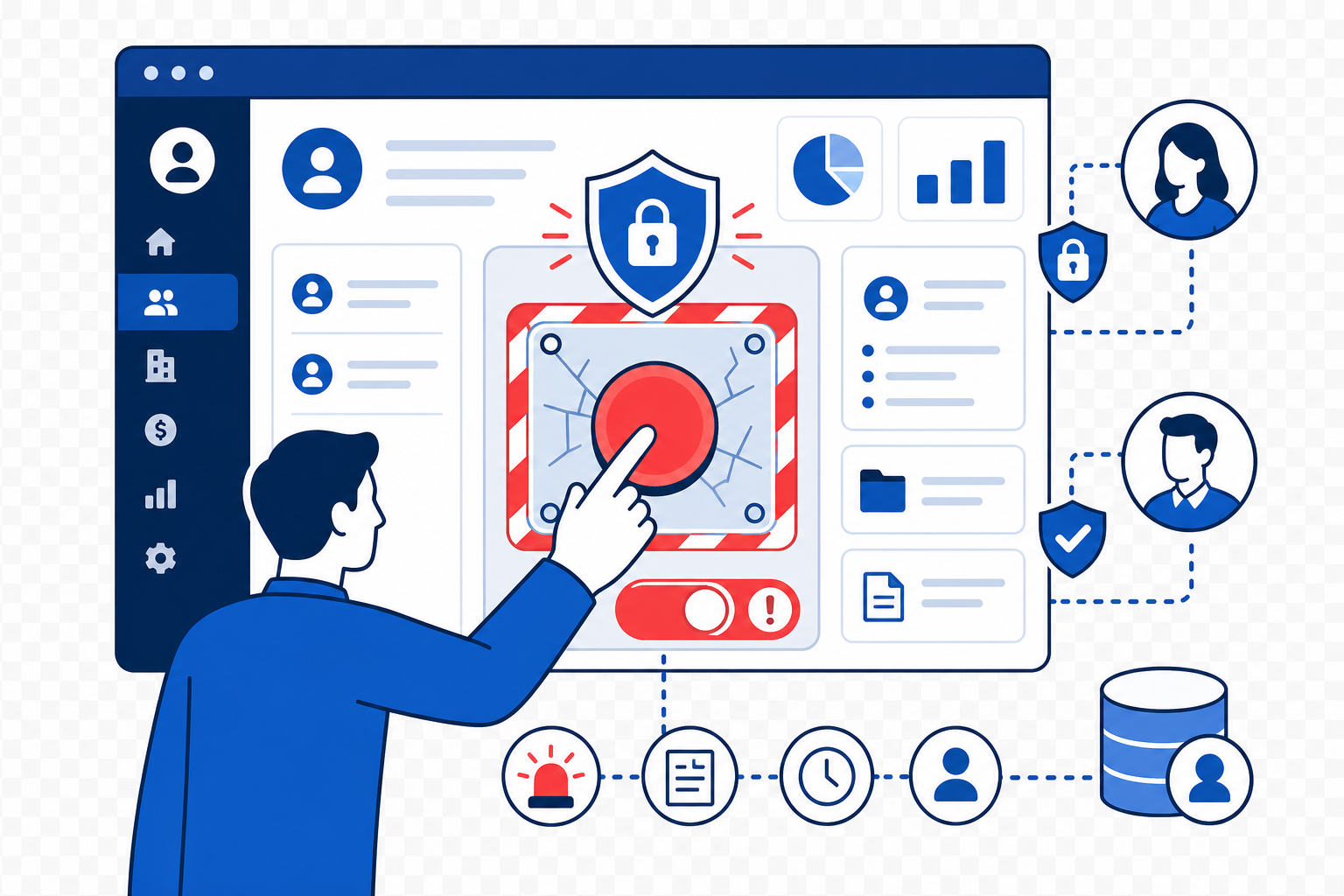
A break-glass override is a permission that allows a small, named set of users to bypass a specific CRM rule (a required field, a validation rule, a stage-gate) and advance a record anyway, with the bypass automatically logged and flagged for follow-up. The name comes from physical fire-alarm boxes and, more directly, from IT security's "break glass" emergency access accounts: credentials deliberately kept behind extra friction and heavy logging, meant for the rare moment when the normal access path has failed and someone still needs to act.
Applied to a CRM, the idea is the same shape: normal validation stays on for everyone, all the time. A tiny number of people hold a separate permission that lets them push a record through anyway, and the system makes that bypass impossible to miss later: not a quiet workaround, a recorded exception.
Why It Matters in 2026
Two trends are pushing more organizations toward formalizing this pattern rather than leaving it to informal admin workarounds.
First, CRM governance has gotten stricter. Required fields, mandatory approval steps, and stage-gating are standard practice now in both Salesforce and HubSpot deployments, often layered on by multiple teams (sales ops, finance, compliance) over time. Stricter rules are good for data quality, but they compound: a record can end up needing five different fields filled in before it can move, and the probability that at least one of those fields is genuinely unanswerable at the moment a deal needs to close goes up with every rule added.
Second, executives increasingly expect the CRM to move at the speed of the business, not the other way around. When a real prospect gives a same-day window and a required field is the only thing standing between "we responded" and "we missed it," "the system wouldn't let me" is not an acceptable answer to a CEO, and it shouldn't have to be. The organizations getting this right aren't removing the rule. They're building a narrow, audited exception path for the handful of people who need it.
How a Break-Glass Override Works
A well-built override has the same handful of components whether it lives in Salesforce or HubSpot:
- A dedicated permission, held by very few people. In Salesforce this is typically a permission set (not a change to the base profile) assigned to a handful of named executives or senior admins. In HubSpot it's a custom user role or property-level permission scoped the same way. The point is that granting the override is a deliberate, auditable act, not a side effect of a broader role.
- A defined trigger. The override should apply to specific fields or specific stage transitions, not "all validation, everywhere." Most implementations start with one or two rules that have actually caused a real problem, rather than pre-building a bypass for rules that have never been an issue.
- Automatic flagging, not a silent pass. Every time the override is used, the record should be automatically tagged (a status field, a flag property, a dashboard filter) so it shows up in reporting as "advanced via override" until someone closes the loop. This is the part teams skip when they build overrides informally, and it's the part that turns a reasonable safety valve into an audit finding.
- A backfill owner and deadline. Someone specific (often the person who invoked the override, or their manager) owns getting the missing data filled in within a set window (a week is common). The flagged-record report is the mechanism that makes sure this actually happens instead of becoming permanent technical debt.
- A review cadence. Whoever owns CRM governance reviews override usage on a regular cycle: monthly is typical. If the same field gets overridden constantly, that's a signal the rule itself needs to change, not that the override needs to be used more quietly.
Break-Glass Override vs. a Standard Approval Workflow
It's worth being precise about when each pattern applies, because they solve different problems and are frequently confused during CRM design conversations.
| Question | Standard approval workflow | Break-glass override |
|---|---|---|
| When does it apply? | Predictable, recurring situations: discounts above a threshold, contract terms outside standard language | Rare, time-sensitive situations a rule didn't anticipate |
| Who can use it? | Anyone whose request meets the criteria, routed to an approver | A small, named list of people, granted the permission directly |
| How fast is it? | Minutes to days, depending on approver availability | Immediate: that's the entire point |
| What happens after? | Approval is logged as part of the normal process; no follow-up data debt | Record is flagged until missing data is backfilled within a set window |
| What if it's used often? | Expected: it's a designed part of the process | A warning sign that the underlying rule or the sales/service process needs to change |
If a bypass request follows a predictable pattern (the same field, the same reason, every month) that's evidence you actually need an approval workflow or a rule change, not a break-glass permission. Reserve the override for situations that are genuinely rare by design.
What Businesses Should Do Next
Before building an override into Salesforce or HubSpot, walk through these steps:
- Find the actual friction point. Pull a list of records that have been stuck, delayed, or manually pushed through in the last six months. Build the override around real cases, not hypothetical ones.
- Name the holders explicitly. Write down who gets the permission by title, not by department. Revisit the list at least annually. Permission creep on override access is exactly the kind of thing an audit will flag.
- Design the flag before the permission. Decide how an overridden record will be visible in a report or dashboard before you turn the permission on. If you can't answer "how would we know this happened?" in one sentence, the override isn't ready.
- Set the backfill window and put someone's name on it. A flag with no owner and no deadline becomes permanent noise in your data within a quarter.
- Put a review date on the calendar. Even a light quarterly check (how many times was this used, was every one backfilled, does the rule still make sense) keeps the safety valve from becoming a habit.
For a deeper look at how audit trails and access logging work in practice, see our related piece on Salesforce data security, audit trails, and compliance best practices.
How Vantage Point Helps
Vantage Point builds governance that bends without breaking. Through our compliance and security solutions and platform implementation work on both Salesforce and HubSpot, our senior consultants design the permission sets, flagging automation, and reporting that make a break-glass override a controlled safety valve instead of an audit gap. We also help teams decide when a recurring exception request is actually a sign the underlying rule needs to change. Senior consultants only. No junior handoffs; the experts you meet are the experts who deliver.
Ready to Build a Safer Exception Path?
If your team has ever manually pushed a record past a required field because the alternative was losing the deal, it's time to replace that habit with a designed, audited override. Contact Vantage Point to scope a governance review, or explore our compliance and security solutions to see how we help teams balance control and flexibility.
Frequently Asked Questions
What is a break-glass override in a CRM?
A break-glass override is a permission that lets a small, named group of users bypass a required field, validation rule, or stage-gate in a genuine emergency, with the bypass automatically logged and flagged for follow-up. It's designed to be a rare, visible exception rather than a routine workaround.
Who should be allowed to use a break-glass override?
Keep the list as small as possible. Typically a handful of senior executives or admins whose judgment on "this really can't wait" is trusted. The permission should be granted explicitly and reviewed at least annually, not bundled into a broader role.
Does a break-glass override weaken data quality?
Not if it's built correctly. The override should trigger automatic flagging so every bypassed record is visible in reporting until the missing data is backfilled within a set window. A silent bypass weakens data quality; a flagged, time-boxed one protects it while still unblocking the business.
How is a break-glass override different from a standard approval workflow?
An approval workflow handles predictable, recurring exceptions, like discount thresholds, by routing a request to an approver, which can take minutes or days. A break-glass override is for rare, time-sensitive situations where waiting for approval isn't an option, and it's granted directly to a small list of people rather than routed case by case.
What should happen after someone uses an override?
The record should be automatically flagged, a specific person should own backfilling the missing data within an agreed window (commonly a week), and the flagged-records report should be checked until the record is cleared. Without an owner and a deadline, overridden records tend to stay incomplete indefinitely.
How often should override usage be reviewed?
A monthly or quarterly review is typical. The review should check that every override was backfilled on time and look for patterns. If the same field is overridden repeatedly, that's usually a sign the validation rule or the underlying process needs to change, not that the team needs to use the override more.
Can this be built in both Salesforce and HubSpot?
Yes. In Salesforce it's typically implemented with a dedicated permission set layered over validation rules. In HubSpot it's built with custom user roles or property-level permissions combined with workflow-based flagging. The governance principles (narrow access, automatic flagging, a backfill owner, and periodic review) are the same on either platform.
Vantage Point is a boutique CRM consulting firm helping businesses transform with Salesforce, HubSpot, and AI. Learn more at vantagepoint.io.