
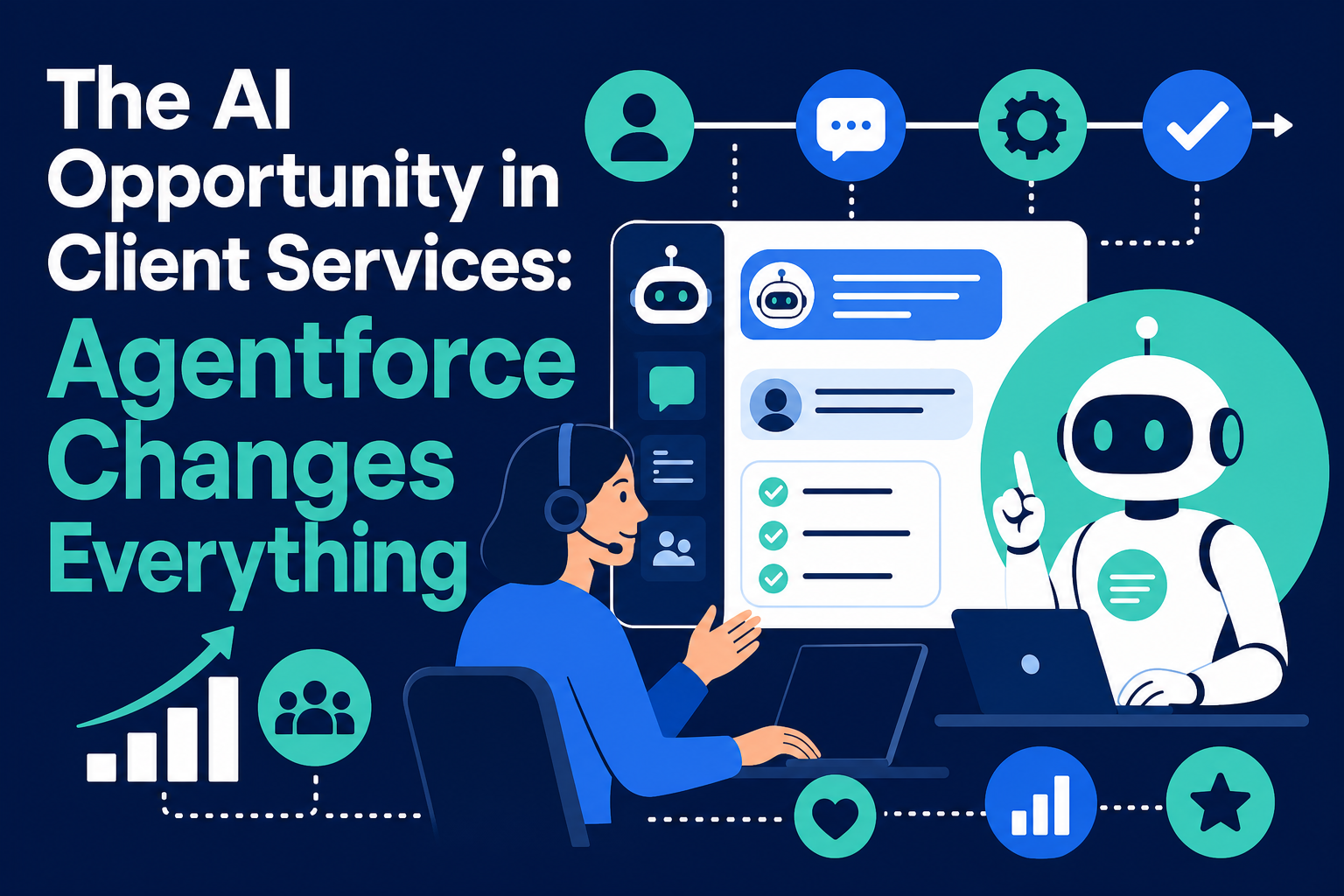
Client service is moving beyond the choice between a person and a portal. The emerging model combines AI agents with the judgment, empathy, and accountability of a skilled service team. It makes human attention more available when it matters.
Quick Answer
Agentic client service uses AI agents to understand a request in context, retrieve trusted information, carry out approved actions, and escalate to a person when judgment or empathy is required. It matters to organizations facing rising interaction volume, fragmented service data, and expectations for immediate, personalized help. The right starting point is one tightly scoped workflow with clear data, actions, guardrails, and human handoff. Vantage Point helps teams connect Agentforce to their CRM, integration, governance, and adoption plans.
Key Takeaways (TL;DR)
- What is it? Agentic client service pairs AI agents with CRM data, approved workflows, and human service professionals to resolve work across digital channels.
- Why it matters: Agentforce can help turn repeatable requests into guided, context-aware resolutions instead of another queue for people to manage.
- The real requirement: Reliable service agents need current knowledge, usable CRM data, clear permissions, integration design, and escalation rules: not just a conversational interface.
- The human role: AI handles routine retrieval, triage, and follow-through while people take responsibility for exceptions, sensitive conversations, and nuanced decisions.
- Best first step: Start with one high-volume, well-defined service journey and improve resolution and handoff quality before expanding.
Client Service Has Evolved From Queues to Connected Conversations
Client service moved from phone queues and email, where representatives located information across systems, to portals, messaging, and self-service knowledge. Those channels created more ways to ask for help, but an issue could still reach a person without enough context.
The emerging stage is agentic service. An AI agent can take a conversational request, connect it to approved knowledge and business data, perform a defined action, and preserve the interaction record. Salesforce describes AI customer service agents as systems that can understand questions, retrieve information, and take specified actions. Its AI customer service agent overview also emphasizes a full-context handoff when a human should take over.
A conventional chatbot is usually a scripted front door. An agentic service model is designed to participate in the service process: identify intent, use a trusted source of context, complete an approved step, and recognize when the situation is outside its authority.
Why Traditional Client Service Models Are Breaking
A simple service question may require CRM, operational, policy, and case data. When these pieces are disconnected, people assemble the story before they can solve the problem.
| Pressure on the service model | What breaks | What an agentic approach can change |
|---|---|---|
| Growing interaction volume | Routine questions compete with urgent work in the same queue. | An agent can handle approved, repeatable requests around the clock. |
| More complex services | Representatives search across policies, history, and systems. | Context can be assembled from CRM, knowledge, and connected systems. |
| Higher expectations | Clients expect continuity across web, messaging, email, and phone. | Intent, history, and next steps can persist across the service journey. |
| Fragmented data | A representative becomes the manual integration layer. | Defined actions can retrieve or update information through governed workflows. |
The goal is not to automate every conversation. It is to stop asking skilled people to repeatedly locate the same information, route the same requests, or re-key the same updates. Their attention is better used for judgment, relationship knowledge, negotiation, and care.
What Does Agentic Client Service Actually Mean?
Agentic client service is a model in which an AI agent understands a goal, uses authorized context, takes bounded action, and collaborates with a human when needed. It means a defined role inside a controlled process.
A useful service agent has four parts:
- Context. The agent needs the right account, interaction, entitlement, order, asset, or case information, plus current knowledge and connected-system data where appropriate. Without dependable context, fluent answers can still be wrong.
- Reasoning within a purpose. It must distinguish work it is expected to handle from work it should route elsewhere. That requires topics, instructions, and business rules: not a vague instruction to “help the client.”
- Approved actions. Service often requires more than an answer. The agent may check status, update a case, create a request, schedule an appointment, or initiate a workflow. Each action needs permissions, validation, and a fallback.
- Escalation with continuity. A useful handoff sends the person the issue, relevant context, attempted steps, and the reason for transfer. Salesforce’s Agentic Patterns and Implementation with Agentforce guide describes this use of topics, actions, guardrails, CRM and knowledge context, and human routing.
This is why an agentic program is a service design project, not only an AI project. The process, data model, integrations, knowledge, permissions, and human workflows must agree on what “resolved” means.
From Reactive Cases to Proactive Service
Reactive service begins after someone reports a problem. Agentic service can act when a meaningful signal appears: a delayed order, missed milestone, expiring document, service interruption, or stalled onboarding step.
A sound pattern is straightforward:
- Detect a meaningful signal from CRM, a service platform, an integration, or trusted operational data.
- Validate context and policy before taking client-facing action.
- Choose a bounded response, such as sharing a status update, offering a scheduling option, opening a case, or alerting an accountable person.
- Invite a human in when the decision is sensitive, context is incomplete, or the client needs a person.
- Capture the outcome so the process and knowledge base improve.
Proactive service must respect preference, consent, communication rules, and the seriousness of the situation. Salesforce’s proactive customer service guidance frames the goal as anticipating and addressing needs before a customer has to ask. The value comes from relevance and timing, not more messages.
How Agentforce Enables the Transformation
Agentforce gives Salesforce teams a platform for building and governing AI agents with CRM context and defined actions. It can be configured around service topics, instructions, knowledge, workflows, and handoff paths.
A practical Agentforce service design brings together five layers:
- Experience: where a client or employee engages, such as a website, portal, messaging channel, or service workspace.
- CRM and knowledge: account history, cases, entitlements, service records, and trusted guidance that explain the situation.
- Actions: Flows, APIs, and integration services that let the agent complete approved work instead of only describing it.
- Guardrails: access controls, validation, escalation criteria, auditability, and policies that constrain the agent’s authority.
- Human service: routing, specialists, and managers who own exceptions and complex moments.
Salesforce positions Agentforce as an AI agent platform for extending autonomous support across web, phone, and applications. Teams must decide which data is authoritative, which actions are safe, what a human must approve, and how outcomes will be reviewed.
Many service journeys also depend on billing, ERP, scheduling, commerce, communications, or product systems. A governed integration layer is what lets an agent resolve work rather than tell a client where to go next. Explore Vantage Point’s system integration and data migration services when a service journey crosses multiple systems.
Four Cross-Industry Examples of Agentic Client Service
These are illustrative patterns, not claims about a specific client or deployment.
| Context | A bounded agentic use case | Where people remain essential |
|---|---|---|
| Financial services | Confirm service-request status, collect required information, explain the next approved step, and flag a time-sensitive exception. | Personalized advice, exception approval, risk decisions, and relationship conversations. |
| Healthcare | Help an individual find appointment information, complete routine intake, or route an administrative question to the correct care team. | Clinical judgment, sensitive care discussions, and decisions outside an approved administrative workflow. |
| Retail | Check an order, explain an approved return path, update a delivery preference, or identify a fulfillment exception. | Complaint recovery, complex exceptions, and discretionary decisions. |
| Manufacturing | Share asset or order status, help open a service request, collect diagnostic details, or alert a specialist to a potential disruption. | Root-cause analysis, safety decisions, engineering judgment, and strategic account support. |
The shared pattern is not the industry. It is a repeatable request, trusted context, an approved action, and a clear escalation threshold.
The Human: AI Partnership Is the Point
Agentic service should improve the work of people as well as the experience of the person seeking help. A strong design assigns work based on accountability, not novelty.
| AI agents are well suited to | People should own |
|---|---|
| Finding verified information, summarizing context, identifying intent, following defined workflows, and capturing routine updates. | Complex diagnosis, emotional or sensitive conversations, exception decisions, negotiation, accountability, and relationship repair. |
| Offering consistent steps and moving work through a queue with useful metadata. | Deciding when policy needs interpretation, when an outcome is fair, and when a client needs a trusted human advocate. |
Service professionals need to know what the agent can do, how to correct it, and when to take over. Leaders need visibility into resolution quality, failed actions, escalations, and feedback: not only interaction volume.
Governance is equally important. Permissions should follow least privilege; knowledge needs an owner; and escalation criteria should be explicit. Vantage Point can help teams connect Agentforce initiatives with practical compliance and security solutions rather than treat governance as a late-stage checklist.
Getting Started With Agentic Client Service
Start with a focused service journey, not a broad AI promise. Use these eight steps:
- Choose one repeatable journey. Look for clear intent, stable policy, reliable data, and a bounded action. Status questions, intake, appointment changes, and case triage are common examples.
- Map the current path. Identify every handoff, data lookup, channel change, and point where a person reconstructs context. This reveals the work an agent must support.
- Define success and escalation. Decide what a correct resolution means, what the agent may do, and exactly when it must ask, transfer, or stop.
- Prepare data and knowledge. Confirm ownership, remove obsolete guidance, clarify workflows, and connect the systems needed for a complete resolution. Do not use an agent to conceal broken CRM fundamentals.
- Build a small action set. Start with safe, testable actions. Each needs validation, meaningful error handling, and traceability.
- Design the human handoff. Give the recipient a conversation summary, source context, actions taken, and the reason for escalation. Test it with the people who will receive the work.
- Pilot and improve. Review unresolved requests, escalations, and unexpected behavior. Improve instructions, knowledge, data, and workflows before increasing scope.
- Plan adoption deliberately. Communicate how responsibilities change, train service teams, and invite them to identify the next high-value use case.
A sound program uses technology to support a clear service strategy, not to create another disconnected channel. Vantage Point’s Salesforce implementation and advisory services, AI-driven personalization and analytics services, and advisory and change management support can help turn a promising use case into an operating model teams can trust.
How Vantage Point Helps
Vantage Point is a boutique, senior-led Salesforce and HubSpot consulting partner. We help organizations assess AI readiness, improve CRM and service data, design workflows and integrations, establish governance, and prepare teams for adoption. The goal is a practical Agentforce roadmap that strengthens service delivery without losing human accountability.
Talk to Vantage Point about Agentforce
Frequently Asked Questions
What is agentic client service?
Agentic client service uses AI agents to understand a request, retrieve authorized context, take approved actions, and involve a person when judgment is needed. It goes beyond a scripted chatbot because the agent participates in a defined service workflow rather than only presenting answers.
How is Agentforce different from a traditional chatbot?
Agentforce can be configured to work with Salesforce data, trusted knowledge, workflows, and defined actions. A traditional chatbot commonly follows a fixed decision tree or directs people to content, while an agentic approach can perform approved work and preserve context for a human handoff.
Which client service workflows should use an AI agent first?
Start with a high-volume, repeatable workflow that has clear policy, reliable data, and a safe action path. Good candidates include status questions, routine intake, appointment changes, basic case triage, and knowledge-guided self-service. Avoid using the first pilot for high-stakes decisions or poorly documented processes.
Will AI agents replace human service professionals?
AI agents should not replace human service professionals. They can handle routine retrieval, triage, and follow-through so people focus on sensitive conversations, complex diagnosis, exceptions, and relationships. The service organization still needs humans to own outcomes and improve the process.
What data does Agentforce need for client service?
Agentforce needs accurate, authorized context for the job it performs, such as account history, cases, products, orders, entitlements, and approved knowledge. It may also need governed integrations to operational systems. Data quality, access controls, and source ownership should be resolved before the agent is given broad authority.
How should teams govern an Agentforce service agent?
Teams should define the agent’s scope, instructions, permitted actions, escalation rules, data access, logging, and review process before launch. They should test normal, ambiguous, and failure scenarios, then monitor resolution quality and handoffs. Vantage Point can help align this work with CRM governance, integration design, and change management.