
Key Takeaways (TL;DR)
- What is it? Five proven Salesforce Agentforce use cases that deliver measurable ROI within the first 90 days of deployment
- Key Benefit: Accelerate time-to-value by focusing on high-volume, low-complexity automations with quantifiable cost savings and revenue impact
- Cost: Agentforce starts at $2/conversation or $0.10/action via Flex Credits — implementation costs range from $25K–$185K depending on scope
- Timeline: Initial agents can be deployed in as little as 2–6 weeks with the right partner; meaningful ROI typically appears within 60–90 days
- Best For: Organizations already on Salesforce looking to automate service, sales, and operations workflows without massive upfront investment
- Bottom Line: Businesses report 62% case deflection, 73% improvement in lead conversion, and $1M+ in annualized savings — with payback periods under 6 months when use cases are properly scoped and implemented
Introduction: Why 90-Day ROI Matters for Agentforce Adoption
Every CRM leader knows the frustration: you invest six figures in a new platform, only to wait 12–18 months before anyone can prove it was worth it. With Salesforce Agentforce, that timeline is shrinking — dramatically.
Agentforce, Salesforce's agentic AI platform, enables organizations to deploy autonomous AI agents that reason, plan, and execute tasks across Sales Cloud, Service Cloud, and beyond. With over 18,000 companies now using Agentforce across 121 countries and 771 million Agentic Work Units completed in Q4 2025 alone, the technology is no longer experimental — it's production-ready.
But here's the challenge: not every use case delivers equal value. Some require months of data preparation, complex integrations, and extensive prompt engineering. Others generate immediate, measurable returns.
In this guide, we'll walk through five Agentforce use cases specifically selected because they deliver payback in 90 days or less. Whether you're building your initial business case or prioritizing your second wave of agents, these are the quick wins that fund your broader AI transformation.
At Vantage Point, we specialize in helping organizations identify, scope, and implement Agentforce use cases that generate the fastest possible time-to-value — backed by our deep Salesforce partnership and hands-on implementation experience.
Use Case 1: Customer Service Case Deflection
What Is Agentforce Service Agent Case Deflection?
The Agentforce Service Agent handles tier-1 and tier-2 support cases autonomously — answering FAQs, processing password resets, providing order status updates, and resolving common issues 24/7 without human intervention. Unlike traditional chatbots that follow rigid scripts, the Service Agent uses Salesforce's Atlas Reasoning Engine to understand context, retrieve relevant knowledge articles, and take action within defined guardrails.
Why It Pays for Itself in 90 Days
Customer service is the ideal starting point for Agentforce because it combines high volume with clear decision criteria — the two prerequisites for fast ROI. Real-world deployments consistently show:
- 62% case deflection rates within the first 90 days
- 39% reduction in average handle time for escalated cases
- 13% improvement in CSAT scores from faster, more consistent responses
Financial impact example: A mid-market SaaS company with 8,200 support cases per month reduced human-handled cases to 3,116 per month after deploying the Agentforce Service Agent. This eliminated the need for 24 support FTEs (through natural attrition), saving $1.44M annually in labor costs against $280K in licensing and $185K in implementation — producing a net Year 1 ROI of $975,000 with a 6-month payback period.
Salesforce itself runs on Agentforce for its own support, handling approximately 32,000 customer conversations per week with an 83% autonomous resolution rate and only 1% of customers needing to speak with a human.
How to Implement It
- Audit your top 20 case categories — identify which represent 60–80% of total volume
- Ensure knowledge base completeness — the agent is only as good as the content it can reference
- Define escalation rules — set clear human-in-the-loop triggers for complex or sensitive issues
- Deploy on your highest-traffic channel first — web chat typically delivers fastest results
- Iterate weekly — review transcripts and refine prompts to improve deflection rates over time
How Vantage Point Helps
Vantage Point conducts a rapid case analysis to identify your highest-deflection-potential categories, configures the Service Agent with optimized prompts and escalation logic, and provides ongoing optimization support to push deflection rates from initial benchmarks (typically 35–45%) toward the 60–70% range within 90 days.
Use Case 2: Inbound Lead Qualification and Speed-to-Lead
What Is Agentforce SDR Agent Lead Qualification?
The Agentforce SDR Agent engages inbound leads instantly — within seconds of form submission or website interaction — qualifying them against your ideal customer profile, answering product questions, and scheduling meetings with sales reps. It works around the clock, ensuring no lead waits until the next business day for a response.
Why It Pays for Itself in 90 Days
Speed-to-lead is the single highest-leverage metric in B2B sales. Research consistently shows that responding to a lead within 5 minutes makes you 21x more likely to qualify that lead compared to waiting 30 minutes. Most organizations average 4+ hours.
Real-world Agentforce SDR deployments show:
- Lead response time drops from 4 hours to under 60 seconds — a 99% reduction
- MQL-to-SQL conversion improves by 73% (from 22% to 38% in documented cases)
- Monthly pipeline generation increases by 76% — from $2.1M to $3.7M
- Sales deal cycles shorten by 24% — from 67 days to 51 days
- Rep time spent on qualification calls drops by 82% — freeing hours for high-value selling
Financial impact example: A B2B services firm with 340 MQLs per month generated an additional $19.2M in annualized pipeline after deploying Agentforce SDR. At an 18% close rate and 35% gross margin, that translates to $1.21M in gross profit contribution against $310K in Year 1 costs — a 290% ROI.
How to Implement It
- Map your qualification criteria — BANT, MEDDIC, or a custom framework the agent can evaluate
- Integrate with your calendar — ensure the agent can book directly on reps' calendars
- Create conversation branches — different paths for enterprise vs. SMB, different product lines, etc.
- Set scoring thresholds — define when a lead is qualified, when it needs nurturing, and when it should be disqualified
- Monitor and tune — review weekly conversion metrics and adjust scoring and messaging
How Vantage Point Helps
Vantage Point designs your qualification framework within Agentforce, builds the SDR Agent with persona-specific conversation flows, integrates it with your existing Sales Cloud workflows, and helps you establish the feedback loops between marketing, sales, and the AI agent that continuously improve conversion rates.
Use Case 3: Sales Pipeline Hygiene and Deal Acceleration
What Is Agentforce Pipeline Management?
Agentforce agents can autonomously monitor your sales pipeline — identifying stalled opportunities, flagging deals with missing next steps, updating opportunity stages based on activity data, and proactively alerting managers when deals are at risk. Think of it as a tireless RevOps analyst working around the clock inside your CRM.
Why It Pays for Itself in 90 Days
Pipeline hygiene is a universal pain point. Sales reps spend an estimated 5–8 hours per week on CRM data entry and pipeline administration — time that produces zero revenue. Meanwhile, inaccurate pipeline data leads to bad forecasts, missed deals, and wasted resources.
Documented results from pipeline-focused Agentforce implementations include:
- 40% reduction in manual CRM data entry time through automated activity logging and field updates
- 8+ hours recovered per consultant/rep per month in billable or selling time
- 71% reduction in status inquiry tickets — managers and executives get real-time dashboards instead of asking reps for updates
- Improved forecast accuracy — clean, real-time data replaces stale, manually entered information
Financial impact example: A professional services firm with 72 consultants recovered 8.3 billable hours per consultant per month after deploying Agentforce for pipeline management and status automation. At a $185/hour blended rate, that's $1.1M in annualized recovered revenue — from time that was previously spent on administrative tasks and status calls.
How to Implement It
- Identify your pipeline hygiene rules — what defines a stalled deal? What fields must be populated at each stage?
- Configure Einstein Activity Capture — ensure emails, calls, and meetings are automatically logged
- Build alert workflows — trigger notifications when opportunities miss stage duration thresholds or lack next steps
- Create manager dashboards — provide real-time pipeline health views that eliminate status meetings
- Establish data quality baselines — measure field completion rates before and after deployment
How Vantage Point Helps
Vantage Point conducts a pipeline health audit, designs custom Agentforce workflows aligned to your sales methodology, and integrates pipeline intelligence with your forecasting processes. We focus on the intersection of Data Cloud and Sales Cloud to ensure your agents have the clean, unified data they need to operate accurately.
Use Case 4: Customer Onboarding Automation
What Is Agentforce Onboarding Automation?
An Agentforce-powered onboarding agent guides new customers through setup, configuration, and activation workflows — from welcome communications and document collection to training scheduling and milestone tracking. The agent proactively reaches out at each stage, answers questions, and escalates to your customer success team only when needed.
Why It Pays for Itself in 90 Days
Poor onboarding is the #1 predictor of early churn. Organizations that streamline onboarding see significantly higher customer lifetime value, faster time-to-value, and reduced support burden during the critical first 90 days.
Key metrics from Agentforce onboarding deployments include:
- Client intake processing reduced from 3 days to 4 hours — an 87% improvement
- First 30-day engagement rates increase 25–40% when onboarding is proactive rather than reactive
- Support ticket volume from new customers drops 30–50% when the agent handles common setup questions
- Time-to-first-value accelerates by 40–60% — customers reach their "aha moment" faster
Financial impact example: Consider an organization onboarding 50 new customers per month with an average contract value of $24K/year. If automated onboarding reduces 90-day churn from 8% to 3%, that's 30 additional retained customers per year — worth $720K in preserved annual recurring revenue. Against implementation costs of $50K–$80K, the ROI is extraordinary.
How to Implement It
- Map your onboarding journey — identify every touchpoint from contract signature to go-live
- Define milestone triggers — automate check-ins at days 1, 7, 14, 30, 60, and 90
- Build a knowledge base — compile setup guides, FAQs, and video tutorials the agent can reference
- Integrate with your CS tools — connect to your customer success platform for health scoring
- Create escalation paths — define when the agent should loop in a human CSM
How Vantage Point Helps
Vantage Point designs end-to-end onboarding journeys within Salesforce, configures Agentforce agents to handle each stage proactively, integrates with Experience Cloud for self-service portals, and helps you build the health scoring models that identify at-risk accounts before they churn.
Use Case 5: Cross-Cloud Workflow Orchestration
What Is Agentforce Cross-Cloud Orchestration?
One of Agentforce's most powerful — and underutilized — capabilities is orchestrating workflows that span multiple Salesforce clouds. A single agent can trigger actions in Sales Cloud, Service Cloud, Marketing Cloud, and Commerce Cloud simultaneously, eliminating the handoff delays and data silos that plague multi-department processes.
Why It Pays for Itself in 90 Days
Manual handoffs between departments are expensive. Every time a deal closes in Sales Cloud and someone has to manually create a case in Service Cloud, update a marketing journey, and notify operations, you're spending 30–60 minutes of human time and introducing error risk. Multiply that by hundreds of transactions per month and the cost is staggering.
Real-world cross-cloud orchestration results include:
- Closed-deal-to-onboarding handoff reduced from 2–3 days to under 2 hours — automatic case creation, entitlement setup, and welcome journey triggering
- Marketing-to-sales handoff errors reduced by 85% — the agent ensures proper lead attribution, campaign association, and routing
- Internal operations requests resolved 60% faster — HR, IT, and finance workflows automated with the same agent framework
- Employee admin time reduced by 15+ hours per month across sales, service, and operations teams
Financial impact example: An organization processing 200 deal closings per month, each requiring 45 minutes of manual cross-department coordination, spends approximately 150 hours/month on handoffs. At a blended cost of $75/hour, that's $135K/year in administrative overhead. Agentforce orchestration eliminates 80% of this — saving $108K annually with a payback period of 8–10 weeks.
How to Implement It
- Map your cross-cloud workflows — identify every process that touches more than one Salesforce cloud
- Prioritize by volume and pain — start with your highest-volume, most error-prone handoff
- Design the orchestration flow — define triggers, actions, and validation steps in each cloud
- Implement guardrails — ensure the agent can't create downstream data issues
- Monitor end-to-end completion — track time-to-completion and error rates across the full workflow
How Vantage Point Helps
As a multi-cloud Salesforce partner, Vantage Point specializes in the architecture that connects Sales Cloud, Service Cloud, Experience Cloud, Marketing Cloud, and Data Cloud into a unified platform. We design cross-cloud Agentforce agents that eliminate departmental silos and ensure seamless data flow — so your teams operate as one.
Best Practices: How to Maximize Agentforce ROI in the First 90 Days
1. Start With High-Volume, Low-Complexity Use Cases
The fastest path to ROI is automating processes that happen hundreds or thousands of times per month with clear, repeatable decision logic. Save the complex, ambiguous use cases for phase two.
2. Invest in Data Quality First
Agentforce agents are only as good as the data they work with. Before deploying any agent, ensure at least 85% field completion on the objects the agent will reference. A data quality sprint of 2–3 weeks can make the difference between 35% and 65% deflection rates.
3. Define Clear Human-in-the-Loop Guardrails
Every agent needs escalation rules. Define exactly when the agent should hand off to a human — and make sure those handoffs are smooth. This builds trust with both customers and your internal teams.
4. Measure Outcomes Continuously
Set up dashboards from day one that track your core KPIs: deflection rate, response time, conversion rate, time saved, and cost per interaction. Review weekly and optimize monthly.
5. Treat Agent Optimization as an Ongoing Program
The best-performing Agentforce deployments treat agent management as continuous, not a one-time project. Weekly transcript reviews, monthly prompt refinements, and quarterly use case expansions compound ROI over time — pushing deflection from 40% at launch to 65%+ after 12 months.
6. Choose the Right Implementation Partner
Agentforce is powerful, but realizing its full potential requires expertise in Salesforce architecture, data strategy, AI prompt engineering, and change management. A certified partner like Vantage Point accelerates your time-to-value and ensures your agents are built on solid foundations.
Agentforce Pricing: What to Budget
Understanding Agentforce costs is critical for building your business case. As of 2026, Salesforce offers several pricing models:
| Pricing Model | Cost | Best For |
|---|---|---|
| Per-Conversation | $2 per conversation | Customer-facing service agents with moderate volume |
| Flex Credits | $0.10 per action (20 credits per action) | High-volume, multi-action workflows |
| Per-User Add-ons | $125–$150/user/month | Internal employee-facing agents (unmetered) |
Important cost considerations:
- Data Cloud subscription may be required for advanced use cases ($150+/user/month)
- Implementation services typically range from $25K–$185K depending on scope and complexity
- Budget for ongoing optimization — typically 10–15% of initial implementation cost annually
Pro tip: Use a three-scenario financial model (conservative/base/optimistic) when presenting to leadership. Lead with payback period — if it's under 12 months, the conversation shifts from "should we do this?" to "how fast can we start?"
FAQ: Agentforce Use Cases and ROI
How quickly can Agentforce be deployed?
Initial agents can be live in as little as 2–6 weeks with the right partner. Companies like Engine deployed their customer-facing AI agent in just 12 days, while Safari365 went live in six weeks. More complex enterprise deployments typically take 8–12 weeks for the first agent.
What kind of ROI can we expect from Agentforce in 90 days?
Results vary by use case, but documented benchmarks include 62% case deflection, 73% improvement in lead conversion rates, 40% reduction in manual CRM data entry, and payback periods as short as 6 months. The key is starting with high-volume, well-defined processes.
Does Agentforce require Data Cloud?
Not all use cases require Data Cloud. Basic service deflection and lead qualification agents can operate with standard Sales Cloud and Service Cloud data. However, advanced cross-cloud orchestration, personalization, and analytics-driven agents benefit significantly from Data Cloud integration.
What if our CRM data quality is poor?
Data quality is the single biggest predictor of Agentforce success. If your field completion rates are below 70%, we recommend a 2–4 week data quality sprint before deploying agents. Vantage Point offers Data Cloud implementation and data hygiene services to prepare your org for AI readiness.
Can Agentforce work alongside our existing automation (Flows, Apex)?
Yes. Agentforce agents execute actions through Salesforce Flows, Apex code, and APIs. They complement your existing automation investments rather than replacing them. In fact, organizations with mature automation foundations typically see faster Agentforce deployment and higher ROI.
How does Agentforce differ from traditional chatbots?
Traditional chatbots follow rigid, rule-based scripts. Agentforce agents use the Atlas Reasoning Engine to understand context, make decisions, and take actions autonomously — within defined guardrails. They can access CRM data in real time, update records, trigger workflows, and seamlessly escalate to humans when needed.
What industries benefit most from Agentforce?
Agentforce delivers value across all industries. Any organization with high-volume customer interactions, repetitive internal processes, or complex multi-department workflows can benefit. The key is identifying use cases with clear decision criteria and measurable outcomes.
Conclusion: Start With Quick Wins, Scale With Confidence
Agentforce isn't a science project — it's a business investment. And like any smart investment, the goal is to generate returns as quickly as possible while building a foundation for long-term growth.
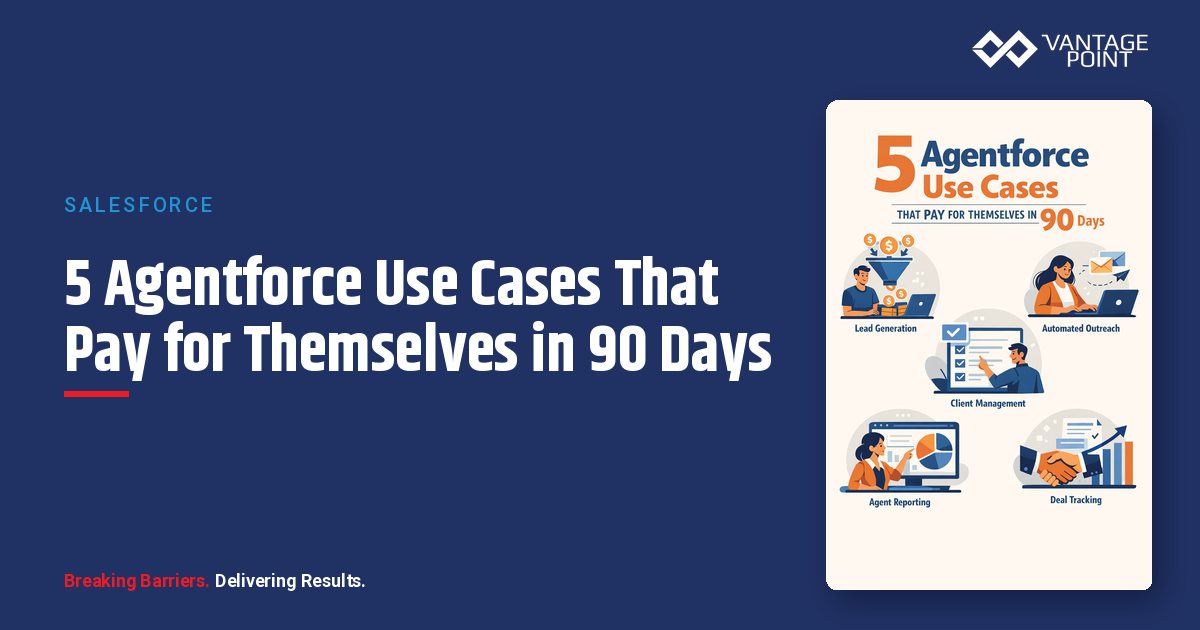
The five use cases outlined in this guide — service deflection, lead qualification, pipeline hygiene, onboarding automation, and cross-cloud orchestration — represent the lowest-risk, highest-return starting points for any Agentforce deployment. Each can pay for itself within 90 days when properly scoped and implemented.
But speed-to-value depends on execution. The difference between a 35% deflection rate and a 65% deflection rate isn't the technology — it's the implementation strategy, data preparation, and ongoing optimization.
Ready to identify your highest-ROI Agentforce use case? Contact Vantage Point for a complimentary Agentforce readiness assessment. We'll analyze your Salesforce environment, identify the use cases with the fastest payback, and build a phased roadmap that turns AI potential into measurable business results.
About Vantage Point
Vantage Point is a Salesforce, HubSpot, and AI implementation partner that helps organizations unlock the full potential of their CRM and automation investments. With deep expertise in Sales Cloud, Service Cloud, Experience Cloud, Data Cloud, MuleSoft integration, and Agentforce AI, we deliver solutions that drive measurable business outcomes across every industry. Our partnerships with Salesforce, HubSpot, Anthropic (Claude AI), Aircall, and Workato enable us to build connected, intelligent business platforms that scale with your growth. Learn more at vantagepoint.io.