Agentforce ITSM Series: Part 5 of 5
This final article turns the series into an actionable deployment plan. The earlier posts cover the opportunity, capabilities, employee support design, and the agentic CMDB foundation.
Quick Answer
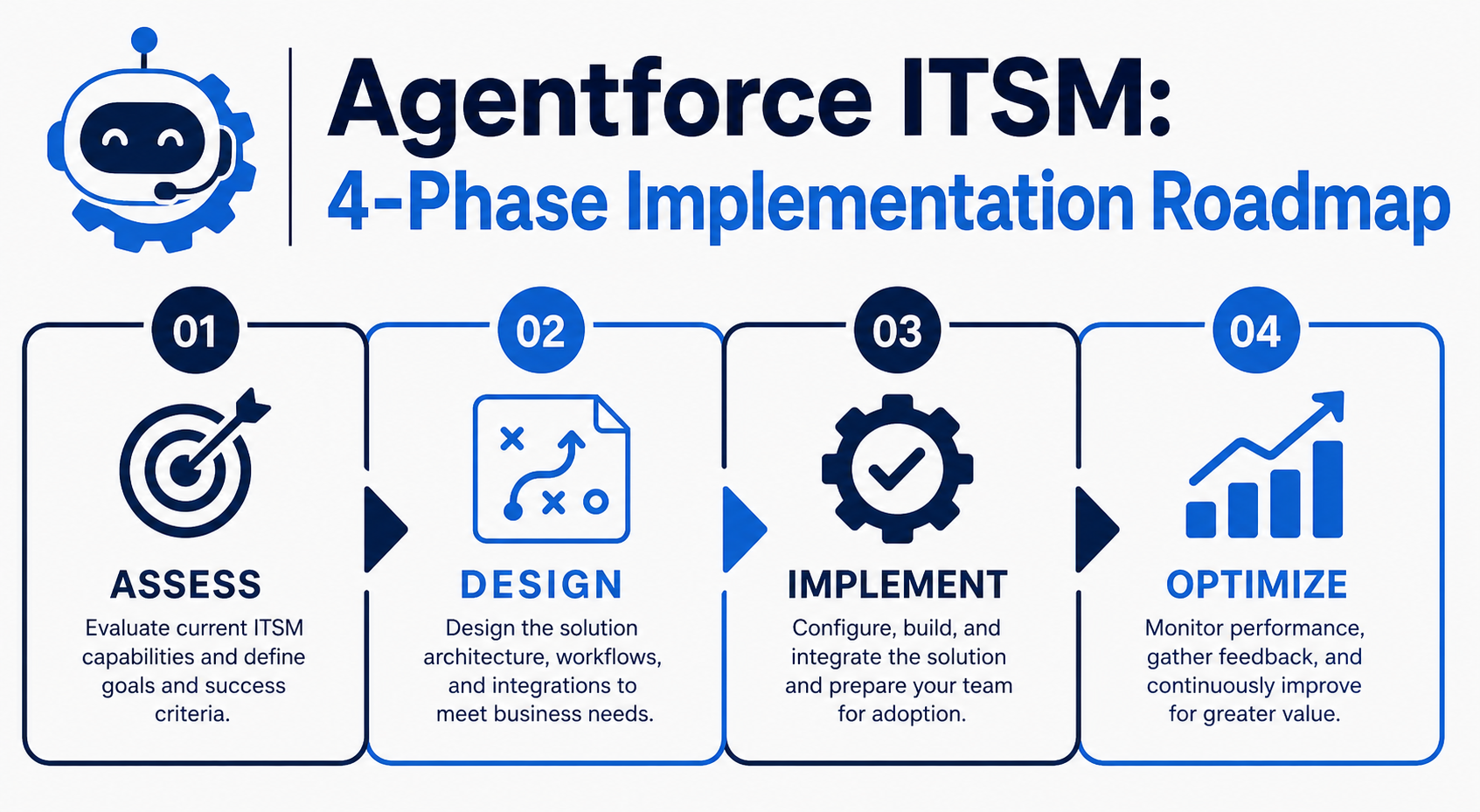
Deploy Agentforce ITSM in four phases: align service goals and stakeholders; establish trusted data, CMDB, integration, and knowledge foundations; pilot a tightly bounded agent journey; then scale only after evidence shows the experience is safe, useful, and supportable. A representative first release often takes roughly 10-16 weeks, depending on data readiness, integrations, governance decisions, and team availability. The goal is not to automate every ticket; it is to improve important service journeys with clear human ownership and a repeatable improvement cycle.
Key Takeaways (TL;DR)
- What is it? A four-phase roadmap for moving Agentforce ITSM from an idea to a governed, adopted service operation.
- Key benefit: It sequences process, data, AI, and adoption work instead of treating an agent as a standalone feature.
- Timeline: Allow about 2-3 weeks for discovery, 4-6 weeks for the foundation, 3-5 weeks for a pilot, and an ongoing optimization cadence.
- Best first use cases: High-volume, low-variance employee requests with current knowledge, well-defined actions, and a clear escalation path.
- Bottom line: A controlled pilot that earns employee and service-team confidence is a stronger starting point than a big-bang rollout.
Where This Roadmap Fits in the Agentforce ITSM Series
Why Agentforce ITSM Needs a Roadmap
Agentforce IT Service brings incident, problem, change, release, request, knowledge, and configuration management together on Salesforce. Salesforce Go can accelerate staged setup of core ITSM capabilities, routing, notifications, Agentforce, and CMDB components. That simplifies enablement; it does not decide which employee journey matters, which data is trustworthy, or where a person must stay accountable.
An agent is useful only with approved context, bounded actions, guardrails, and a reliable human handoff. The roadmap lets service owners prove a manageable journey before expanding scope. Timing varies with process and data maturity.
| Phase | Primary outcome | Typical range | Exit question |
|---|---|---|---|
| 1. Discovery and assessment | Prioritized journey, stakeholders, risks, and measures | 2-3 weeks | Do we agree on the first release and its limits? |
| 2. Foundation | Trusted data, knowledge, CMDB context, integrations, and controls | 4-6 weeks | Can the agent use reliable context and only approved actions? |
| 3. Agent deployment | Tested pilot, controlled release, and human handoffs | 3-5 weeks | Does the experience perform predictably for real requests? |
| 4. Scale and optimize | Repeatable releases and continuous improvement | First cycle: 4-8 weeks; then ongoing | What should expand next based on evidence? |
Phase 1: Discovery and Assessment
Start with one or two employee service journeys, not a broad request to “use AI in IT.” Strong candidates have a clear outcome and limited risk: a standard request, knowledge-driven question, request-status lookup, or structured intake before a human fulfiller takes over.
Analyze the Current State
Map the real journey from question to fulfillment, escalation, closure, and feedback. Identify channels, records, systems, approvals, frequent exceptions, and the information a resolver needs before acting. Review ticket patterns, service-catalog definitions, knowledge quality, identity and access rules, integration dependencies, and available configuration-item relationships.
This reveals whether a popular request is truly ready for agent support: the workflow, knowledge, and definition of success must be reliable.
Align People, Boundaries, and Measures
Include the IT service owner, service desk, security and privacy stakeholders, data and integration owners, process owners, and employee representatives. Decide what the agent can answer, which actions it may initiate, what requires approval, what data it must never expose, and when it transfers to a person.
Set a balanced baseline: employee completion, handoff quality, knowledge freshness, action success or failure, service-level performance, approval compliance, and feedback. The output is an implementation charter with an initial use case, risk tier, accountable data owners, definition of done, and phased backlog. Vantage Point’s Agentforce ITSM advisory services can help turn that assessment into an executable Salesforce roadmap.
Phase 2: Establish the Foundation
Salesforce’s official setup-bundles guidance explains how Salesforce Go stages core ITSM, Agentforce, and CMDB capabilities. It accelerates configuration, but organizations still need data, controls, and operating practices that fit.
Prepare Purposeful Data and CMDB Context
Start with the data the pilot requires, not every historical ticket or document. Define record owners, required fields, identifiers, retention expectations, quality checks, and reconciliation rules. Validate samples with the people who resolve requests today. If they do not trust a record or status, the agent should not treat it as authoritative.
An agentic CMDB is valuable when it adds usable context: the affected configuration item, its owner, dependencies, and likely impact. Begin with a high-confidence scope tied to the pilot. Define configuration-item classes, authoritative sources, relationships, update triggers, and a conflict-resolution process. Do not treat the CMDB as an inventory dump; prove that the required relationships are current before using them in agent decisions.
Configure Integrations, Access, and Knowledge
Inventory only the systems the first journey needs: perhaps identity, asset, monitoring, collaboration, HR, procurement, or an existing support tool. Each connection needs an accountable owner, data classification, access model, error path, and fallback. Use least-privilege permissions. An agent that opens a standard request does not need authority to alter a configuration item or disclose every related record.
Curate the knowledge base as an operating asset. For each pilot topic, identify the approved source, article owner, review date, and route for reporting a gap. Remove duplicated, outdated, unclear, or sensitive guidance. Salesforce’s agent design and implementation guidance emphasizes planning, data preparation, configuration, testing, deployment, and monitoring. Grounded knowledge and governed records are more dependable than a large, unreviewed repository. Vantage Point’s Salesforce implementation and advisory practice can connect service design, data, integration, and platform configuration.
Phase 3: Deploy a Controlled Agent Pilot
A pilot is a learning system, not a publicity launch. Its purpose is to validate one bounded employee experience under realistic conditions while limiting risk and creating evidence for the next release.
Choose a Pilot with Clear Guardrails
Prioritize a journey with meaningful volume, low variance, reliable knowledge, a defined outcome, and an available escalation path. Examples include standard policy answers, service-catalog guidance, request-status lookup, or structured information gathering. Defer ambiguous diagnosis, sensitive access decisions, broad policy interpretation, and complex change approvals until data, governance, and testing maturity are stronger.
“Training” means configuring instructions, approved data and knowledge sources, actions, filters, variables, and handoff behavior: not simply presenting a demo. Service experts should test real request language, incomplete information, conflicting signals, exceptions, and escalation decisions with the implementation team.
Test and Release with Support
Test normal flows and failure modes: ambiguous phrasing, missing data, stale knowledge, failed integrations, denied permissions, out-of-scope requests, and sensitive questions. The agent should ask a useful question, state a limitation, or transfer to a person instead of improvising. Salesforce’s Agentforce Testing Center can assess response accuracy, conversation quality, action execution, subagent recognition, and knowledge retrieval; use it with business acceptance testing.
Release to a small, supported audience with clear guidance and an obvious route to a person. Preserve context on handoff. Exit only when evaluation criteria are met, support staff understand escalation, owners can monitor the service, and the improvement backlog is prioritized.
Phase 4: Scale and Optimize
Scale through releases, not a single broad activation. Add a use case only when the prior one has stable data, accountable owners, tested controls, and an adoption plan. The first expansion cycle often takes four to eight weeks; improvement then becomes a normal service-management rhythm.
Expand along proven journeys: additional knowledge domains, controlled request fulfillment, richer CMDB context, collaboration, or better incident and change coordination. Introduce proactive detection, notifications, and more complex actions only when source reliability, alert ownership, and response procedures are established.
Review sessions, unresolved requests, handoffs, knowledge gaps, integration failures, feedback, and changes to policy or systems. Start weekly during the pilot, then set an ongoing cadence with service, security, product, and data owners. Salesforce’s monitoring and optimization guidance can inform that review, but human owners still need to judge answer quality, trust, and unintended friction.
Change Management and User Adoption
Agentforce ITSM changes how employees seek help and how resolver teams receive and improve work. Adoption begins in discovery, not at go-live.
| Audience | Adoption action | Why it matters |
|---|---|---|
| Employees | Explain supported journeys, give concise examples, and make human support easy to reach. | People need to know when the agent is useful and how to recover when it is not. |
| Service desk | Co-design handoffs and provide a way to flag weak answers or missing knowledge. | Resolver teams see exceptions first and make the service better. |
| Process, security, and data owners | Assign ownership, review changes, and maintain approvals. | Sources and boundaries must remain current for the service to stay trustworthy. |
| Leaders | Communicate the purpose, guardrails, and measured learning plan. | Clear sponsorship reduces anxiety and focuses the rollout on service quality. |
Build feedback into the experience: employees should be able to say an answer was helpful, incorrect, incomplete, or sensitive. Position the agent as a governed service channel that can resolve appropriate work and prepare better handoffs: not as a replacement for expert support.
Common Pitfalls, and How to Avoid Them
| Pitfall | Better approach |
|---|---|
| Starting with broad autonomy | Begin with one bounded journey and state what remains human-led. |
| Treating the knowledge base as complete | Curate pilot knowledge, assign owners, schedule reviews, and capture gaps from live use. |
| Using unverified CMDB data | Limit the first scope to validated configuration items and relationships. |
| Connecting every system at once | Add only the interfaces required for the pilot, with clear error handling. |
| Leaving handoffs undefined | Design triggers, queue ownership, transferred context, and service expectations before launch. |
| Measuring only ticket deflection | Balance completion, quality, escalation, control, and employee-feedback measures. |
| Delaying adoption work | Involve champions early and communicate every release clearly. |
How Vantage Point’s Approach Differs from DIY or Feature-Led Rollouts
A capable internal team can use Salesforce tools to explore Agentforce ITSM in a sandbox. DIY becomes harder when service process design, Salesforce configuration, identity and access, data quality, integrations, AI governance, and change adoption span several owners.
Vantage Point treats implementation as an operating-model change, not an AI switch to turn on. Our senior-led team starts with the service journey and decision boundaries, then connects Salesforce configuration to trusted data, necessary integrations, employee experience, and an accountable improvement cadence. The goal is a release path the organization can own after launch.
Not every partner uses the same method. Ask any prospective partner how it will validate source data, govern agent actions, test failure modes, preserve human handoffs, and measure adoption. Those questions should be answered from the first workshop through post-launch optimization.
Frequently Asked Questions
How long does an Agentforce ITSM implementation take?
Most first releases take roughly 10-16 weeks. Timing depends on process maturity, knowledge and configuration data, integrations, governance, and availability of accountable owners.
What is the best first use case for Agentforce ITSM?
Choose a high-volume, low-variance employee journey with current knowledge, a clear outcome, and a human fallback. Structured request guidance, request-status lookup, and standard intake are usually safer first pilots than sensitive decisions or open-ended diagnosis.
Do we need a CMDB before deploying Agentforce ITSM?
You need reliable configuration context for use cases that depend on it, but you do not need every configuration item perfected before a narrow pilot. Start with validated items and relationships relevant to the first journey, then expand the scope deliberately.
How should we prepare knowledge for an Agentforce ITSM pilot?
Identify approved articles and records, assign owners, remove or flag stale content, and establish review dates. Test the sources against real employee questions and capture feedback when an answer is incomplete or incorrect.
Can Agentforce ITSM take actions without a person approving each one?
Appropriate autonomy depends on the risk of the action, data quality, and your governance requirements. Begin with low-risk, bounded actions and clear permissions; require approval or human intervention for work that is sensitive, ambiguous, or consequential.
How do we measure whether an Agentforce ITSM pilot is working?
Use balanced measures such as employee completion, handoff quality, knowledge gaps, action success and failure, service-level performance, approval compliance, and direct feedback. Review real sessions with service owners so the team understands quality, not just volume.
Talk to Vantage Point About Agentforce ITSM
A successful rollout connects service design, Salesforce configuration, data, integration, governance, and adoption into one practical plan. Vantage Point can help assess readiness, define an initial release, build a trusted foundation, and establish a sustainable improvement cycle.
Talk to Vantage Point about Agentforce ITSM
About Vantage Point
Vantage Point is a boutique, employee-owned CRM and AI consulting firm that helps organizations plan, implement, integrate, govern, and improve Salesforce, HubSpot, and AI solutions. Our senior-only team brings practical service design, data, integration, and change-management experience to every engagement.