
Quick Answer
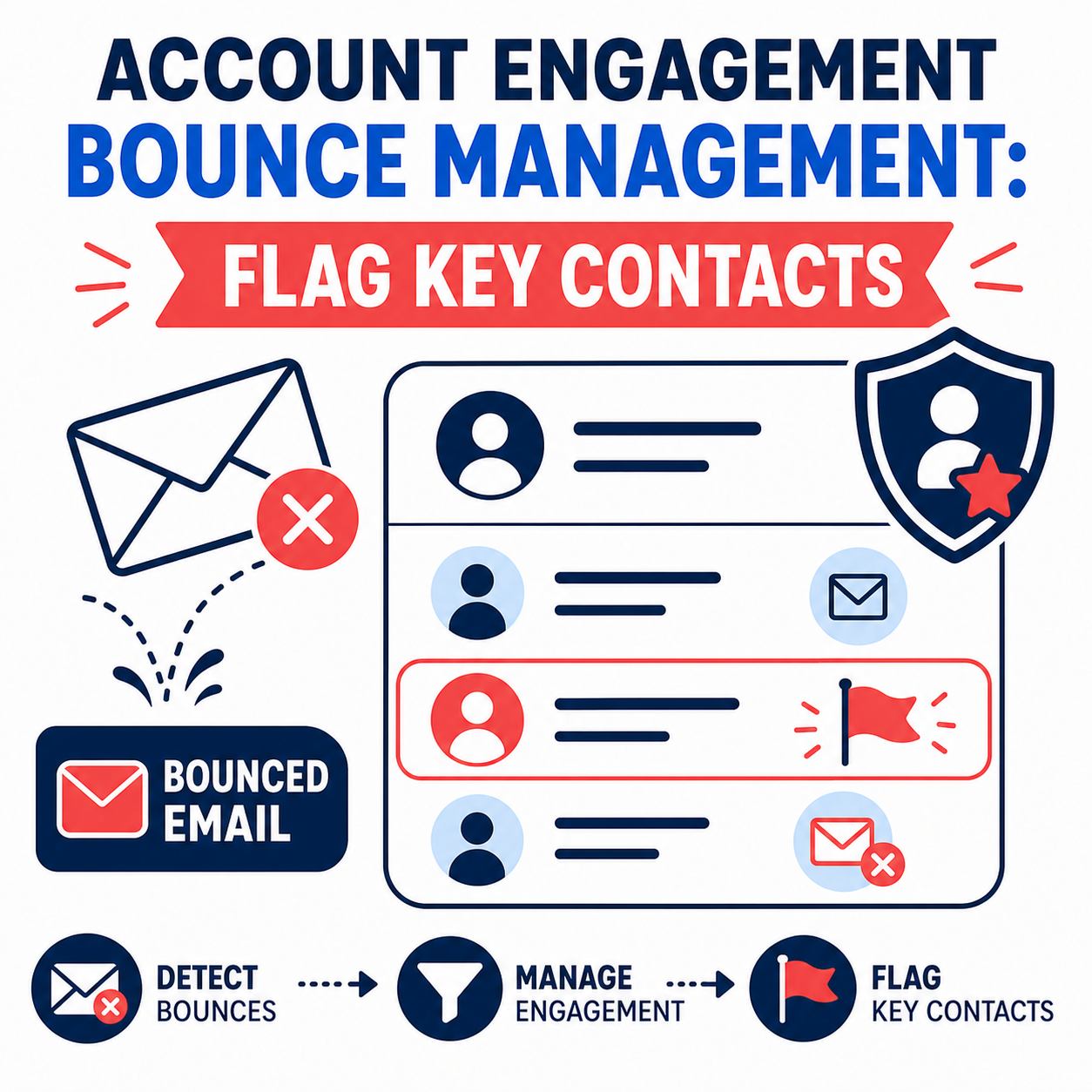
After a large Account Engagement (Pardot) send, the fastest way to find the bounces that matter is the bounce report — it lists every bounced prospect with the reason — filtered or paired with a dynamic list that isolates your key contacts (clients, active opportunities, board members) so you're not eyeballing thousands of rows. Hard bounces make a prospect unmailable automatically; soft bounces are worth a retry window. For ongoing protection, build a standing dynamic list of bounced key contacts, alert their owners in Salesforce, and suppress chronic bouncers to protect sender reputation.
TL;DR
- What it is: The process of finding, triaging, and acting on bounced recipients in Account Engagement — with priority given to contacts the business can't afford to lose touch with.
- Why it matters: Key contacts who silently bounce stop receiving everything; unaddressed hard bounces also damage sender reputation for the whole account.
- Best for: Marketing ops and RevOps teams running large sends to mixed audiences of prospects and existing clients.
- Decision point: Separate sends per audience vs. one send plus dynamic-list triage afterward.
- How Vantage Point helps: Our Salesforce and Account Engagement consultants build the segmentation, alerting, and hygiene cadence around your sends.
What happens when an email bounces in Account Engagement?
Account Engagement distinguishes soft bounces (temporary: full mailbox, server timeout, message size) from hard bounces (permanent: the address doesn't exist or the domain rejects you outright). A hard bounce flips the prospect to unmailable — Account Engagement stops attempting delivery to protect your sender reputation. Soft bounces don't change mailability immediately, but repeated soft bounces are an early warning that an address is decaying.
The prospect record shows the bounce status and reason, and the bounce report aggregates every bounce from your sends in one place — who, when, and why.
Where do you find bounce data after a big send?
- Bounce report: the single view of all bounced prospects with per-bounce reasons — your starting point after any large send.
- Prospect record: mailability status and bounce detail live on the individual prospect.
- List email / email report: per-send bounce counts and rates for trend-spotting.
- Salesforce side: with bounce management enabled, bounced email addresses surface on the Salesforce contact or lead (including the EmailBouncedReason field), which is what makes owner alerts and account-level reports possible.
How do you isolate the key contacts in a sea of bounces?
The practical pattern is a dynamic list that intersects "bounced" with "matters to the business." Depending on how your data is marked, that criteria can be an account type field, a client tag, an active-opportunity roll-up, or a custom "key contact" checkbox. The list refreshes itself, so after each send you review the same short list instead of the whole bounce report.
| Signal to segment on | List criteria idea | Who acts on it |
|---|---|---|
| Existing clients | Account type = Customer AND prospect bounced | Account owner or client services |
| Open opportunities | Contact has an open deal AND prospect bounced | Opportunity owner |
| High-value prospects | Score/grade above threshold AND bounced | Sales development |
| Everything else | Bounced AND none of the above | Marketing ops (bulk hygiene) |
The blunt alternative — separate sends for client audiences — avoids the triage problem but fragments reporting and doubles production work. Most teams get better results from one send plus disciplined post-send triage.
How do you keep bounces from recurring?
- Fix the record, not just the send: when a key contact bounces, the owner confirms the current address and updates both the Salesforce contact and the Account Engagement prospect.
- Watch for domain-level patterns: a cluster of soft bounces at one client domain usually means their mail filters, not your list — flag it to the relationship owner rather than deleting the contacts.
- Verify before big sends: run lists through verification ahead of campaigns; our deliverability guide covers the reputation side.
- Respect mailability: hard-bounced prospects stay unmailable; if an address is confirmed fixed, support can help with bulk resets rather than one-off edits.
- Set a cadence: bounce triage within a few days of every large send, plus a quarterly suppression review.
Who should own bounce triage?
Split it deliberately: marketing ops owns the report, lists, and sender-reputation metrics; record owners own the fix for their key contacts. The connective tissue is alerting — a Salesforce report subscription or Flow that tells an owner "your contact just bounced" beats a monthly spreadsheet nobody opens. A record-triggered Flow or a simple report subscription handles the notification well.
How Vantage Point Helps
Vantage Point implements and manages Account Engagement for teams whose audiences mix prospects, clients, and partners — exactly the scenario where bounce triage gets political. We build the segmentation, owner-alert automation, and hygiene cadence, and our managed services team can run the ongoing monitoring. Senior consultants only — no junior handoffs; the experts you meet are the experts who deliver.
Bounce-backs hiding your most important contacts?
We'll build the reporting and alerting that surfaces key-contact bounces the same day, not the same quarter.
Frequently Asked Questions
Where is the bounce report in Account Engagement?
Account Engagement provides a consolidated bounce report showing every bounced prospect with the bounce reason and timing. Individual prospect records also show bounce status, and per-email reports show bounce counts and rates for each send.
What is the difference between a hard bounce and a soft bounce?
A soft bounce is temporary — a full mailbox, server timeout, or oversized message — and the prospect remains mailable. A hard bounce is permanent — the address doesn't exist or is rejected outright — and Account Engagement marks the prospect unmailable to protect your sender reputation.
Can you get a list of only the client contacts who bounced?
Yes. Build a dynamic list that combines a bounce criterion with whatever marks a contact as a client or key account in your data — account type, a tag, an open-opportunity rollup, or a custom field. The list refreshes automatically after each send.
Should we send to clients separately to make bounces easier to spot?
Usually not. Separate sends fragment reporting and double production effort. One send plus a standing dynamic list of bounced key contacts gives you the same visibility with less operational overhead.
What should a sales owner do when their contact hard-bounces?
Confirm the correct address through another channel, update the Salesforce contact and the Account Engagement prospect, and have marketing ops address mailability if the prospect was marked unmailable. Treat domain-wide bounce clusters as a deliverability issue, not bad data.
Can a hard-bounced prospect ever be mailed again?
Yes, but deliberately. If the address is verified as fixed, the prospect's mailability can be reset — individually or, for bulk cases, with help from Salesforce Support. Don't re-mail chronic hard bouncers; that's how sender reputation dies.