
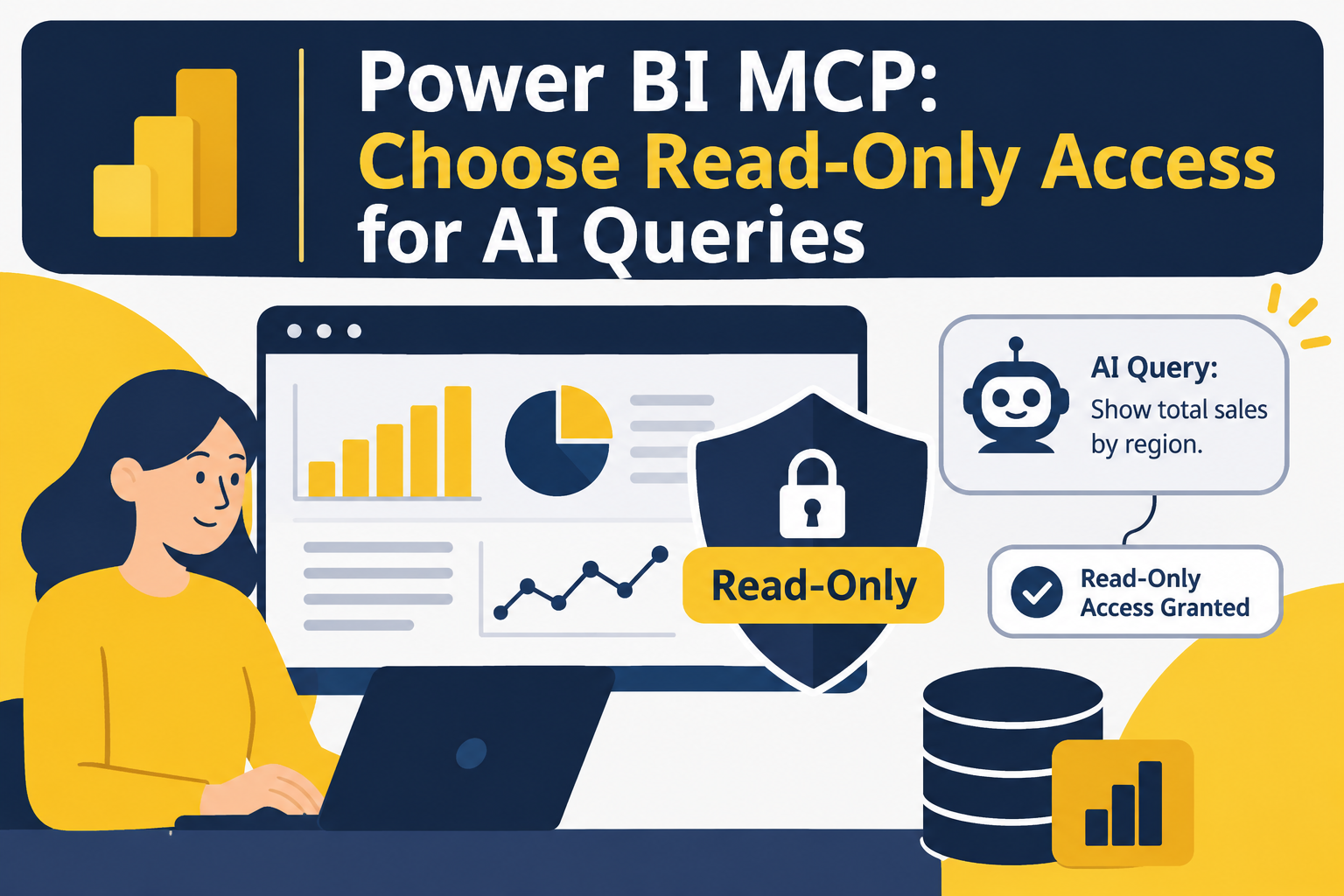
An AI assistant that answers questions about Power BI data does not need permission to redesign the model. Separate those jobs before connecting an assistant to business reporting: consumption tools retrieve information, while authoring tools can change the tables, measures, relationships, and security roles behind it.
Microsoft's current guidance points new Power BI consumption scenarios toward Fabric IQ MCP. That is a different choice from the Power BI Authoring MCP server and the earlier Power BI consumption preview. Picking the right endpoint determines both the available tools and the access review your team needs.
Quick Answer
For read-only AI questions over Power BI reports and semantic models, evaluate Fabric IQ MCP first. Microsoft describes it as a read-only toolset that uses the signed-in user's existing permissions, including row-level and object-level security. Use Power BI Authoring MCP for controlled model development, not everyday business questions. Vantage Point helps teams connect AI workflows to business systems with clear access boundaries and a practical validation plan.
Key Takeaways (TL;DR)
- Choose by operation: querying business data and changing a semantic model are separate use cases.
- Do not mix setup instructions: Fabric IQ and the earlier consumption preview have different authentication and permission requirements.
- Read-only still moves data: query results and model metadata can enter the AI client's conversation context.
- Validate the answer: check user access, business definitions, filters, and data refresh before expanding a pilot.
What does a Power BI MCP connection actually do?
Model Context Protocol gives an AI client a structured set of tools for interacting with another system. In a Power BI consumption workflow, the agent can discover a report, inspect relevant metadata, compose a DAX query, execute it, and explain the returned results. DAX is the expression language used for calculations and queries against Power BI models.
The semantic model supplies the business structure: tables, relationships, and measures such as approved sales or pipeline calculations. Connecting an AI assistant does not automatically resolve ambiguous definitions. A request for growth still needs an agreed period, comparison, measure, and filter context.
Fabric IQ MCP does not itself expose a natural-language answering tool. The calling agent orchestrates the tools and explains their outputs. That distinction matters when an answer is wrong: the failure may be query construction or interpretation, not missing data in Power BI.
Which MCP server should a team choose?
Start with the permitted operation, not the assistant's brand. Microsoft's Power BI MCP overview separates model authoring from business-data consumption.
| Use case | Starting point | Boundary to review |
|---|---|---|
| Ask business questions over governed reports and models | Fabric IQ MCP | Read-only tools, delegated user access, and AI data handling |
| Create or change measures, tables, relationships, or roles | Power BI Authoring MCP | Development permissions, change review, and recovery procedures |
| Maintain an existing earlier consumption integration | Power BI consumption preview documentation | Preview-specific requirements and a review of the current recommended path |
Choose consumption when the goal is an answer, such as comparing approved measures by product or period. Choose authoring when a model developer intentionally needs to change how those measures work. Do not grant authoring access simply because its toolset can also run DAX.
For Claude or another MCP-compatible client, confirm that the specific client supports the endpoint's required transport and OAuth flow. Protocol compatibility alone does not establish that your chosen deployment has the right authentication, consent, resource handling, or administrative controls.
Why should teams avoid copying an older setup checklist?
The earlier Power BI consumption preview documents a tenant setting and Build permission on a semantic model. Current Fabric IQ guidance says a workspace role and Build permission are not required, and that the Power BI MCP preview tenant setting does not apply to Fabric IQ. These are endpoint-specific rules, not interchangeable instructions.
According to Microsoft's Fabric IQ MCP setup guidance, Fabric IQ uses delegated Microsoft Entra authentication. It does not support service-principal or application-only authentication. Some clients need an app registration; Microsoft's documented GitHub Copilot CLI route uses a preregistered application.
Before implementation, record the selected endpoint, client, authentication method, permissions, and tenant consent requirements. Review regional and workload availability in the current documentation. Do not broaden a user's Power BI permissions just to make an outdated checklist pass.
Does read-only access make the integration risk-free?
No. Read-only prevents the consumption toolset from changing the model; it does not prevent sensitive information from being returned to an authorized user and processed by an AI client. Model schema, report metadata, and query results may become context sent to the configured model provider.
Review three boundaries separately:
- Source access: which reports, models, rows, and objects can the signed-in user access?
- Client behavior: where are prompts, tool outputs, exports, and conversation history stored or shared?
- Provider handling: which terms and organizational policies govern the data sent to the AI model?
Fabric IQ applies existing Power BI permissions, row-level security, and object-level security. Test the intended user's identity rather than demonstrating everything with an administrator. Two users may correctly receive different results for the same question because their data access differs.
Limit unnecessary detail in queries. An aggregate may satisfy the business question without transferring record-level data. This is a design choice to make alongside system integration and data migration planning, not an assumption that the MCP label solves governance.
How should a read-only pilot be validated?
Use one well-understood report or semantic model and a small set of representative questions. Establish expected answers in Power BI before testing the assistant. Avoid starting with an unrestricted request to analyze everything.
- Verify discovery: the intended user can find the correct report or model, without seeing items outside their access.
- Verify interpretation: the agent uses the approved measure, reporting period, and filters rather than inventing a calculation.
- Verify execution: the returned data matches a Power BI comparison using the same identity and context.
- Verify restrictions: test a user with narrower access and a request for a restricted field or data slice.
- Verify completeness: check for truncated results, stale refreshes, unsupported item types, and ambiguous names.
- Verify handoff: the explanation identifies its source and assumptions and asks for clarification when the question is underspecified.
For example, a generic sales comparison should specify whether sales means booked revenue, invoiced revenue, or another approved measure. If the assistant produces a plausible number using the wrong definition, the connection may be functioning while the business answer is still wrong.
Current Fabric IQ guidance limits each query execution to one semantic model. An agent may combine outputs from separate executions, but that is not the same as a governed cross-model join. Treat such combinations as an additional validation problem.
What should be ready before wider rollout?
Assign a business owner for definitions, a model owner for data quality, and an integration owner for authentication and client configuration. Document how users report incorrect answers and how the team pauses access when needed.
Keep development and consumption connections separate. If model changes become necessary, route them through a reviewed authoring workflow rather than quietly expanding the business pilot's permissions. Re-run representative questions after changes to measures, relationships, security, or the client.
Training should explain what the assistant can query, what it cannot access, and when an answer needs verification. A successful connection test is a technical milestone, not evidence that every business question is safe or correctly defined.
How Vantage Point Helps
Vantage Point connects AI adoption to the systems and decisions teams already use. Claude consulting and implementation can help define the client workflow, access boundaries, and user enablement before a broader rollout. The starting point is a useful business question and a controlled data path, not a larger permission set.
Plan a governed AI data pilot
Choose a reporting use case, identify the permitted data, and agree on the checks an answer must pass before people rely on it.
Frequently Asked Questions
Which Power BI MCP server is intended for read-only AI questions?
Microsoft currently directs new business-data consumption scenarios to Fabric IQ MCP. Power BI Authoring MCP is intended for creating or changing semantic models, while the earlier consumption preview remains documented for existing integrations.
Does Fabric IQ MCP require Build permission?
Current Microsoft guidance says Fabric IQ MCP does not require a workspace role or Build permission. The caller still needs access to the relevant Power BI report or semantic model, and existing data restrictions continue to apply.
Does Fabric IQ MCP support service-principal authentication?
Fabric IQ MCP currently uses delegated Microsoft Entra authentication and does not support service-principal or application-only authentication. Do not apply the earlier consumption preview's authentication guidance to Fabric IQ without checking the selected endpoint's documentation.
Does row-level security still apply to AI queries?
Fabric IQ MCP applies the signed-in user's existing Power BI permissions, including row-level and object-level security. Test those restrictions with representative user identities rather than relying on an administrator's successful demonstration.
Can a read-only connection still expose sensitive data?
A read-only connection can return sensitive data that its authenticated user is authorized to access. Review how the AI client and model provider handle metadata, query results, exports, and conversation history before approving the workflow.
How can Vantage Point help validate a Power BI AI pilot?
Vantage Point can help define the business workflow, integration boundaries, and acceptance checks for an AI data pilot. Validation should compare expected answers, permissions, definitions, and failure handling before the workflow reaches a wider audience.